

Amazon affiliate links - we earn a commission.Affiliate disclosure

Buying guide · 12 min read · Updated 2026-11-12

Best MIG Welders (2026)

Six MIG welders from a 120V portable to a pro dual-voltage unit, compared on amperage, voltage, gas versus flux-core and controls for steel work.

James MillerBy James MillerLead Machine Editor6 machines comparedSpec-sheet verified
Best MIG Welders

At a glance

Our top picks

Side by side

Spec comparison

MachineInputProcessesOutputControl
Millermatic 211 PRO MIG Welder, 120/240V Auto-SetBest OverallMillermatic 211 PRO MIG Welder, 120/240V Auto-Set120V or 240V dual voltagen/an/an/a
Lincoln Electric Weld-Pak 90i MIG and Flux-Core 120VBest 120V PortableLincoln Electric Weld-Pak 90i MIG and Flux-Core 120V120V householdMIG and flux-coren/an/a
YESWELDER 160A MIG Welder 110V/220V 4-in-1 SynergicBest ValueYESWELDER 160A MIG Welder 110V/220V 4-in-1 Synergic110V or 220V dual voltageFlux-core, gas MIG, stick, lift TIG160ASynergic with digital display
ARCCAPTAIN 165A MIG Welder 110V/220V 4-in-1Best Beginner FeaturesARCCAPTAIN 165A MIG Welder 110V/220V 4-in-1110V or 220V dual voltageGas MIG, flux-core, lift TIG, stick165ASynergic, upgraded MCU and IGBT
YESWELDER 135A MIG Welder 110V Flux Core 3-in-1Best Compact Flux CoreYESWELDER 135A MIG Welder 110V Flux Core 3-in-1110VFlux-core gasless MIG, lift TIG, stick135ASynergic with digital display
ANDELI 135A Pulse Flux-Core MIG Welder 110V/220VBest Pulse FeatureANDELI 135A Pulse Flux-Core MIG Welder 110V/220V110V or 220VFlux-core MIG, stick, lift TIG135An/a

MIG welding feeds a continuously spooled wire through a torch while shielding gas protects the puddle. It is the process most hobbyists and fabricators reach for first, because the wire feed does the rhythm for you and the beads come out clean on mild steel. It is faster than stick and easier to learn than TIG.

The catch is the setup. You need shielding gas for clean results, you need still air, and the machine you can afford on a household circuit has a real limit on metal thickness. Matching the welder to your outlet and your material matters far more than the number on the box.

Before you buy

6 Criteria to Look For Before Buying a MIG Welder

  1. 01

    Input voltage and real reach

    A 110V machine on a 20 amp circuit tops out around 140 to 160A of rated output and handles about 1/8 to 3/16 inch steel with good prep. Dual-voltage units such as the YESWELDER 160A, ARCCAPTAIN 165A and Millermatic 211 PRO double that reach on 220V or 240V. Buy dual voltage if you ever plan to weld quarter-inch steel. A 20 amp breaker and a short, heavy cord matter on 110V machines, because a long thin extension cord cuts the voltage the inverter sees and makes the arc unstable.

  2. 02

    Gas MIG versus flux-core

    Solid wire with shielding gas gives a clean bead and little spatter but needs a cylinder and still air. Flux-core needs no gas and tolerates wind and rust but makes more spatter and slag. The YESWELDER 135A and ANDELI 135A are built around flux-core, while the Miller and 4-in-1 units handle both. Shielding gas for steel is usually 75 percent argon and 25 percent CO2 at about 15 to 25 CFH, and flux-core wire runs with the polarity reversed, a mistake that ruins many first welds.

  3. 03

    Synergic control

    Synergic machines pick voltage and wire speed from a thickness setting, which removes the hardest part of learning MIG. The YESWELDER and ARCCAPTAIN units use it, and the Miller Auto-Set is a refined version. Experienced welders still prefer manual dials, so confirm the machine has both. If you are choosing between synergic and manual, pick the machine that lets you override the synergic numbers by a few percent, because every real joint needs a small tweak.

  4. 04

    Duty cycle

    A rating such as 20 percent at 130A means two minutes of welding in a ten-minute window. Cheap inverter machines may state the duty cycle only on 220V. Shop welding in short beads suits a low duty cycle, but long production runs need a higher one. Short beads of an inch or two let a low duty cycle machine cool, which also reduces heat distortion on thin panels.

  5. 05

    Aluminum and stainless capability

    Aluminum needs a spool gun or push-pull torch to avoid wire tangling. The Millermatic 211 PRO supports aluminum with a spool gun and Dyna-Pulse, while the budget machines are chiefly steel units. If you want to weld aluminum seriously, a dedicated TIG or pro MIG is the better answer. Spool guns add a separate trigger and feed motor at the torch, which stops soft aluminum wire from kinking in a long liner.

  6. 06

    Consumables and support

    Contact tips, nozzles and liners wear out, and brands differ in availability. Lincoln and Miller parts are stocked at nearly every weld shop. Budget brands are often cheaper per part but may need online ordering, so keep spares on hand. Keep a spare liner, a handful of contact tips and a nozzle in the drawer, because a worn consumable is the cause of most feed problems.

Detailed reviews

The 6 best mig welders, explained

01
Millermatic 211 PRO MIG Welder, 120/240V Auto-Set
120V/240VDyna-Pulse MIGAuto-SetBeadVision
Check price on Amazon
Best for: Serious home builders and small shops that weld steel, stainless and aluminum.

The Millermatic 211 PRO is a professional-grade MIG machine, and it earns the top spot on capability rather than price. It runs on 120V or 240V, welds steel, stainless and aluminum when fitted with a spool gun, and the listing quotes up to 3/8 inch material. Dyna-Pulse MIG alternates the current to reduce heat input, which makes thin stainless and aluminum far easier to control.

Auto-Set picks voltage and wire speed from the wire size and thickness you choose, so a newcomer can start quickly, while experienced welders can switch to manual. BeadVision gives real-time feedback on the bead, a feature that is genuinely new and useful for learning. Compared with the 120V-only Lincoln 90i here, the Miller is a machine you grow into rather than out of.

The cost is the top price tier in this guide, a gas cylinder you must buy or lease and a bigger, heavier machine than the inverter hobby units. Expect to do a few rounds of consumable swaps: contact tips, nozzles and liners wear with use. It is the right buy for a fab shop or a serious home builder.

What works

  • 120V and 240V dual voltage
  • Dyna-Pulse for thin metal and aluminum
  • Auto-Set speeds up setup
  • BeadVision bead feedback

Watch out for

  • Top price tier in this lineup
  • Needs gas and a spool gun for aluminum

Spec sheet

Input
120V or 240V dual voltage
Materials
Mild steel, stainless, aluminum with spool gun
Max thickness
Up to 3/8 in per listing
Controls
Auto-Set with Dyna-Pulse MIG
Monitoring
BeadVision bead feedback
02
Lincoln Electric Weld-Pak 90i MIG and Flux-Core 120V
120V onlyMIG and flux-coreShoulder strapKit included
Check price on Amazon
Best for: Repair work and light fabrication where you need a brand-name 120V welder.

The Weld-Pak 90i is a small 120V wire feed welder from a name with decades of service history. It handles MIG and flux-core and comes with a welding gun, nozzle, contact tip and work cable, so you can plug it into a household outlet and weld. The shoulder strap shows what it is for: repairs, maintenance and light fabrication where you carry the machine to the job.

The model name signals the limit. A 90 class machine is designed for thin sheet and light steel, not thick structural work, so it is the smallest welder in this guide. That is a good thing if your projects are exhaust, trailer repairs and thin brackets, and a poor thing if you want to weld quarter inch plate. Compared with the YESWELDER 160A, it gives up capacity for brand support and simplicity.

Ownership is easy. Replace the contact tip and nozzle as they wear, keep the wire dry and the liner clean, and use a dedicated 20 amp circuit when possible. Lincoln parts are widely stocked.

What works

  • Plugs into a standard household outlet
  • Lincoln parts and support widely available
  • Gun and accessories included
  • Light enough to carry on a shoulder strap

Watch out for

  • Limited capacity for thick steel
  • 120V only, no dual-voltage upgrade

Spec sheet

Input
120V household
Processes
MIG and flux-core
Carry
Shoulder strap
Included
Gun, nozzle, contact tip, work cable
Use
Light fabrication and repair
03
YESWELDER 160A MIG Welder 110V/220V 4-in-1 Synergic
160A output110V/220V4-in-1Synergic
Check price on Amazon
Best for: Home garages that want dual-voltage MIG with synergic control at a low price tier.

The YESWELDER 160A is the value machine: a 160 amp inverter with dual voltage, four processes and synergic control with a clear digital display. The listing says you must buy the lift TIG torch separately. The headline 160A rating is a maximum, and the real working range on 110V is lower.

That dual-voltage input is the key advantage. On 220V it has far more headroom for thicker steel, while on 110V it works in a household garage. The synergic control chooses voltage and wire speed from your thickness setting, which helps beginners. Compared with the ARCCAPTAIN 165A, it is nearly the same class, and the choice comes down to price, support and the feel of the controls.

As a lower-cost inverter, expect a less durable feed mechanism and torch than a Miller or Lincoln, and plan to replace consumables regularly. Buy a spare liner and contact tips with it. It is the sensible starter for a home garage that wants to grow.

What works

  • 160A output with 110V and 220V input
  • Four processes in one machine
  • Synergic control for beginners
  • Clear digital display

Watch out for

  • TIG torch is sold separately
  • Budget feed and torch durability

Spec sheet

Output
160A
Input
110V or 220V dual voltage
Processes
Flux-core, gas MIG, stick, lift TIG
Control
Synergic with digital display
TIG note
Lift TIG torch sold separately
04
ARCCAPTAIN 165A MIG Welder 110V/220V 4-in-1
165A output110V/220VGas and gaslessSynergic
Check price on Amazon
Best for: First-time welders who want synergic control and room to grow.

The ARCCAPTAIN 165A is the most beginner-oriented of the budget machines. The listing describes upgraded MCU and IGBT technology for finer adjustment, a clear display and synergic control, and it runs gas MIG, flux-core, lift TIG and stick on 110V or 220V. The TIG torch is a separate purchase.

Its 165A rating is five amps above the YESWELDER 160A, which does not change what you can weld in practice. What matters more is the interface and how it behaves on 110V, where the duty cycle shrinks. For beginners the synergic mode removes the guesswork about wire speed and voltage, while the manual mode remains for those who learn.

As with all budget multi-process units, each mode is a compromise, so treat it as a MIG welder with stick and flux-core as backup. Watch the duty cycle on 110V, and buy a regulator and gas cylinder before the first weld. It is a good choice if your priority is a low learning curve.

What works

  • 165A on dual voltage input
  • Synergic mode removes setup guesswork
  • Four processes available
  • Upgraded MCU and IGBT control

Watch out for

  • TIG torch not included
  • Duty cycle is short on 110V

Spec sheet

Output
165A
Input
110V or 220V dual voltage
Processes
Gas MIG, flux-core, lift TIG, stick
Control
Synergic, upgraded MCU and IGBT
TIG note
TIG torch sold separately
05
YESWELDER 135A MIG Welder 110V Flux Core 3-in-1
135A output110V onlyFlux-core MIGLift TIG and stick
Check price on Amazon
Best for: Beginners and outdoor repair work without a gas setup.

The YESWELDER 135A is the entry machine: 135 amps, 110V only and focused on gasless flux-core MIG, with stick and lift TIG as extras. The listing calls out a synergic control that matches settings to the material, which helps avoid burn-through on thin steel.

Because it is built for flux-core, you do not need a gas cylinder to start, which cuts setup cost and works outdoors in light wind. The trade is a messier bead with spatter and slag and less finish quality than solid wire with gas. Compared with the 160A model from the same brand it is smaller, lighter and limited to 110V.

Use it for gate repairs, trailer work and general shop fixes. Wire quality matters a lot with flux-core, so buy a reputable E71T-11 wire and keep it dry. It is a sensible machine to learn on.

What works

  • No gas needed for flux-core welding
  • Synergic control on thin steel
  • 110V plug-in simplicity
  • Stick and lift TIG available

Watch out for

  • 110V limits thickness
  • Flux-core beads are messier than gas MIG

Spec sheet

Output
135A
Input
110V
Processes
Flux-core gasless MIG, lift TIG, stick
Control
Synergic with digital display
Setup
Ready to weld without gas
06
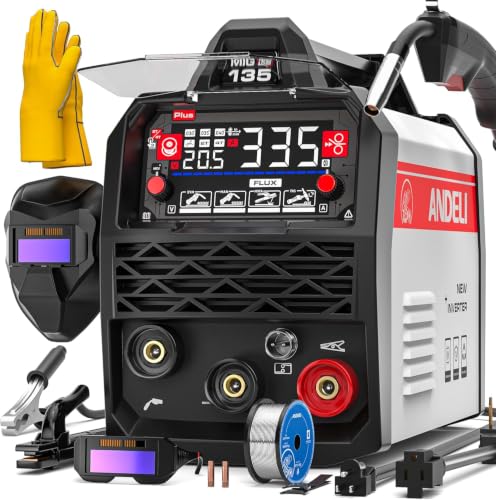
ANDELI 135A Pulse Flux-Core MIG Welder 110V/220V
135A output110V/220VPulse4.1 in LED display
Check price on Amazon
Best for: Hobbyists who want pulse on thin steel at a low price.

The ANDELI 135A adds a pulse mode, which the listing says gives a smoother, more stable arc and finer beads. Pulse reduces average heat while keeping peak current high, which is useful on thin material where burn-through is a risk. It also runs on 110V or 220V and has a 4.1 inch full LED display.

It is a three-in-one with flux-core MIG, stick and lift TIG, so, like the YESWELDER 135A, it is aimed at gasless welding. The 135A rating is below the 160A and 165A machines, but pulse and the dual-voltage input make it versatile for a smaller price. Compared with the Millermatic's Dyna-Pulse, this is a budget version of the same idea.

Treat claims about stronger welds with caution and test your joints on scrap. Consumables are widely available. It suits a hobbyist who wants to experiment with pulse on thin stock.

What works

  • Pulse mode for finer beads
  • 110V and 220V input
  • Large 4.1 in LED display
  • Three processes in one unit

Watch out for

  • Lower 135A rating than the 160A machines
  • Pulse benefit is smaller than on pro-grade machines

Spec sheet

Output
135A
Input
110V or 220V
Processes
Flux-core MIG, stick, lift TIG
Feature
Pulse mode for a smoother arc
Display
4.1 in full LED

Spec sheet decoder

What the numbers on the box really mean

The specs manufacturers lead with, translated into what they tell you about real-world performance.

Output amps

The maximum current the machine can supply. It is not the same as usable thickness. Always read it with the input voltage in mind.

Watch forThe 160A YESWELDER and 165A ARCCAPTAIN give very similar real results, because input voltage matters more.

Duty cycle

The share of a ten-minute window the machine can weld at a stated amperage without overheating. Manufacturers often quote 220V numbers prominently and 110V numbers in small print.

Watch forDuty cycle is usually higher on 220V than on 110V, so check the 110V figure.

Dual voltage

The ability to run on 110V or 220V/240V. Higher voltage raises the usable output. A 110V plug is convenient, but it is a ceiling.

Watch forThe 110V-only YESWELDER 135A and Lincoln 90i cannot move up.

Synergic

A mode that sets voltage and wire speed from material thickness and wire size. Learn to override it as you gain experience.

Watch forManual fine-tuning is still needed for odd joints.

Pulse

Alternating high and low current to reduce heat and spatter. Higher frequency pulse suits thinner material.

Watch forThe ANDELI offers pulse on a budget, while the Millermatic's Dyna-Pulse is a pro-grade version.

Methodology

How We Evaluated These MIG Welders

Input and reach

We compared input voltages and output ratings, from the 120V-only Lincoln 90i to the 120/240V Millermatic 211 PRO. Voltage decides which steel you can weld. A machine that needs extra purchases to deliver a process was scored on what it ships with.

Process range

We noted which machines run gas MIG, flux-core, stick and lift TIG, and which need extra purchases such as a TIG torch. Where a listing quoted a thickness limit we treated it as a best case.

Beginner controls

We looked for synergic and auto-set modes, which cut the learning curve on thin steel. Synergic modes were judged as a learning aid, not as a replacement for skill.

Support and consumables

We weighed brand availability of parts, since contact tips and liners wear out. Consumable cost and availability were part of the long-term picture.

Evidence base

This is based on spec sheets and owner feedback patterns, not our own welding time. Thickness claims are manufacturer figures. We did not rank machines on bead appearance, which depends mostly on the operator.

Decision guide

How to Choose the Right MIG Welders

By Work Type

SituationPickWhy
Steel, stainless and aluminum in a shopMillermatic 211 PRODyna-Pulse and 120V/240V
Garage projects with a 220V outletYESWELDER 160A160A on dual voltage
Beginner learning on thin steelARCCAPTAIN 165ASynergic control
Outdoor repair without gasYESWELDER 135AFlux-core ready out of the box
Portable light repair on 120VLincoln Weld-Pak 90iShoulder strap and kit

By Budget

Budget tierPickWhy
LowestYESWELDER 135ACheapest tier
LowANDELI 135AAdds pulse
Lower middleARCCAPTAIN 165ADual voltage
MiddleYESWELDER 160ADual voltage with display
UpperMillermatic 211 PROPro-grade features

Gas MIG vs Flux-Core

Gas MIG

Solid wire with argon-CO2 gas gives clean beads and little cleanup. The Millermatic 211 PRO, YESWELDER 160A and ARCCAPTAIN 165A support it but need a cylinder.

Flux-core

Gasless wire welds in wind and over light rust but spatters and leaves slag. The YESWELDER 135A and ANDELI 135A are built around it.

Choose gas indoors for finish quality and flux-core outdoors or when you want simplicity.

110V vs 220V

PreferencePickWhy
110V only, simplicityLincoln Weld-Pak 90iHousehold outlet
110V with TIG and stickYESWELDER 135AThree processes
Dual voltageYESWELDER 160AMore thickness on 220V
Dual voltage, proMillermatic 211 PRO120V and 240V

For Thin Sheet Steel Specifically

Look for

Low minimum current, pulse or a synergic mode and 0.023 or 0.030 inch wire. Thin sheet burns through easily.

In this comparison

The ANDELI 135A with pulse and the Miller with Dyna-Pulse are the best at reducing heat. The Lincoln 90i is a good light-duty option.

When to Spend More

Spend more if

You weld daily, need aluminum or stainless, or want parts support. The Millermatic 211 PRO is the buy.

Save if

You weld occasionally on mild steel. The YESWELDER 160A or 135A will do.

Ownership

Maintenance schedule

The upkeep that decides whether this machine lasts two seasons or ten.

TaskIntervalWhy it matters
Replace contact tipEvery few spoolsA worn tip causes erratic arcs and wire burnback. Tips are cheap and quick to swap. Keep spares in the toolbox.
Clean the linerEvery spool changeDust and debris make the wire stick or feed unevenly. Blow it out with air. Pull the wire out and blow the liner clear.
Check drive rollsMonthlyWorn or wrong-groove rolls slip. Use V-groove for solid wire and knurled for flux-core. Replace them as a set.
Inspect the ground clampEach useA poor ground gives an unstable arc. Clean the contact point on bare metal. Wire-brush the contact surface.
Check gas regulatorEach sessionLeaks waste gas and cause porosity. Check flow at 15 to 25 CFH. Soapy water finds leaks at fittings.

FAQ

Frequently Asked Questions

Can I run a MIG welder on a household outlet?

Yes, 110V units like the Lincoln 90i and YESWELDER 135A plug into standard outlets. Expect to weld thin to medium steel, and use a dedicated circuit. Start on scrap of the same thickness as the project before welding a real part.

How much should I spend?

The YESWELDER and ANDELI 135A units sit at the low end, the ARCCAPTAIN and YESWELDER 160A in the middle, and the Millermatic 211 PRO at the top. Pay more for dual voltage and support. A used pro-grade machine can cost the same as a new budget one, so look at both.

How long do budget MIG welders last?

Many years for occasional use, but wire feeders and torches wear sooner than pro-grade parts. Keep spare tips and liners. Ask for the duty cycle at your input voltage, not the best case.

Is a higher amperage always better?

Not necessarily. A 165A machine on 110V behaves like a smaller one. Input voltage and duty cycle decide real capability. Check the polarity and wire type first when a weld looks wrong.

Do I need gas?

Only for solid wire. Flux-core wire needs none, but it is messier. Gas gives clean beads. Gas bottles are usually refillable at a welding supply shop, so you only buy the cylinder once.

Can I weld aluminum with these?

The Miller can with a spool gun. The others are steel machines, and aluminum on a budget MIG is difficult. A TIG or push-pull setup is the proper route to aluminum.

Bottom line

The short version

Browse more mig welderson Amazon →
James Miller, Lead Machine Editor

About the author

James Miller

Lead Machine Editor, MachineFanatic

James Miller leads MachineFanatic's buying guides, turning spec sheets, manuals and owner feedback into clear verdicts on power tools, outdoor power equipment, shop machines and kitchen machines.

More from James →

Keep reading

Related guides