
Amazon affiliate links - we earn a commission.Affiliate disclosure

Buying guide · 12 min read · Updated 2026-11-12

Best Stick Welders (2026)

Six stick welders from a 20 lb Lincoln inverter to a 230V 250A unit, compared on rod range, hot start, arc force, input voltage and portability.

James MillerBy James MillerLead Machine Editor6 machines comparedSpec-sheet verified
Best Stick Welders

At a glance

Our top picks

Side by side

Spec comparison

Stick welding burns a flux-coated electrode that supplies both filler metal and shielding gas. There is no cylinder, no wire feed and almost nothing to set up. It works outdoors, on rusty or painted steel and on thick plate, which is why it is the oldest and most forgiving arc process.

Modern inverter stick welders are small, light and far easier to use than the transformer boxes of old. The things that separate them are the amperage range at your input voltage, how well they start an arc without sticking and how much arc force they give for deep penetration.

Before you buy

6 Criteria to Look For Before Buying a Stick Welder

  1. 01

    Input voltage and real amperage

    A 110V stick welder on a 20 amp circuit delivers roughly 90 to 140A of usable output, regardless of a 200A label. For 1/8 inch and 5/32 inch rods on steel over 3/16 inch, a 230V machine such as the Lincoln 225i or the ARCCAPTAIN 250A is the proper tool. Read the amps at your voltage, not the headline. A 20 amp household circuit simply cannot feed a 200A machine continuously, which is why labels and results drift apart.

  2. 02

    Hot start and arc force

    Hot start adds current at the strike, and arc force boosts current when the arc shortens. Together they prevent most sticking, which is the main complaint of new stick welders. The YESWELDER 205A and ARCCAPTAIN units list both. Without them, expect to fight rods. Check the display reading while striking an arc to verify that hot start actually engages, because some cheap machines omit it.

  3. 03

    Rod compatibility

    E6013 is the friendly rod for thin and dirty steel, E7018 is a low-hydrogen rod for structural joints that must stay dry, and E6010 digs deep on DC machines with strong arc force. The ARCCAPTAIN 205A lists support for 6010, 6011, 6013 and 7018. Match the machine to the rods you plan to use. Rod diameter sets the current: roughly 1 amp per 0.001 inch is a reasonable starting point, so 1/8 inch rods run near 125 amps.

  4. 04

    Duty cycle

    Stick welding at 150A on a budget inverter may allow only 20 to 30 percent duty. Weld short, let it cool and avoid running at maximum current for long. A heavier machine like the Lincoln holds its output longer. Let the machine cool with the fan running for several minutes after heavy use before switching off.

  5. 05

    Weight and portability

    Inverters are light: the Lincoln 225i is about 20 lb and the Hpoouo is toolbox-sized. Light machines are easy to carry to a fence line but have less thermal mass. A shop machine can be heavier. A shoulder strap or handle is a bigger deal than it sounds when you walk a fence line.

  6. 06

    Support and parts

    Lincoln and ESAB parts are stocked widely, while budget brands often rely on online ordering. Electrode holders and ground clamps wear, and replacements are cheap, but a failed board is a repair or replacement. Weigh warranty length against price. Register the product and save the receipt, because inverter boards are warranty items.

Detailed reviews

The 6 best stick welders, explained

01
Lincoln Electric Weld-Pak 225i Stick Welder, 120V/230V
10 to 225A120V/230V20 lbDC stick and TIG
Check price on Amazon
Best for: Farm, trailer and structural repair where a supported, dual-voltage machine matters.

The Weld-Pak 225i is a compact inverter with a wide 10 to 225 amp output range and dual voltage input, weighing about 20 lb. The listing describes it as a dual-voltage DC stick and TIG welder with a built-in carry feature. A range that starts at 10 amps lets you run small rods on thin steel, while 225 amps on 230V lets you run 1/8 and 5/32 inch rods on thick plate.

The key advantage is brand support. Lincoln parts, electrode holders and service are available at nearly every welding supply shop, which matters more than a spec sheet when a lead fails. Compared with the budget ARCCAPTAIN machines, it costs more but is less of a gamble on long-term support.

Expect the typical stick checklist: store E7018 in a rod oven or a sealed tube, use E6013 for general work and E6010 on a DC machine for deep penetration. Keep the vents clear, and use a dedicated circuit on 120V. It is the right choice for a farm, workshop or serious home user. Because it is dual voltage, you can run it on a generator or in a client's garage and still step up to full output back at the shop.

What works

  • 10 to 225A range covers thin and thick work
  • 120V or 230V input
  • 20 lb inverter design
  • Lincoln parts and support everywhere

Watch out for

  • Higher price tier than budget units
  • Stick and lift TIG only, no wire-feed mode

Spec sheet

Output
10 to 225 amps
Input
120V or 230V dual voltage
Weight
20 lb
Processes
DC stick and lift TIG
Design
Inverter with built-in carry strap
02
ESAB HandyArc 1/8 in Stick Welder, Inverter
1/8 in rodsInverterSimple controlsESAB brand
Check price on Amazon
Best for: Hobbyists who want a recognised brand and simple controls.

The HandyArc is ESAB's entry stick welder and is built around 1/8 inch rods. The listing offers little detail beyond a high-efficiency inverter that requires less energy and simple, easy-to-use operation, so check the full specifications on the product page for amperage range and input voltage before you buy.

What a name like ESAB brings is a wide welding supply network and a history of welding equipment. A machine limited to 1/8 inch rods can handle most hobby and repair work on steel up to about 1/4 inch in multiple passes, which is plenty for a gate, a trailer hitch or a fire pit frame. It is simpler than the feature-heavy ARCCAPTAIN units.

Given the sparse listing, use it with common E6011 or E6013 rods and keep them dry. Confirm warranty length. It is a sensible pick for someone who wants a recognised brand without paying for extras. Without a published amperage range in the listing text, ask the seller for the manual before buying and confirm that the minimum current suits thin steel.

What works

  • Recognised welding brand
  • Inverter efficiency
  • Simple controls
  • Suited to common 1/8 in rods

Watch out for

  • Listing gives little spec detail
  • Limited rod range compared with 205A units

Spec sheet

Rod size
Up to 1/8 in
Design
High-efficiency inverter
Controls
Simple, easy to use
Brand
ESAB
Use
Light repair and hobby work
03
YESWELDER 205A Stick Welder, Hot Start and Arc Force
205A outputHot startArc forceIGBT inverter
Check price on Amazon
Best for: Home workshops that want hot start and arc force at a low price tier.

The YESWELDER 205A is a straightforward budget inverter stick welder with hot start and arc force. Hot start gives a burst of extra current when you strike the arc, which helps break through rust and reduces sticking. Arc force adds current when the arc length shortens, preventing the electrode from freezing to the work. These two features are what make stick welding forgiving.

The listing also offers a large LED display with clear data. At 205A it covers the same rod range as the ARCCAPTAIN 205A, with less connectivity but a simpler interface. Compared with the Lincoln 225i it is lighter on the wallet and heavier on risk, since support is through the maker rather than a local shop.

Check the input voltage on the listing, because 205A is not achievable on a 110V outlet. Use the right rod for the job and keep it dry. It suits a home workshop that needs capable stick welding without extras. A spare ground clamp and a good electrode holder are the first upgrades worth making on any budget stick welder.

What works

  • 205A maximum output
  • Hot start and arc force
  • IGBT inverter efficiency
  • Large LED display

Watch out for

  • Support is through the maker, not a local shop
  • Real output depends on input voltage

Spec sheet

Output
Up to 205A
Design
IGBT inverter
Features
Hot start and arc force
Display
Large LED
Use
Portable stick welding
04
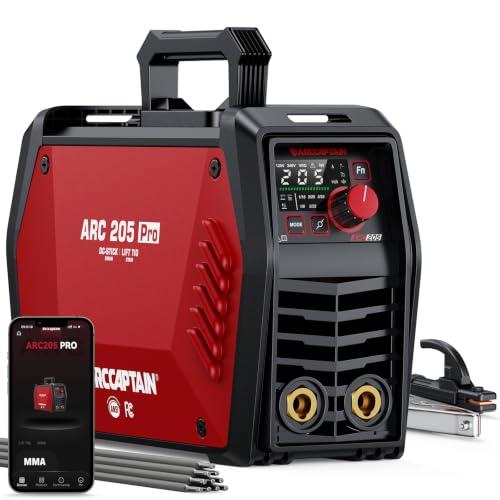
ARCCAPTAIN 205A Stick Welder, APP Control, 120V/240V
205A output120V/240VAPP controlSynergic
Check price on Amazon
Best for: Welders who want rod support and remote adjustment from a phone.

The ARCCAPTAIN 205A takes the budget stick welder further with a phone app that adjusts parameters within about 10 metres, synergic control that matches current to rod diameter, and support for 6010, 6011, 6013 and 7018 rods. It runs on 120V or 240V and also does lift TIG.

Support for 6010 is notable because that rod needs a DC machine with enough arc force for deep penetration, and many budget inverters struggle with it. App control sounds like a gimmick but is useful when you are welding in an awkward position and want to adjust current without reaching for the dial. Compared with the YESWELDER 205A, it adds connectivity and synergic setting.

As with all budget stick welders, rod choice matters more than the machine. Keep 7018 in a sealed tube or oven. Expect the usual duty cycle limits on 120V. Phone control depends on Bluetooth range and a working app, so keep the physical dial as your main control.

What works

  • Handles 6010, 6011, 6013 and 7018 rods
  • APP control within 10 m
  • 120V and 240V input
  • Synergic setting

Watch out for

  • App is a convenience, not a necessity
  • Duty cycle falls on 120V

Spec sheet

Output
Up to 205A
Input
120V or 240V
Rods
6010, 6011, 6013, 7018
Control
APP within 10 m plus synergic
Process
ARC and lift TIG
05
ARCCAPTAIN 250A Stick Welder, 230V MMA/Lift TIG
250A output230V10 rods includedIGBT
Check price on Amazon
Best for: Heavy structural work in a shop with a 230V circuit.

The ARCCAPTAIN 250A is built for higher current on a 230V supply. It lists a 3.2 inch LED display, synergic control, hot start and lift TIG, and comes with ten welding rods. A 250 amp rating means you can run 5/32 and larger rods at full current for thicker steel.

Because it needs 230V, it is a shop machine rather than a household plug-in. The extra amps give headroom for heavy structural work, but duty cycle still limits continuous use. Compared with the 205A models, it offers more output for a higher price tier, and you will only use the top of the range on thick plate.

Plan an electrician for the circuit and use proper lead gauge. Keep rods dry and match them to the job. It is the machine for heavier fabrication and repair at a lower price than a pro brand. Check the supply breaker and wire before plugging in, since a 250A machine pulls real current from a 230V circuit.

What works

  • 250A output on 230V
  • Ten rods included
  • 3.2 in LED display
  • Hot start and synergic control

Watch out for

  • 230V only, not a household plug-in
  • Higher output rarely used on thin work

Spec sheet

Output
Up to 250A
Input
230V
Included
10 welding rods
Display
3.2 in LED
Features
Synergic, hot start, lift TIG
06
Hpoouo 200A Mini Stick Welder 110V with Rods
20 to 200A110VMini size20 rods
Check price on Amazon
Best for: Quick repairs and toolbox storage where size and price matter.

The Hpoouo is a tiny 110V inverter, 7.8 by 3.9 by 5.3 inches, rated 20 to 200 amps with 20 rods included. The listing claims it welds steel from 0.06 to 0.2 inch thick, about 1/16 to 3/16 inch. That is a realistic range for a 110V stick welder.

The 200A label is a maximum that a 110V circuit cannot sustain, so the real output is lower and the duty cycle short. It fits in a toolbox and is useful for quick repairs, hobby projects and fence work. Compared with the Lincoln 225i, it is smaller and cheaper but has no 230V option.

Use small rods like 3/32 inch E6013 and let it cool between welds. It is a good second machine for mobile use. Do not run it at full rated current for long, because a mini inverter has very little heat sink compared with a full-size machine.

What works

  • Tiny size fits a toolbox
  • 20 rods included
  • 20 to 200A adjustable range
  • 110V plug-in

Watch out for

  • 200A is not sustainable on 110V
  • No 230V option for thicker work

Spec sheet

Output
20 to 200A adjustable
Input
110V
Size
7.8 x 3.9 x 5.3 in
Thickness claim
0.06 to 0.2 in steel
Included
20 rods

Spec sheet decoder

What the numbers on the box really mean

The specs manufacturers lead with, translated into what they tell you about real-world performance.

Amperage range

The span of current the machine can output, for example 10 to 225A. A low minimum helps with thin steel. The minimum matters as much as the maximum for thin steel.

Watch forThe Lincoln 225i starts at 10A while the Hpoouo starts at 20A.

Duty cycle

The share of a ten-minute window the machine can weld at a given amperage. Always read it at your own supply voltage.

Watch forDuty cycle is much lower on 110V than on 230V.

Hot start

A short current boost when the arc is struck. It helps break through scale and prevent sticking. Hot start also helps when you are welding with a long lead.

Watch forListed by the YESWELDER 205A and ARCCAPTAIN units.

Arc force

Extra current when the arc gets short, which keeps the rod from freezing to the plate. Too much arc force makes the arc harsh on thin metal.

Watch forWithout it, a rod sticks easily at low current.

Input voltage

The supply voltage the machine accepts, 110V or 120V, 220V or 230V or both. Always match the plug to your outlet.

Watch forThe ARCCAPTAIN 250A is 230V only.

Methodology

How We Evaluated These Stick Welders

Amperage and input

We compared output ratings, from 200A on the Hpoouo to 250A on the ARCCAPTAIN, against the voltage each needs. The real output depends on the supply. Where a listing gave no figure we did not guess.

Arc features

We looked for hot start and arc force, which make stick welding easier for beginners. We counted features that actually help arc starting, not marketing extras.

Rod range

We noted which rods are supported, such as 6010 through 7018 on the ARCCAPTAIN 205A. Rod support was taken from listing statements.

Portability

We compared weights and sizes, from 20 lb to toolbox size. Weight was read from the listing.

Evidence base

This is based on spec sheets and owner feedback patterns, not our own welding time. Output figures are manufacturer claims. All figures are claims unless marked otherwise.

Decision guide

How to Choose the Right Stick Welders

By Job

SituationPickWhy
Structural repair and farm workLincoln Weld-Pak 225i10 to 225A on dual voltage
Heavy plate in a shopARCCAPTAIN 250A250A on 230V
Mixed rods including 6010ARCCAPTAIN 205ASupports 6010 to 7018
Budget inverter with arc featuresYESWELDER 205AHot start and arc force
Quick repairs on 110VHpoouo 200AMini size

By Budget

Budget tierPickWhy
LowestHpoouo 200ACheapest tier
LowYESWELDER 205ACapable inverter
Lower middleARCCAPTAIN 205AApp and synergic
MiddleARCCAPTAIN 250A230V and more output
UpperLincoln Weld-Pak 225iBrand support

110V vs 230V

110V

The Hpoouo and dual-voltage machines on a household outlet weld up to about 3/16 inch steel in short runs. Convenience is the draw.

230V

The Lincoln, ARCCAPTAIN 250A and others deliver full output, higher duty cycle and thicker work. They need a dedicated circuit.

Choose 110V for fence and toolbox repair and 230V for anything structural.

Brand vs Budget Support

PreferencePickWhy
Local parts and serviceLincoln Weld-Pak 225iStocked everywhere
Recognised brand, simpleESAB HandyArcEntry from a major maker
Most features per priceARCCAPTAIN 205AApp and synergic
Plain budgetYESWELDER 205ACore features only

For Rusty and Dirty Steel Specifically

Look for

Hot start, arc force and a machine that runs 6011 or 6010 rods, which penetrate paint and rust.

In this comparison

The ARCCAPTAIN 205A supports 6010 and 6011, and the Lincoln 225i has the amperage and arc stability to run them well.

When to Spend More

Spend more if

You want parts support or run 230V daily. The Lincoln 225i justifies it.

Save if

You weld a few times a year. The YESWELDER 205A or Hpoouo is enough.

Ownership

Maintenance schedule

The upkeep that decides whether this machine lasts two seasons or ten.

TaskIntervalWhy it matters
Store rods dryAlwaysE7018 absorbs moisture and gives porous welds. Keep rods in a sealed tube or rod oven. Seal the tube after each use.
Check cables and clampsEach useLoose or corroded connections heat up and waste power. Tighten lugs when cold.
Blow out the caseEvery 6 monthsDust blocks airflow and overheats inverter boards. Use dry compressed air.
Inspect the electrode holderMonthlyWorn jaws arc and burn. Replacements are cheap. Replace worn jaws.
Check the power cordEach seasonA frayed cord on a high-draw machine is a fire risk. Replace it at the first sign of cracking.

FAQ

Frequently Asked Questions

Can I stick weld on a household outlet?

Yes, with a 110V-capable unit like the Hpoouo or a dual-voltage machine. Expect thinner steel and shorter runs than on 230V. Pick one for how you will actually use it, not the best case.

How much should I spend?

The Hpoouo and YESWELDER 205A sit at the low end, the ARCCAPTAIN models in the middle and the Lincoln at the top. Spend more for support. Prices drift, so check the listing on the day you buy.

How long do inverter stick welders last?

Many years with care. Dust and overheating are the main killers, so keep vents clear and respect the duty cycle. Keep vents clear and avoid running it dusty.

Is stick weaker than MIG?

No. Properly run stick welds are very strong, and stick is a standard process for structural work. Welds fail from poor prep far more often than from the process.

What rod should I start with?

E6013 is the forgiving general rod. Learn on 1/8 inch rods and 90 to 110 amps on 1/4 inch plate. Run a bead on scrap at the same thickness before working on the real part.

Do I need a helmet?

Yes. An auto-darkening helmet protects your eyes and makes striking an arc easier. Choose a shade 10 to 12 lens for stick welding.

Bottom line

The short version

Browse more stick welderson Amazon →
James Miller, Lead Machine Editor

About the author

James Miller

Lead Machine Editor, MachineFanatic

James Miller leads MachineFanatic's buying guides, turning spec sheets, manuals and owner feedback into clear verdicts on power tools, outdoor power equipment, shop machines and kitchen machines.

More from James →

Keep reading

Related guides