
Amazon affiliate links - we earn a commission.Affiliate disclosure

Buying guide · 11 min read · Updated 2026-11-28

Best Oscillating Tools (2026)

Five oscillating multi-tools compared on motor type, oscillation rate, vibration, blade-change system and battery platform for flush cuts and sanding.

James MillerBy James MillerLead Machine Editor5 machines comparedSpec-sheet verified
Best Oscillating Tools

At a glance

Our top picks

Side by side

Spec comparison

An oscillating multi-tool moves a short blade or pad back and forth through a tiny arc, thousands of times a minute. That small motion cuts without kicking, so it works in tight spots a rotary saw cannot reach: plunge cuts, flush cuts against a floor, trimming door jambs, scraping and sanding.

The details that matter are motor type, oscillation rate, vibration, the way blades lock in and the battery platform if it is cordless. Corded units never run flat, while cordless units trade runtime for freedom. The five tools below are compared on those details and on who each is really for.

Before you buy

6 Criteria to Look For Before Buying an Oscillating Tool

  1. 01

    Corded vs cordless

    A corded tool like the Hammerhead never runs flat, which suits long scraping and grout sessions. Cordless tools such as the DEWALT, Milwaukee and Ryobi give freedom on ladders and in crawlspaces, but a battery limits runtime. If you will work for hours in one spot, corded wins. Plunge cuts are the job that sells most of these tools, and a stiff blade with a rigid mount makes a clean slot in drywall or a floorboard where a flexible setup wanders, so look at how well the blade seats, not just how fast the tool runs. Owners who do mostly demolition scraping notice vibration first, while those who do trim work notice blade fit first, so rank the criteria by what you will do every week.

  2. 02

    Motor type

    The DEWALT uses a brushless motor with a claimed 57 percent more run time than brushed, while others use brushed motors. Brushless motors waste less heat and hold speed better under load. For daily trade use, brushless pays back through fewer battery swaps. A brushless motor also needs less service, because there are no carbon brushes to wear out, and that matters on a tool that spends its life in dust and sawdust. Dust is a hidden cost: sanding with an oscillating pad throws fine particles, so check whether an adapter for a vacuum hose is available for your model.

  3. 03

    Oscillation rate and speed steps

    The Milwaukee ranges from 11,000 to 18,000 OPM in twelve steps, and the Ryobi and Hammerhead reach 20,000. Faster cuts quicker in wood, while slower control suits plastics and metal. A wider range matters more than the top number. A faster setting suits wood and soft plastics, while a slower one reduces heat in metal and keeps a blade from glazing, so a tool with a wide range of steps saves blades and time. A tool that feels balanced in the hand is easier to guide for a straight flush cut, so hold it in a shop before buying if you can.

  4. 04

    Vibration and handling

    Vibration tires hands far more than weight does. The Ryobi claims the lowest vibration in its class, and the Milwaukee has a rubberized grip. A dull blade also raises vibration, so replace blades often. Wear gloves and ear protection on long sessions, since the tool buzzes your hands and the cut can be loud against a hard surface. Keep a few spare blades in each type, since a dull blade makes any tool feel weak and burns the cut.

  5. 05

    Blade change system

    The BLACK+DECKER has a one-handed tool-free clamp and the DEWALT has quick change. A blade you can swap without a hex key saves time when you switch between cutting and sanding. Check that the accessories fit the mount. Because each accessory interface differs, buy the blades that suit your tool's mount, and check a blade's fit before you cut a single board. Check the warranty length, because the gear head is the part most likely to fail under heavy use.

  6. 06

    Battery platform

    A bare tool is only a bargain if you already own batteries. The DEWALT 20V, Milwaukee M18, Ryobi ONE+ and BLACK+DECKER 20V platforms power many tools. Buy into the platform you will keep, not the cheapest tool. If you already own two batteries from a brand, a bare tool in that line can cost far less than a kit in another brand, so count what you already have. A work light on the tool is handy in cabinets, but a clip-on light does the same job for any model.

Detailed reviews

The 5 best oscillating tools, explained

01
DEWALT 20V MAX XR Oscillating Tool DCS356D1 Kit
Brushless motor3-speed selectorLED lightKit with battery
Check price on Amazon
Best for: Remodelers who want a brushless cordless tool and a battery platform they will reuse.

The DCS356D1 is a brushless 20V MAX XR oscillating tool that ships as a kit with a battery and charger. A three-speed selector sets the speed range for the job, and a dual-grip variable speed trigger gives fine control within it. The maker claims up to 57 percent more run time than brushed motors.

Brushless motors waste less energy as heat, which is why the run time claim is plausible, and they hold speed better under load. Compared with the Ryobi in this guide it offers a more robust motor and a more flexible battery platform, and compared with the Milwaukee it uses a lighter body.

A quick blade change and an LED light make it easy to use in dark cabinets and crawlspaces. Keep the batteries cool and blades sharp. The DEWALT 20V platform also powers dozens of other tools, which stretches the value of the kit. Use the quick-change lever for each blade swap, and keep the clamp clean so blades seat flat. Keep a spare battery on charge so a long job does not stop when the first one fades.

What works

  • Brushless motor holds speed under load
  • Three-speed selector plus variable trigger
  • LED light and quick blade change
  • Shares 20V MAX batteries with other tools

Watch out for

  • Kit costs more than a bare tool
  • Heavier than basic units
  • Vibration still tires hands on long jobs

Spec sheet

Motor
Brushless
Speeds
3-speed selector plus trigger
Battery
20V MAX, kit included
Blade change
Quick change
Light
LED work light
02
Milwaukee M18 2626-20 Cordless Orbiting Multi-Tool
12 speeds11,000 to 18,000 OPMMetal gear caseM18 platform
Check price on Amazon
Best for: Tradespeople on the M18 platform who want a tough metal gear case.

The M18 2626-20 is a bare tool with twelve speed settings from 11,000 to 18,000 oscillations per minute, an all-metal gear case and a rubberized handle mold. It is described as an orbiting multi-tool, which means its pad moves in a pattern aimed at faster cutting.

The metal gear case is the durability story, since plastic housings crack when dropped from a ladder. Twelve speeds let you slow down for plastics and speed up for wood. Compared with the DEWALT it has a wider speed spread but no stated brushless claim, and compared with the Ryobi it is built heavier.

Because it is a bare tool, you need M18 batteries and a charger. Keep the gear case dry and replace blades when they dull. Expect to carry a spare battery or two for a full day of remodel work. Pair it with a metal case for blades, since loose blades dull and tear drawers.

What works

  • All-metal gear case resists drops
  • Twelve speeds from 11,000 to 18,000 OPM
  • Rubberized handle for grip
  • Fits the large M18 battery platform

Watch out for

  • Bare tool needs batteries and a charger
  • Heavier than lighter-duty tools
  • No stated brushless motor

Spec sheet

Speeds
12 settings
OPM range
11,000 to 18,000
Gear case
All metal
Battery
M18 platform, bare tool
Grip
Rubberized handle
03
Ryobi ONE+ 18V Cordless Oscillating Multi-Tool, Tool Only
20,000 OPMVariable dialLow vibrationONE+ platform
Check price on Amazon
Best for: Homeowners already on the ONE+ platform who want a cheap, low-vibration tool.

The ONE+ oscillating tool reaches up to 20,000 oscillations per minute with a variable speed dial, and the maker claims the lowest vibration in its class, which reduces fatigue. It is a tool-only purchase that runs on ONE+ 18V batteries sold separately.

Vibration is the main fatigue factor with these tools, so a lower-vibration claim matters for long jobs. Compared with the Hammerhead it is cordless and lower in vibration, and compared with the DEWALT it is cheaper and lighter on features.

The ONE+ platform has the largest range of tools in the budget class, so owners often already have batteries. Replace blades when dull, since a dull blade increases vibration. Use the lowest speed when cutting plastic, and let the blade do the work rather than pressing hard. Use the tool-free clamp for quick swaps on a ladder, and keep the lever clean.

What works

  • Up to 20,000 OPM for fast cutting
  • Maker claims lowest vibration in its class
  • Fits the huge ONE+ battery platform
  • Variable speed dial

Watch out for

  • Tool only, so batteries are extra
  • Runtime depends on separately bought batteries
  • Less durable than metal-geared units

Spec sheet

OPM
Up to 20,000
Control
Variable speed dial
Vibration
Lowest in class claim
Battery
ONE+ 18V, sold separately
Use
Cut, sand, scrape
04
BLACK+DECKER 20V MAX Oscillating Tool BDCOS20B, Tool Only
6-speed dialTool-free change20V MAXTool only
Check price on Amazon
Best for: Occasional household jobs on the BLACK+DECKER 20V platform.

The BDCOS20B has a six-speed dial and a one-handed, tool-free clamping mechanism for changing blades, aimed at household cutting, sanding, scraping and grinding. It is a bare tool that uses BLACK+DECKER 20V MAX batteries.

Tool-free blade changes matter because you swap blades often between cutting and sanding. Compared with the Ryobi it offers fewer speed steps and no vibration claim, and compared with the DEWALT it is lighter duty and cheaper.

It suits occasional household jobs such as trimming a door jamb or scraping caulk. For heavy daily use, step up to a brushless unit. Pair it with a set of bimetal blades and a few carbide blades for hard materials. Expect more vibration at the top speed, so use the lowest speed that gets the job done.

What works

  • One-handed tool-free blade change
  • Six-speed dial
  • Light and easy to handle
  • Fits the 20V MAX battery platform

Watch out for

  • Bare tool needs batteries and a charger
  • Light duty for daily trade use
  • No brushless motor stated

Spec sheet

Speeds
6-speed dial
Blade change
One-handed tool-free
Battery
20V MAX, sold separately
Use
Cut, sand, scrape, grind
Class
Household
05
Hammerhead 2.2-Amp Corded Oscillating Multi-Tool with Accessories
2.2 amp corded20,000 OPMVariable dialAccessories included
Check price on Amazon
Best for: Buyers who want unlimited runtime and a bundle of accessories at a low cost.

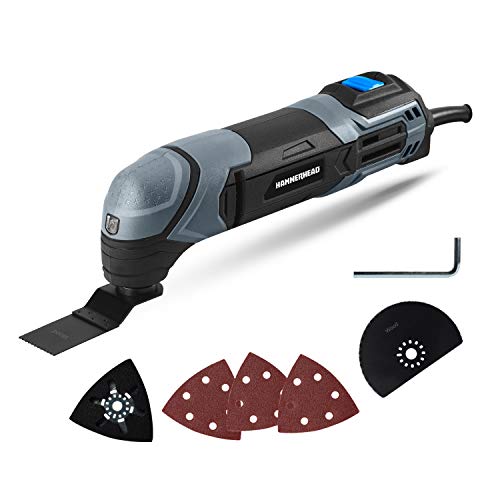
Hammerhead is a corded 2.2 amp tool that reaches up to 20,000 oscillations per minute, with a variable speed dial, a compact body, an ergonomic soft grip and a bundle of accessories including a flush cut blade, a semicircle saw blade and a sanding pad.

A corded motor never runs flat, which suits long scraping and grout removal sessions where a cordless battery would drain. Compared with the Ryobi and DEWALT it has no battery cost and unlimited runtime, but a cord that can snag.

It is the best value here for a first oscillating tool. Keep the vents clear and replace blades when dull. Because the tool is light, a long session of overhead work is less tiring than with a heavier unit, though vibration still builds up. If your tool includes a case, store the accessories in it so nothing goes missing.

What works

  • Corded power never runs flat
  • Up to 20,000 OPM
  • Accessories included in the box
  • Variable speed dial

Watch out for

  • Cord limits reach and can snag
  • Less power than brushless cordless units
  • Vibration is higher than premium tools

Spec sheet

Power
2.2 amp corded
OPM
Up to 20,000
Control
Variable speed dial
Accessories
Flush cut, semicircle blade, sanding pad
Grip
Ergonomic soft grip

Spec sheet decoder

What the numbers on the box really mean

The specs manufacturers lead with, translated into what they tell you about real-world performance.

OPM

Oscillations per minute, how fast the blade moves back and forth. Higher cuts faster. A wider range of speeds is more useful than a higher top number.

Watch forThe Hammerhead and Ryobi list up to 20,000, and the Milwaukee tops at 18,000.

Brushless

A motor without carbon brushes that runs cooler and holds speed better. Brushless motors need no brush replacement.

Watch forThe DEWALT states it.

Tool only

A bare tool without battery or charger. It costs less but needs a battery you own. Check that your batteries and charger are the same platform.

Watch forRyobi, BLACK+DECKER and Milwaukee are sold bare.

Orbiting

A blade motion pattern that adds a small orbit to the oscillation for faster cutting. The orbit adds a small motion that speeds cuts in wood.

Watch forThe Milwaukee is listed as orbiting.

Amp rating

The current a corded motor draws, a rough measure of power. Compare amps only among corded tools.

Watch forThe Hammerhead is 2.2 amps.

Methodology

How We Evaluated These Oscillating Tools

Motor and power

We compared motor type, amp rating and OPM range. The DEWALT brushless motor and the Milwaukee metal gear case lead. Basic brushed motors lose points for sustained cutting. We started from the motor and the stated oscillation range, because those set how well each tool holds speed in a hard cut. We treated stated figures as the maker's claim, and read each listing for what it left out.

Vibration and handling

We read for vibration claims and grips. The Ryobi claims low vibration, and the Milwaukee has a rubberized handle. Units without claims get neutral credit. We looked at what the listing says about vibration, since fatigue is the real limiter on long jobs. We matched each tool to a user type, from weekend homeowner to daily remodeler.

Blade change and accessories

We looked at the blade clamp and the accessories in the box. The BLACK+DECKER and DEWALT lead on change, and the Hammerhead on accessories. We compared blade-change designs, because swapping between cutting and sanding is the daily routine. We kept cost to relative tiers because bare tools and kits are priced differently.

Platform and cost

We considered battery platform and kit contents. Bare tools suit existing owners. The DEWALT kit suits new buyers. We counted what is in the box, since a bare tool needs a battery and a kit includes one. We gave credit for platform breadth, since a tool is worth more when the battery fits many others.

Durability

We looked at gear case materials and brand support. The Milwaukee metal gear case earns credit. Light plastics lose points. We checked the housing and gear case materials as a proxy for how the tool survives a drop from a ladder. We noted where a tool depends on a separate purchase, such as batteries or a case.

Decision guide

How to Choose the Right Oscillating Tools

By Use

SituationPickWhy
Daily remodel workDEWALT 20V MAX XR DCS356D1Brushless and kit
Heavy-duty trade useMilwaukee M18 2626-20Metal gear case
Long grout or scraping sessionsHammerhead 2.2-Amp cordedNever runs flat
Low vibration priorityRyobi ONE+ 18VLowest in class claim
Occasional household jobsBLACK+DECKER BDCOS20BTool-free blade change

By Budget

TierPickWhy
LowestHammerhead 2.2-Amp cordedAccessories included
Lower midBLACK+DECKER BDCOS20BBare tool on 20V
MidRyobi ONE+ 18VBare tool on ONE+
Upper midMilwaukee M18 2626-20Metal gear case
HighestDEWALT DCS356D1 kitBrushless with battery

Corded vs Cordless

Corded

The Hammerhead gives unlimited runtime for scraping and grout. The cord limits reach and can snag on a ladder.

Cordless

The DEWALT, Milwaukee, Ryobi and BLACK+DECKER move freely and suit overhead work. Runtime depends on the battery and load.

Choose corded for long sessions and cordless for access.

By Battery Platform

PlatformPickWhy
DEWALT 20V MAXDEWALT DCS356D1Kit with battery
Milwaukee M18Milwaukee 2626-20Bare tool
Ryobi ONE+Ryobi ONE+ 18VBare tool
BLACK+DECKER 20VBDCOS20BBare tool
No platformHammerhead cordedNo battery needed

For Flush Cuts Specifically

Look for

A slim head, a good flush cut blade and low vibration, so the tool does not skate on the surface. A bimetal blade handles nails.

In this comparison

The Hammerhead ships a flush cut blade and the DEWALT and Milwaukee offer sustained power for trimming door jambs.

When to Spend More

Spend more if

You work daily and need a brushless motor and a tough case. The DEWALT and Milwaukee fit.

Save if

You cut occasionally. The Hammerhead or BLACK+DECKER do the job.

Ownership

Maintenance schedule

The upkeep that decides whether this machine lasts two seasons or ten.

TaskIntervalWhy it matters
Replace dull bladesAs neededA dull blade raises vibration and heat, and burns wood. A soft brush clears dust from the vents and the clamp. A quick wipe after every session keeps dust from caking.
Clear the ventsAfter each sessionDust blocks airflow and overheats the motor. Wipe the clamp face to keep blades seated flat. Check the screw torque on the clamp before heavy use.
Check the blade clampMonthlyA worn clamp lets the blade slip and wobble. A drop of oil on the clamp screw keeps it from seizing. Store blades in a case so they do not dull in a drawer.
Store batteries coolBetween jobsHeat shortens battery life. Remove the battery before changing blades. Charge batteries at room temperature.
Inspect the cord or switchQuarterlyA frayed cord is a hazard, and a dirty switch sticks. Coil the cord loosely to avoid cracking the insulation. Replace a worn switch or cord before it fails on a job.

FAQ

Frequently Asked Questions

What can an oscillating tool do?

It cuts flush against surfaces, makes plunge cuts, trims door jambs, scrapes caulk and sands in corners. Different blades handle wood, metal and tile. Most owners say the first use they find is trimming a door casing so new flooring slides under, which is a job a handsaw cannot do cleanly. Choose a platform first and a tool second, since batteries are the long-term cost.

Is cordless powerful enough?

For most jobs, yes with a brushless motor and a good battery. Long scraping sessions favour a corded unit. A fine-tooth blade leaves a smoother edge in trim, while a coarse blade clears wood quickly in a rough cut. Start with a low speed on a scrap of the same material to feel how the blade bites.

Why do my blades dull so quickly?

Nails and screws dull bimetal blades fast. Use carbide for hard materials and replace blades when cutting slows. Blades that glow blue or smell hot are too dull or too fast for the material, so slow down and change the blade. Clamp small workpieces, because an oscillating blade can walk across a loose board.

Do blades fit all brands?

Many tools accept universal-fit accessories, but proprietary mounts exist. Check the mount before buying blades. A depth stop is rare on these tools, so mark the blade with tape to avoid cutting into pipes or wires behind a wall. Mark your cut line with tape so you can see it through the dust.

How do I reduce vibration?

Use sharp blades, a lower speed for plastics and a firm but not forceful grip. Gloves also help. Dust extraction adapters are useful for sanding, since the pad throws a fine cloud that settles everywhere. A fresh bimetal blade cuts nails in wood well, but carbide lasts longer in hard woods.

Is an oscillating tool safe for beginners?

It kicks less than a circular saw, but blades are sharp. Clamp work and keep both hands on the tool. If your tool trips a breaker, check that the extension lead is rated for its amp draw. Check the manual for the duty cycle, since long continuous use can overheat a light-duty motor.

Bottom line

The short version

Browse more oscillating toolson Amazon →
James Miller, Lead Machine Editor

About the author

James Miller

Lead Machine Editor, MachineFanatic

James Miller leads MachineFanatic's buying guides, turning spec sheets, manuals and owner feedback into clear verdicts on power tools, outdoor power equipment, shop machines and kitchen machines.

More from James →

Keep reading

Related guides