
Amazon affiliate links - we earn a commission.Affiliate disclosure

Buying guide · 13 min read · Updated 2026-11-07

Best Panasonic Microwaves (2026)

Six Panasonic microwaves compared on inverter power, Genius Sensor, flatbed design and air fry combos, from a 0.9 cu ft compact to a 2.2 cu ft family oven.

James MillerBy James MillerLead Machine Editor6 machines comparedSpec-sheet verified
Best Panasonic Microwaves

At a glance

Our top picks

Side by side

Spec comparison

MachineOutput powerCapacityPower deliveryCooking aids
Panasonic NN-SN65KB 1.2 cu ft 1200W inverter microwave, blackBest OverallPanasonic NN-SN65KB 1.2 cu ft 1200W inverter microwave, black1200 W1.2 cu ftInverterGenius Sensor, 3-level popcorn key
Panasonic NN-SN76LS 1.6 cu ft 1250W cyclonic inverter microwaveBest Large FamilyPanasonic NN-SN76LS 1.6 cu ft 1250W cyclonic inverter microwave1250 W1.6 cu ftCyclonic Wave InverterGenius Sensor
Panasonic NN-SD47QSDAYH 0.9 cu ft 1000W inverter microwave, stainlessBest ValuePanasonic NN-SD47QSDAYH 0.9 cu ft 1000W inverter microwave, stainless1000 W0.9 cu ftInverterGenius sensor technology
Panasonic 1.0 cu ft 1200W flatbed microwave with Genius Sensor 2.0Best FlatbedPanasonic 1.0 cu ft 1200W flatbed microwave with Genius Sensor 2.01200 W1.0 cu ftn/aGenius Sensor 2.0 thermo-sensing
Panasonic 2.2 cu ft 1250W cyclonic inverter microwave with dialBest Extra LargePanasonic 2.2 cu ft 1250W cyclonic inverter microwave with dial1250 W2.2 cu ftCyclonic Wave InverterSensor Cook and Reheat
Panasonic HomeChef 4-in-1 1.2 cu ft 1000W microwave air fryer comboBest ComboPanasonic HomeChef 4-in-1 1.2 cu ft 1000W microwave air fryer combo1000 W1.2 cu ftn/an/a

One maker popularized the home inverter microwave, and most of its line still builds on that idea. An inverter holds steady power at each setting, which changes how defrosting, melting and gentle reheating behave in everyday cooking.

The differences inside the lineup come down to cavity size, sensor generation, tray design and whether the oven adds air frying. This guide sorts six distinct models by those traits so the choice follows the kitchen, not the badge on the door.

Before you buy

6 Criteria to Look For Before Buying a Panasonic Microwave

  1. 01

    Inverter versus pulse power

    Panasonic's inverter holds steady output, while standard ovens cycle the magnetron to reach low settings. The NN-SN65KB, NN-SN76LS, NN-SD47QSDAYH and 2.2 cubic foot model all use inverter heating. The difference shows when defrosting, melting and simmering. For plain full-power reheating, a pulse oven behaves almost the same. Try melting a cup of chocolate chips at 30 percent to see the gap, since a pulse oven will scorch spots while an inverter melts smoothly. If you rarely use low power, the premium for an inverter buys you less.

  2. 02

    Cavity size and counter fit

    The lineup runs from 0.9 to 2.2 cubic feet. The 1.2 cubic foot NN-SN65KB fits most counters, while the 2.2 cubic foot unit needs a deep shelf. Measure the counter and clearance before buying. A cavity larger than you need wastes counter space and costs more. Leave a few inches at the back and sides for airflow, and check the door swing so it clears the wall. Many counters run out of depth before they run out of width.

  3. 03

    Sensor generations

    Genius Sensor reads steam to adjust power and time, and the flatbed model uses Genius Sensor 2.0 with thermo-sensing of food temperature. The NN-SN76LS lists fifteen presets including fresh and frozen entrees. Sensors help with variable portions but can be fooled by covered dishes. A fogged cavity from the previous cycle also skews the reading, so open the door briefly between uses. Temperature sensing on the newer generation reduces this error but does not remove it.

  4. 04

    Turntable versus flatbed

    Most Panasonic models rotate food on a tray, while the 1.0 cubic foot model uses a flat floor and a pull-down door. A flatbed fits rectangular dishes and wipes clean in one pass. Rotation gives proven evenness, so stir large dishes on a flatbed. A flatbed also removes the glass tray, which is the part most often cracked in a dishwasher. Ask whether you would trade a little evenness for easier cleaning.

  5. 05

    Wattage tiers

    Panasonic spans 1000, 1200 and 1250 watts in this lineup. A 1250 watt oven cooks about a quarter faster than a 1000 watt one on a full plate. Higher output can overshoot small portions, so sensors and short intervals matter. Package directions assume 1000 to 1200 watts, which means a 1250 watt oven needs slightly less time than printed. Start with the minimum and add ten seconds at a time.

  6. 06

    Combo ovens

    The HomeChef adds air frying and app recipes to a 1000 watt microwave. Combo ovens save counter space but draw more power and need more cleaning. Choose one only if you would actually use the air fry mode. Air frying works best in small batches with space between pieces. A basket or rack that you must wash by hand adds a chore that a plain microwave does not have.

Detailed reviews

The 6 best panasonic microwaves, explained

01
Panasonic NN-SN65KB 1.2 cu ft 1200W inverter microwave, black
1200W1.2 cu ftInverterGenius Sensor
Check price on Amazon
Best for: Most kitchens that want inverter power and a sensor in a compact body.

The NN-SN65KB is the Panasonic most households should buy. Inverter technology produces a steady stream of power rather than pulsing the magnetron, so a 40 percent setting stays at 40 percent and food heats from edge to center more evenly. That difference is clearest when defrosting a chicken breast or melting butter.

Genius Sensor adjusts power and time automatically, and eleven power levels give fine control when you want to set things yourself. A three-level popcorn key is a small touch that avoids burnt bags. The 1.2 cubic foot cavity is large enough for a dinner plate and a medium casserole, yet the cabinet remains compact for a normal counter.

Compared with the NN-SD47QSDAYH, you gain 200 watts and a larger cavity. Compared with the 1.6 cubic foot NN-SN76LS, you save counter space. Wipe the interior after steamy foods so the sensor reads accurately, wash the tray and keep the rear vent clear. It is a mature design, which means parts and manuals are easy to find.

What works

  • Inverter holds steady power at every level
  • Genius Sensor adjusts time and power
  • Eleven power levels for fine control
  • Compact 1.2 cu ft body fits most counters

Watch out for

  • Costs more than pulse-power ovens
  • 1.2 cu ft limits very large dishes
  • Sensor accuracy drops in a steamy cavity

Spec sheet

Output power
1200 W
Capacity
1.2 cu ft
Power delivery
Inverter
Power levels
11
Cooking aids
Genius Sensor, 3-level popcorn key
02
Panasonic NN-SN76LS 1.6 cu ft 1250W cyclonic inverter microwave
1250W1.6 cu ftCyclonic inverter15 presets
Check price on Amazon
Best for: Larger households that want a roomier cavity with the same inverter approach.

Panasonic steps up to 1.6 cubic feet and 1250 watts in this model, and it adds the Cyclonic Wave inverter that circulates heat in a three-dimensional pattern. Fifteen preset smart cooking options include fresh and frozen entrees, so Genius Sensor handles more food types than the 1.2 cubic foot model.

The compact design occupies less counter than the cavity suggests, because the electronics are slim. A larger cavity makes room for family platters, tall bowls and two dishes at once. The extra watts shorten cooking, though small portions can overshoot if you ignore sensor mode.

Compared with the NN-SN65KB, you pay for 0.4 cubic feet and 50 watts. Compared with the 2.2 cubic foot model, you save a lot of counter. Clean the cavity after steamy cooking, and let the oven settle between cycles. It suits larger households that still want a manageable cabinet.

What works

  • 1.6 cu ft cavity fits family platters
  • Cyclonic Wave inverter circulates heat
  • Fifteen smart presets for fresh and frozen foods
  • 1250 W cooks large portions quickly

Watch out for

  • Costs more than the 1.2 cu ft models
  • 1250 W can overshoot small portions
  • Takes more counter than compact units

Spec sheet

Output power
1250 W
Capacity
1.6 cu ft
Power delivery
Cyclonic Wave Inverter
Auto cook
15 presets
Cooking aids
Genius Sensor
03
Panasonic NN-SD47QSDAYH 0.9 cu ft 1000W inverter microwave, stainless
1000W0.9 cu ftInverter15 presets
Check price on Amazon
Best for: Small kitchens that want the inverter and a sensor in a compact box.

This is Panasonic's small inverter oven, and it is the cheapest way to get the brand's steady power. A 0.9 cubic foot cavity at 1000 watts suits a single person, a couple or a small kitchen. Inverter heating keeps edges from cooking while the center stays cold.

Genius sensor technology auto-adjusts the cooking, and fifteen auto-cook presets cover popular foods. The stainless finish blends with other appliances. At 1000 watts, it matches the output of common mid-size ovens while keeping a smaller cabinet.

The tradeoff is cavity size, since a wide dinner plate or tall bowl may not fit. Compared with the NN-SN65KB, you save space and lose 200 watts and 0.3 cubic feet. Wipe the interior and keep the vents clear. This is a good fit for a studio or a secondary kitchen.

What works

  • Inverter in the smallest Panasonic body
  • Genius sensor technology
  • Fifteen auto-cook presets
  • Lowest cost in this guide

Watch out for

  • 0.9 cu ft limits dish size
  • 1000 W is less than the 1200 W models
  • Sensor modes need stirring

Spec sheet

Output power
1000 W
Capacity
0.9 cu ft
Power delivery
Inverter
Auto cook
15 presets
Cooking aids
Genius sensor technology
04
Panasonic 1.0 cu ft 1200W flatbed microwave with Genius Sensor 2.0
1200W1.0 cu ftFlatbedGenius Sensor 2.0
Check price on Amazon
Best for: Cooks who want a flat floor, easy cleaning and a modern look.

Panasonic's flatbed model drops the turntable and adds a pull-down door in a clean-design cabinet. Without a rotating tray, dishes slide in and out and a rectangular container fits side to side. The interior is one flat surface that wipes down in a single pass.

Genius Sensor 2.0 uses thermo-sensing to monitor food temperature, so one-touch cooking can adapt to the dish. Output is 1200 watts in a 1.0 cubic foot cavity. The pull-down door is a design choice that works well on a counter with limited swing space.

Compared with the NN-SN65KB, you gain a flat floor and a newer sensor, and you lose rotation-based evenness. Stir or turn large dishes by hand. It suits cooks who want a modern look and easy cleaning.

What works

  • Flat floor fits rectangular dishes
  • Genius Sensor 2.0 monitors food temperature
  • Pull-down door suits tight counters
  • 1200 W in a 1.0 cu ft body

Watch out for

  • No rotation, so large dishes need turning
  • 1.0 cu ft is smaller than the 1.2 models
  • Higher cost for the design

Spec sheet

Output power
1200 W
Capacity
1.0 cu ft
Interior
Flatbed, pull-down door
Cooking aids
Genius Sensor 2.0 thermo-sensing
Origin
Engineered in Japan
05
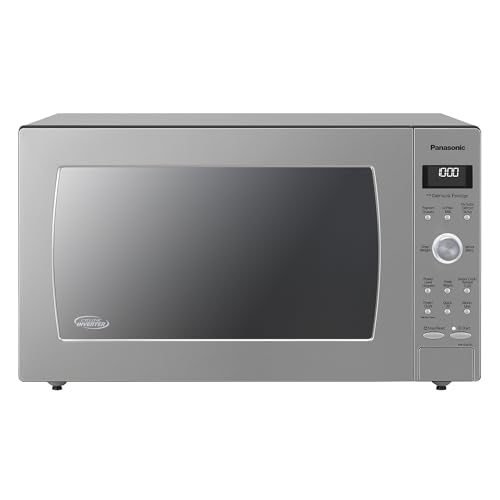
Panasonic 2.2 cu ft 1250W cyclonic inverter microwave with dial
1250W2.2 cu ftCyclonic inverter20 presets
Check price on Amazon
Best for: Big households that batch cook and want a dial plus presets.

This is the largest Panasonic in the guide at 2.2 cubic feet. Cyclonic Wave inverter circulates heat in a three-dimensional pattern, and 1250 watts cooks quickly. A mix of buttons and a dial gives twenty preset menu options, so you are never more than a touch or a turn from a common job.

Sensor Cook and Reheat functions let you cook without setting a time. The big cavity takes large platters and several dishes, which suits a family that batches meals. A large body demands a deep counter and clearance, so measure first.

Compared with the NN-SN76LS, you gain about 0.6 cubic feet. The dial makes setting simple for people who dislike touch pads. Clean the large cavity after steamy cooking. It suits big households and holiday cooks.

What works

  • 2.2 cu ft cavity fits platters
  • Cyclonic inverter with 1250 W
  • Dial plus twenty presets
  • Sensor Cook and Reheat

Watch out for

  • Large body needs deep counter space
  • Higher cost for size
  • Heavy glass tray to wash

Spec sheet

Output power
1250 W
Capacity
2.2 cu ft
Power delivery
Cyclonic Wave Inverter
Controls
Buttons and dial, 20 presets
Cooking aids
Sensor Cook and Reheat
06
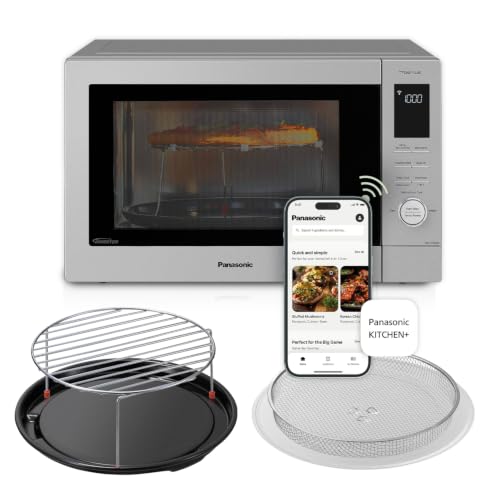
Panasonic HomeChef 4-in-1 1.2 cu ft 1000W microwave air fryer combo
1000W1.2 cu ftAir fryApp recipes
Check price on Amazon
Best for: Cooks who want one cabinet to microwave and air fry with app recipes.

The HomeChef puts four functions in one cabinet: microwave, air fry and related modes, with twenty presets and app-linked recipes. A Panasonic Kitchen+ app lets you pick a dish and pair it with the oven's settings. The 1.2 cubic foot cavity runs at 1000 watts.

It replaces a toaster oven or air fryer for many households, which saves counter space. The combo adds elements and a fan, so the oven draws more power in air fry mode. Compared with the plain NN-SN65KB, you gain crisping and lose inverter focus.

Give the interior a wipe after air frying, since grease bakes on faster. The app depends on Wi-Fi and may change over time. It suits cooks who want one appliance and enjoy app recipes.

What works

  • Four functions including air fry
  • App-linked recipes and 20 presets
  • Saves counter space
  • 1.2 cu ft cavity

Watch out for

  • Combo modes draw more power
  • App depends on Wi-Fi
  • Interior needs cleaning after air frying

Spec sheet

Output power
1000 W
Capacity
1.2 cu ft
Functions
4-in-1 microwave and air fryer
Presets
20
Smart features
App-linked recipes

Spec sheet decoder

What the numbers on the box really mean

The specs manufacturers lead with, translated into what they tell you about real-world performance.

Cyclonic Wave Inverter

This is Panasonic's inverter with a pattern that circulates heat in three dimensions. It aims for even heating.

Watch forThe NN-SN76LS and 2.2 cu ft model list it.

Genius Sensor

A sensor reads steam to adjust power and time. It handles common foods automatically.

Watch forThe NN-SN65KB, NN-SN76LS and NN-SD47QSDAYH list it, and the flatbed lists version 2.0.

1250 W output

This is cooking power delivered to food. It cooks faster than 1000 W models.

Watch forThe NN-SN76LS and 2.2 cu ft model reach 1250 W.

Flatbed interior

A flat floor replaces the rotating tray. It suits rectangular dishes and easy cleaning.

Watch forOnly the 1.0 cu ft Japanese model has it.

4-in-1 combo

It combines microwave and air fry functions. It replaces a small countertop oven.

Watch forOnly the HomeChef has it.

Methodology

How We Evaluated These Panasonic Microwaves

Brand purity

We kept only Panasonic-branded consumer ovens and left out commercial light-duty units. That left six distinct models. Finish variants of the NN-SN65 were counted once. Listings that carry only a model number without a spec sheet were checked against the cavity and wattage data. Imported units built for other voltages were set aside.

Power delivery

We checked for inverter designs. The NN-SN65KB, NN-SN76LS, NN-SD47QSDAYH, flatbed and 2.2 cu ft models list it, and the HomeChef is a combo. Defrost quality weighed heavily.

Size and fit

We compared cubic feet from the spec sheets. The range is 0.9 to 2.2 cu ft. Counter fit weighed above capacity. We also noted that a larger cavity usually means a deeper cabinet. Door style, whether a side swing or a pull-down, was recorded as a placement factor.

Sensor and presets

We compared Genius Sensor versions and preset counts. The flatbed lists Genius Sensor 2.0, and the NN-SN76LS lists fifteen presets. Aids that reduce guesswork scored higher.

Ownership signals

Reported trouble from owners centers on touch pads, latches and magnetrons as wear points. Panasonic's long history in inverter ovens helps with parts and manuals, but combo ovens add elements to maintain.

Decision guide

How to Choose the Right Panasonic Microwaves

By Kitchen Size

SituationPickWhy
Studio or small counterPanasonic NN-SD47QSDAYH0.9 cu ft inverter
Typical counterPanasonic NN-SN65KB1.2 cu ft and Genius Sensor
Larger householdPanasonic NN-SN76LS1.6 cu ft and 1250 W
Big batch cookingPanasonic 2.2 cu ftLargest cavity and dial
Rectangular dishesPanasonic 1.0 cu ft flatbedFlat floor

By Budget

TierPickWhy
LowestPanasonic NN-SD47QSDAYHSmallest inverter
Low to midPanasonic NN-SN65KBBest balance
MidPanasonic NN-SN76LSLarger cavity
Upper midPanasonic 1.0 cu ft flatbedFlatbed and Genius Sensor 2.0
HighestPanasonic 2.2 cu ftLargest cavity

Turntable vs Flatbed

Turntable

The NN-SN65KB, NN-SN76LS and 2.2 cu ft model rotate food through the wave pattern. This is proven and works with any dish. The tray needs washing.

Flatbed

The 1.0 cu ft model keeps a flat floor and a pull-down door. Rectangular dishes fit and cleaning is a single wipe. Large dishes need turning by hand.

Pick the flatbed for cleaning and rectangles. Pick a turntable for proven evenness.

By Cooking Needs

PreferencePickWhy
Gentle defrostPanasonic NN-SN65KBInverter at every level
Fresh and frozen entreesPanasonic NN-SN76LSFifteen smart presets
Dial plus presetsPanasonic 2.2 cu ftDial and twenty presets
Temperature sensingPanasonic 1.0 cu ft flatbedGenius Sensor 2.0
Air fryingPanasonic HomeChef4-in-1 combo

For Defrosting Specifically

Look for

Defrosting needs steady low power, which means an inverter, and a cavity that fits the food. Pulse ovens cook edges before centers thaw.

In this comparison

The NN-SN65KB suits most kitchens. The 2.2 cu ft unit fits large cuts of meat, and the NN-SD47QSDAYH covers small kitchens.

When to Spend More

Spend more if

You cook for a large household or want a flatbed or combo. The NN-SN76LS and 2.2 cu ft models earn their cost.

Save if

You cook for one or two. The NN-SD47QSDAYH gives the inverter at a lower cost.

Ownership

Maintenance schedule

The upkeep that decides whether this machine lasts two seasons or ten.

TaskIntervalWhy it matters
Wipe the cavityAfter spattersSplatter absorbs energy and bakes on. Wipe while warm.
Wash the turntableWeeklyGrease on the tray smokes when heated. Dry it fully.
Wipe the flatbed floorAfter useSpills dry on a flat surface. Avoid abrasive pads that scratch.
Clear the ventsQuarterlyBlocked vents trap heat and shorten magnetron life. Vacuum dust.
Clean the air fry elementsAfter useGrease on the HomeChef elements burns on the next cycle. Wipe once cool.

FAQ

Frequently Asked Questions

What is special about Panasonic inverter microwaves?

The inverter delivers continuous power at each setting rather than pulsing the magnetron. That gives more even defrosting and gentler reheating. It matters most at lower power levels.

Which Panasonic microwave should I buy?

The NN-SN65KB suits most kitchens. The NN-SN76LS and 2.2 cu ft models suit large households, and the NN-SD47QSDAYH suits small kitchens. Choose by counter and household size. A household of one or two rarely needs more than 1.2 cubic feet, while a family of five will use the larger cavities often. Do not pay for volume that you will not fill.

Is the Genius Sensor reliable?

It works well for moist, uncovered foods and struggles with covered dishes. Stir and rest food regardless. Treat sensor times as a strong first guess, and add a short burst if the middle is cool. Rest the dish for a minute so the heat evens out.

Is a flatbed Panasonic better?

It cleans easily and fits rectangular dishes. Rotation gives proven evenness, so large dishes need turning on a flatbed. Choose by cleaning preference.

Is the HomeChef combo worth it?

If you would use the air fry mode weekly, it saves counter space. It draws more power and needs more cleaning. Skip it if you only reheat. The app is a bonus and may change over the years, so the oven should be worth buying without it. Check how the unit behaves when the app is offline.

How long do Panasonic microwaves last?

Realistic lifespan estimates run to several years, with touch pads, latches and magnetrons as common failures. Clean seals and good ventilation help.

Bottom line

The short version

Browse more panasonic microwaveson Amazon →
James Miller, Lead Machine Editor

About the author

James Miller

Lead Machine Editor, MachineFanatic

James Miller leads MachineFanatic's buying guides, turning spec sheets, manuals and owner feedback into clear verdicts on power tools, outdoor power equipment, shop machines and kitchen machines.

More from James →

Keep reading

Related guides