
Amazon affiliate links - we earn a commission.Affiliate disclosure

Buying guide · 12 min read · Updated 2026-11-07

Best Pasta Makers (2026)

Six pasta makers compared by extruder versus roller design, motor power, thickness settings, flour capacity and how much hand work each one leaves to you.

James MillerBy James MillerLead Machine Editor6 machines comparedSpec-sheet verified
Best Pasta Makers

At a glance

Our top picks

Side by side

Spec comparison

A pasta maker comes in two families that do different jobs. An extruder mixes and kneads dough in a chamber and pushes it through a die to make shapes such as spaghetti and penne, while a roller thins a sheet of dough between smooth rollers and cuts it into ribbons. The first is automatic and fast, and the second gives the texture and flexibility of hand-rolled pasta.

The choice depends on the pasta you want. Long noodles and short tubes come from extruders, lasagna sheets, ravioli and fettuccine come from rollers, and a few machines do both. This guide ranks the lineup by how well each design does its job and by what you still have to do by hand, since a pasta maker that needs constant attention is not a time saver.

Before you buy

6 Criteria to Look For Before Buying a Pasta Maker

  1. 01

    Extruder versus roller

    The Philips 7000, Philips Viva and VEVOR are extruders, pushing dough through dies for shapes like spaghetti and penne. The Marcato machines and the GVODE are rollers, thinning dough into sheets for lasagna and fettuccine. Pick the family that makes the pasta you eat. Many households discover that they cook spaghetti and penne most often, which favors an extruder, while a cook who loves lasagna, tortellini and ravioli will be happier with a roller and a rolling pin. Think about the last five pasta dinners you cooked and let that list decide, rather than the feature count on the box.

  2. 02

    Hand work involved

    Extruders mix and knead automatically from flour and liquid, with a recipe that takes under 20 minutes. Rollers need you to make, knead and rest the dough, then crank or run each pass. A motor helps the roller, as on the Atlasmotor, but the dough work remains. A typical roller routine is to mix flour and eggs into a shaggy dough, knead for several minutes, rest it for thirty minutes so the gluten relaxes and then roll and cut, which stretches a simple supper into an hour or more. Extruders collapse most of that into one loading step, which is the real time saving.

  3. 03

    Capacity

    The Philips 7000 claims up to 8 portions, the VEVOR 500 grams of flour for about four people and the Viva two to three servings. A roller makes as much as you have dough for. Match batch size to your household. A rough guide is about 100 grams of flour per person for a main course, so 500 grams feeds about four, which matches the VEVOR's stated capacity. Fresh pasta cooks in a few minutes and does not keep well, so make only what you will eat, or dry or freeze the rest the same day.

  4. 04

    Thickness control

    The Atlasmotor offers ten positions, the GVODE eight from 0.4 to 2 millimeters. Fine control lets you roll thin sheets for ravioli and thicker ones for fettuccine. Extruders fix the shape by the die. Thickness in a roller affects both cook time and texture: thin sheets cook in a minute or two for ravioli and delicate noodles, while thicker ones hold up to heavy sauces and need a few minutes longer. Start at the widest setting, fold and pass the dough several times to smooth it, then step down one setting at a time rather than skipping.

  5. 05

    Motor and run limits

    The GVODE lists 700 watts maximum and a 15 minute run followed by a 5 minute rest. The extruders run at 150 watts for slow, steady work. Follow the manufacturer's duty cycle to protect the motor. A pasta machine under load is working a dense dough, and a motor that smells hot or slows down is asking for a rest. Cutting the dough into manageable pieces and rolling a few sheets at a time keeps a motorized roller inside its limits and gives you time to cut and dust as you go.

  6. 06

    Cleaning

    Rollers are brushed clean when dry and never washed, and extruder discs are brushed and sometimes washed per the manual. Dried dough comes off easily, and wet dough does not. Plan to let parts dry before cleaning.

Detailed reviews

The 6 best pasta makers, explained

01
Philips 7000 Series Pasta Maker, ProExtrude, 8 Discs
ProExtrude150W8 discs8 portions
Check price on Amazon
Best for: Families who want fresh pasta shapes with almost no hand work.

Philips' 7000 Series is a fully automatic extruder: you add flour and liquid, and the machine mixes, kneads and extrudes through one of eight shaping discs. The maker claims pasta in under 10 minutes and up to 8 portions in one go, and a versatile mixing function handles dough beyond pasta.

Automation is why it leads. A traditional pasta machine needs you to make the dough, knead it, rest it and feed it through rollers, while this machine takes dry flour and liquid and delivers noodles in minutes. Eight discs cover spaghetti, penne, fettuccine and other shapes, and an 8 portion capacity feeds a family. A 150 watt motor is modest, but the extrusion is slow and steady.

Extruded pasta has a different texture from rolled pasta, with a rougher surface that holds sauce well and a firmer bite. Weigh flour and liquid precisely, since extruders need a crumbly dough, not a smooth one. Brush the discs clean when dry and do not soak them. Keep spare discs for different shapes. For best results, use a high-protein flour or semolina blend, weigh the flour on a scale rather than by cup, and add liquid slowly through the opening while the machine kneads.

What works

  • Fully automatic mixing, kneading and extruding
  • Eight shaping discs
  • Up to 8 portions per batch
  • Mixing function for other doughs

Watch out for

  • Extruded texture differs from rolled pasta
  • Dough ratios must be exact
  • Discs need careful cleaning

Spec sheet

Method
ProExtrude automatic extruder
Power
150 watt
Discs
8 shaping discs
Capacity
Up to 8 portions
Time
Under 10 minutes claimed
02
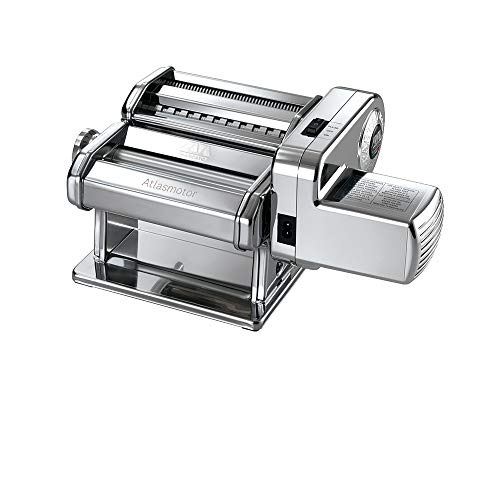
Marcato Atlasmotor 110V Electric Pasta Machine, Atlas 150 and Motor
Atlas 150Pastadrive motor6 in. sheets10 thickness positions
Check price on Amazon
Best for: Cooks who want true rolled sheets and a motor to help.

This set pairs the Italian Atlas 150 roller with a Pastadrive motor, a hand crank and a clamp, so you can roll pasta sheets up to 150 millimeters, or 6 inches, wide either by hand or electrically. An adjustment knob with ten clear positions sets the thickness, and the whole thing is made and assembled in Italy.

The motor changes the workflow. A hand-cranked roller needs two hands, one for the crank and one for the dough, and the motor frees one so you can guide the sheet. Rolled pasta has the smooth, springy texture that people associate with fresh pasta, and the machine produces lasagna sheets, fettuccine and, with attachments, other cuts.

It is more work than an extruder, since you make and rest the dough, but the result is the classic. Clamp it firmly to a counter, dust the dough lightly with flour and fold and re-roll at the widest setting before stepping down. Wipe the rollers with a dry brush and never wash them in water, which rusts them.

What works

  • Authentic roller with 10 thickness positions
  • Pastadrive motor frees a hand
  • Sheets up to 6 inches wide
  • Made in Italy with a clamp and crank

Watch out for

  • You make and rest the dough yourself
  • Rollers cannot be washed
  • Needs a counter edge for the clamp

Spec sheet

Includes
Atlas 150, hand crank, clamp, Pastadrive motor
Sheet width
Up to 150 mm / 6 in
Thickness
10 positions
Origin
Made and assembled in Italy
Finish
Chrome steel
03
GVODE Electric Pasta Maker, Stainless Housing, 700W, 3-in-1
700W Pmax8 thicknesses2 speeds + reverseStainless shell
Check price on Amazon
Best for: Cooks who want an electric roller with a stainless body and reverse.

GVODE's electric roller has a stainless steel shell, two speeds with reverse, eight thickness settings from 0.4 to 2 millimeters and a 3-in-1 roller and cutter set. The listing gives 700 watts maximum power and advises running in 15 minute batches with a 5 minute cool-down.

The stainless housing is what distinguishes this model from the plastic-bodied electric rollers. It resists dents and wipes clean without staining, and the listing contrasts it with a lighter plastic version at around 8 pounds. Reverse is a useful safety feature when dough catches, and two speeds let you roll slowly for thick dough.

The run limit matters: a 700 watt maximum motor heats when it runs continuously, so follow the cool-down. Against the Marcato set, the GVODE is a one-piece electric machine at a different price tier with less brand history. Dust the dough, start thick and step down, and brush the rollers clean when dry. Keep it away from water. Because the machine is electric, set up on a stable counter, keep a bowl for trimmings and never reach near the rollers with loose sleeves or long hair. The reverse function is there to release a stuck sheet, so stop the machine before you pull dough out by hand.

What works

  • Stainless steel housing
  • Two speeds with reverse
  • Eight thickness settings from 0.4 to 2 mm
  • 3-in-1 roller and cutter set

Watch out for

  • 15 minute run limit with a 5 minute rest
  • 700 watt figure is a maximum
  • Less brand history

Spec sheet

Power
700 watt maximum
Thickness
8 settings, 0.4 to 2 mm
Speeds
2 speeds with reverse
Housing
Stainless steel
Run limit
15 minutes on, 5 minutes off
04
VEVOR Electric Pasta Maker, 150W, 8 Shapes, 4 Modes
150W8 shapes4 modes500 g flour
Check price on Amazon
Best for: Buyers who want an automatic extruder at a lower price.

VEVOR's extruder uses a 150 watt motor, comes with eight pasta shapes and four intelligent modes, and handles 500 grams of flour, enough for about four people. A two-way kneading rod and four-dimensional mixing are meant to mimic hand kneading, and the box includes recipes and simple ratios.

It competes directly with the Philips 7000 and costs less. The difference is polish and track record: the Philips has a long brand reputation and a stated 8 portion capacity, while the VEVOR offers similar capability with a shorter history. The four modes automate the mixing and extruding sequence, and 500 grams of flour is a sensible family batch.

Follow the recipe ratios exactly, since extruders need a crumbly dough, and add liquid slowly. Let the machine run through its mode, extrude and cut the pasta as it exits. Brush the discs clean when dry and do not soak them. For the price of a mid-range hand machine, it offers an automatic workflow.

What works

  • Eight shapes and four modes
  • 500 g flour for about four people
  • Two-way kneading rod
  • Recipes and ratios included

Watch out for

  • Less brand track record than the Philips
  • Extruded texture
  • Dough ratios must be precise

Spec sheet

Power
150 watt
Shapes
8 pasta shapes
Modes
4 intelligent modes
Capacity
500 g flour, about 4 people
Kneading
Two-way kneading rod with four-dimensional mixing
05
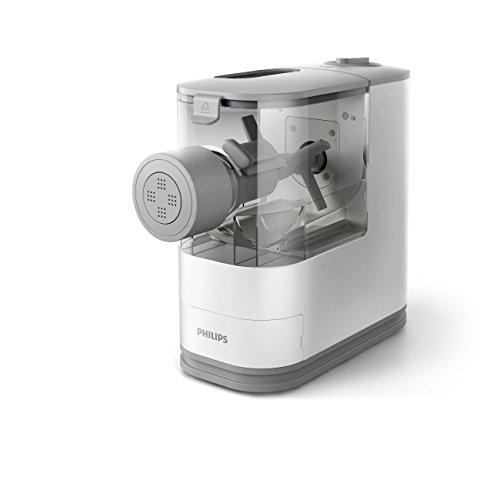
Philips Viva Compact Pasta and Noodle Maker, 3 Discs
2 to 3 servings18 minutes3 discsCompact
Check price on Amazon
Best for: Couples and small households who want a compact automatic extruder.

The Viva is a compact Philips extruder that automatically kneads and extrudes two to three servings of fresh pasta in about 18 minutes. It ships with three shaping discs for spaghetti, penne and fettuccine, and the listing says you can vary flour and add egg, herbs or vegetable juice.

It is the small sibling of the 7000 Series, with a smaller batch, a slower cycle and fewer discs. For a couple or a small family, that is enough, and the compact body stores more easily. The automatic stirring design mixes and extrudes without your intervention.

Use the supplied cup to measure flour and liquid exactly, since extruders are fussy. Let the machine run, extrude and cut as it exits, and brush the discs clean when dry. If you want more shapes or bigger batches, the 7000 Series is the step up.

What works

  • Compact body
  • Automatic kneading and extruding
  • Spaghetti, penne and fettuccine discs
  • Works with egg, herbs and vegetable juice

Watch out for

  • Smaller batch of two to three servings
  • Slower than the 7000 Series
  • Only three discs

Spec sheet

Capacity
2 to 3 servings
Time
About 18 minutes
Discs
Spaghetti, penne, fettuccine
Operation
Automatic kneading and extruding
Flexibility
Eggs, herbs, vegetable juices
06
Marcato Atlas 150 Manual Pasta Machine, Made in Italy
Hand crank3 pasta cutsChrome and nickel steelItaly
Check price on Amazon
Best for: Cooks who make rolled pasta occasionally and want a lasting tool.

The Atlas 150 is the classic hand-cranked pasta machine: nickel and chrome-plated steel rollers and cutters with an ABS crank, making lasagna sheets, fettuccine and tagliolini. It is made in Italy and is the reference design that many electric machines copy.

Its virtue is simplicity and durability. There is no motor to fail, the rollers are precisely ground and the machine lasts for decades with simple care. It makes the same smooth, springy rolled pasta as the motorized set, and costs far less than any electric machine. You give up the motor and the automation, so you make the dough, knead it, rest it and crank each pass.

Clamp it to a counter, dust the dough with flour and pass it through at the widest setting several times before stepping down. Brush the rollers clean when dry and never wash them. It is the right machine for lasagna, ravioli sheets and special-occasion pasta, and a poor fit if you want pasta on a weeknight in ten minutes.

What works

  • Precision steel rollers with no motor to fail
  • Makes lasagna, fettuccine and tagliolini
  • Made in Italy
  • Lasts for decades with care

Watch out for

  • All work is by hand
  • Needs a counter edge for the clamp
  • Rollers cannot be washed

Spec sheet

Operation
Hand crank
Cuts
Lasagna, fettuccine, tagliolini
Material
Nickel-plated and chrome-plated steel, ABS
Origin
Made in Italy
Class
Manual roller

Spec sheet decoder

What the numbers on the box really mean

The specs manufacturers lead with, translated into what they tell you about real-world performance.

ProExtrude

Philips' name for its automatic extruding system.

Watch forThe 7000 Series uses it.

Thickness positions

Settings that set the gap between rollers.

Watch forThe Atlasmotor lists ten, the GVODE eight.

Pmax

Peak or maximum power rating, not sustained power.

Watch forThe GVODE lists 700 watts Pmax.

Shaping disc

A die that shapes extruded dough.

Watch forThe Philips 7000 has eight, the Viva three.

Sheet width

The maximum width of the rolled sheet.

Watch forThe Atlas 150 rolls up to 150 millimeters.

Methodology

How We Evaluated These Pasta Makers

Design family

We separated extruders from rollers and judged each on its own job.

Automation

We compared how much work each machine leaves to the cook.

Capacity

We compared stated portions and flour capacities.

Controls

We looked at thickness settings, discs and modes.

Build and cleaning

We weighed materials, run limits and cleanup.

Decision guide

How to Choose the Right Pasta Makers

By Pasta Type

SituationPickWhy
Spaghetti and penne from flourPhilips 7000 SeriesEight discs, automatic
Lasagna and ravioli sheetsMarcato AtlasmotorRolled sheets with a motor
Fettuccine and tagliolini by handMarcato Atlas 150Classic manual
Electric rolled sheetsGVODE 700WStainless roller with reverse

By Budget

TierPickWhy
LowestMarcato Atlas 150 ManualClassic manual
Low-midVEVOR ExtruderAutomatic with eight shapes
MidPhilips VivaCompact automatic
HigherPhilips 7000 SeriesLarge capacity and eight discs

Extruder vs Roller

Extruder

The Philips and VEVOR mix and extrude from flour and liquid, make shapes quickly and need little skill.

Roller

The Marcato and GVODE roll sheets with a smooth texture, suit lasagna and filled pasta and need dough skills.

Pick an extruder for speed and shapes; pick a roller for lasagna, ravioli and texture.

By Household Size

SituationPickWhy
CouplePhilips VivaTwo to three servings
Family of fourVEVOR Extruder500 g flour
Large familyPhilips 7000 SeriesUp to 8 portions
Occasional batchesMarcato Atlas 150Makes what you roll

For Fresh Weeknight Pasta Specifically

Look for

Automatic mixing, a short cycle and shapes you eat. Weigh ingredients for consistent results.

In this comparison

The Philips 7000's under 10 minute claim and the VEVOR's four modes suit weeknights.

When to Spend More

Spend more if

You make pasta weekly, where an automatic extruder or a motorized roller saves effort.

Save if

You make pasta for special meals. The manual Atlas 150 is enough.

Ownership

Maintenance schedule

The upkeep that decides whether this machine lasts two seasons or ten.

TaskIntervalWhy it matters
Let dough dry before cleaningAfter each useDried dough crumbles off with a brush, while wet dough smears. Never soak rollers.
Brush rollers and diesAfter each useA dry brush removes flour without rusting steel.
Wipe the housingAfter each useFlour dust attracts moisture. A damp cloth keeps it clean.
Follow the duty cycleDuring useMotors overheat when run continuously. Rest as the maker advises.
Store dryAfter cleaningMoisture rusts steel parts.

FAQ

Frequently Asked Questions

Is an extruder better than a roller?

It depends on the pasta you want. Extruders make shapes such as spaghetti and penne automatically from flour and liquid, with a rougher surface that holds sauce. Rollers make sheets with a smoother, more elastic texture that suits lasagna, ravioli and fettuccine, but they need dough skills and more time.

Can I wash the rollers?

No. Water rusts steel rollers and can leave dough stuck in the gears. Let leftover dough dry for a short while, brush it off with a dry brush or a wooden pick and wipe the surfaces with a dry cloth. Never use a dishwasher, and avoid oil on the rollers, which transfers to the next batch of dough.

Why is my extruder dough sticky?

Too much liquid, which makes a smooth ball that clogs the die and gums the screw. Extruder dough should look like damp, pea-sized crumbs. Weigh the flour, add liquid slowly and follow the maker's ratio, adjusting by a teaspoon at a time if the dough looks dry or sticky after the first minute of mixing.

How thin should I roll pasta?

About 1 to 2 millimeters for fettuccine and tagliatelle, a little thicker for pappardelle, and thinner for ravioli so the filled pasta is not doughy. Test by holding the sheet up: you should be able to see the shadow of your hand through a thin ravioli sheet. Start thick and step down, since a sheet rolled too thin cannot be thickened again.

Can I use whole wheat flour?

Yes, but it makes a denser, nuttier pasta and needs more liquid because the bran absorbs water. Many cooks blend whole wheat with regular flour or semolina for a better texture, and let the dough rest a little longer. Extruders are fussier with whole grain, so start with a half-and-half blend and adjust the ratio from there.

Is fresh pasta worth the effort?

Many cooks think so for texture and flavor, since fresh pasta cooks in a few minutes and has a tender bite that dried pasta does not. An extruder reduces the effort to loading flour and liquid, while a roller turns pasta into a small project. If you cook pasta twice a month or less, a manual roller is the most economical way to try it.

Bottom line

The short version

Browse more pasta makerson Amazon →
James Miller, Lead Machine Editor

About the author

James Miller

Lead Machine Editor, MachineFanatic

James Miller leads MachineFanatic's buying guides, turning spec sheets, manuals and owner feedback into clear verdicts on power tools, outdoor power equipment, shop machines and kitchen machines.

More from James →

Keep reading

Related guides