
Amazon affiliate links - we earn a commission.Affiliate disclosure

Buying guide · 13 min read · Updated 2026-11-16

Best Plastic-Free Coffee Makers (2026)

Six coffee makers built to keep plastic off the water path: a drip brewer, a steel French press and four percolators, with honest limits on each claim.

James MillerBy James MillerLead Machine Editor6 machines comparedSpec-sheet verified
Best Plastic-Free Coffee Makers

At a glance

Our top picks

A plastic-free coffee maker means different things in different listings. The strict version keeps plastic away from every surface that touches hot water or brewed coffee. The loose version only removes the carafe or the reservoir, and leaves plastic tubing, lids or housings in the path.

No electric machine is plastic-free everywhere, since switches, housings and cord bases usually contain some. What matters is the contact path from reservoir to cup. This guide ranks six models by how clean that path is and how well the machine brews, and it flags every place where a claim reaches its limit.

Before you buy

6 Criteria to Look For Before Buying a Plastic-Free Coffee Maker

  1. 01

    Where plastic touches

    A strict plastic-free claim covers every surface that meets hot water or coffee. The SimplyGoodCoffee Brewer and the steel Ziruma press aim at that, while the Presto percolator is steel but its knob and handle need checking. Read the listing for the lid, tubing and basket. Silicone seals are common and are usually considered a separate material from rigid plastic, but the listing should say so.

  2. 02

    Percolator or drip

    A percolator recirculates water over the grounds, which tends to over-extract and taste bitter. A drip machine like the SimplyGoodCoffee Brewer passes the water over the grounds once. If you want a gentle, clean cup, choose drip or a press. A percolator also keeps the coffee boiling hot, which flatters dark roasts more than light ones.

  3. 03

    Temperature window

    Good coffee extracts best between about 195 and 205 F. The SimplyGoodCoffee Brewer states that range, and a French press relies on you pouring water just off the boil. Machines that run cooler produce sour coffee. A thermometer in the kettle removes the guesswork for press brewing.

  4. 04

    Glass or steel body

    Glass lets you watch the brew but breaks, as on the glass percolator and the Yeeke carafe. Steel, as on the Presto and Ziruma, survives drops and holds heat in a double wall. Choose by how rough your kitchen is. A cracked glass knob on a percolator is a cheap part, but a cracked pot is not.

  5. 05

    Batch size

    The Presto and APOXCON make up to 12 cups, the SimplyGoodCoffee Brewer 8 and the Yeeke 6. Brewing far under capacity weakens a percolator. Match the machine to your daily batch. A six-cup Yeeke wastes less coffee for a solo drinker than a twelve-cup pot.

  6. 06

    Honest limits

    Electric machines have switches, housings and cord bases that contain plastic, so none is plastic-free everywhere. Manual presses come closest. Treat a marketing claim as a statement about the brew path only. If the claim matters to you, ask the maker which parts are not plastic-free.

Detailed reviews

The 6 best plastic-free coffee makers, explained

01
SimplyGoodCoffee The Brewer 8-Cup Plastic-Free Drip Coffee Maker
8-cup capacity195 to 205 FNo-plastic water pathBloom option
Check price on Amazon
Best for: People who want automatic drip with a clean contact path.

This is an automatic drip brewer designed around the contact path. Water heats to a range of 195 to 205 degrees and passes through components chosen to avoid plastic and aluminum, so the water and coffee touch steel, glass and silicone-style seals instead. A single button runs a cycle that the maker says takes about six minutes for eight cups.

An optional Bloom feature wets the grounds first and pauses, letting carbon dioxide escape before the main pour, which is what a careful pour-over does by hand. Compared with the percolators in this guide, a drip machine passes water over the grounds once, so there is less risk of over-extraction, and the cup tastes cleaner.

The tradeoffs are cost and parts: this is the most expensive machine on the list, and the housing, controls and cord still contain plastic, as with any electric appliance. Descale on schedule and hand wash the carafe. For someone who wants real automatic drip without plastic on the water path, it is the strongest match. Treat the cost as an investment in a long-lived machine rather than an impulse purchase.

What works

  • Water path avoids plastic and aluminum
  • Heats water within 195 to 205 F
  • Optional Bloom wets grounds before the main pour
  • One-button operation with an eight-cup pot

Watch out for

  • Costs the most of the six machines
  • Housing and controls still contain some plastic

Spec sheet

Capacity
8 cups
Brew temperature
195 to 205 F
Brew time
About 6 minutes
Water path
No plastic or aluminum touches water or coffee
Operation
One button with optional Bloom
02
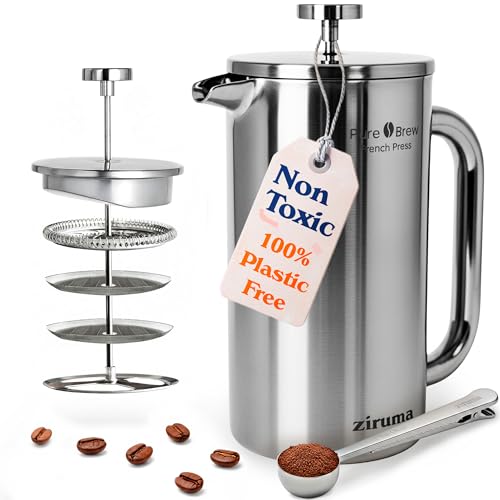
Ziruma 34 oz Stainless Steel French Press with 4-Layer Filter
34 oz capacity316 steelDouble wall4-layer filter
Check price on Amazon
Best for: Hand brewers who want no plastic and no electronics.

The simplest plastic-free coffee maker is a steel French press. It has no motor, no heater and no tubing, so the only materials near the coffee are stainless steel and a filter. This one uses 316 grade steel in a double wall that holds heat through the steep, and a four-layer filter holds back fine grounds.

Because it is a manual device, you supply the heat and the timing: add coarse grounds, pour hot water, steep about four minutes and press the plunger. Compared with the SimplyGoodCoffee Brewer, it takes your attention and cannot start itself, but it costs far less and has nothing to break.

Expect to rinse the plunger parts after every use, because oils hide between filter layers. A press makes a full-bodied cup with some silt, which differs from filter coffee. This is the best fit for a household that wants to avoid plastic and is happy to brew by hand. Consider it a good gift for anyone who camps as well.

What works

  • 316 steel body with no plastic in the brew path
  • Double wall holds heat through the steep
  • Four-layer filter limits silt
  • Nothing to heat, wire or break

Watch out for

  • You must supply hot water and watch the timer
  • Immersion coffee carries more body and silt than drip

Spec sheet

Capacity
34 oz
Material
316 surgical-grade stainless steel
Insulation
Double wall
Filter
Four-layer
Power
None
03
Presto 02811 12-Cup Stainless Steel Electric Coffee Percolator
2 to 12 cupsStainless steelRapid brewCordless serve
Check price on Amazon
Best for: Drinkers who like a bold, hot percolated cup in a steel pot.

A percolator brews by recirculation. Water boils at the base, rises through a tube and sprays over the grounds in a basket, then drips back down to boil again. Presto builds this in stainless steel, so there is no glass or plastic liner in the pot, and it brews at about a cup per minute.

The recirculation is the weakness: the same water passes over the grounds repeatedly, which tends to over-extract and gives a hotter, bolder, sometimes bitter cup. Compared with the drip SimplyGoodCoffee Brewer, it is cheaper and faster but less gentle on the grounds.

The pot handles two to twelve cups, so it works for solo mornings and gatherings. Check the listing for the knob and handle materials, since those parts may not be steel. Wash by hand, and avoid long standing on the heat. It is the best fit for someone who likes a classic, strong cup and a stainless pot. It is easy to find replacement parts for this long-running design.

What works

  • All-steel pot with no glass or plastic liner
  • Brews about a cup a minute
  • Handles two to twelve cups
  • Easy to rinse and wipe clean

Watch out for

  • Recirculation can over-extract and turn bitter
  • Knob and handle materials need checking

Spec sheet

Capacity
2 to 12 cups
Material
Stainless steel
Brew speed
About a cup per minute
Type
Electric percolator
Cleaning
Steel construction rinses easily
04
APOXCON 12-Cup Stainless Steel Electric Percolator with Glass Knob
12-cup capacityStainless interiorGlass knobCordless base
Check price on Amazon
Best for: Larger households that want a steel percolator with a glass knob.

The point of this percolator is that nothing aluminum or plastic touches the brew. The interior and the filter basket are stainless steel, and a tempered borosilicate glass knob in the lid lets you watch the coffee perk. A cordless serving base lets you carry the pot to the table.

It shares the recirculating mechanism with the Presto, so the same over-extraction caution applies, and the glass knob is a nice touch that lets you stop the brew when the color is right. Compared with the Presto, it adds the glass knob and the keep-warm function.

The knob is glass, which can crack, and the base still contains plastic and electronics. Watch the brew color rather than the clock, and unplug at the right moment. Reach for it as a good pick for a larger household that wants a pot-style machine and cares about aluminum and plastic in the water path. The glass knob adds a tiny breakage risk that a plain lid does not have.

What works

  • Stainless interior and basket with no aluminum
  • Glass knob shows the brew color
  • Cordless base serves at the table
  • Keep Warm function holds temperature

Watch out for

  • Glass knob can crack if hit
  • Recirculation brewing can turn bitter

Spec sheet

Capacity
12 cups
Interior
Stainless steel and steel basket
Knob
Tempered borosilicate glass
Base
Cordless serving base
Warming
Keep Warm function
05
Borosilicate Glass Electric Percolator Coffee Pot with Auto and Manual Brew
Borosilicate glassAuto and manual modesKeep warmPlastic-free contact
Check price on Amazon
Best for: People who want to watch the brew in a glass pot.

An all-glass percolator lets you watch the whole process, from the first bubbles to the final color. Borosilicate glass resists thermal shock and does not carry flavors the way plastic can. The maker states that no plastic touches the water or the coffee.

Two modes, auto and manual, cover a hands-off brew and a watch-it-yourself approach, and a Keep Warm function holds the pot after brewing. Compared with the steel Presto, the glass lets you judge strength by eye, which helps tame the over-extraction that percolators suffer.

Glass is fragile, so a drop ends the pot, and the base and switches still contain plastic like every electric machine. Expect to hand wash it carefully. See it as a good choice for someone who likes to see the brew and wants glass instead of steel, and it is less rugged than the stainless options. Store it where it will not get bumped.

What works

  • Borosilicate glass shows the full brew
  • Auto and manual modes give control
  • Glass does not carry old flavors
  • Keep Warm function holds the pot

Watch out for

  • Glass breaks if dropped
  • Base and switches still contain plastic

Spec sheet

Body
Borosilicate glass
Modes
Auto and manual brew
Warming
Keep Warm
Indicators
Blue lights on both modes
Claim
No plastic touches water or coffee
06
Yeeke 6-Cup Electric Percolator Coffee Pot with 3 Brew Modes
6-cup capacity3 brew modes12-hour timerBorosilicate carafe
Check price on Amazon
Best for: One or two drinkers who want percolator controls and a timer.

The Yeeke tackles the percolator's weak point with brew modes tuned for light, medium and dark roasts, which let you shorten the recirculation for a delicate bean. A 12-hour delay timer starts a pot before you wake, which most percolators cannot do. A memory function saves settings if you lift the carafe.

At six cups, it suits one or two drinkers, and it is the smallest machine in this guide. Compared with the 12-cup APOXCON and Presto, it brews less but gives more control, and compared with the drip SimplyGoodCoffee Brewer it still recirculates water over the grounds.

The borosilicate glass carafe is easy to see through, though it is a breakable part, and the electronics still use plastic. Check how the manufacturer describes the lid and basket materials before you rely on the claim. This works as a good fit for a small household that wants a percolator with modern controls. The small size is also easy to store.

What works

  • Three modes tuned to light, medium and dark roasts
  • 12-hour delay timer for a ready pot
  • Memory function keeps settings when lifted
  • Compact six-cup size suits small households

Watch out for

  • Holds only six cups
  • Lid and basket materials need checking on the listing

Spec sheet

Capacity
6 cups
Modes
Three, for light, medium and dark roasts
Timer
12-hour delay
Carafe
Borosilicate glass
Memory
Saves settings when carafe is lifted

Spec sheet decoder

What the numbers on the box really mean

The specs manufacturers lead with, translated into what they tell you about real-world performance.

Plastic-free

A claim that no plastic touches the water or coffee. It does not cover the housing or cord base.

Watch forThe SimplyGoodCoffee Brewer and the glass percolator both make this claim, and both still use plastic elsewhere. Ask which parts are excluded from the claim.

316 stainless steel

A corrosion-resistant steel alloy with molybdenum, often called surgical grade. It resists acid and salt better than 304. Take it as a good choice for a daily-use steel press.

Watch forThe Ziruma press uses it.

Borosilicate glass

Glass with low thermal expansion that survives sudden heat changes. It still breaks on impact. Preheat it with warm water to reduce stress.

Watch forThe glass percolator and the Yeeke use it for the pot.

Percolator recirculation

Water cycles through the grounds repeatedly while the pot boils. It gives a hot, bold cup and risks bitterness. A shorter perk time reduces the bitterness.

Watch forThe Presto, APOXCON, glass percolator and Yeeke all use it.

Bloom

A short pre-wetting that lets gas escape from fresh grounds. It leads to more even extraction. Many manual brewers do it with a splash of water first.

Watch forThe SimplyGoodCoffee Brewer offers it as an option.

Methodology

How We Evaluated These Plastic-Free Coffee Makers

Contact path

We examined which surfaces touch water and coffee, from reservoir to cup. A steel or glass path scored highest, and a listing that was vague about the lid or knob lost points. We did not score the housing, because none of the electric machines can avoid plastic there.

Brew method

We compared drip, immersion and percolator mechanisms. Drip and press scored higher for a clean cup, and percolators lost points for over-extraction risk. Taste differences between methods are real, so we compared them by extraction logic.

Temperature control

We looked at whether a machine states a brew temperature range. The SimplyGoodCoffee Brewer scored highest at 195 to 205 F. Machines with no stated range were scored as unknown.

Durability

We weighed steel against glass and the number of electronic parts. The Ziruma press scored highest, and glass pots lost points for breakage. Replacement part availability was considered too.

Honesty of the claim

Based on the spec sheet and owner feedback patterns, we noted where a plastic-free claim reaches its limit. Machines that name the contact path scored higher than those with a broad claim. Silicone seals were noted where mentioned.

Decision guide

How to Choose the Right Plastic-Free Coffee Makers

By Brewing Style

SituationPickWhy
Automatic dripSimplyGoodCoffee The BrewerClean path, temperature window
Manual, full bodyZiruma Steel French PressNo electronics
Classic bold potPresto 12-Cup PercolatorSteel and fast
See the brewGlass Electric PercolatorBorosilicate pot

By Budget

TierPickWhy
LowestZiruma Steel French PressNo electronics
Low to midPresto 12-Cup PercolatorPlain steel pot
MidAPOXCON Steel PercolatorGlass knob and cordless base
HighestSimplyGoodCoffee The BrewerAutomatic drip

Drip vs Percolator

Drip

The SimplyGoodCoffee Brewer passes water over the grounds once, which gives a clean, even cup. It costs more and has a more complex path.

Percolator

The Presto, APOXCON, glass percolator and Yeeke recirculate water, which makes a hot, bold cup but risks bitterness. They cost less and are simpler.

Choose drip for a clean cup and a percolator for a strong classic brew.

Batch Size

PreferencePickWhy
One or two cupsYeeke 6-Cup PercolatorSix cups, with a timer
Small familySimplyGoodCoffee The BrewerEight cups
Large potAPOXCON 12-Cup PercolatorTwelve cups
Variable amountsPresto 12-Cup PercolatorTwo to twelve cups

For Strict Plastic-Free Use Specifically

Look for

A manual steel or glass brewer, or an electric machine whose maker names every food-contact material. Check lids, knobs and tubing.

In this comparison

The Ziruma press has no electronics and the SimplyGoodCoffee Brewer states a no-plastic water path, making them the closest matches.

When to Spend More

Spend more if

You want automatic drip with a clean path and a stated temperature. The SimplyGoodCoffee Brewer offers both.

Save if

You are happy to brew by hand. The Ziruma press costs far less and has nothing to break.

Ownership

Maintenance schedule

The upkeep that decides whether this machine lasts two seasons or ten.

TaskIntervalWhy it matters
Hand wash all contact partsAfter each brewCoffee oils build up on steel and glass and turn rancid. A soft sponge removes them. Pay attention to the lid, which holds oil.
Descale the machineMonthly in hard waterScale builds on heating elements and narrows the water path. Use citric acid or vinegar and rinse well. Run two plain cycles afterward to clear any taste.
Take apart the press filterAfter each useGrounds hide between layers and sour. Rinse every plate. A small brush helps reach the spiral and cross plates.
Check glass partsMonthlyA chip or crack can fail under heat. Replace a damaged knob or carafe. Never pour cold water into a hot glass pot.
Dry steel partsAfter washingStanding water leaves spots and can stain. Wipe dry before storing.

FAQ

Frequently Asked Questions

Is any electric coffee maker truly plastic-free?

No. Switches, housings and cord bases usually contain some plastic. The useful claim is that no plastic touches the water or coffee. A manual steel press comes closest.

Are percolators healthier than drip machines?

The material in the contact path matters more than the brewing style. A stainless percolator avoids plastic contact, but recirculation can over-extract and taste bitter. Pick the material first and the method second.

What is the simplest plastic-free option?

A steel French press has no heater, motor or tubing. You supply the hot water and timing. It is also the cheapest option here.

Does glass or steel keep coffee hotter?

A double-wall steel pot holds heat better than a glass one. Glass loses heat faster but lets you see the brew. Preheat either one with hot water before brewing.

Can a percolator make good coffee?

Yes, if you watch the brew time and use a coarse grind. Shorter cycles reduce bitterness. Unplug as soon as the color looks right.

How do I check a plastic-free claim?

Read the listing for the lid, basket, tubing and reservoir, and look for named materials. A vague claim without part details deserves caution. When in doubt, ask the seller to confirm in writing.

Bottom line

The short version

Browse more plastic-free coffee makerson Amazon →
James Miller, Lead Machine Editor

About the author

James Miller

Lead Machine Editor, MachineFanatic

James Miller leads MachineFanatic's buying guides, turning spec sheets, manuals and owner feedback into clear verdicts on power tools, outdoor power equipment, shop machines and kitchen machines.

More from James →

Keep reading

Related guides