
Amazon affiliate links - we earn a commission.Affiliate disclosure

Buying guide · 12 min read · Updated 2026-11-13

Best Power Station for the Money (2026)

Six affordable small power stations compared on real watt-hours, rated versus surge output, cell chemistry, charge speed and the compromises behind each value.

James MillerBy James MillerLead Machine Editor5 machines comparedSpec-sheet verified
Best Power Station for the Money

At a glance

Our top picks

Side by side

Spec comparison

Value in a power station is not the lowest outlay. A cheap unit with a shaky battery, an undersized inverter or a slow charger can cost more in frustration than a mid-priced one costs in money, so the question is what each unit gives per dollar of real capability.

The numbers worth comparing are watt-hours, rated continuous output, cell chemistry and recharge speed. This guide ranks small and budget stations by how honestly those numbers add up to something you will use.

Before you buy

6 Criteria to Look For Before Buying a Power Station for the Money

  1. 01

    Real watt-hours

    Compare watt-hours, not mAh, and subtract about 15 percent for inverter losses. The BLUETTI and DaranEner 288Wh give roughly 245Wh of usable AC energy, the MARBERO 237Wh about 200Wh and the Powkey 192Wh about 163Wh. Runtime equals usable Wh divided by load watts. A good habit is to write the usable figure on a label stuck to the unit, so nobody in the household plans a day around the printed capacity.

  2. 02

    Continuous watts, not marketing peak

    The Daran 288Wh lists 350W rated and 600W surge, the MARBERO 300W with 375W peak and the BLUETTI 600W. Only the continuous figure matters for what runs for minutes. Surge covers a startup spike that lasts a second. If an appliance's nameplate lists a higher number than the rating, assume the station cannot run it.

  3. 03

    Cell chemistry

    LiFePO4 survives 2000 to 3000 cycles or more, while standard lithium-ion packs often last 500 to 800. The BLUETTI, both DaranEner units and the Powkey use LiFePO4, while the MARBERO does not state it. Over five years of use, the chemistry matters more than the sticker. A cheap pack that fails at year three is no bargain next to one that lasts a decade.

  4. 04

    Recharge speed and path

    A 100 watt wall limit, like the DaranEner 192Wh's, means two to three hours to refill. The BLUETTI charges to 80 percent in 45 minutes. A slow charger makes a small battery feel smaller. Fast charging matters most if you use the station as a UPS, because the pack must be full again before the next outage.

  5. 05

    Weight and size

    The Powkey weighs 4.7 lb and the BLUETTI Elite 30 V2 9.4 lb. If the unit will live in a bag, weight decides how often it travels. A heavy station gets left at home.

  6. 06

    Outlets and ports

    A 60 watt USB-C PD port, as on the Daran 288Wh, charges a laptop more efficiently than an AC outlet. Count the ports you need, because a station with few can need a power strip. Avoid paying for outlets you will not use.

Detailed reviews

The 5 best power station for the money, explained

01
BLUETTI Elite 30 V2 288Wh 600W LFP Power Station
288Wh LFP600W output1500W power lifting10ms UPS
Check price on Amazon
Best for: Buyers who want the most capable small station without stepping up to a heavy unit.

Twice the output of most 288Wh stations is the headline claim, and the BLUETTI Elite 30 V2 backs it with a 600 watt inverter where rivals in this class stop near 300 watts. Power Lifting Mode extends that to 1500 watts for resistive loads like a small kettle or hair dryer. It weighs 9.4 pounds, packs LFP cells for long cycle life and charges to 80 percent in 45 minutes. For the buyer who wants one unit that can double as a desk UPS and a weekend camping battery, that combination of features is hard to find at this size, and it is why the model tops the value ranking despite a higher sticker.

Those features add up to more usable capability than the price suggests. A 10 millisecond UPS makes it suitable for a router or desktop, and the stated smarter cooling and cells cut standby consumption by about half. Against the 288Wh DaranEner it costs more but offers double the inverter and faster charging, and against the 192Wh Powkey it has more energy and a far stronger output. The honest limit is energy: 288Wh is a few hours of laptop work or a night of router and phone charging, not a day of anything heavy, so think of the extra money as paying for capability rather than capacity.

The sensible way to use it is to keep it on the shelf near the router and treat it as both a UPS and a travel battery. Use Power Lifting Mode only for resistive appliances, and keep it above freezing when charging. Keep the firmware current through the app, and use the charge-limit setting if the unit will live plugged in as a UPS, which reduces wear on the cells.

What works

  • 600W inverter with 1500W power lifting beats other 288Wh units
  • LFP cells with a 45 minute charge to 80 percent
  • 10ms UPS suits a router or desktop
  • Only 9.4 lb

Watch out for

  • Most expensive unit in the group
  • 288Wh runs a heater for only minutes
  • Power Lifting Mode does not suit motors

Spec sheet

Capacity
288Wh LFP
AC output
600W, 1500W power lifting
Weight
9.4 lb
Charge speed
0 to 80 percent in 45 minutes
UPS function
10 millisecond switchover
02
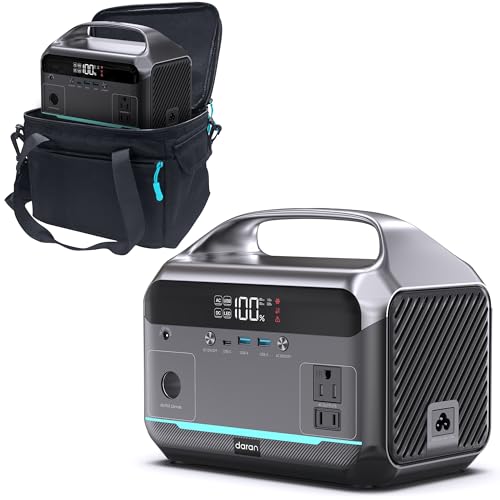
DaranEner 288Wh LiFePO4 Power Station with 350W Output
288Wh LiFePO4350W, 600W surge60W USB-C PD2 AC outlets
Check price on Amazon
Best for: Occasional campers and emergency kits wanting LiFePO4 at a modest outlay.

LiFePO4 cells at a modest outlay are the DaranEner's reason to exist. The 288Wh pack sits behind two AC outlets rated at 350 watts, with a 600 watt surge allowance, a 60 watt USB-C PD port and two 18 watt USB-A ports. For a phone, a tablet, a laptop and a fan, that is a complete setup. At this size it also doubles as a decent bedside backup, since a lamp, a phone and a small fan together draw well under a hundred watts.

The trade is polish: the app, the support and the fast charging are all basic, and its inverter is rated lower than the Elite 30 V2's. Compared with the 192Wh DaranEner it adds nearly half again the energy and 50 watts of output, and compared with the 237Wh MARBERO it carries LiFePO4 instead of a conventional lithium cell, which should last longer. For occasional use it is a sensible buy. Because the 600 watt surge allowance is only a brief allowance, an appliance rated at 400 watts or more on its nameplate should be treated as unsupported.

Set it on a shelf, top it up every few months and do not leave it in a hot car. Do not expect it to run a kettle, a hair dryer or a space heater, and keep the load list short. If you camp often, buy a compatible solar panel early, since the slower recharge is the biggest everyday annoyance with this class of unit.

What works

  • LiFePO4 cells at a modest outlay
  • 350W rated with a 600W surge allowance
  • 60W USB-C PD charges laptops directly
  • Two AC outlets plus several USB ports

Watch out for

  • Basic app and limited support
  • Cannot run heating or cooking appliances
  • Slower recharge than the BLUETTI

Spec sheet

Capacity
288Wh LiFePO4
AC output
Two outlets, 350W rated, 600W surge
USB-C
60W PD
USB-A
Two 18W ports
Charging
Wall, car or solar
03
DaranEner 192Wh LiFePO4 Power Station with 300W Output
192Wh LiFePO4300W, 600W surge2 AC outlets100W wall charge
Check price on Amazon
Best for: Light users and gift buyers who want a basic LiFePO4 station at a low outlay.

A 192 watt-hour LiFePO4 battery with two 300 watt AC outlets is among the cheapest ways to get a useful power station in this guide, and the claim of cells lasting up to ten times longer than standard lithium-ion fits the chemistry. It is aimed at phones, tablets, laptops, fans and similar small gear. It is a sensible gift for a student or a first-time camper because the learning curve is almost nonexistent.

Recharging is slow by design: a 100 watt maximum from the wall means roughly two to three hours to refill 192Wh, and solar input is capped at 60 watts. That is fine for weekend use but frustrating if you want a quick turnaround. Next to the 288Wh Daran it has a third less energy for a lower outlay, and against the Powkey 192Wh it offers a more capable inverter at a similar capacity.

Keep expectations modest. It is a good bedside backup for a CPAP at low settings, a lamp and a phone, but a refrigerator or a coffee maker is out of reach. Store it at partial charge and avoid heat. If it runs a CPAP, check the machine's wattage first and turn off the humidifier heater, which draws far more than the blower motor.

What works

  • LiFePO4 cells at one of the lowest outlays
  • Two 300W AC outlets for small devices
  • Compact enough for a bag
  • Charges from wall, car or solar

Watch out for

  • 100W maximum wall charge is slow
  • 192Wh runs most appliances only briefly
  • Basic features and support

Spec sheet

Capacity
192Wh LiFePO4
AC output
Two outlets at 300W, 600W surge
AC recharge
Up to 100W from the wall
Solar input
Up to 60W DC
Cell claim
Up to 10 times longer than standard lithium-ion
04
Powkey 200W 192Wh LiFePO4 Power Station
192Wh LiFePO4200W output4.7 lbLED flashlight
Check price on Amazon
Best for: Backpackers and drawer-kit buyers who value weight over output.

Weight is the Powkey's strength: at 4.7 pounds and a footprint of 7.1 by 5.3 by 5.5 inches, it is the smallest full power station in this guide that still carries an AC outlet. It stores 192 watt-hours in LiFePO4 cells, delivers 200 watts, and includes a dual-white-light LED flashlight with an emergency mode. Because the case is so small, it slips into a glovebox or a go-bag without anyone noticing it is there.

At 200 watts it handles a laptop, a router, a fan or a camera charger, but not appliances that spike. It can charge from wall, car or a solar panel sold separately. Against the 192Wh DaranEner it has a smaller inverter, and against the 128Wh BLUETTI Elite 10 Mini it has more energy at a similar weight, though without the UPS function. A 200 watt rating also means a laptop charger and a phone together are fine, but a hair dryer or a coffee maker will trip the overload protection at once.

It is a good emergency drawer unit. Check the charge level every few months, keep it dry and remember it is limited to 200 watts, so read the nameplate of anything you plug in.

What works

  • Only 4.7 lb and compact
  • LiFePO4 cells for long cycle life
  • Built-in flashlight with emergency mode
  • Three ways to recharge

Watch out for

  • 200W limits appliance use
  • No UPS function stated
  • Solar panel not included

Spec sheet

Capacity
192Wh LiFePO4
AC output
200W 120V
Weight
4.7 lb
Size
7.1 by 5.3 by 5.5 inches
Charging
Solar panel, wall or car
05
MARBERO M823 300W 237Wh Power Station
237Wh300W, 375W peakPure sine ACLED lantern
Check price on Amazon
Best for: Campers who want pure sine output and built-in lighting at a low outlay.

Pure sine output is a feature many budget stations skip, and the MARBERO lists it on two AC outlets rated at 300 watts with a 375 watt peak. That cleaner waveform suits laptop chargers and sensitive gadgets better than stepped output. A pair of LED lanterns, one on top of the case, makes it camping-friendly.

It holds 237 watt-hours in what the listing describes as a lithium battery without naming LiFePO4, so expect a standard cycle life of several hundred cycles. The 375 watt peak is modest, so it is not for compressors. Compared with the 288Wh DaranEner it is a little smaller and without a confirmed LiFePO4 pack, while against the 192Wh Powkey it carries more energy and a stronger inverter. The twin lanterns are practical in a tent, though running them for hours will use a fair share of the 237Wh.

Use it for car camping and as a lamp-and-phone backup. Avoid leaving it fully charged for months, and recharge it at the beginning of storm season. Treat the manual as the source of truth for what the two outlets can supply together, since the rated total is shared rather than doubled.

What works

  • Pure sine AC outlets suit chargers and gadgets
  • 237Wh with two 300W outlets
  • Two LED lanterns built in
  • Pure sine output at a low outlay

Watch out for

  • Chemistry is not stated as LiFePO4
  • 375W peak is limiting
  • Slower to charge than premium units

Spec sheet

Capacity
237Wh lithium
AC output
Two outlets, 300W with 375W peak
Waveform
Pure sine wave
Lighting
Two LED camping lanterns
Series
M82 latest 300W model

Spec sheet decoder

What the numbers on the box really mean

The specs manufacturers lead with, translated into what they tell you about real-world performance.

Watt-hours

The stored energy, which sets runtime. Convert mAh to Wh by multiplying by voltage and dividing by 1000.

Watch forThe Powkey 192Wh and Daran 288Wh differ by a third in energy.

Rated versus surge watts

Rated is what the inverter can hold, surge is a brief spike allowance.

Watch forThe Daran lists 350W rated and 600W surge.

Pure sine wave

A smooth AC waveform matching grid power. It suits sensitive chargers and electronics.

Watch forThe MARBERO lists pure sine and the BLUETTI is also pure sine.

UPS switchover

How quickly the unit moves to battery when wall power drops.

Watch forOnly the BLUETTI Elite 30 V2 lists 10ms in this lineup.

Cycle life

The number of full charge cycles before capacity falls to about 80 percent.

Watch forLiFePO4 units far outlast the unspecified MARBERO pack.

Methodology

How We Evaluated These Power Station for the Money

Capability per outlay

We compared watt-hours and continuous watts against relative price tiers. The BLUETTI Elite 30 V2's 600W stands out, and the DaranEner 288Wh offers a low outlay for LiFePO4.

Chemistry and longevity

We favored LiFePO4 because it holds up over years. The MARBERO's unstated chemistry cost it points.

Charging convenience

We compared AC charge speeds, from the BLUETTI's 45 minutes to 80 percent to the Daran 192Wh's slow 100W limit.

Portability

We weighed carrying weight, including the Powkey at 4.7 lb and BLUETTI at 9.4 lb.

Ownership realism

Support, app polish and fan noise came from spec sheets and owner feedback patterns. Brands with documented warranties earned credit.

Decision guide

How to Choose the Right Power Station for the Money

By Use

SituationPickWhy
Router or desktop UPS plus campingBLUETTI Elite 30 V210ms UPS and 600W
Laptop, phone and fan weekendDaranEner 288Wh288Wh LiFePO4 at a low outlay
Backpack or drawer emergency kitPowkey 192Wh4.7 lb
Sensitive chargers and lightingMARBERO M823Pure sine and LED lanterns

By Budget

TierPickWhy
Lowest outlayPowkey 192WhCheapest unit and the lightest
LowDaranEner 192WhLiFePO4 with a stronger inverter
MiddleDaranEner 288WhMore energy for a small step up
Highest in the groupBLUETTI Elite 30 V2Best inverter, UPS and charge speed

LiFePO4 vs Standard Lithium

LiFePO4

The BLUETTI, both DaranEner units and the Powkey use LiFePO4, which lasts thousands of cycles and tolerates heat. It weighs more per Wh.

Standard lithium

The MARBERO lists a lithium pack without naming LiFePO4, so expect fewer cycles. It can be lighter for the same energy.

Choose LiFePO4 for long-term use and standard lithium only for occasional trips.

Charging Needs

PreferencePickWhy
Fast refillBLUETTI Elite 30 V20 to 80 percent in 45 minutes
USB-C laptop chargingDaranEner 288Wh60W PD
Slow charging is fineDaranEner 192Wh100W wall charge

For Emergency Kits Specifically

Look for

LiFePO4 cells that tolerate sitting, a lamp or flashlight and a unit you can keep topped up. Check it every three months.

In this comparison

The Powkey 192Wh includes a flashlight, and the BLUETTI Elite 30 V2 adds UPS for a router.

When to Spend More

Spend more if

You want a UPS and a stronger inverter. The BLUETTI Elite 30 V2 delivers both.

Save if

You only charge phones and a fan occasionally. A DaranEner is enough.

Ownership

Maintenance schedule

The upkeep that decides whether this machine lasts two seasons or ten.

TaskIntervalWhy it matters
Top up the batteryEvery three monthsSelf-discharge drains a stored pack. A top-up avoids deep discharge.
Store at partial chargeDuring storageAbout 40 to 60 percent charge reduces cell stress.
Avoid heatAlwaysA hot car degrades cells. Keep the unit in a stable environment.
Do not charge frozenWinterCharging below freezing can damage cells. Warm it first.
Switch off the inverterAfter each useAn enabled inverter drains the pack slowly even with no load.

FAQ

Frequently Asked Questions

Is a cheap power station worth buying?

Yes for light, occasional use. Choose LiFePO4 and a real continuous rating, and avoid paying for an inflated surge number. Read the specification sheet for rated output and watt-hours, and treat any figure that appears only in marketing text with suspicion.

Can a small station run a refrigerator?

Not reliably. A refrigerator needs a compressor start and hours of runtime, which 192Wh to 288Wh cannot supply.

What can 288Wh actually run?

A laptop for several charges, a fan for around ten hours or a router for a day. Heating appliances drain it in minutes. Those numbers assume a modern efficient device, and an old laptop charger can draw twice as much.

Do I need pure sine wave?

For sensitive chargers and electronics, it is safer. Some budget units use simplified output, so check the listing. If you only charge phones and laptops through USB-C, the waveform matters much less.

Can I charge a small station from solar?

Yes within its limits. The Daran 192Wh accepts up to 60W DC, so match panel voltage and connector first.

Can I take a power station on a plane?

Only very small ones. Up to 100Wh is allowed without approval and 100 to 160Wh needs airline approval, so units above 160Wh stay on the ground.

Bottom line

The short version

Browse more power station for the moneyon Amazon →
James Miller, Lead Machine Editor

About the author

James Miller

Lead Machine Editor, MachineFanatic

James Miller leads MachineFanatic's buying guides, turning spec sheets, manuals and owner feedback into clear verdicts on power tools, outdoor power equipment, shop machines and kitchen machines.

More from James →

Keep reading

Related guides