

Amazon affiliate links - we earn a commission.Affiliate disclosure

Buying guide · 13 min read · Updated 2026-11-07

Best Pressure Washers for Houses and Siding (2026)

Six electric pressure washers for house washing and siding, compared by rated PSI, flow, soap delivery and reach, plus tips to keep water behind panels out.

James MillerBy James MillerLead Machine Editor6 machines comparedSpec-sheet verified
Best Pressure Washers for Houses and Siding

At a glance

Our top picks

Side by side

Spec comparison

Washing a house is a different job from cleaning a driveway. Siding is thin, laps overlap in a way that lets water run behind them if you spray upward, and the dirt is mostly a thin film of algae, pollen and mildew that comes off with detergent and a gentle rinse rather than raw force.

That favours machines with moderate rated pressure, decent flow to rinse a wall quickly, and a reliable way to apply cleaner at low pressure. A tall target also rewards a longer hose and a lance you can handle without stretching.

Before you buy

6 Criteria to Look For Before Buying a Pressure Washer for Houses and Siding

  1. 01

    Moderate pressure, plenty of flow

    Siding needs a rinse more than a blast, and flow clears a wall faster. The Greenworks 3000 lists up to 2.0 GPM, while the Westinghouse WPX3000e rates 1.1 GPM and the ePX3100 1.24. If two machines rate the same PSI, the one with more flow cleans a wall faster.

  2. 02

    Soap delivery

    House washing is mostly a detergent job, applied at low pressure and left to dwell. The ePX3500 has a 20-ounce onboard tank, the ePX3050 a foam cannon and most others a downstream injector through the soap nozzle. A foam cannon clings longer on vertical siding.

  3. 03

    Tip choice and angle

    Use a 25 or 40 degree tip, hold the lance angled downward and never spray upward under laps, which drives water behind the siding. A 0 degree tip can gouge wood and dent aluminum. Work from the top down so dirty water runs over unwashed siding.

  4. 04

    Reach and mobility

    Houses are large, so look at hose and cord lengths. The ePX3050 has a 35-foot GFCI cord and the WPX3000e a 25-foot hose. Wheeled carts on never-flat wheels follow you around without tipping on uneven ground.

  5. 05

    Rated versus peak output

    Westinghouse lists rated output next to peak: 2600 PSI at 1.1 GPM against a 3000 PSI max on the WPX3000e. The Greenworks 3000 claims lab-verified numbers. Prefer machines that state rated output.

  6. 06

    Surface and substrate

    Vinyl and painted wood tolerate far less than brick or concrete, and old caulk, window seals and loose paint can be blown off. The ePX3050 at 1800 rated PSI is gentle, while the WPX3000e can do more damage if misused. Test in a hidden spot first.

Detailed reviews

The 6 best pressure washers for houses and siding, explained

01
Greenworks 3000 PSI brushless electric pressure washer
3000 PSI2.0 GPM maxTruBrushlessJETTFLOW
Check price on Amazon
Best for: Whole-house washing where fast rinsing and a margin of power both matter.

For house washing, flow does a lot of the work, because a wall is mostly a rinse job after the detergent has done its dwell. The Greenworks lists up to 2.0 GPM with JETTFLOW technology, which the maker says delivers up to 50% more flow for rinsing and reaching higher areas, and states that the pressure and flow figures were verified by an independent lab. That is useful when so many figures on this category are only claims.

The 3000 PSI is far more than siding needs, but a machine that can do 3000 can be throttled back with a wide tip, and the same unit then handles concrete and decks. Against the Westinghouse WPX3000e, it offers higher flow, though the Westinghouse states a lower rated figure honestly. Against the Greenworks 2000, you pay for the brushless motor and the extra reach in rinsing.

For siding, use a 25 or 40 degree tip, keep the lance angled downward, work top to bottom and let the soap dwell without drying. The axial cam pump is not rebuildable, so keep it from running dry and drain it before freezing weather. On a big house, plan the job in sections: soap a manageable area, rinse it before the cleaner dries, then move on, rather than coating the whole house and racing the sun. Early morning or overcast days give you the longest dwell time.

What works

  • Up to 2.0 GPM for fast rinsing
  • Output claims verified by an independent lab
  • Brushless motor runs cooler
  • 3000 PSI can be throttled back with wide tips

Watch out for

  • 2.0 GPM is a maximum, not sustained at full pressure
  • Axial pump is not serviceable

Spec sheet

Pressure
3000 PSI
Flow
2.0 GPM max
Motor
14 amp TruBrushless
Flow tech
JETTFLOW, up to 50% more flow
Verification
Output verified by independent lab
02
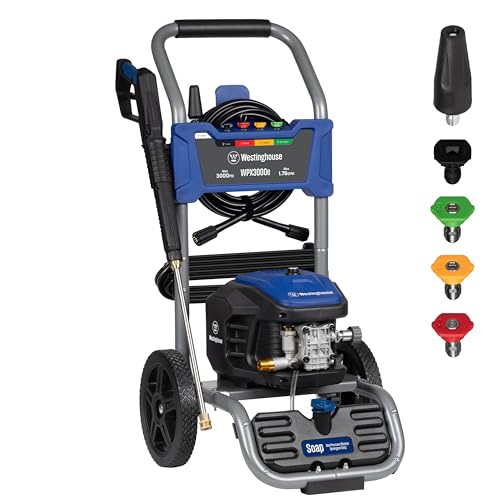
Westinghouse WPX3000e induction-motor electric pressure washer
3000 max PSI2600 rated PSI1.1 rated GPMInduction motor
Check price on Amazon
Best for: Owners who want clearly stated working output with a quiet induction motor.

The WPX3000e spells out what it does under load: 2600 PSI at 1.1 GPM, about 2,860 cleaning units, with a 3000 PSI and 1.76 GPM peak at different settings. For siding, that rated flow of 1.1 GPM is the number to notice, because it means a wall takes longer to rinse than with the Greenworks.

The heavy-duty induction motor and axial three-piston auto-stop pump are built to be low maintenance, and the induction design tends to run quietly. A 25-foot abrasion-resistant hose with a metal gun and a wand with five quick-connect nozzles come in the box. Against the ePX3500 it gives more rated pressure, at the same sort of flow.

The practical advice for house washing is to use the soap nozzle at low pressure for the detergent pass, let it dwell for several minutes but not dry, and rinse from the top down with a wide tip. Keep the lance low and angled down so water cannot get behind laps. Drain the pump after use. Work with the wind at your back so overspray does not blow onto freshly rinsed siding, and cover nearby plants with a tarp before you start, since detergent runoff can burn tender foliage.

What works

  • Clear rated output of 2600 PSI at 1.1 GPM
  • Induction motor runs quiet
  • 25-foot hose and five quick-connect tips
  • Auto-stop pump saves wear

Watch out for

  • 1.1 GPM rated flow is slower on large walls
  • Peak figures of 3000 PSI and 1.76 GPM apply at different settings

Spec sheet

Max pressure
3000 PSI
Rated output
2600 PSI at 1.1 GPM
Max flow
1.76 GPM at lowest pressure
Motor
120V heavy-duty induction
Hose
25-ft super-flex
03
Westinghouse ePX3500 compact electric pressure washer
2000 rated PSI1.2 rated GPM19 lb20 oz soap tank
Check price on Amazon
Best for: Single-storey vinyl or painted siding where a light rolling machine and onboard soap are enough.

A sensible machine for siding because 2000 PSI at 1.2 GPM is a rated output that needs no throttling for vinyl, and the onboard 20-ounce soap tank means you can apply cleaner at low pressure without extra equipment. It stands 16.5 inches tall, weighs about 19 pounds and has four quick-lock wheels with anti-tipping design, so it follows you around the house.

The braided nylon hose coils easily and resists kinking, a small point that matters when you drag it along a long wall. Compared with the ePX3100 below, this model offers a higher rated pressure, though the flow is almost the same. Against the WPX3000e it is lighter and easier to store, at the price of 600 PSI of rated output.

To care for it, store the hose coiled loosely, drain the pump, and check the quick-connect o-rings. Run detergent only through the soap nozzle setting, flush the tank after use and never leave chemicals sitting in it.

What works

  • 2000 rated PSI suits vinyl without throttling
  • Onboard 20 oz soap tank
  • Light at about 19 lb with wheels
  • Braided hose resists kinks

Watch out for

  • Rated flow of 1.2 GPM means slow rinsing on large walls
  • Small soap tank needs refills on a big house

Spec sheet

Max pressure
2500 PSI
Rated output
2000 PSI at 1.2 GPM
Weight
About 19 lb
Soap tank
20 oz onboard
Hose
25-ft braided nylon
04
Westinghouse ePX3100 compact electric pressure washer
1900 rated PSI1.24 rated GPM19 lbAnti-tipping
Check price on Amazon
Best for: Typical single-storey houses where a soap pass and a gentle rinse is the whole job.

The ePX3100 is the older, plainer sibling of the ePX3500, rated at 1900 PSI and 1.24 GPM, about 2,356 cleaning units. That is a hair higher flow than the ePX3500 and a little less pressure, which is arguably the better balance for rinsing siding.

It shares the 16.5-inch height, 19-pound weight and anti-tipping layout, so it is just as easy to move around a house. At this level it is best for a typical single-storey home where the job is a soap pass and a rinse, not a deep clean on stubborn stains. Compared with the Greenworks 2000, the Westinghouse spells out rated figures, which makes comparison straightforward.

Keep the lance angled down, rinse top to bottom, and use the wide tips. The on-board hose reel is the piece that earns its keep here, since a coiled hose kinks far less on a two-storey wall than a loose one dragged around the house. Before you begin, close windows and doors, check that window screens and weep holes are intact, and tape over any exterior outlets or light fixtures, since a stream can force water into places a garden hose never reaches.

What works

  • Rated 1.24 GPM is a touch higher than the ePX3500
  • Compact, light and anti-tipping
  • Clearly stated rated output
  • Good balance of pressure and flow for siding

Watch out for

  • Lower rated pressure than the ePX3500 and WPX3000e
  • Not suited to stubborn stains on brick or concrete

Spec sheet

Max pressure
2300 PSI
Rated output
1900 PSI at 1.24 GPM
Weight
About 19 lb
Height
16.5 inch
Design
Anti-tipping, quick-lock wheels
05
Westinghouse ePX3050 electric washer with foam cannon, 35-ft cord
1800 rated PSI26-inch profileFoam cannon35-ft GFCI cord
Check price on Amazon
Best for: Houses where one outlet must reach the whole wall and a foam cannon helps cleaner dwell.

A long 35-foot GFCI cord is the practical advantage here, because a house wash often means moving around a whole building with a single outlet nearby. The low 26-inch cart on 5-inch never-flat wheels follows you around without tipping on uneven ground, and a foam cannon is included for applying cleaner.

Rated at 1800 PSI and 1.2 GPM, it is the gentlest of the Westinghouse set, which suits vinyl and painted wood siding well. The foam cannon coats a wall with clinging cleaner, which gives a long dwell time, though it dilutes through the cannon rather than the downstream injector. Against the ePX3500, you trade a built-in tank for a cannon and a longer cord.

Flush the cannon with clean water after each use so soap does not dry in the orifice, drain the pump and coil the cord loosely. Check the wheels for grit and keep the machine upright when you store it.

What works

  • 35-foot GFCI cord gives reach
  • Foam cannon for clinging cleaner
  • Low 26-inch cart on never-flat wheels
  • 1800 rated PSI is gentle on vinyl

Watch out for

  • Lowest rated pressure of the Westinghouse set
  • Cannon dilutes cleaner differently than a downstream injector

Spec sheet

Max pressure
2100 PSI
Rated output
1800 PSI at 1.2 GPM
Profile
26 inch low cart
Wheels
5-inch never-flat
Cord
35-ft GFCI
06
Greenworks 2000 PSI electric pressure washer, PWMA rated
2000 PSI1.2 GPMPWMA ratedMedium duty
Check price on Amazon
Best for: Small houses and mixed light cleaning where a standards-rated, no-frills machine is enough.

Greenworks says this unit was rated in accordance with PWMA standards, the industry body's test method, which at least ties the 2000 PSI and 1.2 GPM figures to a common procedure. That works out to about 2,400 cleaning units, in line with the Westinghouse ePX3500.

The maker positions it for medium-duty projects such as patio furniture, grills, walkways and vehicles, and that is a fair description of what it will do on siding too: a soap pass and a gentle rinse on a modest house. Compared with the Greenworks 3000, it is far less powerful and has no brushless motor, but it also costs less and is far easier to control around trim and windows. Against the Westinghouse machines it is plainer, with fewer accessories documented.

Upkeep is minimal, as there is no engine to maintain. With no engine and a short lance, the only routine task is keeping the quick-connect collar clean so tips seat fully under load. Keep a spare pair of quick-connect o-rings in the toolbox, and never leave the machine outdoors over winter.

What works

  • Rated to PWMA standards for a common test method
  • 2000 PSI at 1.2 GPM suits siding without throttling
  • Easy to control around trim and windows
  • No engine or fuel to maintain

Watch out for

  • Plain accessory set compared with the Westinghouse models
  • Modest flow means slow rinsing on large walls

Spec sheet

Pressure
2000 PSI
Flow
1.2 GPM
Standard
Rated to PWMA standards
Class
Medium-duty residential
Power
Corded electric

Spec sheet decoder

What the numbers on the box really mean

The specs manufacturers lead with, translated into what they tell you about real-world performance.

Rated PSI and GPM

The working output under load, as opposed to peak numbers that apply at different settings.

Watch forWPX3000e rated 2600 PSI at 1.1 GPM, ePX3100 rated 1900 at 1.24.

Downstream injector

A fitting that draws detergent into the stream after the pump, at low pressure, to avoid pump damage.

Watch forCommon on consumer machines with a soap nozzle.

Foam cannon

A bottle that mixes soap, water and air into clinging foam for vertical surfaces.

Watch forThe ePX3050 includes one.

Nozzle degree

Spray fan width. 0 is a pencil jet, 15 to 25 degrees for hard surfaces, 40 degrees and wider for rinsing.

Watch forUse 25 to 40 degrees on siding.

Induction motor

A motor type that runs quieter and cooler than universal motors.

Watch forThe WPX3000e uses one.

Methodology

How We Evaluated These Pressure Washers for Houses and Siding

Flow for rinsing

We compared rated and claimed flow from 1.1 to 2.0 GPM, since rinsing speed decides how long a wall takes. Higher flow scored better where the figure was credible. We relied on specifications, not bench time.

Pressure control

We looked at rated pressure from 1800 to 3000 PSI and whether a machine can be throttled for siding. Clearly rated machines scored higher. Excess headroom on the Greenworks 3000 is useful because it can be backed off.

Detergent delivery

We compared the 20 oz onboard tank, the foam cannon and injector soap nozzles. Cleaner applied at low pressure with long dwell is the heart of house washing.

Reach and handling

We compared hose and cord lengths and cart designs from 19 pounds upward. A 35-foot cord or a stable low cart scored higher for large houses.

Ownership burden

We reviewed upkeep: pump type, winterizing and fitting care. All are low-maintenance electrics, with differences in serviceability.

Decision guide

How to Choose the Right Pressure Washers for Houses and Siding

By House

SituationPickWhy
Large house, fast rinsingGreenworks 3000 PSIUp to 2.0 GPM
Quiet, clearly ratedWestinghouse WPX3000e2600 rated PSI at 1.1 GPM
Single storey, built-in soapWestinghouse ePX350020 oz tank
Typical house, simpleWestinghouse ePX31001900 rated PSI at 1.24 GPM
One outlet, long wallsWestinghouse ePX305035-ft GFCI cord

By Budget

TierPickWhy
Lowest outlayWestinghouse ePX3100Plain compact electric
Low to midWestinghouse ePX3050Adds cannon and cord
Mid tierWestinghouse ePX3500Higher rated PSI and tank
Upper tierWestinghouse WPX3000eInduction motor, 2600 rated PSI
Highest outlayGreenworks 3000 PSIBrushless, lab verified, more flow

Cannon vs Soap Tank

Foam cannon

The ePX3050 coats a wall in clinging foam that dwells longer on vertical siding. It needs the cannon filled and rinsed each time.

Onboard soap tank

The ePX3500 draws cleaner through a downstream injector at low pressure, with less fuss and thinner coverage. It suits quick passes.

Take a cannon for mildew-prone siding, and an onboard tank for light seasonal washing.

By Siding Material

MaterialPickWhy
VinylWestinghouse ePX30501800 rated PSI is gentle
Painted woodWestinghouse ePX3100Moderate pressure and flow
Stucco or brickWestinghouse WPX3000eHigher rated pressure
Mixed surfaces, large houseGreenworks 3000 PSIThrottle back with tips

For Mildew and Algae Specifically

Look for

A reliable way to apply cleaner at low pressure and a machine with enough flow to rinse. Let the cleaner dwell without drying.

In this comparison

The ePX3050 with its foam cannon and the ePX3500 with its tank are set up for soap, and the Greenworks 3000 rinses fastest.

When to Spend More

Spend more if

The house is large or tall and you value a fast rinse. The Greenworks 3000 saves time.

Save if

The house is a single storey in decent condition. The ePX3100 is enough.

Ownership

Maintenance schedule

The upkeep that decides whether this machine lasts two seasons or ten.

TaskIntervalWhy it matters
Drain the pumpAfter each session and before freezingTrapped water can freeze and crack an axial pump.
Flush soap from the cannon or tankAfter each washDried detergent clogs orifices and weakens foam.
Check o-rings and fittingsEach seasonWeeping connectors waste pressure. Replace worn seals.
Never run the pump dryEvery useDry running overheats the pump quickly. Purge air before pulling the trigger.
Inspect the cord and GFCIBefore each useLong cords near water must be undamaged. Test the GFCI.

FAQ

Frequently Asked Questions

Is a pressure washer safe for vinyl siding?

Yes with a wide 25 or 40 degree tip, downward angle and moderate pressure. Never spray upward under laps, which drives water behind the panels.

How much PSI do I need for a house?

Moderate pressure is enough: about 1800 to 2600 rated PSI. Flow matters more for rinsing speed.

Do I need detergent?

Usually yes. Mildew and algae are removed mainly by cleaner dwelling on the surface, then rinsed with a gentle stream.

Can I clean a second storey from the ground?

A long lance can reach a bit, but spraying upward risks water behind laps. For tall walls use an extension pole made for pressure washers or a soft-wash approach.

Which tip is best for siding?

The 25 or 40 degree tip, with the soap nozzle for detergent. Avoid the 0 degree tip.

Will pressure washing damage paint or caulk?

It can on old or failing finishes. Test a hidden area first and keep a good distance.

Bottom line

The short version

Browse more pressure washers for houses and sidingon Amazon →
James Miller, Lead Machine Editor

About the author

James Miller

Lead Machine Editor, MachineFanatic

James Miller leads MachineFanatic's buying guides, turning spec sheets, manuals and owner feedback into clear verdicts on power tools, outdoor power equipment, shop machines and kitchen machines.

More from James →

Keep reading

Related guides