
Amazon affiliate links - we earn a commission.Affiliate disclosure

Buying guide · 12 min read · Updated 2026-11-07

Best Professional Leaf Blowers (2026)

Six backpack-class leaf blowers for crews and serious owners, compared on engine size, sustained airflow, harness comfort and serviceability.

James MillerBy James MillerLead Machine Editor6 machines comparedSpec-sheet verified
Best Professional Leaf Blowers

At a glance

Our top picks

Side by side

Spec comparison

A professional leaf blower is judged by what happens on the fortieth hour of the month, not the first five minutes. Sustained airflow, a harness that spreads weight across a long shift, easy starting and parts you can actually buy matter more than a headline number.

That is why backpack gas machines dominate crews. A tank refuels in a minute, an engine holds output all day and a dealer can swap a part in an afternoon. Cordless has caught up for light work, but the demanding jobs still favour a motor and fuel.

Before you buy

6 Criteria to Look For Before Buying a Professional Leaf Blower

  1. 01

    Sustained airflow, not peak

    A crew machine runs for hours, so a large engine matters. The 580BTS's 75.6cc and the ECHO's 79.9cc hold output all day, while the Greenworks 80V's pack runs down. Look at displacement before the CFM figure.

  2. 02

    Harness engineering

    A harness is the difference between finishing a shift and quitting early. The 580BTS has a ventilated, load-reducing design with a padded hip belt, and the HTK offers a fully padded harness. Try on any machine you can before buying, loaded with fuel, and adjust the sternum strap and hip belt so the engine rides on your pelvis and not your collarbones. A harness that fits well makes a heavy machine feel lighter than a lighter machine that fits badly.

  3. 03

    Serviceability and dealers

    A crew cannot afford a week of downtime. Husqvarna and ECHO have large dealer networks that stock parts. A value import like the VEVOR may save money up front and cost it back in waiting.

  4. 04

    Starting aids

    Cold starts waste time. The HTK's air-purge system clears the carburetor and fuel lines for easier starting. A reliable starter matters more over a season than a few extra CFM, because a crew that loses ten minutes a day to hard starts loses more than a day a month.

  5. 05

    Control on the tube

    A tube-mounted throttle, like the ECHO's, lets you adjust output without moving your hand. Over a day, that saves effort and improves precision. Check cruise control too.

  6. 06

    Noise and site rules

    Gas blowers are loud, and some sites restrict them. The Greenworks 80V is quieter by about 40 percent per the maker, but its runtime is limited. Know the site rules before you commit to one fleet, and ask clients about quiet hours, since a blower that cannot be used before eight in the morning changes how you schedule routes.

Detailed reviews

The 6 best professional leaf blowers, explained

01
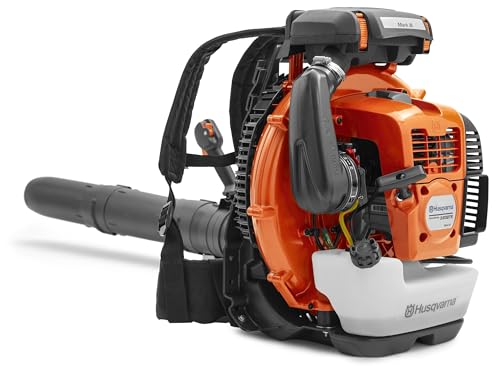
Husqvarna 580BTS backpack blower, 75.6cc 4.59HP, 1000 CFM, 220 MPH
1000 CFM220 MPH75.6cc X-Torq4.59HP claim
Check price on Amazon
Best for: Crews and serious owners who work long days on large lots.

The 580BTS is the machine a landscape crew chooses when the goal is to finish the lot on one tank. A 75.6cc X-Torq engine pushes 1000 CFM at 220 MPH, and a ventilated, load-reducing harness with a padded hip belt spreads the weight evenly across a long day. The 47 newton blowing force claim is the maker's way of saying it pushes harder than airflow numbers alone suggest.

Compared with the ECHO PB-9010T at 1110 CFM, it moves slightly less air but in a package engineered around support: the dealer network that stocks plugs, filters and carburetor parts. Against the 360BT, it adds roughly 110 CFM and a larger engine, but also more weight and fuel burn.

Make the maintenance routine non-negotiable. Clean the air filter daily in dusty work, replace the spark plug on schedule and mix premix to the maker's ratio. Check the harness stitching, the anti-vibration mounts and the throttle trigger monthly, because those are the parts that fail under all-day use. A crew that runs two of these machines on alternating days will notice that the second unit always starts easier, simply because it has been rested and re-checked; treat spare capacity as part of the cost of the first machine, not a luxury. Keep a laminated service card on the tool box so every operator knows the fuel ratio.

What works

  • 1000 CFM with a 75.6cc engine
  • Ventilated harness with a padded hip belt
  • Large dealer and parts network
  • Commercial engineering for all-day use

Watch out for

  • Heavy and expensive
  • Premix fuel and strict maintenance
  • Loud, needs hearing protection

Spec sheet

Airflow
1000 CFM
Air speed
220 MPH
Engine
75.6cc X-Torq 2-cycle
Blow force
47 N claim
Harness
Ventilated, padded hip belt
02
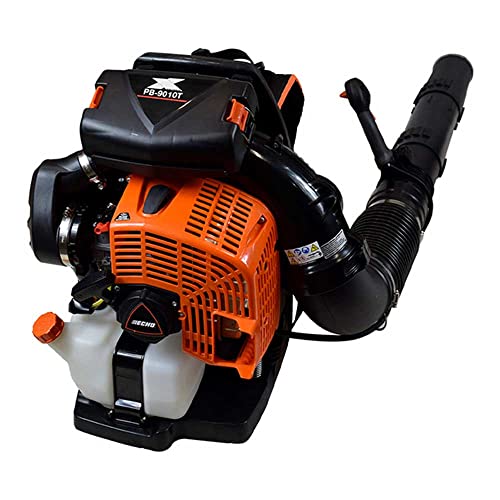
ECHO PB-9010T backpack blower, 79.9cc, 1110 CFM, 220 MPH
1110 CFM220 MPH79.9cc 2-strokeTube throttle
Check price on Amazon
Best for: Large commercial lots and anyone who wants the maximum volume.

ECHO's X Series PB-9010T is built around the largest engine of the group, 79.9cc, and the highest quoted airflow, 1110 CFM. The tube-mounted throttle is a professional detail: it puts the speed control where your hand already is, so you can feather output without taking a hand off the nozzle. For crews on commercial parking lots and big lawns, that control is the point.

It costs more in fuel and weight than the Husqvarna 360BT, and its extra airflow only pays when the lot is large enough to need it. On a half-acre, the 360BT will finish the job at lower strain. On several acres, the extra volume saves minutes per pass.

Ownership is classic two-stroke. Use fresh premix, keep the air filter spotless and carry a spare plug. Check the throttle cable and the harness each month, and drain the tank before long storage. Because the engine is large, it rewards a proper warm-up of a minute or so before you open the throttle fully, which reduces wear on the piston and rings across a season. Never run a hot engine dry of fuel, and top up only when the machine has cooled.

What works

  • 1110 CFM is the highest here
  • Tube throttle for hand-held control
  • Large 79.9cc engine holds output
  • Established ECHO dealer support

Watch out for

  • Heavier and thirstier than mid-size units
  • Overkill for small lots
  • Loud and needs premix

Spec sheet

Airflow
1110 CFM
Air speed
220 MPH
Engine
79.9cc 2-stroke
Throttle
Tube-mounted
Line
ECHO X Series
03
Husqvarna 360BT backpack blower, 65.6cc, 890 CFM, 232 MPH
890 CFM232 MPH65.6cc X-Torq30 N claim
Check price on Amazon
Best for: Residential crews running lawns all day.

The 360BT is the pro's workhorse for mid-size jobs. Its 65.6cc engine produces 890 CFM at the fastest tip speed of the gas group, 232 MPH, and it is lighter than the 580BTS. That makes it the usual choice for crews running a mixed day of residential lawns, where a heavy machine would tire the operator faster than it saved time.

The 30 newton force claim sits below the 580BTS's 47, which is the honest tradeoff: the 360BT moves less mass of air. It is the machine to buy if you value stamina over raw capacity. Against the HTK at 665 CFM, it moves roughly 34 percent more air.

Keep a maintenance log. Clean the filter, check the plug and track hours, because a crew machine runs through a season's worth of use in a month. Rotate with a spare if you can, so a failure does not stop the day. Operators often underestimate how much the fan housing collects in damp, dusty work, so knock the debris out of the intake at every fuel stop. A quick wipe of the cooling fins prevents the overheating that shortens the life of a hard-worked two-stroke.

What works

  • 232 MPH is the highest gas tip speed here
  • Lighter than the 580BTS
  • 890 CFM covers most residential lots
  • Strong dealer and parts support

Watch out for

  • Lower force than the 580BTS
  • Premix and strict upkeep
  • Not the largest volume

Spec sheet

Airflow
890 CFM
Air speed
232 MPH
Engine
65.6cc X-Torq 2-cycle
Blow force
30 N claim
Power claim
3.81HP
04
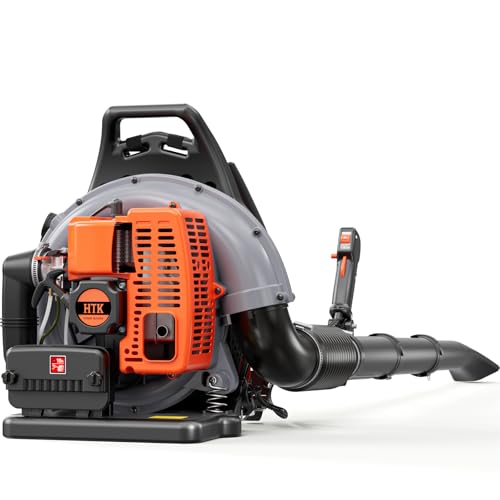
HTK 63cc gas backpack blower, 665 CFM, 205 MPH, air purge
665 CFM205 MPH63cc 2-strokeAir purge
Check price on Amazon
Best for: Small crews and serious owners who want gas power at a lower tier.

HTK is the value gas option with a 63cc engine, 665 CFM and up to 205 MPH. An air-purge system clears the carburetor and fuel lines to simplify starting, and oversized controls make it easy to operate in gloves. A fully padded harness spreads the load.

It is a commercial-grade claim from a newer brand, so check the warranty and parts support closely. Against the 360BT, it moves less air and has less pedigree. For a small crew or a serious homeowner it is a capable machine, but for a business that cannot afford downtime, it is a riskier choice.

Buy a service kit with it, change the plug each season and use fresh premix. Check bolts after the first few hours, and clean the air filter after every dusty job. If the air-purge bulb cracks it will make starting harder, so replace it at the first sign of hardening, which is cheap compared with a lost morning. Keep the tank cap vent clear so the engine does not starve of fuel under load.

What works

  • 63cc engine with 665 CFM
  • Air purge simplifies starting
  • Oversized controls work with gloves
  • Padded harness

Watch out for

  • Less airflow than the Husqvarna and ECHO
  • Thinner support network
  • Newer brand

Spec sheet

Airflow
665 CFM
Air speed
Up to 205 MPH
Engine
63cc 2-stroke
Starting
Air-purge system
Harness
Fully padded
05
VEVOR backpack gas blower, 1110 CFM, 220 MPH, earmuffs included
1110 CFM220 MPHPull startEar muffs kit
Check price on Amazon
Best for: Small crews who need big airflow at a low tier.

VEVOR claims the same 1110 CFM and 220 MPH as the ECHO PB-9010T at a much lower tier, and includes earmuffs and a corrugated tube in the box. A shock-absorption system and ergonomic straps are described, and it starts with a manual pull and is said to run smoothly with minimal maintenance.

What the number cannot tell you is the build behind it. A commercial machine's value is in the engine casting, the carburetor quality and the dealer behind it, and a value-priced import carries more risk on each. If the claimed figures hold up, it is a bargain for a small crew.

Treat it as a working tool with a shorter service life. Keep spares of the plug, filter and fuel line, and plan a tune-up before each season. Check the harness stitching and the tube clamps early. If the numbers on the box prove optimistic, the machine will still do real work, but budget for a heavier hand on maintenance and keep a record of any warranty correspondence so a claim is not a guessing game.

What works

  • 1110 CFM and 220 MPH claimed at a low tier
  • Earmuffs and tube included
  • Shock-absorbing straps
  • Simple pull start

Watch out for

  • Build quality is unproven
  • Thin service network
  • Claims need real-world confirmation

Spec sheet

Airflow
1110 CFM
Air speed
220 MPH
Starting
Manual pull start
Harness
Shock-absorbing straps
Kit
Earmuffs, corrugated tube, manual
06
Greenworks 80V brushless blower, 700 CFM, 170 MPH turbo, 2.5Ah
700 CFM170 MPH turbo80V2.5Ah
Check price on Amazon
Best for: Noise-restricted sites where fumes and sound matter.

Greenworks 80V is the cordless answer for noise-sensitive jobs: the maker says it is about 40 percent quieter than gas and has no fumes or pull cord. A brushless motor and 700 CFM make it a serious tool, and the maker compares it to a 27cc gas blower, which is a small-engine class far below the machines above.

For professional use the 2.5Ah pack is the limit. A working day needs several packs and a charging station, which costs money and organisation. It is best used by crews on schools, hospitals and residential estates where noise rules matter.

Treat batteries as a managed fleet: label them, rotate them and keep them out of the truck cab in summer heat. A cordless professional tool is only as good as its charging routine. On a job with several sites in a day, a small generator or a vehicle inverter at the truck can top up packs between stops, which keeps one set of batteries working all shift.

What works

  • About 40 percent quieter than gas by maker claim
  • No fumes or pull cord
  • 700 CFM with brushless 80V motor
  • Fits an 80V tool platform

Watch out for

  • 2.5Ah pack runs down fast under load
  • Needs several packs for a full shift
  • Far below the gas machines in sustained airflow

Spec sheet

Airflow
700 CFM
Turbo speed
170 MPH
Platform
80V brushless
Battery
2.5Ah with charger
Noise claim
About 40 percent quieter than gas

Spec sheet decoder

What the numbers on the box really mean

The specs manufacturers lead with, translated into what they tell you about real-world performance.

Displacement (cc)

Engine size, the best guide to real power. Bigger engines move more air and burn more fuel.

Watch forECHO 79.9cc, Husqvarna 580BTS 75.6cc, 360BT 65.6cc, HTK 63cc.

Blow force (N)

The force of the air stream in newtons, a better measure of push than CFM alone.

Watch for580BTS claims 47 N and 360BT 30 N.

CFM and MPH

Volume and speed. Both are manufacturer bench figures.

Watch forVEVOR and ECHO both claim 1110 CFM at 220 MPH.

Horsepower claim

Gross horsepower is a marketing figure on small engines. It is not directly comparable between brands.

Watch for580BTS 4.59HP and 360BT 3.81HP are the maker's own claims.

Air purge

A primer bulb that clears air from the carburetor so the engine starts faster.

Watch forHTK includes an air-purge system.

Methodology

How We Evaluated These Professional Leaf Blowers

Sustained output

We evaluated engine displacement and airflow, from the 79.9cc ECHO to the 63cc HTK. Cordless was treated as a light-duty option. Machines that hold output all day scored highest.

Harness and carry

Based on the spec sheet, we compared harness design, from the 580BTS ventilated hip belt to padded designs on lower-tier machines.

Serviceability

We weighed dealer networks and parts availability. Husqvarna and ECHO scored highest, value imports lower.

Starting and control

We looked at air-purge systems, tube throttles and oversized controls, all of which reduce friction in daily use.

Cost of ownership

We compared relative tiers, fuel use and the likelihood of downtime. A lower price that causes downtime is not a saving.

Decision guide

How to Choose the Right Professional Leaf Blowers

By Workload

SituationPickWhy
Full-time crew, large lotsHusqvarna 580BTS1000 CFM and ventilated harness
Commercial parking lotsECHO PB-9010T1110 CFM and tube throttle
Residential crew lawnsHusqvarna 360BT890 CFM and lighter weight
Small crew, mixed workHTK 63cc665 CFM with air purge
Noise-restricted sitesGreenworks 80VQuieter cordless

By Budget

SituationPickWhy
Lowest cost gasVEVOR 1110 CFMBig airflow claim with a kit
Low cost gas with starting aidHTK 63ccAir purge and padded harness
Mid cordlessGreenworks 80VBrushless and quiet
Higher gas, provenHusqvarna 360BTDealer support
Top tierHusqvarna 580BTSCommercial grade

Large Engine vs Mid Engine

Large engine

The 580BTS and PB-9010T move 1000 to 1110 CFM and suit large lots. They weigh more and burn more fuel. They reward heavy daily use.

Mid engine

The 360BT and HTK move 665 to 890 CFM and are lighter. They are easier on the operator over a day. They suit residential lawns.

Choose a large engine for big lots and commercial sites; choose mid for residential routes.

Support Axis

PreferencePickWhy
Best dealer networkHusqvarna 580BTSWide service coverage
Strong ECHO networkECHO PB-9010TEstablished X Series
Lowest cost, thin supportVEVOR 1110 CFMValue import
Battery fleetGreenworks 80V80V platform

For Daily Crew Use Specifically

Look for

A large engine, a ventilated harness, a tube throttle and a dealer within an hour of your route. Keep a spare machine if downtime costs you money. Log hours and service on schedule.

In this comparison

The Husqvarna 580BTS and 360BT are the best for daily crew use. The ECHO PB-9010T is best for very large lots.

When to Spend More

Spend more if

The machine earns your income. The 580BTS or PB-9010T repays its cost in service access and uptime.

Save if

You are a serious owner with a big lot. The HTK or VEVOR offers commercial airflow at a lower tier.

Ownership

Maintenance schedule

The upkeep that decides whether this machine lasts two seasons or ten.

TaskIntervalWhy it matters
Clean the air filterDaily in dusty workA clogged filter richens the mix and lowers power. A clean filter extends engine life.
Check plug and fuelEach seasonFresh premix and a new plug prevent no-starts. Never leave mixed fuel for months.
Inspect the harnessMonthlyStitching and buckles wear under daily loads. A failed strap is a safety risk.
Check mounts and boltsMonthlyVibration loosens fasteners and cracks mounts. Re-torque and replace worn parts.
Log hours and serviceOngoingA log shows when parts are due and supports warranty claims.

FAQ

Frequently Asked Questions

What makes a blower professional grade?

A larger engine, a better harness, easier serviceability and a dealer network. Peak CFM is often similar to cheaper machines. Durability is the difference.

Gas or battery for professionals?

Gas still wins for sustained output and all-day use. Battery blowers like the Greenworks 80V suit light-duty or noise-restricted sites. Packs and charging are the constraint.

How much should a professional spend?

The VEVOR and HTK sit at lower tiers, the Husqvarna 360BT in the middle and the 580BTS and ECHO higher. Spend where downtime costs money.

How long do professional blowers last?

With regular service, many seasons. Clean filters, fresh fuel and bolt checks matter most. Neglect shortens life quickly, and a machine that is never cleaned or checked will often fail at the worst moment.

Is a bigger engine always better?

No. A larger engine moves more air but weighs and burns more. Match it to lot size and operator fatigue, and remember that the bigger engine you do not need is a cost you pay in fuel and strain every single day.

Do I need hearing protection?

Yes. Gas blowers are loud. Wear ear and eye protection every time, along with sturdy boots and long trousers, since a blower throws gravel and twigs at speed.

Bottom line

The short version

Browse more professional leaf blowerson Amazon →
James Miller, Lead Machine Editor

About the author

James Miller

Lead Machine Editor, MachineFanatic

James Miller leads MachineFanatic's buying guides, turning spec sheets, manuals and owner feedback into clear verdicts on power tools, outdoor power equipment, shop machines and kitchen machines.

More from James →

Keep reading

Related guides