
Amazon affiliate links - we earn a commission.Affiliate disclosure

Buying guide · 13 min read · Updated 2026-11-13

Best Quiet RV Inverters (2026)

Four pure sine RV inverters judged for quiet running: low idle draw, power save modes, fan behavior and where to mount them, with no invented decibel figures.

James MillerBy James MillerLead Machine Editor4 machines comparedSpec-sheet verified
Best Quiet RV Inverters

At a glance

Our top picks

Side by side

Spec comparison

Noise from an RV inverter comes from two sources: a cooling fan that spins up under load, and a transformer that can hum or buzz. Neither is usually measured on a listing, so a quiet unit is found by reading what it does with its fan and how little heat it makes in the first place.

The quietest inverter is the one that wastes the least. High efficiency, a low idle draw, a power save mode and a mounting spot away from the bed all matter more than any claim of silence, because heat is what makes a fan run.

Before you buy

6 Criteria to Look For Before Buying a Quiet RV Inverter

  1. 01

    Waste heat decides fan noise

    A fan runs because the inverter makes heat, and heat equals watts lost. A 92 percent efficient 2000W inverter loses about 160W, and a 90 percent one loses about 200W. The Renogy PUH 2000W states above 92 percent, the ALLWEI 1000W claims ultra-low no-load loss, and the 600W unit simply has less to lose. Quiet starts with efficiency. A unit that makes less heat gets by with a slower fan, and a slower fan is the difference between background hum and a noise you notice at three in the morning. Every watt of waste heat is a watt the fan has to remove.

  2. 02

    Size to the real load

    An oversized inverter spends its time lightly loaded, which is fine for noise but costs idle draw. A laptop, a CPAP and a fan total about 150W, which the 600W unit handles. A microwave near 1000W needs the ALLWEI 1000W or larger. Do not buy 2500W for a 300W night. Oversizing is not a noise problem so much as an idle draw problem, and idle draw makes heat. In practice the two problems feed each other, because a hot box runs its fan more and wastes more battery.

  3. 03

    Power save and idle draw

    A power save mode, as on the AIMS 2500W, lowers idle draw when nothing is connected. The ALLWEI 1000W claims ultra-low no-load loss. Lower idle means less heat and a still fan overnight. Check the manual for the exact idle figure, because listings rarely state it. A unit that publishes it is easier to trust.

  4. 04

    Transformer type

    Low-frequency inverters, like the AIMS 2500W, use a heavy transformer and tolerate long surges. They can hum, so a solid mount matters. High-frequency units like the Renogy PUH are light and efficient but rely on fans. Neither is silent, so mounting location decides the experience. A sealed cabinet next to the bed will always sound worse than an open bay.

  5. 05

    Remote switching

    The simplest way to a quiet night is to turn the inverter off. The Renogy PUH has a wired remote and Bluetooth, so you can switch it from bed. A unit with only a front-panel switch requires a trip to the bay, which most people skip. A remote removes the excuse.

  6. 06

    Mounting and vibration

    A thin cabinet wall acts as a drum for fan noise and transformer hum. Even a modest unit sounds loud when it is bolted to a hollow panel next to a mattress. Mount the inverter on a solid surface with rubber isolation, away from the bedroom wall, and leave a few inches of air around it. A good mount reduces perceived noise more than any spec. Rubber isolators cost very little compared with the inverter.

Detailed reviews

The 4 best quiet rv inverters, explained

01
Renogy PUH 2000W pure sine inverter, transfer switch, Bluetooth
2000W continuousPure sine waveAbove 92% efficiencyBluetooth control
Check price on Amazon
Best for: Owners who want an efficient, switchable inverter they can control from bed.

Efficiency is the quiet inverter's best friend , and the Renogy PUH 2000W states it above 92 percent. At 2000W, every percentage point lost is about 20W of heat the cooling system must remove, so a more efficient unit simply has less to cool. Fewer watts of heat means a fan that spins slower or less often.

The unit includes an automatic transfer switch that swaps between shore power and the battery, plus built-in Bluetooth and a wired remote switch. For a quiet coach, the remote matters because you can switch the inverter off at bedtime from the bed instead of making a trip to the bay. The listing mentions a figure for power consumption that reads as garbled, so check the manual for the exact idle draw.

It sits near the top of the price tiers, which is the cost of efficiency and monitoring. A full 2000W load draws about 190A from a 12V bank, so cable and fuse requirements apply. Mount it in a ventilated bay away from the bedroom wall , and put a gap behind it so the fan is not muffled into a drone. It does not publish a decibel figure, so treat its quiet as a design reasoning and not a measured fact. Owners who sleep within a few feet of the bay should plan the mount before they plan the purchase.

What works

  • Efficiency stated above 92 percent reduces heat and fan work
  • Wired remote and Bluetooth control from inside the coach
  • Built-in transfer switch prevents back-feeding
  • Pure sine output at 2000W continuous

Watch out for

  • Near the top of the price tiers
  • No decibel rating is published
  • Full load draws about 190A at 12V

Spec sheet

Continuous output
2000W
Waveform
Pure sine
Efficiency
Above 92 percent
Transfer switch
Built-in UPS-style
Control
Bluetooth app and wired remote
02
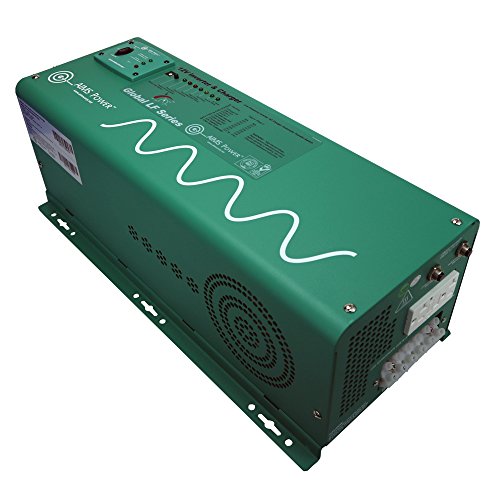
AIMS 2500W pure sine inverter charger, 7500W surge, transfer switch
2500W continuous7500W for 20 secondsLow frequencyPower save mode
Check price on Amazon
Best for: Owners who want a heavy-duty inverter charger with a long surge and a power save mode.

A low-frequency design is the quiet inverter's heavy option. The AIMS uses a large transformer, which is why such units weigh more, and its 7500W surge for 20 seconds is a far longer startup allowance than the one or two seconds on most high-frequency boxes. That long surge helps with compressor starts that other units struggle to survive.

The listing adds a charge current control dial, an AC direct connect terminal block, auto generator start, conformal-coated circuit boards and a power save mode. The coating protects against humidity, and a power save mode lowers idle draw, a real help for a quiet night. Protections cover overload, over temperature, high and low voltage and short circuits, and it is internally fused.

The tradeoff is weight and price: it sits at the upper-middle tier and needs a sturdy mount. Transformers can hum, so mount it on a solid surface away from the sleeping area. A 2500W load draws about 235A at 12V. The inverter charger design also replaces a separate converter, which saves a box. For a heavy-duty, long-lived coach install, it is the old-school answer.

What works

  • 7500W surge for 20 seconds covers compressor starts
  • Power save mode lowers idle draw
  • Inverter, charger and transfer switch in one box
  • Conformal-coated boards resist humidity

Watch out for

  • Heavier than high-frequency units
  • Transformer hum is possible, so mounting matters
  • Upper-middle price tier

Spec sheet

Continuous output
2500W
Surge
7500W for 20 seconds
Design
Low-frequency transformer
Features
Charger, transfer switch, auto gen start
Mode
Power save
03
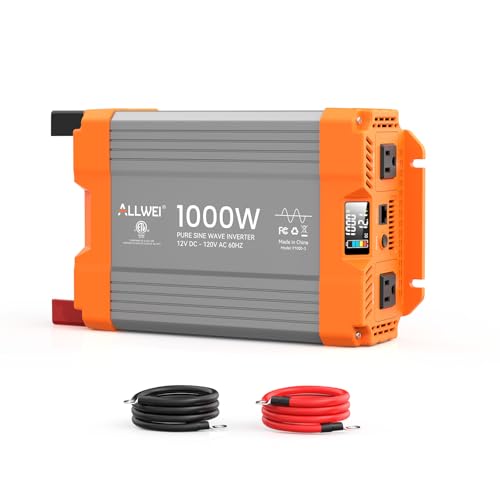
ALLWEI 1000W pure sine inverter, ETL listed to UL 458, low no-load loss
1000W continuous2000W peakETL UL 458 listedUltra-low no-load loss
Check price on Amazon
Best for: Owners who want a certified, low-idle pure sine inverter for plug-in loads.

A listing to the UL 458 standard is uncommon at this size, and it is the first reason to consider this ALLWEI. UL 458 covers power converters and inverters for vehicles, and an ETL listing means an independent lab checked the unit against it. That reassures you about the electrical safety of a box that will sit near your bed.

The second reason is the no-load claim: ultra-low no-load loss means the inverter wastes little while nothing is plugged in. For a quiet coach, low idle loss means little heat and a fan that stays still while you sleep. The listing gives no number, so verify it in the manual. Eight-fold protection covers voltage, overload, short circuit and temperature, and the output is utility-grade pure sine with 2000W of peak surge.

It sits at the lower-middle tier, which makes it the best value in this short guide. A full 1000W load draws about 90 to 100A from a 12V bank, a size most house batteries handle. It lacks a transfer switch, app or display, so it suits a simple installation with plug-in loads. Mount it with a gap for airflow and fuse it near the battery.

What works

  • ETL listed to UL 458
  • Ultra-low no-load loss is claimed
  • Pure sine output with 2000W peak
  • Lower-middle price tier

Watch out for

  • No transfer switch, app or display
  • No idle figure is given in the listing
  • No decibel rating is published

Spec sheet

Continuous output
1000W
Peak surge
2000W
Certification
ETL listed to UL 458
No-load loss
Described as ultra-low
Protections
Eight-fold
04
600W pure sine inverter, 2 AC, dual 3.4A USB, digital display
600W continuousPure sine wave2 AC outletsDigital display
Check price on Amazon
Best for: Quiet-sleeping coaches with small loads like a laptop and CPAP.

A smaller inverter is quieter because it has less to cool. This 600W unit produces about a third of the waste heat of a 2000W model at the same efficiency, so its fan has little to do at typical loads. It is a pure sine design with two AC outlets, two 3.4A USB ports and a display that shows DC input and AC output voltage.

The listing is inconsistent about peak power, so size by the 600W continuous number only. A full 600W load draws about 55A from a 12V source. That is a size that runs a laptop, a CPAP, a small TV and a fan, which are the loads of a quiet night.

It sits at the lower-middle tier. It has no transfer switch or remote, so it is a plug-in solution. For a coach where noise matters and the loads are small, choosing a smaller inverter is the surest way to a quieter night. Mount it with some clearance, and switch it off when you do not need it. A smaller box is also easier to place away from the sleeping area.

What works

  • Small size means little waste heat and fan work
  • Pure sine output at 600W continuous
  • Display shows input and output voltage
  • Draws only about 55A at full load

Watch out for

  • Peak rating is inconsistent in the listing
  • No transfer switch or remote
  • Cannot run a microwave

Spec sheet

Continuous output
600W
Waveform
Pure sine
AC outlets
2
USB
Dual 3.4A
Display
DC input and AC output voltage

Spec sheet decoder

What the numbers on the box really mean

The specs manufacturers lead with, translated into what they tell you about real-world performance.

Efficiency

The share of battery power that becomes AC. The rest becomes heat that the fan must remove.

Watch forThe Renogy PUH 2000W states above 92 percent.

No-load loss

The power the inverter burns with nothing connected. It sets the idle heat.

Watch forThe ALLWEI 1000W calls it ultra-low but gives no figure.

Low-frequency design

An inverter built around a large line-frequency transformer. It is heavy and tolerates long surges.

Watch forThe AIMS 2500W is low frequency.

Surge duration

How long the inverter can exceed its continuous rating. Longer helps compressor starts.

Watch forThe AIMS lists 7500W for 20 seconds.

UL 458

A safety standard for power converters and inverters used in vehicles.

Watch forThe ALLWEI 1000W is ETL listed to it.

Methodology

How We Evaluated These Quiet RV Inverters

Waste heat

We credited stated efficiency and idle-loss claims, since heat drives the fan. Efficiency is the one number that most listings do state, so it is the fairest place to compare. The Renogy PUH 2000W states above 92 percent, and the ALLWEI 1000W claims ultra-low no-load loss. No listing gives a measured decibel figure, so we did not invent one.

Idle behavior

We looked at power save modes and idle claims. Idle behavior matters because most of a night is spent at no load or a very light one. The AIMS has a power save mode and the ALLWEI claims low loss. Units without any statement scored lower. A silent listing often means a figure that does not flatter the unit.

Control from the bed

We credited remotes and apps that let you switch the unit off without leaving the bed. The more steps between you and the off switch, the less often you will use it. The Renogy PUH leads with Bluetooth and a wired remote.

Mechanical design

We compared transformer type and mounting needs. A heavy transformer needs a solid shelf, and a light electronic unit can sit almost anywhere. The AIMS is heavy and needs a solid mount. The high-frequency units are light and easier to place.

Ownership

We considered certification, protections and wiring needs. The ALLWEI's UL 458 listing and the AIMS's conformal coating stood out.

Decision guide

How to Choose the Right Quiet RV Inverters

By Sleeping Setup

SituationPickWhy
Bedroom wall next to the bay600W unitLeast heat, least fan
Switch off from bedRenogy PUH 2000WBluetooth and wired remote
Plug-in loads onlyALLWEI 1000WLow no-load loss
Heavy-duty with generatorAIMS 2500WCharger and auto gen start
Mixed loads with monitoringRenogy PUH 2000WApp readout

By Budget

SituationPickWhy
Lower-middle small600W unitPure sine with display
Lower-middle certifiedALLWEI 1000WUL 458 listed
Upper-middle heavy dutyAIMS 2500WInverter charger
Upper efficientRenogy PUH 2000WEfficiency and monitoring
Any tier, small loads600W unitDo not overbuy

Low-Frequency vs High-Frequency

Low frequency

The AIMS 2500W uses a heavy transformer with a 20 second surge and a long life. It can hum, weighs more and needs a solid mount.

High frequency

The Renogy PUH, ALLWEI and 600W units are lighter and more efficient. They rely on fans, which spin up under load.

Choose low frequency for heavy surges, high frequency for efficiency and weight.

Mounting Location

SituationPickWhy
Close to the bed600W unitSmall and cool
Basement bayRenogy PUH 2000WRemote switch
Solid floor mountAIMS 2500WHeavy transformer
Closet near the kitchenALLWEI 1000WPlug-in loads
Any spot with a gapRenogy PUH 2000WEfficient and light

For Sleeping Next to the Inverter Specifically

Look for

A small unit, a power save mode and a remote switch. Fan noise tracks heat, so a 600W unit at a 150W load barely warms. A bedtime switch-off removes the sound entirely. If the inverter has to stay on, a small unit at a light load is the next best thing, since its fan may never start.

In this comparison

The 600W unit is the quietest by design, and the Renogy PUH 2000W lets you switch it off from bed. The AIMS offers power save mode but a transformer that can hum.

When to Spend More

Spend more if

You run heavy loads and want efficiency, monitoring and a remote. The Renogy PUH 2000W and AIMS 2500W provide those.

Save if

Your loads are small. The 600W unit and ALLWEI 1000W cover them at lower tiers.

Ownership

Maintenance schedule

The upkeep that decides whether this machine lasts two seasons or ten.

TaskIntervalWhy it matters
Clear fan ventsEvery 3 monthsDust makes fans work harder and louder. A dusty intake can double the time the fan runs, so this is the cheapest noise fix there is. Use compressed air from outside. Check that nothing is stored against the intake. Camping gear and spare bedding tend to creep toward the bay over a season.
Check the mountingEvery 6 monthsA loose mount turns vibration into noise. Pay special attention after a long drive, when the coach has shaken for hours. Re-tighten the screws and check the rubber pads. Replace any pad that has gone hard or cracked. Hard pads pass vibration straight to the cabinet.
Check terminals and lugsEvery 3 monthsVibration loosens connections. Re-tighten and look for discoloration.
Inspect the fuse and cableEvery 6 monthsCorroded holders and chafed insulation add resistance. Replace as needed.
Switch off at bedtimeEvery nightIdle draw makes heat and noise. Even a small unit does this, so make the switch-off a habit. Use the remote or the switch. Doing it every night costs nothing and saves battery as well.

FAQ

Frequently Asked Questions

How loud are RV inverters?

The listings here publish no decibel figures, so we cannot give one. Noise comes from the fan and the transformer, and both depend on heat and mounting. A fan that runs constantly is usually answering a hot bay or a dusty intake and not a defective inverter. A small, efficient unit on a solid mount is the quietest approach. That combination beats any spec on a listing. If you want a number, ask the seller for a sound reading at your expected load.

Is a low-frequency inverter quieter?

Not necessarily. It has a heavy transformer that can hum, but it may run its fan less. Mounting on a solid surface helps. A rubber pad under the feet also takes the edge off a hum. High-frequency units are lighter and more efficient.

How can I make my inverter quieter?

Choose a unit sized to your load, mount it on rubber pads away from the bedroom, keep the vents clear and switch it off at bedtime. These steps matter more than any spec.

Does a bigger inverter make more noise?

Usually it makes more heat at the same load, but it can run lightly loaded and quiet. A properly sized unit is best. Oversizing costs idle draw. It also costs money you could spend on a bigger bank.

What is UL 458?

A safety standard for power converters and inverters used in vehicles. The ALLWEI 1000W is ETL listed to it, which means an independent lab checked it.

Should I choose pure sine for quiet running?

Yes. Pure sine loads run cooler and quieter, and refrigerators and fans hum less. The difference is most noticeable on a refrigerator compressor late at night. All four units here are pure sine.

Bottom line

The short version

Browse more quiet rv inverterson Amazon →
James Miller, Lead Machine Editor

About the author

James Miller

Lead Machine Editor, MachineFanatic

James Miller leads MachineFanatic's buying guides, turning spec sheets, manuals and owner feedback into clear verdicts on power tools, outdoor power equipment, shop machines and kitchen machines.

More from James →

Keep reading

Related guides