


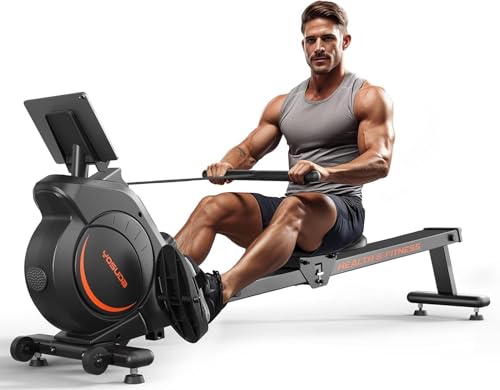


The UMAY uses a magnetic brake on a flywheel, so resistance is smooth and nearly silent, quoted at about 25 dB. Sixteen levels climb up to 110 pounds of resistance, which is generous for a rower at this price. The dual rail is 25 mm thick, with a 1.5 mm wall, and that heavier rail is the reason the seat glides without the wobble found on thin single-rail frames.
Compared with the hydraulic FEIERDUN, the UMAY gives a stroke that feels continuous, because a flywheel carries momentum through the recovery. A hydraulic piston resets and pushes back at a fixed stroke length, which is less natural. The trade-off is size: the UMAY is a full length rower, so it needs more storage space than the folded piston units.
A 350 pound rating suggests a stout steel frame. Magnetic resistance has no pads to wear, so the main upkeep is wiping the rail and checking bolts. Compared with the YPOO, the UMAY and YPOO are close in layout, but the UMAY lists a bit more resistance and a quieter rating. If you plan to row several times a week, this is the machine to choose.
What works
- Thick 25 mm dual rail keeps the seat steady
- Magnetic resistance runs at about 25 dB
- Up to 110 lb of resistance across 16 levels
- 350 lb capacity suits larger users
Watch out for
- Full length frame needs more storage space
- Magnetic resistance feels constant, not water-like
- Does not match the stroke of an air or water rower
Spec sheet
- Type
- Magnetic rower
- Resistance
- 16 levels, up to 110 lb
- Noise
- About 25 dB
- Rail
- 25 mm dual rail
- Capacity
- 350 lb