
Amazon affiliate links - we earn a commission.Affiliate disclosure

Buying guide · 12 min read · Updated 2026-11-07

Best Sewing Machines (2026)

Six home sewing machines compared by stitch set, motor design, bobbin system and ownership upkeep, from simple mechanical to computerized quilting models.

James MillerBy James MillerLead Machine Editor6 machines comparedSpec-sheet verified
Best Sewing Machines

At a glance

Our top picks

Side by side

Spec comparison

A home sewing machine is a small mechanism with a few moving parts that must stay in time: the needle bar, the hook that catches the thread loop, and the feed dogs that walk the cloth. Differences between models are mostly in how that mechanism is driven and controlled.

Most buyers overpay for decorative stitches they never use and underpay for the things that decide daily satisfaction: a reliable needle threader, a bobbin that drops in cleanly, and a motor that holds speed through a seam. This guide ranks machines on those points first.

Before you buy

6 Criteria to Look For Before Buying a Sewing Machine

  1. 01

    Mechanical or computerized

    A mechanical machine such as the Brother XM2701 sets length and width by knob, so it has fewer failure points but asks you to adjust for each fabric. A computerized one like the CS5055 chooses those values from the stitch you select. For a first machine, computerized convenience usually beats mechanical simplicity, unless you plan to repair it yourself.

  2. 02

    Stitch count that matters

    Advertised counts run from 27 on the XM2701 to 600 on the Singer 9960, but a normal sewist needs straight, zigzag, stretch, blind hem and buttonhole. Sixty stitches on the CS5055 cover all of those. Buy more stitches only if you sew decorative work; otherwise the money is better spent on feet and a table.

  3. 03

    Motor strength

    Motor design matters more on thick fabric than stitch menus. The Singer 4552 uses a DC motor that keeps torque at low speed, which is what lets the needle push through a jeans seam. The Brother models are better for quilting cotton, garments and home dec.

  4. 04

    Presser feet in the box

    Feet are the hidden cost. The XM2701 includes 6, the CS5055 includes 7, the CS7000X includes 10 and the Singer 9960 includes 13. A zipper foot and a buttonhole foot are essential; the rest are optional. Count what you will use before paying for a larger set.

  5. 05

    Bobbin and threader

    A drop-in top bobbin with a clear cover lets you see when thread is running out, and an automatic needle threader saves eyes. All six machines here have a threader. Skip any machine that needs a front-loading metal bobbin case if you are a beginner, because the tension adjustments are fussier.

  6. 06

    Table and workspace

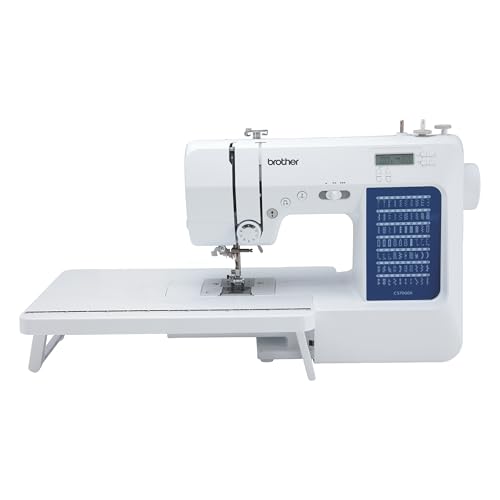
    The CS7000X and XR9550 include a wide table, which supports large panels and quilts. Without a table, bedding and curtains drag from the free arm and pull the stitch line. If you sew mostly small items, the table is optional.

Detailed reviews

The 6 best sewing machines, explained

01
Brother CS5055 computerized machine, 60 stitches
60 stitchesLCD screen7 presser feetAuto threader
Check price on Amazon
Best for: First machine for a household that wants clean stitches without learning dial settings.

The CS5055 puts a small electronic stitch engine behind a plain control layout. You pick a stitch on the LCD, and the machine sets length and width for that pattern, which removes the guesswork that makes a dial machine feel fiddly to a newcomer. Sixty stitches is a sensible number: it covers straight, zigzag, stretch, blind hem and a one-step buttonhole, plus enough decorative patterns for a hem or a pillow edge.

Its rival at the same tier of the lineup, the XM2701, has 27 stitches and no screen, so you gain more than double the stitch library and the computer-set tension and length. Seven presser feet in the box is also two more than you might guess you need, which matters because buying a zipper or buttonhole foot separately adds up. The trade is a plastic-heavy body and a stitch engine that is not meant for stacked denim seams day after day.

Upkeep is the usual drop-in top-bobbin routine: lift the clear cover, brush lint out of the bobbin race and from under the feed dogs after every few bobbins, and change the needle with each new project. Because the board is not user serviceable, keep the box and register the warranty; a dead board is a service-center job, not a weekend repair.

What works

  • LCD stitch selection sets length and width automatically
  • Sixty stitches cover real sewing plus light decoration
  • Seven presser feet included in the box
  • Automatic threader reduces eye strain at the needle

Watch out for

  • Board and LCD are a repair-center job if they fail
  • Light-duty frame struggles with many layers of denim

Spec sheet

Type
Computerized
Built-in stitches
60
Presser feet
7
Display
LCD
Needle threader
Automatic
02
Brother XM2701 mechanical machine, 27 stitches
27 stitches6 feetDrop-in bobbinAuto threader
Check price on Amazon
Best for: Hems, mending and curtains without paying for electronics.

The XM2701 is the simplest machine here, and that is its virtue. Stitch choice is a dial, length and width are knobs, and the whole drive is mechanical, so there is no circuit board to fail and the machine behaves the same every time you switch it on. It still carries an automatic needle threader and a drop-in top bobbin, features that used to be reserved for pricier models.

Against the CS5055 you give up the screen and 33 stitches, and every adjustment is by hand. For hemming trousers, making curtains and mending, that is fine. For stretch fabrics and neat buttonholes you will find the dial method slower, and you will fiddle with length and width more than on the computerized unit.

Maintenance is easy to learn on this design because everything is visible: remove the needle plate, brush the feed dogs, wipe the bobbin race, and change the needle often. Six included feet, a twin needle and four bobbins cover a starter kit, though the plastic housing means it is better parked in a closet than carried to classes weekly.

What works

  • Mechanical drive has no circuit board to fail
  • Automatic needle threader on a simple dial machine
  • Four bobbins and six feet are in the box
  • Easy to see and clean the stitching area

Watch out for

  • Length and width are set by hand for every stitch
  • Twenty-seven stitches limits stretch and decorative work

Spec sheet

Type
Mechanical
Built-in stitches
27
Presser feet
6
Bobbin
Drop-in top
Needle threader
Automatic
03
Brother CS7000X quilting machine, 70 stitches
70 stitchesWide table10 feetHard case
Check price on Amazon
Best for: Occasional quilters who also want everyday sewing.

The CS7000X is essentially the CS5055 platform with more accessories: ten feet instead of seven, a wide extension table that gives a quilt top somewhere to rest, a quilt guide, and a protective hard case. The 70 stitches add little over the 60 on the cheaper unit, so the extra money is really buying the table and the feet.

If you never quilt, the table is the only feature that earns its keep, because it widens the work surface for large panels such as bedding or drapery. Compared with the XR9550 further down this list, it keeps a simpler stitch menu and is easier to learn.

Upkeep follows the family pattern. Remove the table before cleaning under the needle plate, keep the hard case closed to stop dust settling in the bobbin race, and confirm the quilt guide is snug before each session so it does not drift. A machine that lives in its case between projects lasts longer than one left open on a dusty table.

What works

  • Wide table supports large quilt tops and curtains
  • Ten feet cover zipper, buttonhole and specialty work
  • Hard case keeps dust out of the bobbin area
  • Computer-set stitch parameters stay consistent

Watch out for

  • Stitch library barely grows over the cheaper 60-stitch model
  • Still a light-duty body for thick quilt sandwiches

Spec sheet

Type
Computerized
Built-in stitches
70
Presser feet
10
Extras
Wide table and quilt guide
Cover
Hard case
04
Brother XR9550 computerized machine, 165 stitches
165 stitchesWide tableLCDHard cover
Check price on Amazon
Best for: Hobbyists who want a large decorative library with a manageable interface.

The XR9550 is where a Brother buyer lands after outgrowing the 60-stitch machine. The library jumps to 165 stitches, of which 110 are utility and decorative designs, and the LCD makes browsing them practical rather than a trip through a printed chart.

Compared with the CS7000X it offers more than double the pattern count, so it suits someone who sews gifts, home dec trim and decorative hems. Compared with the Singer Quantum Stylist 9960 it is calmer: fewer stitches, less to learn, and a layout that does not hide the basics behind menus.

Ownership is routine: lint brush after each bobbin change, a fresh needle with each project, and a quick wipe of the thread path. Keep the hard cover on and the wide table stored flat so it does not warp, and do not let decorative stitches tempt you into running dense patterns on thin fabric without stabilizer, which causes puckering.

What works

  • Large 165-stitch library with 110 utility and decorative patterns
  • LCD makes browsing stitches practical
  • Wide table and hard cover included
  • Same drop-in bobbin routine as other Brother units

Watch out for

  • Most buyers will use under ten of the stitches
  • Plastic body is not a heavy-fabric tool

Spec sheet

Type
Computerized
Built-in stitches
165
Utility and decorative
110
Display
LCD
Extras
Wide table and hard cover
05
Singer Heavy Duty 4552 with DC motor, 32 stitches
32 stitchesDC motorSpeed control110 applications
Check price on Amazon
Best for: Denim hems, canvas bags and repair work.

Singer builds the 4552 around its motor rather than its menu. A DC motor delivers more force at low speed than a small universal-style motor, which is what you need when the needle meets a seam hump on a pair of jeans, and a speed limiter lets you hold a slow, controlled pace.

The stitch count is only 32, yet Singer cites 110 applications by combining stitch settings, which is the more honest figure for heavy sewing. Next to the Brother XM2701 it is the stronger option for canvas, denim hems and upholstery-weight work, and it gives up the screen entirely.

Heavy-duty machines reward good needles more than any other model: use a denim needle in a heavier size for jeans and replace it as soon as the tip dulls, because a worn point is what causes skipped stitches and stalled seams. Clear lint from the bobbin race often when sewing canvas, which sheds more than quilting cotton.

What works

  • DC motor gives better low-speed punch through thick seams
  • Speed control keeps heavy sewing deliberate
  • Stitch applications reach 110 from 32 stitches
  • Simple controls suit repair and utility sewing

Watch out for

  • No screen or computerized stitch setting
  • Thirty-two stitches is a limited decorative range

Spec sheet

Type
Heavy duty mechanical
Built-in stitches
32
Stitch applications
110
Motor
DC
Speed control
Yes
06
Singer Quantum Stylist 9960, 600 stitches
600 stitches1,172 applications13 feetHard case
Check price on Amazon
Best for: Experienced home sewists who want a giant stitch menu and many feet.

The Quantum Stylist 9960 is the maximalist choice. Six hundred stitches, 1,172 stitch applications and thirteen presser feet come with a hard case and an extension table, so everything for a sewing room starter kit is in the box.

The reality check is that nobody uses 600 stitches. The practical value is in the thirteen feet and the large menu of buttonholes and stretch stitches, which suit someone making clothes. Against the CS5055 it is a much wider feature set that comes with more to learn, so it is better for a sewist who already knows what a satin foot and a cording foot are for.

Care is the same as any computerized home machine, but with more accessories to track: store the feet in their case, keep the table flat, and clean the bobbin race on a schedule because decorative stitching uses more thread and sheds more lint. If you only sew straight seams, the extra capability is wasted.

What works

  • Six hundred stitches and 1,172 applications available
  • Thirteen presser feet cover most specialty tasks
  • Hard case and extension table included
  • Computerized control gives consistent tension

Watch out for

  • Menu depth is overkill for basic hemming and mending
  • More accessories to store and keep track of

Spec sheet

Type
Computerized
Built-in stitches
600
Stitch applications
1,172
Presser feet
13
Extras
Hard case and extension table

Spec sheet decoder

What the numbers on the box really mean

The specs manufacturers lead with, translated into what they tell you about real-world performance.

Built-in stitches

This counts stored patterns, including utility, stretch and decorative designs. It says little about sewing quality.

Watch forThe Singer 9960 lists 600 while the Brother XM2701 lists 27, and both can hem pants equally well.

Stitch applications

Singer counts variations of stitch settings as applications, so the number is larger than the stitch count. It is a marketing multiplier, not a separate feature.

Watch forThe 4552 lists 110 applications from only 32 stitches.

Presser feet included

Each foot is shaped for a task such as zippers, blind hems or buttonholes. More feet means fewer separate purchases.

Watch forThe CS7000X lists 10 while the XM2701 lists 6, so compare which feet, not just how many.

Motor type

A DC motor holds torque at low speed. A basic motor loses force when the speed pedal is eased off.

Watch forThe Singer 4552 advertises a DC motor; the Brother models do not emphasize one.

Extension table

A flat surface that enlarges the free arm bed. It supports big projects and reduces fabric drag.

Watch forThe CS7000X and XR9550 include one; the CS5055 and XM2701 do not.

Methodology

How We Evaluated These Sewing Machines

Stitch engine quality

We compared how each machine sets stitch length and width, whether by dial or by computer. We checked the stitch menu against what a home sewist really uses. The CS5055 at 60 stitches and the XR9550 at 165 stitches were weighed against actual need.

Feeding and fabric range

We looked at feed system, motor type and the stated fabric range. The Singer 4552 with a DC motor and the lightweight XM2701 sit at opposite ends. We did not credit a machine for a motor it does not list.

Ease of setup

We looked at threading, bobbin loading and the clarity of controls. Automatic needle threaders and drop-in bobbins mattered most. Every machine listed has both.

Accessories and ownership

We counted feet, tables and cases and considered how each would live in a home. The 13 feet on the Singer 9960 and the 6 on the XM2701 were treated as different tiers of kit.

Value across the lineup

We ranked by what the buyer gets compared with sibling machines. The CS5055 sits low in price tier, while the Singer 9960 sits near the top, so we asked whether the extra capability is useful.

Decision guide

How to Choose the Right Sewing Machines

By Sewing Task

SituationPickWhy
First machine for clothesBrother CS5055Automatic stitch settings and 60 stitches
Hemming and curtains onlyBrother XM2701Simple mechanical dial machine
Quilt tops and beddingBrother CS7000XWide table and quilt guide
Denim and canvasSinger Heavy Duty 4552DC motor holds torque at low speed
Decorative giftsBrother XR9550165 stitches with an LCD
Advanced garment sewingSinger Quantum Stylist 996013 feet and 600 stitches

By Budget

TierPickWhy
Lowest tierBrother CS5055Best features for the money in this list
Low tierBrother XM2701Mechanical, fewer things to break
Middle tierSinger Heavy Duty 4552Motor strength for tough work
Upper-middle tierBrother XR9550Large library, wide table
Top tierSinger Quantum Stylist 9960Largest stitch menu and 13 feet

Mechanical vs Computerized

Mechanical

The Brother XM2701 and Singer 4552 set stitch values by dial or knob. There is no board to fail and every adjustment is visible. You will need to learn how length and width affect each fabric.

Computerized

The CS5055, CS7000X, XR9550 and Singer 9960 choose stitch parameters for you and add an LCD. Tension and length stay consistent from one stitch to the next, at the cost of a board that only a service center can fix.

Pick mechanical if you sew simple items and want long-term simplicity; pick computerized if you want precision and variety.

Accessories You Get

PreferencePickWhy
Most feetSinger Quantum Stylist 996013 feet
Large tableBrother XR9550Wide table and hard cover
Quilt guideBrother CS7000XIncludes quilt guide and table
Fewest accessoriesBrother XM2701Basic six-foot kit

For Sewing Clothes Specifically

Look for

A one-step buttonhole, a stretch stitch and a blind hem foot are the three features that save the most time when making garments.

In this comparison

The Brother CS5055 carries all of those with 60 stitches and 7 feet, while the Singer 9960 adds more feet for advanced techniques.

When to Spend More

Spend more if

You quilt large tops, sew decorative work or want the Singer 9960 feet and the XR9550 stitch library for creative projects.

Save if

You mend and hem. The XM2701 and CS5055 handle that for the least money in this list.

Ownership

Maintenance schedule

The upkeep that decides whether this machine lasts two seasons or ten.

TaskIntervalWhy it matters
Brush out bobbin raceAfter every few bobbinsLint builds in the bobbin race and under the feed dogs. A brush clears it without pushing lint deeper.
Change the needleEvery 8 to 10 sewing hours or each projectA dull needle causes skipped stitches and fabric damage. Match the needle type to the fabric.
Check manual before oilingPer manualMany modern top-loading machines should not be oiled by the owner. Using the wrong oil gums the mechanism.
Clean feed dogsEvery project on fleece or flannelFuzzy fabrics shed heavily. Packed lint makes feeding uneven.
Cover when storedAfter each sessionDust and pet hair settle in the thread path. The hard cases on the XR9550 and Singer 9960 help.

FAQ

Frequently Asked Questions

Is a computerized machine better than a mechanical one?

For most beginners, yes, because the machine sets stitch length and width. A mechanical unit like the Brother XM2701 is a good choice if you want fewer parts that can fail.

Do I need hundreds of stitches?

No. Straight, zigzag, stretch, blind hem and buttonhole cover most needs. The Brother CS5055 at 60 stitches does all of that.

Which machine handles denim best?

The Singer Heavy Duty 4552 with its DC motor is the best fit here. Use a denim needle and slow speed through seam humps.

Are the budget machines durable?

They are durable for light use, but plastic bodies are not designed for daily heavy work. Care, clean needles and regular lint removal extend life.

Why does my machine skip stitches?

Usually a dull or wrong needle, or thread caught in the bobbin race. Change the needle first and brush out lint.

Can I oil my machine?

Check the manual first. Some top-loading models should not be oiled, and others call for a drop in specific spots.

Bottom line

The short version

Browse more sewing machineson Amazon →
James Miller, Lead Machine Editor

About the author

James Miller

Lead Machine Editor, MachineFanatic

James Miller leads MachineFanatic's buying guides, turning spec sheets, manuals and owner feedback into clear verdicts on power tools, outdoor power equipment, shop machines and kitchen machines.

More from James →

Keep reading

Related guides