
Amazon affiliate links - we earn a commission.Affiliate disclosure

Buying guide · 13 min read · Updated 2026-11-25

Best RV Battery Chargers (2026)

Five RV battery chargers compared: three 55 amp converter chargers for the house bank and two smart maintainers for starter and storage batteries.

James MillerBy James MillerLead Machine Editor5 machines comparedSpec-sheet verified
Best RV Battery Chargers

At a glance

Our top picks

Side by side

Spec comparison

An RV has two charging jobs that look alike and are not. One is the converter that turns shore power into 12 volts for the house battery and every light and pump in the coach. The other is the small maintainer that keeps a starter or storage battery alive during months of rest.

The right charger depends on the battery chemistry, the amp budget of your power source and how long the rig sits. This guide compares three 55 amp converter chargers and two smart maintainers, and explains the settings that decide whether a charger helps or harms.

Before you buy

6 Criteria to Look For Before Buying a RV Battery Charger

  1. 01

    Battery chemistry

    Lead-acid and lithium iron phosphate want different voltages and different charge profiles. The PowerMax PM3-55LK and WAVLINK GS800RV-55 offer adjustable output from 13 to 16.5 volts, while the WF 8955-AD and TowerTop are tuned for lead-acid. A wrong profile can undercharge or overcharge, so match the charger to the battery. Check the battery label for its charge voltage window and compare it with the charger setting, instead of relying on a general claim that a charger works with all batteries.

  2. 02

    Amps versus bank size

    A common guide is to size charging amps to roughly a fifth to a quarter of the bank's amp hours, so a 200 amp-hour bank is comfortable at 40 to 50 amps. A 55 amp converter suits large banks, while a 2 amp maintainer like the NOCO Genius2D only holds a charge. Pick for your bank size. A small bank charged hard by a very large charger can overheat, so the right answer is a charger that matches the battery limits, not the biggest number on the shelf.

  3. 03

    Shared output with 12V loads

    A 55 amp converter shares its output with every 12V load. While the fridge control, fan and pump run, less current reaches the battery. A full-timer with lots of 12V equipment charges more slowly than the label suggests. One way to see this is to watch the charge current with the fridge fan and water pump running, then again with everything off.

  4. 04

    AC input and generator limits

    The PowerMax lists an 11 amp maximum AC input. On a small generator, that matters. A charger that draws most of a generator's capacity leaves nothing for other loads, so check the AC draw before you rely on one. If the generator also runs an air conditioner or a microwave, the charger and those loads compete, and the generator may bog down or trip.

  5. 05

    Temperature compensation and ventilation

    Batteries need less voltage when warm and more when cold. A charger that adjusts, or a user who sets it by season, avoids cooking batteries in summer. A temperature sensor on the battery, where the charger supports it, is the best way to get this right in a hot compartment. Converters also make heat, so mount them where air moves.

  6. 06

    Mounting and wiring

    A deck-mount converter needs cabinet space and fused output lugs. A power center like the WF 8955-AD replaces the panel. A direct-mount maintainer like the NOCO Genius2D bolts near the battery. Check the space and the wire gauge before ordering. Measure the cabinet, the distance to the battery and the length of the cable run, since a long thin run wastes power as heat.

Detailed reviews

The 5 best rv battery chargers, explained

01
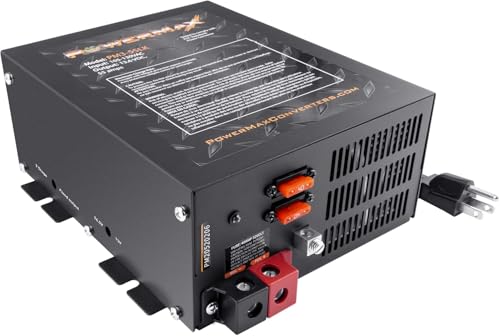
PowerMax PM3-55LK 55 amp RV converter charger, lithium compatible
55A outputLithium compatible3-stageAdjustable 13 to 16.5V
Check price on Amazon
Best for: Rigs with a lithium or mixed house bank and a place for a deck-mount converter.

The PM3-55LK converts 120 volts AC into 12 volts DC, up to 55 amps total, with an 11 amp maximum AC input. In factory mode it runs a three-stage charging program with boost, normal and storage steps at preset voltages around 14.6 volts in boost. A fixed-output mode works as an adjustable 12 volt power supply from 13.0 to 16.5 volts, which is the feature that lets it suit lithium iron phosphate banks.

The 55 amps are shared between the battery and every 12V load in the coach, so while the lights, pump and fan run, less current goes to the battery. The 11 amp AC input limit matters on a generator, because the converter will draw close to that at full output. Set beside the WAVLINK, the PowerMax is the better pick if you care about lithium and have a deck-mount location ready.

Routine care is mostly about setting it correctly. Match the charge voltage to the battery type, check the temperature compensation and tighten the output lugs each year. A loose lug at 55 amps will melt a connector long before the charger itself fails. If you are swapping an old converter, note the wire gauge on the output side, because a thin lead that carried a 30 amp unit will run hot behind a 55 amp one.

What works

  • Lithium compatible with an adjustable output
  • Three-stage charging in factory mode
  • 55A capacity for a large house bank
  • 11A AC input suits a generator budget

Watch out for

  • The 55A is shared with all 12V loads
  • Needs correct voltage settings for each battery type
  • Deck mounting requires cabinet space and ventilation

Spec sheet

Output
55A total, shared
AC input
11A maximum at 120V
Charging
3-stage: boost, normal, storage
Fixed mode
Adjustable 13.0 to 16.5V
Chemistry
Lead-acid and LiFePO4
02
WAVLINK 55 amp RV converter with three charging modes
55A output3 modes13 to 16.5V120V AC input
Check price on Amazon
Best for: Owners who want selectable battery modes and adjustable output.

WAVLINK sells a 55 amp RV charger converter, model GS800RV-55, with three smart charging modes tuned to different battery types and an adjustable output from 13 to 16.5 volts. It converts 120V AC to 12V DC and supplies up to 55 amps to the onboard electronics and the battery. The mode choices are the useful part, because an owner with lead-acid today and lithium tomorrow can change settings without changing the converter.

The tradeoff is documentation and track record. The maker is better known for networking than for RV power, and a charger that sits in a hot compartment needs good ventilation and a clear manual. As with any 55 amp converter, the current is shared between loads and battery, so a full-timer running a lot of 12V equipment sees slower charging.

Treat setup as a project. Confirm the mode that matches your battery chemistry, check that the output voltage rises and falls as expected with a meter, and tighten all terminals. Keep the manual with the rig paperwork. A short checklist of the exact voltage settings you chose, taped inside the cabinet, saves a lot of guessing when a battery is changed years later.

What works

  • Three charging modes for different battery types
  • Adjustable output from 13 to 16.5 volts
  • Up to 55 amps for large banks
  • Converts 120V AC to 12V DC

Watch out for

  • Less known in the RV power category
  • 55A is shared with all 12V loads
  • Needs ventilation and a careful voltage check

Spec sheet

Output
Up to 55A
Input
120V AC
Modes
3 smart charging modes
Fixed range
13V to 16.5V adjustable
Model
GS800RV-55
03
WF 8955-AD 55 amp RV power center converter charger
55A output3-stage105 to 130 VACRV power center
Check price on Amazon
Best for: Replacing a failed all-in-one power center in a trailer or camper.

The WF 8955-AD is an RV power center, meaning it combines a 55 amp converter charger with an AC and DC distribution panel in one box. It offers automatic three-stage charging and accepts 105 to 130 volts AC at 60 Hz, which tolerates the voltage sag of a weak pedestal or a small generator. It is built to replace an older converter in a camper, trailer or van.

The tradeoff is size and age of the design. A power center replaces the whole panel, so the swap involves wiring, breakers and fuses rather than a simple converter exchange. The three-stage program targets lead-acid batteries, so lithium owners should look elsewhere.

Use it where the old power center has failed and you want a like-for-like replacement. Photograph every wire before you disconnect anything, label them and replace fuses with the correct ratings. Because a power center feeds every circuit in the coach, test each light, outlet and pump after the swap before you close up the cabinet.

What works

  • Combines converter and distribution panel
  • Automatic three-stage charging
  • Accepts 105 to 130 VAC input
  • 55 amp output for typical house banks

Watch out for

  • Replacing a panel is a bigger job than a converter swap
  • Three-stage logic is aimed at lead-acid batteries
  • Wiring must match the old unit

Spec sheet

Model
WF8955-AD
Output
55 amp converter
Charging
Automatic 3-stage
Input
105 to 130 VAC, 60 Hz
Format
Power center with breakers
04
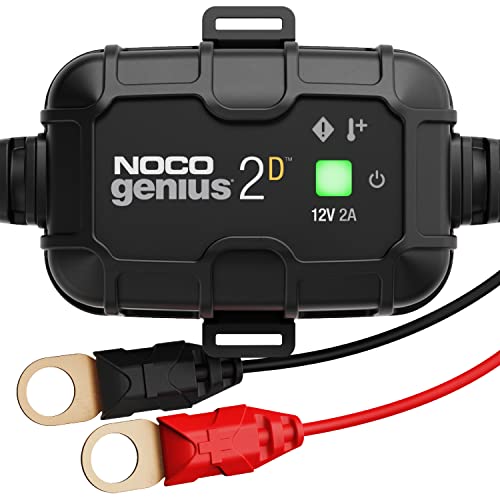
NOCO GENIUS2D 2 amp direct-mount onboard charger
2ADirect mount12V lead-acidOvercharge protection
Check price on Amazon
Best for: Starter batteries that sit for months between trips.

The NOCO Genius2D is a two amp onboard battery charger and maintainer designed to mount near the battery. It supports 12 volt lead-acid chemistries, including AGM, gel, sealed, valve-regulated and flooded batteries, and it includes overcharge protection. A snap-fit bracket mounts it in place, so you can leave it connected for months of storage.

The tradeoff is current. Two amps is a maintainer, not a charger for a depleted house bank, and it would take a very long time to charge an RV battery from low. It is aimed at a starter battery in a tow vehicle or a motorized RV engine battery, not at lithium house banks.

It shines in storage. Permanently connect it to the starter battery, run the lead to a convenient spot and plug it in when the rig is parked. Check the connections each season. A maintainer that is plugged in all winter also deserves a glance at the AC cord, since a cord pinched in a hatch or chewed by a rodent is a common storage-season failure.

What works

  • Direct-mount design stays on the battery
  • Supports AGM, gel and flooded lead-acid
  • Overcharge protection for long storage
  • Small, quiet and simple

Watch out for

  • Two amps cannot recharge a depleted house bank
  • Not intended for lithium batteries
  • Needs a nearby AC outlet

Spec sheet

Output
2 amp
Mount
Direct, snap-fit bracket
Chemistry
AGM, gel, SLA, VRLA, flooded
Protection
Overcharge and related safeties
Use
Under-hood or onboard
05
TowerTop 2/10/25 amp 12V smart charger with engine start
2/10/25AEngine startAuto detectLead-acid
Check price on Amazon
Best for: Owners who want a flexible portable charger for several batteries.

TowerTop's charger offers 2, 10 and 25 amp settings with four adjustable current levels, fully automatic charging that detects battery status and an engine start function. It is designed for 12 volt sealed lead-acid batteries in cars, boats, RVs and power sports equipment. The range of rates makes it a flexible bench charger.

A fair warning is that it is a portable charger, not a permanent converter. A 25 amp rate is useful for reviving a starter battery or topping up a house bank in a day, but it does not run your lights and fans like a converter. It is aimed at lead-acid, so lithium owners must confirm compatibility with the maker.

Keep it in a storage bay and use it when a battery needs a boost. Connect the clamps to the battery before plugging it in, and use the lowest rate that gets the job done. A slow charge is kinder to an aging battery, and a fast charge on a warm battery in a closed bay is how plates warp.

What works

  • Three charge rates up to 25 amps
  • Automatic detection of battery state
  • Engine start function
  • Works across cars, boats and RVs

Watch out for

  • Portable, not a replacement for a converter
  • Intended for lead-acid chemistries
  • High rates generate heat and need ventilation

Spec sheet

Rates
2, 10 and 25 amp, 4 adjustable settings
Operation
Fully automatic
Chemistry
12V sealed lead-acid
Extra
Engine start function
Use
Cars, boats, RVs, power sports

Spec sheet decoder

What the numbers on the box really mean

The specs manufacturers lead with, translated into what they tell you about real-world performance.

Charger amps

The maximum current the charger can deliver. A bigger number charges a bank faster, within the battery's limit.

Watch forPowerMax, WAVLINK and WF list 55A, the NOCO lists 2A.

Three-stage charging

A program that uses boost, absorption and float stages. It fills the battery quickly then holds it safely.

Watch forWF lists automatic three-stage; PowerMax lists boost, normal and storage.

Adjustable output

A fixed-voltage mode where you set the output. It lets you match lithium or special batteries.

Watch forPowerMax and WAVLINK list 13.0 or 13V to 16.5V.

AC input amps

The current the charger draws from the wall or generator. It limits how many other loads you can run.

Watch forPowerMax lists an 11A maximum.

Float voltage

The lower voltage a charger holds once the battery is full. It prevents gassing and loss of water.

Watch forA wrong float setting shortens battery life.

Methodology

How We Evaluated These RV Battery Chargers

Chemistry flexibility

We asked whether a charger supports lead-acid, AGM and lithium, noting the adjustable 13 to 16.5 volt range on the PowerMax and WAVLINK. Flexibility matters because many owners change batteries. An RV that starts with lead-acid often moves to lithium after a few seasons, and a charger that can follow saves a second purchase.

Capacity for the bank

We compared 55 amp converters to a 2 amp maintainer and a 25 amp portable charger. We matched each to the bank size it can serve. A 2 amp unit has no business near a 300 amp-hour bank, and a 55 amp converter is more than a single small battery needs.

Installation effort

We weighed deck-mount converters, power centers and plug-in maintainers by how much wiring each needs. A simple plug-in unit scores higher for easy use. We also noted how many tools and how much wiring each task requires, since an owner who dreads the job will put it off.

Safety and protection

We looked at overcharge protection, auto detection and input tolerance. A charger that handles a weak pedestal gracefully scored higher. We also credited chargers whose listings describe fault behavior in plain terms, such as what happens when the input voltage drops.

Maintenance and support

We considered manuals, warranty and brand history. A charger that is easy to troubleshoot earns trust. Clear status lights, a printed manual and a reachable support line make a difference when a battery will not charge on a trip.

Decision guide

How to Choose the Right RV Battery Chargers

By Battery Type

SituationPickWhy
Lithium house bankPowerMax PM3-55LKAdjustable output and lithium compatible
Lead-acid, replace a panelWF 8955-ADPower center with three-stage charging
Mixed chemistry, want modesWAVLINK 55 ampThree charging modes
Starter battery in storageNOCO GENIUS2DMaintainer for lead-acid

By Budget

TierPickWhy
LowestNOCO GENIUS2DSmall maintainer
Low to midTowerTop 2/10/25Portable multi-rate charger
MidWF 8955-ADReplacement power center
UpperPowerMax PM3-55LKLithium-compatible converter

Converter vs Maintainer

Converter

The PowerMax, WAVLINK and WF units supply 55 amps and run the coach as well as charge the bank. They are permanent installations.

Maintainer

The NOCO and TowerTop units charge or hold a single battery. They are for storage and top-ups, not for running loads.

Most rigs need a converter for the house bank and a maintainer for the starter battery.

Generator Axis

PreferencePickWhy
Known AC draw limitPowerMax PM3-55LK11A maximum AC input
Tolerates weak powerWF 8955-AD105 to 130 VAC input
Low AC draw maintainerNOCO GENIUS2D2A output
Bench charging onlyTowerTop 2/10/25Portable, plug in as needed

For Long Storage Specifically

Look for

A maintainer with a float stage and overcharge protection. Connect it to the starter battery and leave it.

In this comparison

The NOCO GENIUS2D mounts directly near the battery, while the PowerMax converter keeps the house bank in storage mode.

When to Spend More

Spend more if

You have lithium or a large bank. The PowerMax's adjustable output and capacity justify the cost.

Save if

You have one small battery. The NOCO or the TowerTop is enough.

Ownership

Maintenance schedule

The upkeep that decides whether this machine lasts two seasons or ten.

TaskIntervalWhy it matters
Tighten output lugsEvery yearA loose lug at 55 amps heats and melts. Torque to the maker spec. Re-check after the first few weeks, since new lugs settle as the metal relaxes under heat.
Check battery voltageEach tripA charger that is on but not charging shows up as a low reading. Measure at the battery.
Clear ventilationEvery seasonConverters make heat. Keep stored items away from the vents.
Verify charge settingsAfter battery changesA new battery chemistry needs the right profile. Check the mode before connecting.
Inspect cablesEvery yearCorroded or frayed cables cause voltage drop. Clean and replace as needed. A thin film of dielectric grease on clean terminals slows the return of corrosion.

FAQ

Frequently Asked Questions

What size charger do I need?

Many owners aim for a charge current of roughly a fifth to a quarter of bank capacity. A 55 amp converter suits a large bank, while a 2 amp maintainer only holds a charge.

Can I use a lead-acid charger on lithium?

Not unless it offers a matching profile. Lithium needs a different voltage and no equalize or desulfation stage. Many lithium batteries also include a battery management system that will disconnect when it senses a problem, so the charger and the battery have to cooperate.

Should I leave a charger connected in storage?

A smart maintainer with a float stage is designed for it. A plain charger without a float stage can overcharge. Even with a smart maintainer, check the battery water level in flooded batteries once in a while, since long float charging still evaporates some water.

Why does my battery not charge fully?

Shared loads, a low AC supply, loose connections or a wrong profile can all limit charging. Measure at the battery and check each in turn. Start with the simplest causes, such as a tripped breaker or a loose terminal, and only then suspect the charger.

Can I run it on a generator?

Yes, if the generator can supply the AC input current. Check the charger's input rating against the generator output.

Is a power center worth it?

A power center is worth it when the original has failed and you want a like-for-like replacement. Otherwise a converter alone is simpler. If the old power center is only partly failed, repairing a single board or fuse can be cheaper than swapping the whole box.

Bottom line

The short version

Browse more rv battery chargerson Amazon →
James Miller, Lead Machine Editor

About the author

James Miller

Lead Machine Editor, MachineFanatic

James Miller leads MachineFanatic's buying guides, turning spec sheets, manuals and owner feedback into clear verdicts on power tools, outdoor power equipment, shop machines and kitchen machines.

More from James →

Keep reading

Related guides