
Amazon affiliate links - we earn a commission.Affiliate disclosure

Buying guide · 12 min read · Updated 2026-11-13

Best RV Inverter for Air Conditioner (2026)

Three pure sine RV inverters sized for rooftop air conditioners, with continuous and surge ratings decoded, battery cable demands and honest limits.

James MillerBy James MillerLead Machine Editor3 machines comparedSpec-sheet verified
Best RV Inverter for Air Conditioner

At a glance

Our top picks

Side by side

Spec comparison

Running a rooftop air conditioner from batteries is the hardest job an RV inverter can be given. A compressor is a motor load, it pulls several times its running power for a fraction of a second at startup, and it then keeps pulling for as long as the cabin is hot.

That means the inverter rating is only one part of the answer. The battery bank, the cable gauge and the air conditioner's own startup behavior decide whether the setup works, so this guide treats the inverter as one piece of a chain rather than a stand-alone purchase.

Before you buy

6 Criteria to Look For Before Buying a RV Inverter for Air Conditioner

  1. 01

    Air conditioner running versus startup watts

    A rooftop compressor draws its rating continuously but spikes to two or three times that for a moment at startup, so size the inverter to the running figure and make sure the surge allowance covers the spike. The SUNWHEEL 4000W with 8000W of startup headroom clears a standard unit easily, while the AIMS 2000W relies on its 6000W surge for the same job. Buyers often read only the peak number and discover the problem when the inverter trips on a hot afternoon.

  2. 02

    Soft start versus hard start compressors

    A soft-start device or an inverter-driven air conditioner trims the startup spike to roughly the running load, which is what lets the 2500W EGSCATEE or the 2000W AIMS cope with a full-size unit. Without one, a standard compressor can need close to 3000W for a heartbeat. Check which kind of unit your roof carries before choosing an inverter size, because it can decide between the 2000W and 4000W options.

  3. 03

    Battery current at 12 volts

    Divide the running watts by 12 and add losses and you get the battery draw: 1500W of cooling is roughly 130 to 150 amps, and the SUNWHEEL at its full 4000W would pull close to 370 amps. Typical lead-acid batteries sag hard under that, so lithium or a large parallel bank is the realistic partner. Many buyers choose the inverter first and only then discover the battery cannot feed it.

  4. 04

    Cable gauge and fuse sizing

    Voltage drop turns into heat and into low-voltage shutdowns, so use short, heavy-gauge cable and a fuse rated for the inverter's full draw, sized near the battery. A 4000W unit like the SUNWHEEL needs the heaviest cable you can fit, while the 2000W AIMS tolerates a lighter run. Following the manual's cable chart is non-negotiable at these currents.

  5. 05

    Transfer switch and shore power

    A built-in transfer switch lets the air conditioner circuit move between pedestal power and the battery automatically, which is the feature of the EGSCATEE 2500W and the AIMS 2000W. The SUNWHEEL has none, so you would need a separate switch or manual changeover. For a rig that alternates between campgrounds and boondocking, the integrated switch is worth more than extra continuous watts.

  6. 06

    How long the battery can actually cool

    Watt-hours decide runtime: 1500W of cooling empties a 2400Wh lithium bank in a little over an hour and a half after losses. No inverter changes that arithmetic, so the choice of inverter matters less than the size of the bank. Use the lineup here for the conversion and plan on a generator or shore power for all-night cooling. A pragmatic approach is to pre-cool the rig on shore power, then let the battery carry only the afternoon peak, which stretches a modest bank much further than running the compressor flat out all day.

Detailed reviews

The 3 best rv inverter for air conditioner, explained

01
SUNWHEEL 4000W Pure Sine Wave Inverter 12V
4000W continuous8000W peakPure sine wave12V DC input
Check price on Amazon
Best for: Owners with a standard rooftop air conditioner and a large lithium bank who want continuous headroom.

This is the largest continuous rating in the lineup and the one with real breathing room for a standard rooftop air conditioner. A unit in the 13,500 BTU class typically draws somewhere around 1,300 to 1,800 running watts and spikes well above that on compressor start, so a 4000W continuous rating with an 8000W startup allowance clears both numbers without the inverter living at its limit. Pure sine output matters here because a compressor motor runs cooler and quieter on a clean waveform than on a stepped one.

The cost of that capacity is current. At 12 volts, 1500 running watts is already about 130 to 150 amps from the battery once conversion losses are counted, and the full 4000W rating would pull in the neighborhood of 370 amps. Nothing about a thin cable or a single lead-acid battery survives that, so the SUNWHEEL only makes sense with short, very heavy cables, a class-T or similarly rated fuse near the battery and a lithium or large deep-cycle bank. Next to the 2500W EGSCATEE it offers 1500W more continuous power, but it has no built-in transfer switch, so shore power and inverter power stay separate circuits.

Ownership is mostly about discipline. Mount it where the cooling fan can breathe, keep the battery run under about six feet, torque the lugs, and recheck them after the first few trips because loose lugs at hundreds of amps melt insulation. The low-voltage and overheat shutdowns protect the unit, but they shut the air conditioner off with no warning, so a battery monitor on the same bank is worth having.

What works

  • 4000W continuous rating clears a typical rooftop unit with room to spare
  • Pure sine wave output suits compressor motors
  • 8000W startup allowance covers hard-starting compressors
  • Low-voltage, overheat and overload shutdowns protect the unit

Watch out for

  • Needs enormous 12V battery current and very heavy cabling
  • No built-in transfer switch for shore power
  • A big unit that wastes battery on idle draw if left on

Spec sheet

Continuous output
4000W
Peak output
8000W at startup
Waveform
Pure sine wave
Input
12V DC
Protections
Under and over voltage, overheat, overload
02
EGSCATEE 2500W Pure Sine Inverter with Built-in ATS
2500W continuous5000W peakBuilt-in ATSHardwire AC input
Check price on Amazon
Best for: Campers who want automatic shore-to-battery switching feeding a small or soft-start air conditioner.

The EGSCATEE pairs a 2500W pure sine inverter with an automatic transfer switch, so the same box passes shore power through when it is connected and falls back to the battery when it is not. For an air conditioner that matters because the cabin circuit never has to be rewired or flipped by hand: plug in at the pedestal and the compressor keeps running on grid power. The terminal block for hardwired AC input also points to a fixed install rather than a plug-in gadget.

Two and a half kilowatts is enough for a small or soft-start rooftop unit but marginal for a standard one with a hard-starting compressor. The 5000W peak figure covers a brief spike, yet a unit that wants 1800 running watts is already using nearly three quarters of the continuous rating, which leaves little for a coffee maker or microwave at the same time. Beside the SUNWHEEL it gives up 1500W of continuous capacity but wins on integration, and beside the AIMS it offers 500W more continuous power with a lower peak allowance.

Upkeep is straightforward. Check the AC input and output terminals for heat discoloration each season, keep the vents clear and size the DC fuse for the full draw rather than the most convenient fuse you own. The transfer relay is a mechanical part, so expect an audible click each time it switches, and use a surge-protected pedestal when connecting to shore power.

What works

  • Built-in automatic transfer switch handles shore power fallback
  • 2500W pure sine output suits soft-start air conditioners
  • Hardwired AC input terminals support a clean fixed install
  • 5000W peak rating covers a typical startup spike

Watch out for

  • 2500W is marginal for a hard-starting standard rooftop unit
  • Lesser-known brand, so check fuse and cable guidance carefully
  • No battery charger, so shore power does not recharge the bank

Spec sheet

Continuous output
2500W
Peak output
5000W
Waveform
Pure sine wave
Transfer switch
Built-in automatic
AC input
Hardwired terminal block
03
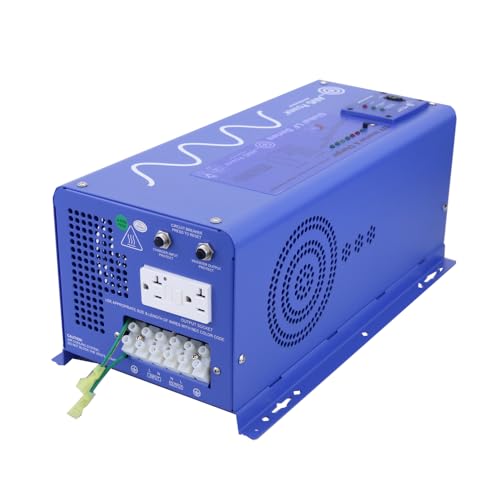
AIMS 2000W Pure Sine Inverter Charger with Transfer Switch
2000W continuous6000W surge70A chargerTransfer switch
Check price on Amazon
Best for: Smaller rigs wanting one hardwired box that inverts, charges and switches for a modest air conditioner.

AIMS builds this as three devices in one chassis: a pure sine inverter, a 70 amp multi-stage battery charger and an automatic transfer switch. The surge rating of 6000W, three times the continuous figure, is the generous kind that helps when a compressor refuses to start on a weaker supply. Because it also charges, plugging into shore power refills the bank while the air conditioner runs, which removes the separate converter and charger most small rigs carry.

The limit is the 2000W continuous rating. A small unit or a soft-start conversion works; a standard rooftop unit that runs near 1500 watts leaves about 500W of margin, and any second load can trip it. That is why this model is the right size for a compact trailer or a van with a mini-split style unit rather than a large coach. Compared with the 2500W EGSCATEE it is smaller on output but adds the charging stage, and compared with the SUNWHEEL it trades 2000W of capacity for a complete power center.

The heavy-duty build means weight and size, so plan a solid shelf, ventilation and a short, fused battery run. Set the charger profile to match the battery chemistry before the first plug-in, since the gel, AGM, lead-acid and lithium options charge to different voltages. Expect the cooling fan to run noticeably under load, which is worth remembering for a bedroom-adjacent compartment.

What works

  • Inverter, 70A charger and transfer switch in a single unit
  • 6000W surge helps stubborn compressor starts
  • Charger profiles cover AGM, gel, lead-acid and LiFePO4
  • Pure sine output keeps motors running cooler

Watch out for

  • 2000W continuous leaves little margin for a standard rooftop unit
  • Heavy and bulky, so it needs a solid mounting shelf
  • Fan noise rises under heavy load

Spec sheet

Continuous output
2000W
Surge output
6000W
Charger
70A multi-stage
Battery types
Gel, AGM, lead-acid, LiFePO4
Functions
Inverter, charger, transfer switch

Spec sheet decoder

What the numbers on the box really mean

The specs manufacturers lead with, translated into what they tell you about real-world performance.

Continuous watts

The power the inverter can hold indefinitely, limited by heat. It is the number to compare against an air conditioner's running draw.

Watch forCompare the 2000W AIMS, 2500W EGSCATEE and 4000W SUNWHEEL against your unit's running watts, not its startup.

Peak or surge watts

A short-duration allowance, typically one to a few seconds, for startup spikes. It does not extend how long the inverter can run a heavy load.

Watch forThe 8000W SUNWHEEL peak is generous, but only the 4000W continuous figure matters for hours of cooling.

Pure sine wave

An output matching grid power, which compressors and electronics need to run cool and quiet. Modified sine output can overheat motors.

Watch forAll three units here are pure sine, so waveform is not a differentiator in this comparison.

Built-in ATS

An automatic transfer switch moves the load between shore and battery power and prevents back-feeding. It simplifies wiring and removes manual changeover.

Watch forThe EGSCATEE and the AIMS include one, while the SUNWHEEL does not.

Charger amperage

On an inverter charger, the amps pushed into the battery from shore power. A higher figure refills the bank faster after boondocking.

Watch forThe AIMS offers a 70A charger, and the other two have no charging stage.

Methodology

How We Evaluated These RV Inverter for Air Conditioner

Continuous capacity versus real loads

We compared each inverter's continuous rating with the running draw of typical rooftop air conditioners, not only the marketing peak. The 2000W AIMS, 2500W EGSCATEE and 4000W SUNWHEEL span the range from soft-start units to full-size hard-start ones. Ratings come from the listing and spec data, and we did not count a pick as capable on peak figures alone.

Startup surge allowance

A compressor can need several times its running power for a moment, so we checked each surge figure against that pattern. The AIMS stands out at three times its continuous rating, while the SUNWHEEL carries twice. Surge was a supporting factor and never the main score.

Integration and wiring

We looked at what each box replaces: transfer switches, chargers and terminal blocks. The AIMS combines three functions, the EGSCATEE adds the switch, and the SUNWHEEL stays inverter-only. Wiring complexity and likelihood of an owner mistake fed into the score.

Battery and cable demands

Each unit's DC current at its continuous rating shapes the battery bank and cable it needs. At 12V the 4000W SUNWHEEL asks for far more than the 2000W AIMS, which we weighed as a real cost. Picks that are easy to feed scored higher.

Ownership realism

We considered fan noise, mounting weight, fuse guidance and protection shutdowns based on the spec sheets and owner feedback patterns. Brands with thinner documentation lose points, and a unit that is hard to install correctly was ranked lower.

Decision guide

How to Choose the Right RV Inverter for Air Conditioner

By Air Conditioner Type

SituationPickWhy
Standard rooftop unit, hard-start compressorSUNWHEEL 4000W4000W continuous and 8000W peak clear the startup spike
Soft-start or small rooftop unitEGSCATEE 2500W2500W continuous covers a trimmed startup draw
Compact trailer or van mini unitAIMS 2000W2000W continuous with 6000W surge is enough for a small load
Shore power at some sites, battery at othersEGSCATEE 2500WBuilt-in transfer switch changes source automatically

By Budget

TierPickWhy
Lowest cost per continuous wattSUNWHEEL 4000WThe cheapest of the three and the largest rating
Middle tier with a transfer switchEGSCATEE 2500WIntegration without the highest outlay
Highest cost, most featuresAIMS 2000WCharger plus switch justifies the premium over the others

Standalone Inverter vs Inverter Charger

Standalone inverter

The SUNWHEEL 4000W and EGSCATEE 2500W only convert battery power. You keep your existing converter or charger and pay less for a bigger rating, but the install has more parts.

Inverter charger

The AIMS 2000W inverts, charges at 70 amps and switches sources in one housing. It replaces other devices and simplifies wiring but costs more per watt of output.

Pick the SUNWHEEL if capacity matters most, and the AIMS if you want one tidy power center for a smaller rig.

Battery Bank Size

BankPickWhy
Single 100Ah lithiumAIMS 2000WA small load keeps battery current within the pack's limits
Two to three 100Ah lithium in parallelEGSCATEE 2500WHandles around 200 amps without cable melt
Four or more lithium or a 24V-class systemSUNWHEEL 4000WOnly a large bank supports its high current

For Boondocking Cooling Specifically

Look for

A battery bank sized in watt-hours rather than amp-hours, a soft-start air conditioner and an inverter with low idle draw. Cooling for hours is a battery problem first and an inverter problem second.

In this comparison

The AIMS 2000W suits a soft-start unit on a modest bank, while the SUNWHEEL 4000W suits a large lithium system with a standard unit. The EGSCATEE 2500W is the middle path.

When to Spend More

Spend more if

You want to run a standard rooftop unit regularly, or you want shore switching and charging in one box. The AIMS 2000W buys integration, and a premium lithium bank buys the runtime the SUNWHEEL 4000W needs.

Save if

You will only run a small unit now and then, or you camp mostly with shore power. The EGSCATEE 2500W gives you the essentials at a lower outlay.

Ownership

Maintenance schedule

The upkeep that decides whether this machine lasts two seasons or ten.

TaskIntervalWhy it matters
Retorque DC lugsAfter first trip, then every seasonHundreds of amps heat any loose lug and melt insulation. A quick check prevents a fire risk.
Inspect fuse and cableEvery seasonHeat discoloration or green corrosion raises resistance. Replace any suspect cable before it fails under load.
Clear dust from ventsTwice a yearBlocked vents cause overheat shutdowns. Compressed air keeps the fan and heat sink efficient.
Check transfer relay operationEvery few monthsPlug and unplug shore power to confirm the switch changes cleanly. A stuck relay can cause unpredictable AC behavior.
Verify battery voltage under loadYearlyVoltage sag past the low cutoff shuts the air conditioner off. A healthy bank holds above the cutoff at full load.

FAQ

Frequently Asked Questions

Can a 2000W inverter run an RV air conditioner?

Only a small or soft-start unit, and only with little else running. A standard rooftop unit with a hard-start compressor can need close to 3000W for a moment at startup, which a 2000W inverter may not survive even with a 6000W surge rating.

Is a bigger inverter always better?

No. A bigger inverter has a higher idle draw and demands larger cables and batteries. Choose the smallest unit that comfortably covers the air conditioner's startup and running load.

How long will batteries run the air conditioner?

A 100Ah lithium battery holds roughly 1200Wh, so 1500W of cooling empties it in well under an hour once losses are counted. A large bank or a generator is needed for all-night cooling.

Does the inverter need pure sine wave?

For a compressor motor, yes. A pure sine output runs the motor cooler and avoids humming, and all three picks in this lineup provide it. Modified sine units are cheaper, but they can shorten compressor life and sometimes refuse to start the motor at all.

Do I need a transfer switch?

If the air conditioner shares a circuit with shore power, yes. The built-in switch in the EGSCATEE or AIMS prevents the inverter from back-feeding the pedestal and saves manual changeover.

Can I run the air conditioner from the starting battery?

It is a poor idea. The current demand drains a starting battery quickly and can leave the engine unable to crank. Use a dedicated deep-cycle or lithium bank, wired through its own fuse, and let the inverter's low-voltage alarm protect that bank instead of relying on the engine battery as a backup. Keeping the two systems separate is a basic rule of RV power design.

Bottom line

The short version

Browse more rv inverter for air conditioneron Amazon →
James Miller, Lead Machine Editor

About the author

James Miller

Lead Machine Editor, MachineFanatic

James Miller leads MachineFanatic's buying guides, turning spec sheets, manuals and owner feedback into clear verdicts on power tools, outdoor power equipment, shop machines and kitchen machines.

More from James →

Keep reading

Related guides