
Amazon affiliate links - we earn a commission.Affiliate disclosure

Buying guide · 12 min read · Updated 2026-11-13

Best RV Inverter for Refrigerator (2026)

Five pure sine inverters that can run an RV or residential-style refrigerator, compared on startup surge, idle draw, wattage margin and battery current.

James MillerBy James MillerLead Machine Editor5 machines comparedSpec-sheet verified
Best RV Inverter for Refrigerator

At a glance

Our top picks

Side by side

Spec comparison

MachineContinuous outputSurge outputOutletsPorts
Ampeak 2000W Pure Sine Inverter with 6000W SurgeBest OverallAmpeak 2000W Pure Sine Inverter with 6000W Surge2000W6000WThree AC including a 20A outletn/a
BELTTT 1000W Pure Sine Inverter with 2000W PeakBest ValueBELTTT 1000W Pure Sine Inverter with 2000W Peak1000Wn/an/aTwo AC outlets and USB
BELTTT 1500W Pure Sine Inverter with 3000W SurgeBest Compact Mid-Size PickBELTTT 1500W Pure Sine Inverter with 3000W Surge1500W3000Wn/aDual AC and 5V 2.1A USB
ZETAWALE 2000W Pure Sine Inverter with LCD RemoteBest Feature-Rich PickZETAWALE 2000W Pure Sine Inverter with LCD Remote2000Wn/aFour AC, one hardwire terminalUSB and Type-C
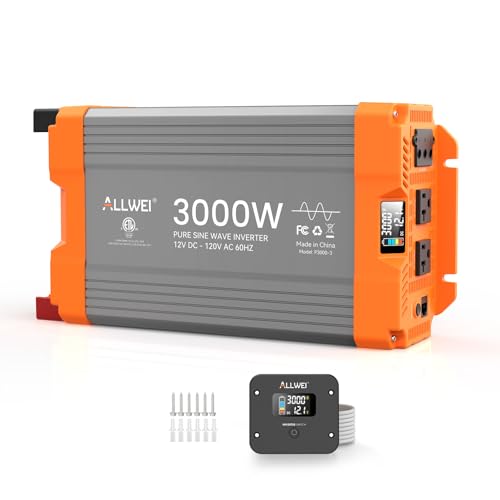
ALLWEI 3000W Pure Sine Inverter with 6000W SurgeBest High-Capacity PickALLWEI 3000W Pure Sine Inverter with 6000W Surge3000W6000WDual 20A AC socketsn/a

A refrigerator looks like a modest load, but it is one of the most deceptive appliances to power from a battery. It runs only part of the time, it needs a surge of current each time the compressor starts, and it never really stops, so a small waste in the inverter becomes a large drain over a full day.

That is why inverter choice for a fridge is about two numbers beyond the headline rating: the startup surge the unit can ride out and the power it wastes when the fridge is idle. The lineup here is judged on both.

Before you buy

6 Criteria to Look For Before Buying a RV Inverter for Refrigerator

  1. 01

    Compressor startup surge

    A refrigerator compressor can draw several times its running power for a fraction of a second. The Ampeak 2000W with 6000W surge and the ALLWEI 3000W with 6000W surge handle large compressors, while the BELTTT 1000W with 2000W peak suits only small ones. Match the surge to the biggest compressor in the rig, and remember that a freezer drawer or an ice maker adds a second motor that may start at the same moment as the main compressor.

  2. 02

    Idle draw over a full day

    A fridge cycles on perhaps a third of the time, so the inverter spends most of the day idling. A 3000W unit like the ALLWEI has more circuitry to feed than the 1000W BELTTT, and over 24 hours that matters. Choose the smallest inverter that safely covers the fridge's startup, then spend the saved battery capacity on more usable runtime instead of on unused inverter headroom.

  3. 03

    Clean pure sine output

    Modern fridges have electronic control boards that dislike stepped waveforms. All five lineup units are pure sine, and the Ampeak states 3 to 4 percent distortion. Modified sine inverters can cause buzzing, heat or board failures.

  4. 04

    Low-voltage behavior

    A bank that sags during compressor start can trigger an inverter shutdown, and a fridge that quits at night spoils food. Units that regulate output as voltage falls, like the Ampeak, ride it out better. Pair a bigger bank with any inverter you pick, and consider a low-voltage disconnect set a little above the inverter's own cutoff so you are warned while there is still time to start the generator or drive for an hour.

  5. 05

    Hardwire versus plug outlets

    A hardwired fridge circuit avoids loose plug contacts that heat under a long duty cycle. The ZETAWALE 2000W and ALLWEI 3000W provide hardwire terminals, while the BELTTT units rely on sockets. A fridge that runs for years deserves a fixed connection.

  6. 06

    Battery current at 12 volts

    A fridge averages perhaps 50 to 100 watts, but the inverter must still be wired for its full rating. The ALLWEI would draw roughly 280 amps at 3000W, the Ampeak 190, and the BELTTT 1000W around 95. Wire to the inverter's rating, not the fridge's average.

Detailed reviews

The 5 best rv inverter for refrigerator, explained

01
Ampeak 2000W Pure Sine Inverter with 6000W Surge
2000W continuous6000W surgeTHD 3 to 4%3 AC outlets
Check price on Amazon
Best for: RV owners running a full-size or residential fridge with a few small loads beside it.

A surge allowance of 6000W on a 2000W unit is the kind of margin a refrigerator compressor appreciates. The compressor in a full-size fridge can pull several times its running power for a fraction of a second, and an inverter with only a thin surge allowance may trip or shut off just when the cabin is quiet. The Ampeak's 3 to 4 percent total harmonic distortion also keeps the output clean enough for the electronic control boards in modern refrigerators.

The 2000W continuous rating is enough for a residential fridge plus a coffee maker or a few small loads, and its voltage regulation is described as adjusting to battery sag under load, which matters because a flat bank often causes the nuisance shutdowns that spoil food. It has three AC outlets including a 20 amp socket and two USB ports, so it can serve the kitchen without a power strip. Beside the 3000W ALLWEI it has a lower capacity and a smaller battery appetite, and beside the 1000W BELTTT it has twice the headroom.

Put it close to the battery and keep the cable runs short; a fridge's duty cycle makes the inverter run all day, so cooling matters. Fuse for roughly 190 amps at full load, and switch the inverter off when the fridge is empty and not needed.

What works

  • 6000W surge cushions the compressor start
  • Low 3 to 4 percent distortion suits control boards
  • Adjusts output as the battery voltage sags
  • Includes a 20A outlet and two USB ports

Watch out for

  • Draws roughly 190 amps at full load from 12V
  • Little-known brand with limited support history
  • Three outlets limit kitchen use without a strip

Spec sheet

Continuous output
2000W
Surge output
6000W
Distortion
3 to 4 percent THD
Outlets
Three AC including a 20A outlet
USB
Two ports
02
BELTTT 1000W Pure Sine Inverter with 2000W Peak
1000W continuous2000W peakLCD displayDual AC outlets
Check price on Amazon
Best for: Vans and compact trailers with a small 12V-class or compact AC refrigerator.

Small refrigerators, the kind used in vans, truck campers and compact trailers, draw well under 100 watts while running, and 1000W of pure sine capacity is more than enough for them. The BELTTT's lower idle draw compared with a 3000W unit is its real advantage, because the inverter will run for hours between cabin visits. An LCD shows input and output, which makes it easy to confirm what the fridge actually uses.

The 2000W peak covers the start of most compact compressors. It is not the unit for a residential fridge with a large ice maker or a freezer drawer, where startup can climb sharply, and it leaves no room for a microwave beside it. Next to the 1500W BELTTT it is smaller and cheaper, and against the 2000W Ampeak it gives up the extra surge headroom.

Place it near the battery with short cables, and use the display to verify that nothing else is hiding on the circuit. Because a small unit is easy to load past its limit, label the outlets so a heater is never plugged in beside the fridge.

What works

  • Low idle draw suits all-day fridge duty
  • Pure sine output for refrigerator control boards
  • LCD shows live input and output numbers
  • The lowest outlay in the lineup

Watch out for

  • 1000W leaves no margin for a residential fridge
  • No remote or transfer switch included
  • Fan is audible in small spaces and may disturb sleepers

Spec sheet

Continuous output
1000W
Peak output
2000W
Waveform
Pure sine wave
Display
LCD for input and output
Ports
Two AC outlets and USB
03
BELTTT 1500W Pure Sine Inverter with 3000W Surge
1500W continuous3000W surgeLCD displayUSB port
Check price on Amazon
Best for: Mid-size RV refrigerators plus a small extra load.

Step up from the 1000W model and you gain headroom for a mid-size apartment-style refrigerator and a laptop or a fan at the same time. The 3000W surge allowance is double the continuous rating, and that ratio is generally comfortable for refrigerator compressors that start under no load. Thick three-foot cables come in the box, which helps keep the voltage drop low when the compressor starts.

Pure sine output means the electronic thermostat and the control board see clean power, and the LCD lets you watch the fridge cycle. At full 1500W it would pull around 140 amps from a 12 volt battery, but a fridge uses a small fraction of that on average. Compared with the Ampeak 2000W it gives up a thousand watts of surge but costs less, and compared with the 1000W BELTTT it adds 500W of margin.

Install with a fuse near the battery, mount it on a vertical surface and give the fan space to move air. If the fridge shares the circuit with a coffee maker or a space heater, move those to a separate inverter or accept that the sum can exceed 1500W.

What works

  • 1500W continuous gives margin over a fridge's needs
  • 3000W surge doubles the continuous rating
  • Thick short cables reduce voltage drop
  • Pure sine output with an LCD display

Watch out for

  • Not enough for a large residential fridge with a microwave
  • No remote switch, so the front panel must be reached
  • Fan noise is noticeable at higher loads

Spec sheet

Continuous output
1500W
Surge output
3000W
Display
LCD
Ports
Dual AC and 5V 2.1A USB
Cables
3 ft thick battery cables
04
ZETAWALE 2000W Pure Sine Inverter with LCD Remote
2000W continuous4000W peak4 AC outletsLCD remote
Check price on Amazon
Best for: Kitchen setups that want a hardwire terminal, multiple outlets and a remote display.

Heat dissipation is the quiet design point of the ZETAWALE: instead of relying only on fans and the outer housing, the unit moves heat through internal heat sinks, which helps in an enclosed compartment where a refrigerator inverter runs for hours. It has four AC outlets, a hardwire terminal, USB and Type-C ports and an LCD remote, so it can serve as a small kitchen power center.

The 2000W continuous and 4000W peak rating are the same as many competitors, but the hardwire terminal lets you feed the refrigerator circuit directly, which is the cleanest way to power a fridge. Compared with the 3000W ALLWEI it carries a smaller rating and a smaller battery demand, and compared with the 2000W Ampeak it has a lower surge allowance but a larger set of connections.

Hardwire the refrigerator circuit rather than using the plug outlets, and use the remote to turn the inverter off when the fridge is empty. Mount it in a ventilated spot and check the terminal screws each season. Because a refrigerator circuit rarely gets shut off, a loose terminal here causes more trouble than on a seldom-used kitchen inverter.

What works

  • Hardwire terminal supports a dedicated fridge circuit
  • Heat sink design helps in tight compartments
  • Four AC outlets plus USB and Type-C
  • LCD remote for status and switching

Watch out for

  • 4000W peak is lower than the Ampeak's surge allowance
  • Brand is newer with limited track record
  • Needs a fused, heavy battery cable like any 2000W unit

Spec sheet

Continuous output
2000W
Peak output
4000W
Outlets
Four AC, one hardwire terminal
Ports
USB and Type-C
Remote
LCD remote
05
ALLWEI 3000W Pure Sine Inverter with 6000W Surge
3000W continuous6000W surgeDual 20A outlets30A hardwire
Check price on Amazon
Best for: Large lithium systems powering a residential refrigerator alongside kitchen appliances.

Ultra-low no-load loss is the claim that stands out on the ALLWEI, and it matters for a refrigerator application because the inverter sits idle between compressor cycles. The unit delivers 3000W continuous and 6000W surge with two 20 amp sockets and a 30 amp hardwire terminal, which is roomy enough for a residential refrigerator, a microwave and a few small loads together. Eight-fold protection covers the usual low voltage, high voltage, overload and thermal cases.

The cost of capacity is battery current: about 280 amps at full load, which must come from a large lithium bank. For fridge duty alone it is overkill, and the larger inverter will always have a higher idle draw than a 1000W or 1500W model despite the no-load loss claim. Beside the 2000W ZETAWALE it adds a full kilowatt of continuous capacity, and beside the Ampeak it adds the 30A hardwire option.

Feed the refrigerator through the hardwire terminal and keep the sockets for small appliances. Use a fuse sized for the full draw, keep cables short and check the terminal each season.

What works

  • 3000W continuous with 6000W surge for big compressors
  • Ultra-low no-load loss claim helps fridge duty
  • Two 20A sockets plus a 30A hardwire terminal
  • Eight-fold protection set

Watch out for

  • Draws about 280 amps at full load from 12V
  • Overkill if the fridge is the only load
  • Heavier and costlier than the 2000W options

Spec sheet

Continuous output
3000W
Surge output
6000W
Outlets
Dual 20A AC sockets
Hardwire
30A terminal
Protections
Eight-fold protection

Spec sheet decoder

What the numbers on the box really mean

The specs manufacturers lead with, translated into what they tell you about real-world performance.

Surge watts

A brief allowance for compressor startup, lasting about a second or two. It protects against nuisance shutdowns on motor start.

Watch forThe Ampeak and ALLWEI list 6000W, while the BELTTT 1000W lists 2000W.

No-load loss

The power an inverter uses with nothing plugged in, which for a fridge setup accrues all day.

Watch forThe ALLWEI claims ultra-low no-load loss, but a larger unit still idles above a 1000W unit.

THD

Total harmonic distortion measures how far the waveform departs from a perfect sine. Lower is gentler on electronics.

Watch forThe Ampeak lists 3 to 4 percent, and the others only claim pure sine.

Hardwire terminal

A screw terminal that feeds a dedicated circuit without a plug. It gives a solid connection for appliances that run constantly.

Watch forThe ZETAWALE and ALLWEI include one, and the BELTTT models do not.

Continuous watts

The sustained power the inverter can supply. It must exceed the fridge plus anything else sharing the circuit.

Watch forThe lineup ranges from 1000W on the small BELTTT to 3000W on the ALLWEI.

Methodology

How We Evaluated These RV Inverter for Refrigerator

Startup handling

We compared each inverter's surge allowance with the compressor start of small and residential refrigerators. The Ampeak and ALLWEI at 6000W lead, and the BELTTT 1000W at 2000W is limited to small fridges.

Idle consumption

Because a fridge cycles, we preferred smaller units and any stated low no-load loss. The BELTTT 1000W and 1500W benefit, and the ALLWEI's claim helps but cannot beat size.

Waveform and voltage stability

Pure sine output and the Ampeak's stated voltage regulation under sag were weighted heavily. A fridge that survives a low battery is the goal.

Wiring quality

Hardwire terminals, cable length and outlet layout were rated, since a fridge runs for years. The ZETAWALE and ALLWEI scored well.

Ownership realism

Fan noise, brand support and fuse guidance came from spec sheets and owner feedback patterns. Units with clear instructions and a stated cable size ranked higher.

Decision guide

How to Choose the Right RV Inverter for Refrigerator

By Refrigerator Type

SituationPickWhy
Small 12V-class or compact fridgeBELTTT 1000WPlenty of capacity with the lowest idle draw
Mid-size apartment fridgeBELTTT 1500W1500W with 3000W surge
Full-size fridge plus small loadsAmpeak 2000W6000W surge cushions the start
Residential fridge plus microwaveALLWEI 3000W3000W continuous, 6000W surge

By Budget

TierPickWhy
Lowest outlayBELTTT 1000WCheapest unit and adequate for small fridges
MiddleAmpeak 2000WStrong surge for a moderate cost
HighestALLWEI 3000WCapacity for a full kitchen

Large Inverter vs Small Inverter

Large inverter

The ALLWEI 3000W handles a residential fridge plus other appliances, but it idles higher and needs a larger bank and cable. It is justified only when other loads share it.

Small inverter

The BELTTT 1000W or 1500W wastes less in standby and fits a modest battery, but it limits what else can run.

Use a small inverter if the fridge is the main load and a large one if the kitchen shares it.

Connection Style

PreferencePickWhy
Plug the fridge inBELTTT 1500WDual sockets with thick short cables
Dedicated hardwired fridge circuitZETAWALE 2000WHardwire terminal and heat sink design
Hardwire plus heavy capacityALLWEI 3000W30A hardwire terminal

For Overnight Fridge Backup Specifically

Look for

An inverter with stable output as the battery falls and a low idle draw, paired with a bank that holds the fridge through the night. A fridge averages around a third of its day on.

In this comparison

The Ampeak 2000W regulates voltage as the bank sags, and the BELTTT 1000W idles least for small fridges.

When to Spend More

Spend more if

You run a residential fridge or live aboard. The ALLWEI 3000W and a large bank give headroom.

Save if

You have a small or compact fridge. The BELTTT 1000W is enough.

Ownership

Maintenance schedule

The upkeep that decides whether this machine lasts two seasons or ten.

TaskIntervalWhy it matters
Check fuse and cableEvery seasonA fridge circuit runs for years under load. Corroded cable adds heat and voltage drop.
Retorque terminalsAfter the first trip, then yearlyVibration loosens lugs. Loose terminals overheat under a constant duty cycle.
Clean ventsTwice a yearDust reduces cooling and the inverter runs near its thermal limit in a compartment.
Watch fridge cyclingMonthlyA fridge that runs constantly signals a problem. Use the inverter display to spot odd draw.
Test low-voltage cutoffYearlyConfirm the alarm sounds before the shutdown. A flat bank spoils food.

FAQ

Frequently Asked Questions

What size inverter do I need for an RV refrigerator?

A compact fridge needs 1000W, a mid-size one 1500W and a residential model 2000W or more. Size to the surge as well as the running watts.

Will an inverter drain my batteries?

Yes, even idling. A fridge cycling on and off averages perhaps 50 to 100W, so a 100Ah lithium bank can last a day or so with careful use.

Do I need pure sine for a fridge?

Yes. A fridge with an electronic control board runs better and cooler on pure sine power, and all five lineup picks provide it.

Can I leave the inverter on all the time?

If the fridge needs it, yes, but turn it off when the fridge is empty. The idle draw of the unit adds up over days.

Is surge or continuous more important?

Both. Surge keeps the unit from tripping at compressor start, and continuous decides what else runs beside the fridge.

Should I run the fridge from the starting battery?

No. The inverter can drain the starting battery and leave you stranded. Use a separate house bank, and if the coach cannot isolate the two, install a battery isolator or a DC-to-DC charger so the house side can never pull down the engine start battery.

Bottom line

The short version

Browse more rv inverter for refrigeratoron Amazon →
James Miller, Lead Machine Editor

About the author

James Miller

Lead Machine Editor, MachineFanatic

James Miller leads MachineFanatic's buying guides, turning spec sheets, manuals and owner feedback into clear verdicts on power tools, outdoor power equipment, shop machines and kitchen machines.

More from James →

Keep reading

Related guides