
Amazon affiliate links - we earn a commission.Affiliate disclosure

Buying guide · 12 min read · Updated 2026-11-13

Best RV Inverter with Transfer Switch (2026)

Five pure sine RV inverters with a built-in automatic transfer switch, comparing switch speed, pass-through, Bluetooth control, surge and battery current.

James MillerBy James MillerLead Machine Editor5 machines comparedSpec-sheet verified
Best RV Inverter with Transfer Switch

At a glance

Our top picks

Side by side

Spec comparison

A built-in transfer switch decides which power source feeds the rig: the pedestal when it is available, the battery when it is not. Done right, the changeover happens without anyone touching a breaker, and the inverter can never push power backward into a campground outlet.

The details that separate one switch from another are how fast it moves, how much current it can pass and whether it also charges the battery. This guide ranks inverters on those details as well as on their basic output.

Before you buy

6 Criteria to Look For Before Buying a RV Inverter with Transfer Switch

  1. 01

    Switchover speed

    Electronics reset when power drops for more than a few tens of milliseconds, so a fast switch matters for routers and computers. The LiTime 2000W states a switchover within 20 milliseconds, and the Renogy PUH models advertise UPS-style switching. Units with no stated figure may be slower. A switch that clicks over slowly may not reset a computer, but it can make LED lights flicker and cause a microwave to restart its clock, which is a good reality check on the claim.

  2. 02

    Transfer switch current rating

    The switch must pass the full shore power current, not just the inverter's output. A 30 amp rig passes up to about 3,600 watts, and the inverter's AC input terminals must be rated for that. Check the manual's input limit before assuming a 2500W unit will pass a 30 amp circuit. If the circuit you feed is only a subpanel of selected outlets, you can size the switch to that subpanel instead of the whole coach.

  3. 03

    Charger or no charger

    The AIMS 2000W includes a 70 amp multi-stage charger, so it replaces the converter. The LiTime, ZETAWALE and Renogy PUH units switch but do not charge, so you need a separate converter or charger. Count the whole system cost. Whichever route you take, make sure the charger can reach the correct float voltage for your battery type.

  4. 04

    Standby consumption

    A transfer inverter sits idle while on shore power, and its standby draw adds up. Renogy lists under 18W for the PUH 3000W. Check the figure in the manual because a 40W draw costs nearly a kilowatt-hour per day. Over a month of hookups that idle draw is real energy, even though the pedestal pays for it.

  5. 05

    Safe AC input wiring

    A wrongly wired transfer switch can back-feed a pedestal or short a neutral. The ZETAWALE, LiTime and Renogy units use hardwired AC input terminals. Have the install checked, especially in a coach with a generator. A coach with a generator adds a third source, so confirm the inverter's switch can handle two AC inputs or add a separate generator switch.

  6. 06

    Battery current at full load

    The Renogy PUH 3000W pulls about 280 amps at 12 volts, the ZETAWALE about 230 and the 2000W units about 190. The PUH 1000W draws only about 95. Match the inverter to the battery bank before you buy. A transfer switch does not reduce the battery current when running on batteries, so wiring rules stay the same.

Detailed reviews

The 5 best rv inverter with transfer switch, explained

01
Renogy PUH 3000W Pure Sine Inverter with Transfer Switch
3000W continuousUPS transfer switchBluetooth and remoteOver 92% efficient
Check price on Amazon
Best for: Rigs that move between pedestals and batteries and want seamless switching with a big inverter.

Standby consumption of less than 18 watts is a figure most inverter listings leave out, and it is what makes the Renogy PUH 3000W cheaper to leave plugged in than its rating suggests. The unit includes an on-grid transfer switch that moves between pedestal power and the battery without a gap, so a computer or a router should not notice the change. Built-in Bluetooth and a wired remote supply control and data. For a rig that spends half its life on pedestals, that low standby figure is the kind of quiet saving that adds up across a season.

The pure sine output is rated at 3000W continuous with an efficiency stated above 92 percent, high enough that a large share of battery energy reaches the outlets. For a coach with a microwave, a residential refrigerator and a few small appliances it is a comfortable size. Compared with the 2500W ZETAWALE it adds 500W and better documentation, and compared with the 2000W LiTime it adds a thousand watts at a higher price.

A 3000W draw is about 280 amps at 12 volts, so the install demands lithium, heavy cable and a class-T fuse. Have the AC input wired by someone who understands transfer switches and neutral bonding, and pair the app before a trip.

What works

  • UPS-style switching keeps sensitive electronics running
  • Standby consumption under 18W is low for 3000W
  • Bluetooth app and wired remote included
  • Efficiency stated above 92 percent

Watch out for

  • About 280 amps at full load from 12V
  • Higher cost than most competitors
  • AC input wiring needs a competent installer

Spec sheet

Continuous output
3000W
Transfer switch
On-grid automatic, UPS style
Control
Bluetooth app and wired remote
Efficiency
Above 92 percent
Standby consumption
Under 18W
02
LiTime 12V 2000W Inverter with ATS Transfer Switch
2000W continuous4000W surge20 ms switchoverDual fans
Check price on Amazon
Best for: Trailers and vans wanting a mid-size inverter with a fast stated switchover at a low outlay.

Switchover within 20 milliseconds is a number you can actually plan around, and the LiTime states it for its automatic transfer switch. Twenty milliseconds is faster than most computers notice, and it keeps lights, routers and modern appliances from resetting when the pedestal power drops. The unit delivers 2000W continuous and 4000W surge of clean 120 volt power at 60 hertz with two AC sockets and USB ports.

Dual intelligent cooling fans and an operating range from minus 20 to 40 degrees Celsius are aimed at hot compartments and cold climates. For a typical travel trailer or van it is a sensible, mid-capacity choice, and its price sits well below the Renogy. Compared with the 2500W OLTEANP it has 500W less capacity, and compared with the 2000W AIMS it lacks a charger but has a faster stated switchover. Cold-weather camping is where the stated temperature range matters, because many inverters derate or refuse to start below freezing.

Fuse the battery cable for roughly 190 amps, mount it with fan clearance and wire the AC input carefully. Because the fans work in two stages, expect them to be quiet at light loads and noticeable at heavy ones.

What works

  • Switchover stated within 20 milliseconds
  • Dual intelligent cooling fans handle heat
  • Operating range from minus 20 to 40 Celsius
  • 2000W with 4000W surge at a modest outlay

Watch out for

  • No built-in battery charger
  • About 190 amps at full load from 12V
  • Newer brand with a short history in inverters

Spec sheet

Continuous output
2000W
Surge output
4000W
Switchover time
Within 20 milliseconds
Cooling
Dual intelligent fans
Operating range
-20 to 40 degrees Celsius
03
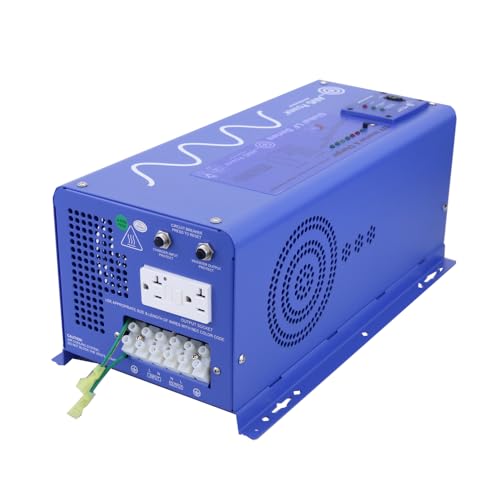
AIMS 2000W 12V Pure Sine Inverter Charger with Transfer Switch
2000W continuous6000W surge70A chargerATS built in
Check price on Amazon
Best for: Rigs replacing a converter that want inverter, charger and transfer switch in a single box.

Three functions in one housing is the whole identity of the AIMS: a pure sine inverter, a 70 amp multi-stage battery charger and an automatic transfer switch. When the pedestal is connected, the unit passes power to the cabin and charges the bank; when it is not, it inverts. That replaces the separate converter many rigs carry, which simplifies the wiring diagram.

The 6000W surge allowance is three times the continuous rating and is the most generous in the lineup relative to size. For a transfer switch application it is the most complete unit, though it costs more than a simple inverter with a switch. Beside the LiTime 2000W it adds a real charger and a larger surge, but gives up the stated 20 millisecond switchover, and beside the Renogy 3000W it is smaller but cheaper.

Set the charger profile for the battery chemistry before the first plug-in, since gel, AGM, lead-acid and lithium charge to different voltages. Mount it on a solid shelf because it is heavy, and keep vents clear. Keep the original manual, since the charger parameters are easy to forget after the first install.

What works

  • Inverter, 70A charger and transfer switch in one unit
  • 6000W surge allowance is generous
  • Charger profiles cover AGM, gel, lead-acid and LiFePO4
  • Pure sine output

Watch out for

  • Heavy and bulky for its output
  • Higher outlay than a plain inverter with a switch
  • Fan noise is noticeable at heavy loads

Spec sheet

Continuous output
2000W
Surge output
6000W
Charger
70A multi-stage
Battery support
Gel, AGM, lead-acid, LiFePO4
Functions
Inverter, charger, transfer switch
04
ZETAWALE 2500W Pure Sine Inverter with Built-in ATS
2500W continuous5000W peakBuilt-in ATSLCD display
Check price on Amazon
Best for: Mid-size coaches and vans wanting 2500W with automatic source switching.

Aimed squarely at RV owners and van builders, the ZETAWALE offers 2500W of pure sine power with an automatic transfer switch that chooses between external AC and the battery. An LCD shows status and protection codes, and the 5000W peak rating covers most compressor starts. It is a straightforward way to add switching to a mid-size system.

The unit does not include a charger, so shore power charging needs a separate converter, and the listing gives less detail on switch speed than the LiTime does. In capacity terms it sits between the 2000W models and the 3000W Renogy, which makes it a good pick for a coach with a microwave. Compared with the OLTEANP 2500W it offers the same ratings and a similar feature list, and compared with the AIMS it lacks the charger but costs less.

Wire the AC input with care, because a miswired transfer switch can back-feed a pedestal. Fuse for about 230 amps and check the terminals each season. Photograph the wiring before closing the access panel, which makes future troubleshooting far quicker.

What works

  • 2500W pure sine output with a built-in ATS
  • 5000W peak helps with compressor starts
  • LCD shows status and protection codes
  • Sits between the 2000W and 3000W classes

Watch out for

  • No built-in battery charger
  • About 230 amps at full load from 12V
  • Limited detail on switchover speed

Spec sheet

Continuous output
2500W
Peak output
5000W
Transfer switch
Built-in automatic
Display
LCD
Target users
RV owners and camper van builders
05
Renogy PUH 1000W Pure Sine Inverter with Transfer Switch
1000W continuousUPS transfer switchBluetooth appPure sine wave
Check price on Amazon
Best for: Vans and small trailers wanting a compact inverter with a UPS-style switch.

Compatibility with most household devices is the claim Renogy makes for the PUH 1000W, and the pure sine output backs it up. A built-in UPS transfer switch moves between grid and battery instantly, and the Renogy app displays voltage, load and error codes. For a van or small trailer with a laptop, a router, lights and a small appliance, it is the smallest unit in the lineup that still carries the switch.

At 1000W the full-load draw is about 95 amps, light enough for a single lithium battery, and that makes the whole install simpler than a larger unit. It lacks the capacity for a microwave on top of other loads, so compared with the 2000W LiTime it is a smaller, simpler choice, and compared with the 3000W Renogy it is the same family at one third of the output. It also shares the Renogy app with the larger models, which lowers the learning curve if you upgrade.

Plan the install as you would a bigger Renogy: proper AC input wiring, a fuse near the battery and a Bluetooth pairing check before you leave. If your needs grow, the larger PUH models share the app and settings.

What works

  • UPS-style transfer switch in the smallest package
  • Renogy app shows voltage, load and error codes
  • Light 95 amp draw suits a single battery
  • Pure sine output for electronics

Watch out for

  • 1000W cannot run a microwave with other loads
  • AC input wiring still needs care
  • Higher cost per watt than the larger models

Spec sheet

Continuous output
1000W
Transfer switch
Built-in UPS style
Control
Renogy app, voltage, load and error codes
Waveform
Pure sine wave
Input voltage
12V DC

Spec sheet decoder

What the numbers on the box really mean

The specs manufacturers lead with, translated into what they tell you about real-world performance.

ATS

An automatic transfer switch that selects between shore and battery power. It prevents back-feeding and removes manual changeover.

Watch forAll six picks include one, though only the LiTime states a switchover time.

UPS-style switching

A switch fast enough that connected electronics ride through the transition without resetting.

Watch forThe Renogy PUH models describe their switching as UPS style.

Pass-through amperage

The shore current the switch can carry to the loads. It limits how much a rig can draw from the pedestal through the inverter.

Watch forCheck the manual for the AIMS and Renogy AC input limits.

Standby consumption

The power the inverter uses while idle on shore power. It is a constant daily cost.

Watch forThe Renogy PUH 3000W lists under 18W.

Charger amperage

The current the built-in charger sends to the battery. It sets recharge speed.

Watch forThe AIMS offers 70A, and the other five have no charger.

Methodology

How We Evaluated These RV Inverter with Transfer Switch

Switching behavior

We compared stated switchover speed and UPS-style claims. The LiTime's 20 millisecond figure and the Renogy PUH family's UPS-style switch scored best.

Integration

We looked at whether the unit also charges the battery. The AIMS with a 70 amp charger leads, and the plain switching units rely on external gear.

Capacity

Ratings from the 1000W Renogy to the 3000W Renogy were matched to typical rig loads. A bigger switch inverter is only useful if the battery can feed it.

Standby and efficiency

Because a transfer inverter idles on shore power, standby draw and efficiency matter. The Renogy PUH 3000W's under 18W and above 92 percent scored best.

Ownership realism

Wiring complexity, fan noise and brand support came from spec sheets and owner feedback patterns. Units that explain AC input wiring clearly gained points.

Decision guide

How to Choose the Right RV Inverter with Transfer Switch

By Rig Size

SituationPickWhy
Van or small trailer, light loadsRenogy PUH 1000WUPS-style switch with a 95 amp draw
Travel trailer with a microwaveLiTime 2000W2000W with a 20 ms switchover
Mid-size coachZETAWALE 2500W2500W with a built-in ATS
Large coach with a residential fridgeRenogy PUH 3000W3000W with UPS-style switching

By Budget

TierPickWhy
Lowest outlayLiTime 2000WCheap for 2000W with a stated switchover
MiddleZETAWALE 2500WCapacity and ATS at a moderate cost
HighestRenogy PUH 3000WPremium capacity and features

Switch Only vs Inverter Charger

Switch only

The LiTime 2000W, ZETAWALE 2500W and Renogy PUH models switch sources but rely on a separate converter for charging. They suit rigs that already have a good charger.

Inverter charger

The AIMS 2000W adds a 70A multi-stage charger, replacing the converter. It costs more but simplifies the whole system.

Choose the AIMS for a new system and a switch-only unit when the converter is already fine.

Control and Monitoring

PreferencePickWhy
Bluetooth app and wired remoteRenogy PUH 3000WBoth included
App monitoring in a small unitRenogy PUH 1000WRenogy app shows voltage, load and codes
Front panel LCD onlyZETAWALE 2500WLCD shows status and protection codes

For Campground Hookups Specifically

Look for

A switch that passes your pedestal's full current, a fast changeover and low standby draw, since the inverter idles at every hookup.

In this comparison

The Renogy PUH 3000W combines UPS switching with under 18W standby, and the LiTime 2000W offers a stated 20 millisecond switchover.

When to Spend More

Spend more if

You want one box that charges, inverts and switches, or you run sensitive electronics. The AIMS 2000W and Renogy PUH 3000W justify the price.

Save if

You mostly camp off-grid or already own a good converter. The LiTime 2000W is enough.

Ownership

Maintenance schedule

The upkeep that decides whether this machine lasts two seasons or ten.

TaskIntervalWhy it matters
Test the transfer switchEvery few monthsCycle shore power off and on to confirm a clean changeover. A stuck relay leaves circuits dead. It takes a few minutes and avoids a surprise on the first night of a trip.
Inspect AC input terminalsEvery seasonLoose AC terminals heat under load. Check for discoloration and tighten as needed. It takes a few minutes and avoids a surprise on the first night of a trip.
Retorque DC lugsAfter first trip, then yearlyVibration loosens battery cable lugs. High current through a loose lug melts insulation. It takes a few minutes and avoids a surprise on the first night of a trip.
Clean vents and fansTwice a yearDust blocks cooling and triggers shutdowns. Compressed air restores airflow. It takes a few minutes and avoids a surprise on the first night of a trip.
Review charger or app settingsWhen batteries changeWrong chemistry settings shorten battery life. Match the profile to the bank. It takes a few minutes and avoids a surprise on the first night of a trip.

FAQ

Frequently Asked Questions

What does an RV inverter transfer switch do?

It selects between shore power and battery power for the cabin circuits and prevents the inverter from back-feeding the pedestal. A built-in switch removes manual changeover. On a rig with a generator, the switch also decides whether the generator or the inverter feeds the cabin.

Is a built-in switch better than a separate one?

Usually, for simplicity and fewer connections. A separate switch allows a different inverter brand but adds wiring and failure points. For most owners a built-in switch is the neater and more reliable path.

How fast should the switchover be?

Twenty milliseconds or less keeps most electronics running. The LiTime states that figure, and the Renogy PUH models use UPS-style switching.

Will the switch charge my batteries?

Only on inverter chargers like the AIMS 2000W. Switch-only units need a separate converter or charger for shore power charging.

Can a 2000W inverter pass 30 amps from shore?

The switch passes shore power directly, so it depends on the AC input rating, not the inverter output. Check the manual's input limit. Always read the pass-through rating, because a unit rated for 2000W of inversion may pass a full 30 amps from the pedestal.

Do I need professional installation?

For AC input wiring, a qualified installer is wise. A wrongly wired switch can back-feed a pedestal or create a shock hazard.

Bottom line

The short version

Browse more rv inverter with transfer switchon Amazon →
James Miller, Lead Machine Editor

About the author

James Miller

Lead Machine Editor, MachineFanatic

James Miller leads MachineFanatic's buying guides, turning spec sheets, manuals and owner feedback into clear verdicts on power tools, outdoor power equipment, shop machines and kitchen machines.

More from James →

Keep reading

Related guides