
Amazon affiliate links - we earn a commission.Affiliate disclosure

Buying guide · 13 min read · Updated 2026-11-25

Best RV Refrigerator Vent Fans (2026)

Five 12V RV refrigerator vent cooling fans compared on motor speed, mounting, auto temperature control and remote options for absorption fridge compartments.

James MillerBy James MillerLead Machine Editor5 machines comparedSpec-sheet verified
Best RV Refrigerator Vent Fans

At a glance

Our top picks

Most RV refrigerators use an absorption cooling cycle, which has no compressor and relies on a flow of air over a hot coil at the back of the cabinet. When the outside air is hot and still, that air does not move fast enough and the fridge struggles.

A vent fan forces the air through. It is a small, cheap upgrade that can lower cabinet temperatures in summer, but only if it is the right size, mounted solidly and powered correctly. What follows ranks five 12V fan options for the side vent or roof vent of a refrigerator compartment.

Before you buy

6 Criteria to Look For Before Buying a RV Refrigerator Vent Fan

  1. 01

    Fan size versus vent opening

    A 140mm fan covers a typical American side vent better than a 90mm unit. The Quick Products QP-RFVCF90 is 90mm and suits compact vents. A fan that does not fit leaves gaps that let air short-circuit around the blades. Measure the vent opening in both directions, and note whether the slats are angled, since a fan sized for a flat grille may not seat on a louvered one.

  2. 02

    Motor speed and airflow

    Beech Lane says its patented 3,000 RPM motor moves more air than competitors that run around 700 RPM. More airflow cools better but may be louder. Match speed to your climate and to how close the vent is to the sleeping area. In a hot, dry place the faster fan earns its noise, while in a humid, cool place a slow fan is plenty and lets you sleep.

  3. 03

    Auto versus manual control

    An auto mode starts the fan when the compartment warms, saving current. The 5.5 inch auto fan starts sensing at about 68F, and the TITAN combines auto and manual. A plain switch like the Beech Lane 3,000 RPM is simple but depends on you. If you tend to forget, wire the fan to a switched circuit so it runs only when the rig is on, or choose an auto model.

  4. 04

    Mounting and vibration

    Side-vent fans are held by brackets that must survive road vibration. The Beech Lane and TITAN list re-engineered brackets for American vents. Check the mounts after the first long trip and add thread lock if screws back out. Use stainless screws where the bracket meets a metal vent, because mixed metals corrode in road spray.

  5. 05

    Weather and moisture

    A fridge vent sees rain, road spray and dust. The Beech Lane dual kit lists a waterproof design. An unsealed connector will corrode, so seal splices and use dielectric grease. Heat shrink with adhesive lining makes a splice that lasts, and a drip loop in the wire keeps water from running along the cable into the connector.

  6. 06

    Power and fusing

    These fans run on 12V and should be on a fused feed. Fan count and speed set the draw, so two fans use more than one. Use appropriate wire gauge and a switched source that turns off with the ignition. A fan wired straight to the battery can run for days and drain it, which is worse than a warm fridge.

Detailed reviews

The 5 best rv refrigerator vent fans, explained

01
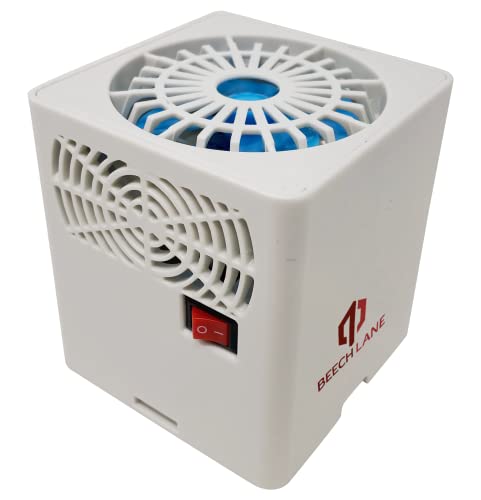
Beech Lane high-power 3,000 RPM RV fridge fan
3,000 RPM motorSwitch controlLifetime warrantyWeb top vent
Check price on Amazon
Best for: Owners who want a single strong fan and a long warranty.

Beech Lane builds this fan around a patented 3,000 RPM motor and contrasts it with competitor versions it says use around 700 RPM. A faster motor moves more air through the cooling fins, which is the whole job of a fridge vent fan. The top opening has been re-engineered with a spider-web pattern for more airflow, and the unit is backed by a lifetime warranty and US-based customer service.

The tradeoff is power and noise. A fan that spins four times faster than a competitor will move more air but may also produce more sound, and it will draw more current. The control is a simple switch rather than a thermostat, so you remember to turn it on and off. Beside the remote-controlled dual-fan kit from the same maker, it is simpler but less automatic.

Ownership is easy. Mount the unit so air flows out of the vent rather than recirculating, clean dust from the blades and use a fused 12V feed. The lifetime warranty is the feature that makes the purchase low risk. Keep the receipt and a photo of the installed fan, since a warranty claim goes faster with proof of purchase and a clear picture of how the unit was mounted.

What works

  • Patented 3,000 RPM motor for strong airflow
  • Lifetime warranty with US-based service
  • Simple on and off switch
  • Re-engineered top opening for more air

Watch out for

  • No thermostat or remote
  • A fast motor may be louder than slow fans
  • Draws more current than a slow fan

Spec sheet

Motor
3,000 RPM, patented
Control
On and off switch
Warranty
Lifetime, USA-based service
Top
Re-engineered web-style opening
Fit
Multiple side vents
02
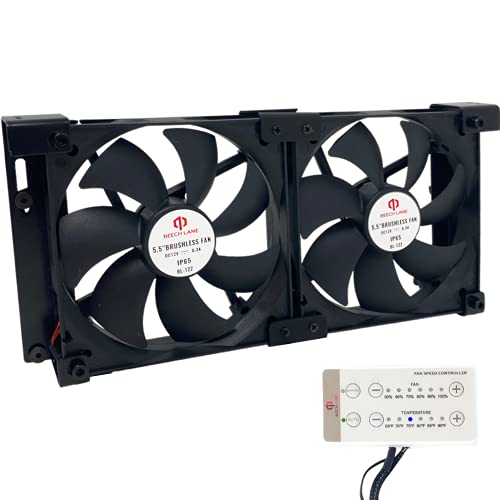
Beech Lane dual 5.5 inch waterproof fridge fan with remote
Dual 5.5 inchWaterproofRemoteAuto and manual
Check price on Amazon
Best for: Owners who want dual fans with a remote and weather resistance.

This kit has two 5.5 inch fans, a waterproof design, a custom remote and auto and manual modes. The mounts are re-engineered to fit American RV side vents, which matters because many fans sold online are built for European vent shapes. Two fans cover more of the vent area than one, and the remote lets you switch modes without opening the cover.

The tradeoff is complexity. A kit with a remote and a control board has more parts to fail, and a pair of fans draws more current than one. A waterproof rating covers rain on the vent but still demands a sealed electrical connection. Set beside the 3,000 RPM single fan, this is the more convenient and less simple option.

Install by fitting the mounts to the vent slats, running the wire neatly to a fused 12V source and pairing the remote. Check the mounts after the first long trip, because vibration can loosen brackets. Two fans in one vent also deserve a quick look at the wire routing, since a loose lead that touches a hot surface behind the fridge can melt its insulation over a hot summer.

What works

  • Dual 5.5 inch fans cover more vent area
  • Waterproof design for side vents
  • Remote with auto and manual modes
  • Mounts re-engineered for American vents

Watch out for

  • More electronics to fail
  • Two fans draw more current
  • Brackets can loosen with vibration

Spec sheet

Fans
Dual 5.5 inch, 140mm
Weather
Waterproof, high power
Control
Custom remote, auto and manual
Mounts
Re-engineered for American RV vents
Voltage
12V
03
TITAN 12V long-shaped RV fridge ventilation fan
Long-shaped body12V DCAuto temp controlSturdy brackets
Check price on Amazon
Best for: Long, narrow vent openings where a square fan leaves gaps.

TITAN designed a long, narrow fan to match the shape of American RV fridge side vents, with robust brackets and an intelligent control mode that combines auto temperature control and manual speed. A long format fits the vent opening better than a square fan, which can leave gaps. The sturdy brackets are meant to hold the fan against road vibration.

The price of that is that the listing says little about airflow numbers or motor speed, so you are trusting the design rather than a measured figure. Auto temperature control is helpful but depends on a sensor placed correctly. Against the Beech Lane kits, it has a smaller brand story.

Check that your vent dimensions match the listing before ordering. Mount the fan to push air outward, route the wire away from heat and test the auto mode on a warm day. A hot day on pavement is the best test, because a fan that helps there will help anywhere, and a fan that does nothing there is not worth keeping.

What works

  • Long shape fits American side vents
  • Robust mounting brackets
  • Auto temperature control plus manual speed
  • Easy installation

Watch out for

  • Little data on airflow or motor speed
  • Sensor placement affects auto mode
  • Smaller brand story than Beech Lane

Spec sheet

Shape
Long format for American side vents
Voltage
12V DC
Control
Auto temperature and manual speed
Brackets
Robust mounting design
Install
Easy fit to standard vents
04
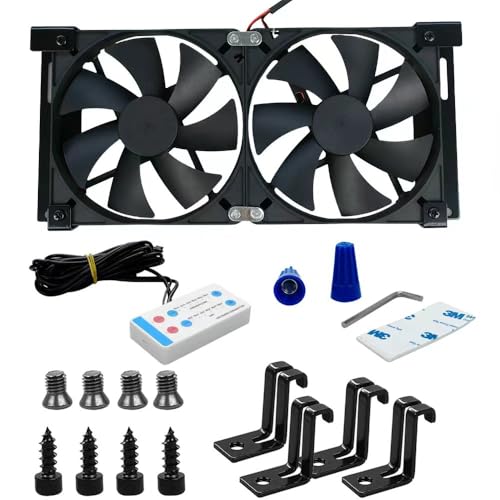
12V 5.5 inch fridge vent fan with auto sensing and remote
5.5 inch fanAuto from 68F6-speed manualUnder 32 dB
Check price on Amazon
Best for: Mild-climate owners who want quiet automatic cooling help.

This 5.5 inch fan offers automatic temperature sensing that begins at 68 degrees Fahrenheit, a six-speed manual mode and a remote, and the maker claims silent operation under 32 dB. Auto mode lets the fan start only when the compartment warms, which saves current. A quiet motor matters when the fridge vent sits near a bedroom wall.

What you give up is that a quiet low-power fan moves less air than a 3,000 RPM motor. In extreme heat, it may not be enough. The 32 dB figure is a maker claim measured at a speed the listing does not detail.

It makes sense for a mild-climate owner who wants a quiet, automatic fan. Mount the temperature sensor where it reads the compartment air, not the sun on the vent, and clean the blades each season. If the fan starts too early or too late, move the sensor a few inches and try again, since a sensor in the wrong spot is the main reason an auto mode disappoints.

What works

  • Auto sensing starts at about 68F
  • Six manual speeds
  • Claimed noise under 32 dB
  • Remote control

Watch out for

  • Less airflow than a high-RPM fan
  • Noise figure is a maker claim
  • Sensor placement matters

Spec sheet

Size
5.5 inch, 140mm
Auto mode
Temperature sensing from 68F
Manual
6-speed adjustment
Noise
Under 32 dB claimed
Control
Remote
05
Quick Products QP-RFVCF90 90mm refrigerator vent fan
90mm fanAuto and manualSelectable speedsControl box
Check price on Amazon
Best for: Compact vents that cannot take a 140mm fan.

Quick Products makes this 90mm refrigerator vent fan with automatic cooling, on-demand operation and selectable speeds shown on an easy-to-read control box. At 90mm it is smaller than the 140mm designs, so it suits a compact vent where a bigger fan will not fit. The control box lets you see speed at a glance.

The tradeoff is size. A smaller fan moves less air, so it helps modestly in a hot compartment. It does not carry the waterproof or remote features of the Beech Lane kit. It also mounts differently, so confirm the vent opening before ordering.

Use it where a small fan is all that fits. Mount the control box within reach, route the wire cleanly and clean the blades each season. In a tight compartment, check that the fan housing does not rub against a vent slat when the rig flexes on the road, because a rubbing fan will chew through its own blades.

What works

  • 90mm size fits compact vents
  • Auto and manual modes
  • Selectable speeds on a control box
  • Established accessory brand

Watch out for

  • Smaller fan moves less air
  • No remote or waterproof claim
  • Needs the vent size confirmed

Spec sheet

Size
90mm
Modes
Auto and manual
Speeds
Selectable
Control
Display control box
Brand
Quick Products

Spec sheet decoder

What the numbers on the box really mean

The specs manufacturers lead with, translated into what they tell you about real-world performance.

RPM

Revolutions per minute describes motor speed. A faster motor moves more air but may be louder.

Watch forBeech Lane lists 3,000 RPM versus about 700 RPM for competitors.

Size in mm

Fan diameter sets how much vent area it covers. A bigger fan moves more air at a lower speed.

Watch for140mm versus 90mm changes fit.

Auto start temperature

The temperature at which an auto mode starts the fan. Lower numbers run the fan more often.

Watch forThe 5.5 inch auto fan starts from 68F.

Waterproof rating

A claim of resistance to water on the vent. It does not cover submerged or flooded wiring.

Watch forBeech Lane lists a waterproof design.

Absorption cycle

A cooling cycle that uses heat and a flow of air, not a compressor. It depends on ventilation behind the fridge.

Watch forA vent fan helps only absorption-style fridges.

Methodology

How We Evaluated These RV Refrigerator Vent Fans

Airflow strength

We compared stated motor speeds and fan sizes, such as 3,000 RPM and 140mm versus 90mm. A fan that moves more air cools better in heat. We treated numbers as maker claims, and we noted that a larger fan at a lower speed is often quieter than a small fan at a high one, even when the airflow is similar.

Control options

We looked at auto sensing, manual speeds and remotes. A fan that runs only when needed saves current and noise. We also noted whether a manual override exists, since an auto mode that misreads the compartment needs a fallback.

Fit and mounting

We considered bracket design, vent shape and size. A fan that matches American vents scored higher, because many low-cost fans are built for different vent shapes and need creative mounting that can fail on the road.

Weather resistance

We checked for waterproof claims and sealed connections. Vent fans live outdoors and fail when water gets in, so a sealed motor and a protected connector are worth more than an extra speed setting.

Support and warranty

We weighed warranty terms and service. A lifetime warranty with US-based service adds confidence, because a fan that dies in its second summer should be replaced without an argument.

Decision guide

How to Choose the Right RV Refrigerator Vent Fans

By Climate

SituationPickWhy
Hot desert campingBeech Lane 3,000 RPMStrongest airflow claim
Humid summers, rain on the ventBeech Lane dual 5.5 inchWaterproof design
Mild climate, quiet preference12V 5.5 inch auto fanUnder 32 dB claim
Small ventQuick Products 90mmCompact size

By Budget

TierPickWhy
LowestTITAN long fanPlain 12V fan
Low to midQuick Products 90mmCompact accessory
Mid12V 5.5 inch auto fanAuto mode and remote
UpperBeech Lane 3,000 RPMStrong motor and warranty

Single Strong Fan vs Dual Kit

Single

The Beech Lane 3,000 RPM unit moves a lot of air from one fan with a simple switch. It is the simplest and sturdiest option.

Dual

The Beech Lane dual kit covers more vent area and adds a remote and weather protection. It is more convenient and more complex.

Choose a single fan for simplicity; choose a dual kit for coverage and remote control.

Control Axis

PreferencePickWhy
Set and forget12V 5.5 inch auto fanAuto sensing
Simple switchBeech Lane 3,000 RPMOn and off
Remote from the cabBeech Lane dual 5.5 inchCustom remote
See the speed at a glanceQuick Products 90mmControl box display

For Summer Boondocking Specifically

Look for

A fan that moves air without draining the battery. Auto start saves current, and a strong motor helps in heat.

In this comparison

The 12V 5.5 inch auto fan starts only when the compartment warms, while the Beech Lane 3,000 RPM unit gives the strongest airflow.

When to Spend More

Spend more if

You camp in hot places. The Beech Lane 3,000 RPM fan and its lifetime warranty justify the cost.

Save if

Your fridge copes well already. The TITAN or the Quick Products 90mm is enough.

Ownership

Maintenance schedule

The upkeep that decides whether this machine lasts two seasons or ten.

TaskIntervalWhy it matters
Clean blades and ventEvery few monthsDust and lint reduce airflow. A soft brush keeps the blades balanced, and a quick wipe with a damp cloth removes the sticky film that builds up from road spray and cooking vapor.
Check mountsAfter long tripsVibration loosens brackets. Tighten screws and add thread lock, and confirm that no part of the housing rubs the vent slats, because rubbing wears through plastic quickly on a rough road.
Inspect wiringEvery yearCorrosion at a splice causes a dead fan. Reseal with dielectric grease, and replace any connector that shows green corrosion, since a high-resistance joint can run hot and slow the fan before it fails outright.
Test auto modeEach seasonA sensor that is dirty or misplaced may not start. Check it on a warm day by holding a warm hand near the sensor and listening for the fan to start, or by switching to manual and back to confirm the override works.
Check the burner areaEvery yearA fan cannot fix a dirty burner or flue. Clean the compartment too, vacuuming dust, wasp nests and lint from behind the fridge, since a blocked flue starves the cooling unit of draft and no fan can make up for that.

FAQ

Frequently Asked Questions

Does a vent fan really help an RV fridge?

It can, because an absorption fridge depends on air moving over its cooling coil. In hot, still weather a fan can lower cabinet temperature noticeably. The gain is largest when the rig sits in full sun with the fridge compartment facing the sun, and smallest in shade with a breeze.

Which size should I buy?

Measure your vent opening. A 140mm fan covers a typical American side vent, while a 90mm fan suits a compact one. If you are between sizes, choose the larger fan only if the mounts seat firmly, because a loose fan is worse than a small one.

Should I run the fan all the time?

Not necessarily. An auto mode runs only when the compartment warms, which saves power and noise.

Will a fan work on a compressor fridge?

It helps less, because a compressor fridge has its own cooling fan. A vent fan is aimed at absorption-style units.

Why is my fridge still warm?

Check level, door seals, burner or element operation and ventilation, in that order, and keep the rig level when parked. A fan cannot fix a fridge that is off level.

Can I wire it myself?

Many owners do. Use a fused 12V feed, seal connections and route wires away from heat. A switched feed that turns off with the ignition, or a fuse you can pull, keeps a forgotten fan from draining the battery over a long storage period.

Bottom line

The short version

Browse more rv refrigerator vent fanson Amazon →
James Miller, Lead Machine Editor

About the author

James Miller

Lead Machine Editor, MachineFanatic

James Miller leads MachineFanatic's buying guides, turning spec sheets, manuals and owner feedback into clear verdicts on power tools, outdoor power equipment, shop machines and kitchen machines.

More from James →

Keep reading

Related guides