
Amazon affiliate links - we earn a commission.Affiliate disclosure

Buying guide · 13 min read · Updated 2026-11-25

Best RV Vent Fans (2026)

Five 14 inch RV roof vent fans compared on remote or manual control, rain shields, speed steps and install details, from 3-speed manual to 10-speed remote.

James MillerBy James MillerLead Machine Editor5 machines comparedSpec-sheet verified
Best RV Vent Fans

At a glance

Our top picks

Side by side

Spec comparison

MachineSpeedsControlRainOpening
OUTPRIZE 14 inch remote roof vent fan with rain shieldBest OverallOUTPRIZE 14 inch remote roof vent fan with rain shield10, reversibleRemoteBuilt-in rain cover14 x 14 inch, fits up to 14.5 inch
OUTPRIZE 14 inch manual roof vent fan with rain shieldBest Manual Rain-ShieldOUTPRIZE 14 inch manual roof vent fan with rain shield3, reversibleManual crank lid and switchBuilt-in rain covern/a
RVMATE 14x14 reversible roof vent fan with remoteBest Simple RemoteRVMATE 14x14 reversible roof vent fan with remoten/aHigh-sensitivity remoten/a14 x 14 inch
14x14 10-speed roof vent fan with remote and rain sensorBest Spare Screen Included14x14 10-speed roof vent fan with remote and rain sensor10 via remoten/aIntegrated rain sensor14 x 14 inch
GDDGHS 14 inch manual-opening roof vent with 12V fanBest Basic Manual VentGDDGHS 14 inch manual-opening roof vent with 12V fann/an/an/aManual

A roof vent fan does three jobs that an air conditioner cannot: it clears cooking smoke, it vents humid air from a shower and it brings in cool night air for free. Because it works on a few amps, it can run all night where an air conditioner cannot run at all.

The differences between fans are mostly in the lid, the controls and the weather protection. Below we compare five 14 inch roof fans on how they open, how they handle rain, how many speeds they offer and what the installation really involves.

Before you buy

6 Criteria to Look For Before Buying a RV Vent Fan

  1. 01

    Remote versus manual lid

    A remote lets you operate the lid and fan from bed, while a manual crank keeps electronics out of the roof. The OUTPRIZE remote model and RVMATE offer remotes, and the OUTPRIZE manual and GDDGHS use cranks. If the remote battery dies at 2 a.m., a manual backup is worth more than any feature on the box. A remote can also be paired to only one fan, so a rig with two roof fans may need two remotes or a wall controller, and that is worth checking before you buy a pair.

  2. 02

    Rain protection type

    A built-in rain cover lets a fan run in light rain, while a sensor closes the lid. The OUTPRIZE models have the cover, and the 10-speed 1000 CFM model has a sensor. Choose by whether you want airflow during rain or protection while you are away. A cover also helps in dusty places, where it keeps grit off the blades, and in autumn, where it keeps leaves out of the opening.

  3. 03

    Speed steps

    Ten speeds give a finer low setting than three, which matters for night use. The OUTPRIZE remote and the 10-speed 1000 CFM models offer ten, and the OUTPRIZE manual offers three. Matching steps to use avoids drafts and noise. If you plan to leave the fan running all night, favor a unit whose lowest step is truly gentle, and test it on a calm evening before deciding it is right.

  4. 04

    Noise claim and real sound

    The OUTPRIZE models claim about 45 dB, which is moderate. Real noise depends on blade speed and lid rattle. A fan that is quiet at low speed may be loud at the top, so judge by the speed you will use at night. A claimed 45 dB is similar to a quiet office, which most people find acceptable, but a light sleeper may still prefer a brushless design.

  5. 05

    Opening and roof thickness

    The standard opening is 14 by 14 inches, and the OUTPRIZE fits up to about 14.5 inches. Roof thickness affects the flange, so check the range on the listing. A poor fit means gaps that leak or let in bugs. Take a tape measure to the roof, measure the opening in both directions and write the numbers down before you shop, since a square opening can be a little out of square after years of flexing.

  6. 06

    Fuse and wire

    Roof fans commonly use a fused 12V circuit, often around 10 to 15 amps, and the OUTPRIZE manual includes spare 5 amp slow-blow fuses. Use the gauge the maker lists and place the fuse near the source. If the original wire looks brittle or discolored, replace it rather than reusing it, because a fan that draws a few amps for hours will find any weak connection.

Detailed reviews

The 5 best rv vent fans, explained

01
OUTPRIZE 14 inch remote roof vent fan with rain shield
10-speedRemote controlRain shield45 dB claim
Check price on Amazon
Best for: Everyday RVers who want rain-time airflow and remote control at a mid tier.

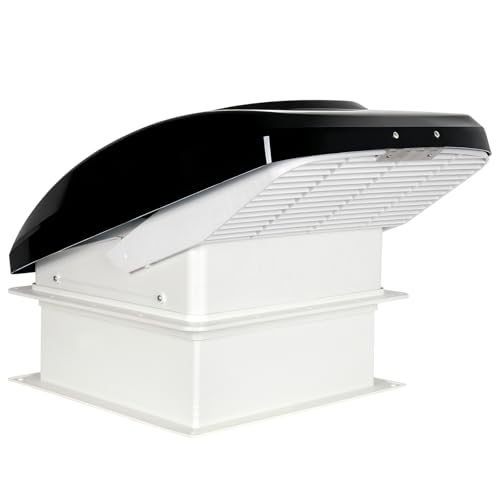
OUTPRIZE combines a ten-speed reversible 12V fan with a remote and a built-in rain cover, in a design that fits a standard 14 inch roof opening and tolerates openings up to about 14.5 inches. The rain cover protects against rain, dust and fallen leaves while the fan runs, which makes it useful at the shower and in damp weather. The remote means you can change speed and direction without leaving bed.

The catch is that the 45 dB noise claim is not whisper quiet, and the figure is a maker claim. The electronics also draw a little when the fan is off. Beside the manual OUTPRIZE, you are paying for convenience and an extra layer of electronics that can fail. If the remote battery dies, you want a manual way to operate the lid.

Ownership is routine: clean the screen, check the flange sealant each year and confirm the fuse rating. The maker includes spare 5 amp slow-blow fuses on related models, so keep a few on hand. Also confirm your roof thickness against the listing before you cut or modify anything. When you pull the old fan, check the roof framing around the opening for soft spots, because a leak that went unnoticed for years can leave rotted wood that a new fan will not fix.

What works

  • Ten speeds with a remote
  • Built-in rain cover allows running in light rain
  • Reversible for intake or exhaust
  • Fits openings up to about 14.5 inches

Watch out for

  • 45 dB is louder than the quietest brushless fans
  • Remote and board add electronics that can fail
  • Idle draw is not zero

Spec sheet

Speeds
10, reversible
Control
Remote
Rain
Built-in rain cover
Noise
45 dB claimed
Opening
14 x 14 inch, fits up to 14.5 inch
02
OUTPRIZE 14 inch manual roof vent fan with rain shield
3-speedManual crankRain shield45 dB claim
Check price on Amazon
Best for: Owners who value mechanical simplicity and a rain cover.

This manual OUTPRIZE has three speeds, a reversible fan, a crank-opened lid and the same built-in rain cover as the remote model. Manual control keeps the electronics to a minimum, and the maker argues it is more flexible and reliable than a remote version. Two extra 5 amp slow fuses come in the box.

The downside is that three speeds are coarse and the crank requires you to reach the ceiling. If you sleep in a loft or a bunk above the vent, that is inconvenient. The fan lacks a thermostat and an electric lid, so you cannot automate cooling. Next to the remote version, you save on electronics but give up fine control.

It suits an owner who likes mechanical simplicity. Keep the crank mechanism lubricated, clean the screen and recheck the flange sealant each year. If the lid does not hold position, adjust the tension screw rather than forcing the crank. A manual lid also means you can leave it cracked a little for ventilation while you are out, which suits an owner who wants a vent that never needs a battery or a remote.

What works

  • Built-in rain cover allows running in rain
  • Manual crank means fewer electronics
  • Three speeds with a reversible fan
  • Two spare 5A slow-blow fuses included

Watch out for

  • Only three speed steps
  • Crank requires reaching the ceiling
  • 45 dB is a mid-level noise claim

Spec sheet

Speeds
3, reversible
Control
Manual crank lid and switch
Rain
Built-in rain cover
Noise
45 dB claimed
Fuses
Two spare 5A slow-blow included
03
RVMATE 14x14 reversible roof vent fan with remote
RemoteReversible6 inch bladesUV-resistant plastic
Check price on Amazon
Best for: Buyers who want a plain remote fan for a standard opening.

RVMATE sells a white 14 by 14 inch roof vent fan with a high-sensitivity remote, reversible exhaust and 6 inch blades. The body is premium plastic with a UV-resistant finish, which resists fading on a sunny roof. It is designed to fit standard openings.

One limit is that the listing carries few details on speeds, rain protection or noise. A remote adds convenience, and you will want to know what happens if the remote fails. It has no stated rain shield, so rain means a closed lid.

It is a straightforward upgrade from a failing basic fan. Install with fresh sealant, clean the screen and keep the remote battery fresh. If the remote loses range, check the battery before blaming the receiver. White plastic bodies also show dirt and road film more than dark ones, so a periodic wash with mild soap keeps the lid from yellowing and keeps the sensor area clear.

What works

  • Remote control for the lid and fan
  • Reversible exhaust and intake
  • UV-resistant plastic body
  • Standard 14 x 14 inch fit

Watch out for

  • Little detail about speeds and noise
  • No stated rain shield
  • Remote adds a battery to maintain

Spec sheet

Opening
14 x 14 inch
Control
High-sensitivity remote
Blades
6 inch
Body
UV-resistant plastic, white
Fit
Standard roof openings
04
14x14 10-speed roof vent fan with remote and rain sensor
10-speedRain sensor1000 CFM claimSpare screen frame
Check price on Amazon
Best for: Buyers who want automatic rain closing and a spare screen frame.

This ten-speed 14 by 14 inch roof fan includes a remote, an integrated rain sensor that closes the lid, a claimed 1000 CFM peak and an extra screen frame in the box. The spare screen is a small convenience, because a bug screen gets dirty or torn long before the motor fails. The remote covers speed and direction.

The real cost is that a rain sensor closes the lid, so airflow stops when it rains. The 1000 CFM claim is a maximum, and the listing is light on brand history. It lacks the rain shield of the OUTPRIZE remote model.

Use it where you want automatic rain closing and a spare screen. Clean the sensor with a damp cloth, check the sealant and keep the remote battery fresh. Keep the spare screen frame in a drawer with the fan paperwork, so a torn screen in the middle of a bug season is a two-minute swap rather than an order.

What works

  • Ten speeds via remote
  • Integrated rain sensor closes the lid
  • Spare screen frame included
  • 1000 CFM peak claimed

Watch out for

  • Sensor closes the lid but does not allow rain-time airflow
  • Brand history is thin
  • 1000 CFM is a top-speed claim

Spec sheet

Speeds
10 via remote
Airflow
Up to 1000 CFM claimed
Rain
Integrated rain sensor
Extra
Spare screen frame included
Opening
14 x 14 inch
05
GDDGHS 14 inch manual-opening roof vent with 12V fan
Manual opening12V fanScreenPutty tape
Check price on Amazon
Best for: Budget swaps where a plain manual vent is enough.

GDDGHS offers a universal 14 by 14 inch roof vent with a 12 volt fan, a manual opening lid, a screen and putty tape for sealing. It is the plainest option here and is aimed at bathrooms and campers where a simple vent is enough. The included putty tape helps with a first installation.

The tradeoff is features. There are no stated speed steps, no rain cover and no remote. The listing gives few performance numbers, so you are buying a basic vent. For a budget swap, that is acceptable, but it will not match the control of the 10-speed models.

Install with fresh sealant, clean the screen and treat the fan as a replaceable part. If you want rain-time airflow or fine control, spend more on a different model. A basic vent is also a fine choice for a storage shed or a tool trailer where the fan only needs to move stale air a few times a week.

What works

  • Universal 14 x 14 inch fit
  • Manual opening with few electronics
  • Screen and putty tape included
  • Simple 12V fan

Watch out for

  • Few performance details
  • No rain cover or remote
  • Limited control over airflow

Spec sheet

Size
14 x 14 inch universal
Opening
Manual
Fan
12V motor
Included
Screen and putty tape
Use
Bathroom or camper ventilation

Spec sheet decoder

What the numbers on the box really mean

The specs manufacturers lead with, translated into what they tell you about real-world performance.

Rain cover

A hood that keeps rain off the opening so the fan can run with the lid open. It differs from a sensor.

Watch forOUTPRIZE lists it on both its models.

Rain sensor

A sensor that closes the lid when it detects water. It protects the cabin but ends airflow.

Watch forThe 10-speed 1000 CFM model has one.

CFM

Cubic feet per minute of air moved at a stated speed. It is a top-speed number.

Watch forThe 10-speed model claims up to 1000 CFM.

dB

Decibels describe noise. Lower is quieter, and the speed matters.

Watch forOUTPRIZE claims 45 dB on its models.

Reversible

The fan can pull air in or push it out. It lets you exhaust smoke or bring in cool night air. Pairing intake at one end of the rig with exhaust at the other creates a cross breeze that cools better than either fan alone.

Watch forOUTPRIZE and RVMATE list reversible airflow.

Methodology

How We Evaluated These RV Vent Fans

Weather handling

We compared rain covers, sensors and lid seals. A cover that allows running in rain scored highest. We noted that a sensor protects a cabin when you are away. We also asked how each lid seals when closed, since a fan that leaks air around the gasket defeats the point of keeping rain out.

Control and convenience

We looked at remotes, manual cranks and speed steps. A remote and ten speeds improve comfort, while a manual crank improves reliability. Neither is better in every case, so we scored them against the habits of a typical owner and noted where the tradeoff is personal.

Noise and airflow claims

We recorded stated dB and CFM and treated them as maker claims. We favored listings that name the speed the figure applies to, and we marked down any listing that quotes only a peak number with no context. A single number without a condition is a weak basis for a purchase.

Fit and install

We checked opening sizes, roof thickness ranges and included parts such as screens, fuses and putty tape. Fit details reduce install surprises. We also noted which listings include hardware, since a fan that arrives with the right screws, a gasket and tape saves a trip to the store on installation day.

Simplicity and reliability

We weighed the number of electronic parts that can fail. A simpler fan can beat a feature-rich one over years of use, especially on a rig that sits for months at a time. We gave extra credit to designs that fail gracefully, leaving the lid closed or the vent usable by hand.

Decision guide

How to Choose the Right RV Vent Fans

By Control Style

SituationPickWhy
Sleep under the vent, want a remoteOUTPRIZE remote with rain shieldTen speeds and a remote
Prefer mechanical simplicityOUTPRIZE manual with rain shieldCrank lid, three speeds
Plain remote on a standard openingRVMATE 14x14High-sensitivity remote
Automatic rain closing10-speed 1000 CFM modelIntegrated rain sensor

By Budget

TierPickWhy
LowestGDDGHS manual ventBasic fan
Low to midOUTPRIZE manual with rain shieldRain cover at a lower tier
MidRVMATE 14x14Remote
UpperOUTPRIZE remote with rain shieldTen speeds and rain cover

Cover vs Sensor

Cover

The OUTPRIZE models let you run the fan in light rain. They keep air moving and cut condensation.

Sensor

The 10-speed 1000 CFM model closes the lid when it rains. It protects an empty cabin.

Choose a cover if you are inside during storms; choose a sensor if you leave the rig open when you go out.

Speed Axis

PreferencePickWhy
Fine low settingOUTPRIZE remote with rain shieldTen steps
Fine low setting with sensor10-speed 1000 CFM modelTen steps
Coarse and simpleOUTPRIZE manual with rain shieldThree steps
No stated stepsGDDGHS manual ventBasic

For Bathroom Venting Specifically

Look for

A fan that can run during a shower and stay open in humid weather. A rain cover helps in wet conditions.

In this comparison

The OUTPRIZE manual with rain shield pairs a crank lid with a cover, and the GDDGHS is a plain bathroom-style vent.

When to Spend More

Spend more if

You camp in all weather. The OUTPRIZE remote with rain shield offers ten speeds and rain-time airflow.

Save if

You camp in fair weather. The GDDGHS or RVMATE is enough.

Ownership

Maintenance schedule

The upkeep that decides whether this machine lasts two seasons or ten.

TaskIntervalWhy it matters
Clean the screenEvery few monthsA dirty screen cuts airflow and strains the motor. Remove it and wash with mild soap.
Inspect roof sealantEvery yearCracked sealant leaks. Re-seal the flange at the first sign of cracking.
Check the fuseEvery yearA blown fuse is the first cause of a dead fan. Replace with the listed rating. If it blows again right away, look for a pinched wire or a seized motor rather than fitting a bigger fuse.
Lubricate the crankEvery yearA dry crank binds and strips. Use a dry lubricant on the pivot, and avoid oily sprays that attract dust and gum up the track over a season of travel.
Replace remote batteryEvery yearA weak battery shortens range and causes missed commands.

FAQ

Frequently Asked Questions

How do I choose between remote and manual?

A remote is convenient and offers finer speed control, while a manual crank is simpler and more reliable. If you sleep below the vent, a remote is worth it. If the rig is a weekend toy that you use in fair weather, the extra electronics may not pay off.

Can I run the fan in the rain?

Only if it has a built-in rain cover. A rain sensor simply closes the lid. The cover version keeps air moving, which helps with humidity, and the sensor version protects the cabin when you are away from the rig.

Will a 14 inch fan fit my roof?

Most RVs have a 14 by 14 inch opening, and some fans tolerate up to about 14.5 inches. Check your roof thickness and trim.

Why is my fan noisy?

Noise comes from blades, lid vibration and speed. Lower the speed and check for loose screws. A rattle at one speed often points to a loose trim ring or a bent blade rather than a motor fault.

What fuse should I use?

Use the rating on the maker sheet, often a 10 to 15 amp circuit. Keep spares on hand.

Does a roof fan replace an air conditioner?

No. A fan exhausts heat and smoke but cannot cool below outside air.

Bottom line

The short version

Browse more rv vent fanson Amazon →
James Miller, Lead Machine Editor

About the author

James Miller

Lead Machine Editor, MachineFanatic

James Miller leads MachineFanatic's buying guides, turning spec sheets, manuals and owner feedback into clear verdicts on power tools, outdoor power equipment, shop machines and kitchen machines.

More from James →

Keep reading

Related guides