

Amazon affiliate links - we earn a commission.Affiliate disclosure

Buying guide · 16 min read · Updated 2026-11-06

Best RV Solar Generators (2026)

Six RV solar generators compared on watt-hours, inverter output, 30 amp outlets, solar input and alternator charging, from 1 kWh kits to 3.8 kWh stations.

James MillerBy James MillerLead Machine Editor6 machines comparedSpec-sheet verified
Best RV Solar Generators

At a glance

Our top picks

Side by side

Spec comparison

MachineCapacityAC outputUPSSolar
Anker SOLIX C2000 Gen 2 2,048Wh Power StationBest OverallAnker SOLIX C2000 Gen 2 2,048Wh Power Station2,048 Wh LiFePO4, expandable to 4 kWh2,400 W rated, 4,000 W peakn/an/a
BLUETTI AC180 with 200W Solar PanelBest Starter KitBLUETTI AC180 with 200W Solar Panel1,152 Wh LFP1,800 W, 2,700 W boost20 ms switchovern/a
EcoFlow DELTA 3 Classic with 220W PanelBest Compact Fast ChargerEcoFlow DELTA 3 Classic with 220W Panel1,024 Wh LiFePO41,800 W, 3,600 W surge, X-Boost to 2,600 WUnder 10 ms220 W bifacial panel, about 5.8 h
Jackery HomePower 3000 with 2x200W PanelsBest for 30A RV HookupJackery HomePower 3000 with 2x200W Panels3,072 Wh LiFePO43,600 W, 7,200 W surge20 ms or lessTwo 200 W panels, 80% in about 9 h
Jackery HomePower 3600 Plus with 2x200W PanelsBest ExpandableJackery HomePower 3600 Plus with 2x200W Panels3,584 Wh LFP, expandable to 21 kWh3,600 W, 7,200 W in paralleln/aTwo 200 W panels
ABOK Ark3600 with 400W Solar PanelBest Large-Capacity ValueABOK Ark3600 with 400W Solar Panel3,840 Wh, expandable to 11,520 Wh3,600 W rated, 4,500 W peakn/an/a

An RV solar generator is a lithium battery power station paired with panels, so the camper can run its fridge, lights, water pump and electronics without a campground hookup. It replaces a noisy generator for most daily loads, but only if the battery and solar input are sized to what the RV actually uses. Listings blur watt-hours with watts, which hides the real limit.

This guide explains how to size a station to an RV's daily energy use, what the output and surge ratings mean for a rooftop air conditioner, and how alternator, shore and solar charging fit a travel day. Start with the picks above for the shortlist, then read the reviews below to match a station to your rig, your travel style and your budget.

Before you buy

6 Criteria to Look For Before Buying a RV Solar Generator

  1. 01

    Daily watt-hour budget

    Add up what the RV uses in a day: a compressor fridge takes about 1 to 1.5 kilowatt-hours, lighting and water pumps a few hundred watt-hours, and a laptop and router another 300 to 500. A 1,024 Wh station such as the EcoFlow Delta 3 Classic covers about a day of the basics, while the 3,584 Wh HomePower 3600 Plus covers two or more. Buyers often size for peak watts and discover the battery lasts an evening. Add 20 percent for inverter losses before you decide.

  2. 02

    Rooftop air conditioner reality

    A 13,500 BTU rooftop air conditioner runs on roughly 1,300 to 1,500 watts, so a 3,072 Wh station like the HomePower 3000 gives about two hours of cooling, and the 2,048 Wh Anker C2000 Gen 2 about 1.5 hours. Startup surge is the second problem: look for a surge rating of 4,000 watts or more, and consider a soft start device. A portable station cools for hours, not overnight, unless you pair it with heavy panels.

  3. 03

    Charging routes while traveling

    Solar alone is slow and weather-dependent, so the other routes matter. The Anker C2000 Gen 2 quotes up to 800 watts from the vehicle alternator, refilling in about 3 hours of driving, while the BLUETTI AC180 quotes 1,440 watts from AC for a one hour refill. The ABOK Ark3600 limits AC charging to 1,500 watts but accepts 2,000 watts of solar. If you drive daily, alternator charging beats a big panel array.

  4. 04

    30 amp outlet and RV plug

    An RV shore cord runs on 30 or 50 amps and cannot plug into a household outlet at full capacity. The Jackery HomePower 3000 has a built-in TT-30 port and the ABOK Ark3600 lists one 30 amp AC outlet. Others rely on 20 amp household outlets, which limit what you can feed. Check that the port type matches your cord before you buy, and do not backfeed an RV through its shore cord without a proper transfer arrangement.

  5. 05

    Battery chemistry and cycle life

    Lithium iron phosphate cells tolerate heat and thousands of cycles, which matters in a hot RV bay. The Jackery HomePower 3600 Plus is rated 6,000 cycles and the HomePower 3000 4,000 cycles, and the EcoFlow Delta 3 Classic is rated for 10 plus years of daily use. LiFePO4 is heavier than older lithium-ion, but the longevity is worth the weight. Avoid stations that do not state chemistry or cycle life.

  6. 06

    Weight, mounting and ventilation

    A 41.7 pound Anker C2000 Gen 2 can be carried and shifted, while a 3 kWh wheeled unit is a semi-permanent fixture. Heavy batteries must be strapped so they do not slide in a turn, and cooling fans need open airflow. Avoid enclosed cabinets where temperatures rise above 100 degrees Fahrenheit in summer. Plan the cable run to the RV before you pick a size.

Detailed reviews

The 6 best rv solar generators, explained

01
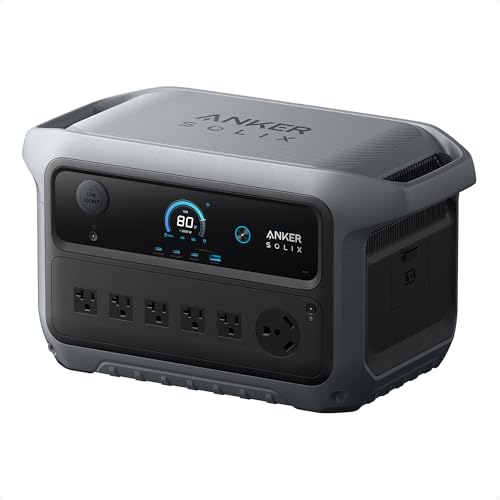
Anker SOLIX C2000 Gen 2 2,048Wh Power Station
2,048 Wh LiFePO42,400 W (4,000 W peak)800 W alternator charging41.7 lb
Check price on Amazon
Best for: RVers who want one station with strong output, long standby efficiency and alternator charging.

For an RV, the C2000 Gen 2 has the most useful combination of capacity, output and charging routes. It stores 2,048 watt-hours, enough to run a dual-door fridge for roughly 32 hours at its quoted 9 watt standby draw, and its 2,400 watt rating with 4,000 watts of peak output is described by Anker as enough for most window and RV air conditioners. The expansion battery path to 4 kilowatt-hours also gives a growth route.

What sets it apart in a camper is the 800 watt alternator charging, which Anker says refills the station in about 3 hours while you drive, as opposed to a cigarette socket's trickle. That turns travel days into charging time and cuts the need for big solar arrays. Compared with the Jackery HomePower 3000, it carries about a third less capacity but weighs a bit more than 40 pounds, a more manageable lift. Compared with the Bluetti AC180, it doubles the capacity for the same class of output.

The tradeoff is that the unit ships as a bare station, and a rooftop air conditioner will still drain 2,048 Wh quickly, about 1.5 hours of running a typical 13,500 BTU unit. Plan solar and alternator charging for any multi-day trip. Ownership is simple: LiFePO4 chemistry, no fuel, and a quiet fan. Mount it where the vents are clear and the cable runs are short.

What works

  • Eight hundred watt alternator charging refills it while driving
  • Nine watt standby draw runs a fridge for about 32 hours
  • Rated 2,400 W with 4,000 W peak for compressor starts
  • Expands to 4 kWh with an add-on battery

Watch out for

  • Holds about 1.5 hours of a typical rooftop AC at full draw
  • Sold as a station, so panels are a separate purchase
  • At 41.7 lb it is a two-handed lift out of a cargo bay

Spec sheet

Capacity
2,048 Wh LiFePO4, expandable to 4 kWh
AC output
2,400 W rated, 4,000 W peak
Weight
41.7 lb
Recharge
Full in about 58 min (AC and solar)
Alternator charging
Up to 800 W, 100% in 3 h
Standby draw
9 W
02
BLUETTI AC180 with 200W Solar Panel
1,152 Wh LiFePO41,800 W (2,700 W boost)200 W panel11 outlets
Check price on Amazon
Best for: Smaller RVs and vans that need a fast-charging station with panels included for fridge and electronics.

The AC180 is the entry-level complete RV kit, and its strength is charging speed. A single cable can deliver up to 1,440 watts, which Bluetti says takes the 1,152 watt-hour battery to full in about an hour, and the included 200 watt panel recharges it in roughly 4.8 to 9.6 hours of sun. That matters in an RV because shore power or a generator hookup is often brief.

Its 1,800 watt output with a 2,700 watt boost mode covers a microwave, a fridge and a laptop together, but the battery is the limit. At 1,152 watt-hours it holds just over half the C2000 Gen 2's capacity, so heavy loads drain it within an hour or two. A 13,500 BTU rooftop air conditioner is outside its comfort zone, and Bluetti's boost needs the app to enable. Compared with the EcoFlow Delta 3 Classic, it offers a slightly larger battery and similar output.

With 11 outlets and a 20 millisecond UPS function, it also works as a home backup, which helps justify owning one. Ownership is simple, but check the box contents, since the station and panel may ship separately. Mounting it in a cargo bay needs good ventilation, and the panel should be stored flat to avoid damage.

What works

  • Fast 1,440 W charging refills the battery in about an hour
  • Boost mode lifts output to 2,700 W through the app
  • Eleven outlets cover many loads without a power strip
  • Works as a 20 ms UPS for home backup as well

Watch out for

  • 1,152 Wh is only half the capacity of the Anker C2000 Gen 2
  • Boost mode must be switched on and does not run an RV AC
  • Solar charging takes up to 9.6 hours with one 200 W panel

Spec sheet

Capacity
1,152 Wh LFP
AC output
1,800 W, 2,700 W boost
Fast charge
1,440 W, about 1 h
Solar kit
200 W panel
Outlets
11
UPS
20 ms switchover
03
EcoFlow DELTA 3 Classic with 220W Panel
1,024 Wh LiFePO41,800 W (3,600 W surge)220 W bifacial panel45 min to 80%
Check price on Amazon
Best for: Compact campers and van builders who want fast charging and high surge power in a small box.

The Delta 3 Classic is the compact pick, with 1,024 watt-hours and 1,800 watts of output plus a 3,600 watt surge. EcoFlow's X-Boost raises sustainable output up to 2,600 watts for resistive loads such as heaters and kettles, which is handy in an RV with an induction cooktop or a hot plate. The AC charging speed reaches 80 percent in about 45 minutes, and the 220 watt bifacial panel recharges it in about 5.8 hours.

The small battery is the limit. Compared with the Anker C2000 Gen 2, it carries half the energy, so heavy RV loads such as a microwave and a coffee maker will drain it within an hour. Compared with the Bluetti AC180, it has less capacity but a larger panel at 220 watts and faster solar recharge. It is best as a supplemental power source for a camper that has other hookups.

The panel and station may arrive separately, which is worth knowing when you open the first box. The station has a sub 10 millisecond UPS for computers and medical devices. Keep it at partial charge in storage, and plan for a longer solar day if you run the fridge overnight.

What works

  • Charges to 80 percent in about 45 minutes from AC
  • Surge rating of 3,600 W starts compressors and motors
  • X-Boost lifts resistive loads up to 2,600 W
  • Bifacial 220 W panel is larger than most entry kits

Watch out for

  • 1,024 Wh drains in under an hour at a microwave load
  • Station and panel can ship separately
  • Not enough battery for a rooftop AC beyond a short run

Spec sheet

Capacity
1,024 Wh LiFePO4
AC output
1,800 W, 3,600 W surge, X-Boost to 2,600 W
AC charge
0 to 80% in 45 min
Solar
220 W bifacial panel, about 5.8 h
UPS
Under 10 ms
Battery
10+ years of daily use
04
Jackery HomePower 3000 with 2x200W Panels
3,072 Wh LFP3,600 W (7,200 W surge)TT-30 RV port20 ms UPS
Check price on Amazon
Best for: Travel trailer owners who want to plug the RV cord straight into a 3 kWh station.

The HomePower 3000 is the RV pick for owners who want to plug the trailer cord straight into the station. A built-in TT-30 port accepts a 30 amp RV plug, and a 3,600 watt rating with 7,200 watts of surge is large enough to start a rooftop air conditioner. Its 3,072 watt-hours of capacity gives a real overnight reserve for fridge, lights and a fan, or several hours of AC.

Solar is where it shows its size. Jackery says two 200 watt panels charge it to 80 percent in about 9 hours, so for fast refills you want the wall (about 2.2 hours) or a hybrid AC and DC source (1.7 hours). Compared with the 3,584 watt-hour HomePower 3600 Plus, it has less capacity but a lower weight and a smaller footprint. Compared with the C2000 Gen 2 it offers 1,000 more watt-hours but cannot charge from an alternator as quickly.

The station is a wheeled unit rather than a lift-by-hand one, and you should treat it as a semi-fixed power source in a cargo bay. Jackery's ChargeShield system manages charging behavior, and the LiFePO4 cells are rated for a long cycle life. Keep it ventilated and avoid leaving it at full charge for months.

What works

  • Built-in TT-30 port takes a 30 amp RV plug directly
  • Seven thousand two hundred watt surge starts large compressors
  • Three kilowatt-hours covers overnight fridge and fan loads
  • Quoted 2.2 hour AC refill is fast for its capacity

Watch out for

  • Solar recharge takes about 9 hours to reach 80 percent
  • Heavier and wheeled, not a carry-by-hand unit
  • Cannot run a rooftop AC for an entire afternoon

Spec sheet

Capacity
3,072 Wh LiFePO4
AC output
3,600 W, 7,200 W surge
RV outlet
Built-in TT-30
AC recharge
About 2.2 h
Solar
Two 200 W panels, 80% in about 9 h
UPS
20 ms or less
05
Jackery HomePower 3600 Plus with 2x200W Panels
3,584 Wh LFP3,600 W outputExpandable to 21 kWh2 h hybrid charge
Check price on Amazon
Best for: Full-time RVers and boondockers who want a large battery now and room to expand later.

The 3600 Plus is the choice when the RV is also the household backup, or when you plan to grow. It holds 3,584 watt-hours, expands to 21 kilowatt-hours with add-on batteries, and can run at 7,200 watts and 240 volts when two units are linked in parallel. Jackery quotes a full recharge in about 2 hours with hybrid AC and DC, which is fast for a unit of this size.

Compared with the HomePower 3000, it adds about 500 watt-hours and a 6,000 cycle rating versus the 3000's 4,000, along with the expansion path. The cost is bulk and spend: this is a luggage-style wheeled unit, and the panels ship separately from the station. Compared with the ABOK Ark3600, its battery is slightly smaller but its expansion and cycle life are well documented.

For an RV owner who boondocks for days, the expansion path is the real value, because adding a battery avoids buying a second generator. Ownership is largely hands-off. The ceramic membrane cells are designed to resist thermal runaway, per Jackery's description, and the unit can sit plugged in as a standby source. Plan for a secure mount, since a heavy battery sliding in a cargo bay is a real hazard.

What works

  • Expands to 21 kWh per unit for long boondocking stays
  • Six thousand cycle rating outlasts most competing packs
  • Quoted 2 hour hybrid recharge keeps travel days productive
  • Linking two units gives 240 V at 7,200 W

Watch out for

  • Heavy luggage-style design needs a secure mount in the RV
  • Panels ship separately from the station
  • Costs far more than the 1 kWh kits in this roundup

Spec sheet

Capacity
3,584 Wh LFP, expandable to 21 kWh
AC output
3,600 W, 7,200 W in parallel
Voltage
120 V, 240 V in parallel
Recharge
0 to 100% in 2 h hybrid AC and DC
Cycle life
6,000 cycles
Solar
Two 200 W panels
06
ABOK Ark3600 with 400W Solar Panel
3,840 Wh LiFePO43,600 W (4,500 W peak)2,000 W solar input15 outlets
Check price on Amazon
Best for: Boondockers who want the biggest battery and the highest solar input in a single unit.

The Ark3600 is the largest battery here at 3,840 watt-hours, expandable to 11,520, and its 2,000 watt solar input means a big roof array can recharge it quickly. It has 15 outlets, including a 30 amp AC port, which lets it feed an RV panel. A 3,600 watt rating with 4,500 watts peak covers most trailer loads except for a large rooftop AC starting together with other loads.

The tradeoff is brand maturity. ABOK is newer than Jackery, Anker or EcoFlow, with thinner service history, and the AC input is limited to 1,500 watts, so a wall refill takes much longer than the Jackery's quoted 2 hours. The included 400 watt panel is a good start, but a 3,840 Wh battery needs more panels to be a real off-grid system. Compared with the HomePower 3600 Plus, it has more capacity and more solar input but less documented cell life.

Bluetooth app monitoring is a convenience. As with any large station, ventilation and mounting are the real installation tasks. Check shipping details, as the station and panels may arrive separately. If you value battery size per dollar over brand history, this is the one to look at, and a solid warranty check is wise.

What works

  • Biggest battery here at 3,840 Wh with expansion to 11,520 Wh
  • Accepts up to 2,000 W of solar for fast daytime refills
  • Fifteen outlets include a 30 A AC port for RV hookup
  • Bluetooth app shows charge and load from outside the RV

Watch out for

  • AC charging is limited to 1,500 W, so wall refills are slower
  • Newer brand with less service history than Jackery or Anker
  • Station and panels may ship separately

Spec sheet

Capacity
3,840 Wh, expandable to 11,520 Wh
AC output
3,600 W rated, 4,500 W peak
Solar input
Up to 2,000 W
AC charging
1,500 W
Outlets
15 including a 30 A AC
Control
Bluetooth app

Spec sheet decoder

What the numbers on the box really mean

The specs manufacturers lead with, translated into what they tell you about real-world performance.

Wh capacity

Watt-hours measure the stored energy. Divide by the load in watts to estimate runtime, then subtract about 15 percent for inverter loss.

Watch forThe Delta 3 Classic and the AC180 are about 1 kWh class, while the Ark3600 is 3.8 kWh. Do not compare units by watts alone.

Rated AC watts

The continuous output of the inverter. This decides which appliances can run together.

Watch forThe AC180's 2,700 W boost needs the app and applies to resistive loads, so size to the 1,800 W figure.

Surge or peak watts

A brief overload capacity for motor starts, normally a few seconds.

Watch forThe HomePower 3000's 7,200 W surge is twice its 3,600 W rating, so it is a starting figure rather than a working one.

Solar input watts

The maximum power the charge controller accepts from panels. It sets the fastest possible solar recharge.

Watch forThe Ark3600's 2,000 W input is only useful if you actually carry that much panel area.

UPS switchover

The time the station takes to switch to battery when the source drops. Under 20 ms keeps most electronics running.

Watch forDelta 3 Classic quotes under 10 ms and HomePower 3000 20 ms or less. Not all stations list a figure.

Methodology

How We Evaluated These RV Solar Generators

Capacity against RV loads

We compared watt-hours across the lineup, from the 1,024 Wh Delta 3 Classic to the 3,840 Wh Ark3600, against a typical RV daily use of a fridge, lights and electronics. A station that covered less than a day of basics scored lower for full-time use.

Output and surge

We compared rated watts and surge, including the Anker at 2,400 W with a 4,000 W peak and the Jackery HomePower 3000 at 3,600 W with a 7,200 W surge. We read air conditioner claims cautiously because compressor startup exceeds running draw.

Charging flexibility

We compared AC, solar and vehicle charging, including the Anker's 800 W alternator route, the AC180's 1,440 W AC input and the Ark3600's 2,000 W solar input. A station with only one fast route scored lower for travel.

RV compatibility

We checked for a TT-30 or 30 amp outlet, outlet counts and app control. The Jackery HomePower 3000 and ABOK Ark3600 list RV-style ports, while others require adapters.

Longevity and brand support

We compared cell chemistry, cycle ratings of 4,000 to 6,000 cycles, and brand track record. Newer brands such as ABOK were treated as higher risk for long-term service.

Decision guide

How to Choose the Right RV Solar Generators

By RV Size and Use

Match the battery to how long you stay off-grid.

RV useRecommended pickWhy
Weekend camper, fridge and lightsEcoFlow DELTA 3 Classic1,024 Wh with fast charging
Van life with a laptop and fridgeBLUETTI AC1801,152 Wh and panel included
Travel trailer, daily drivingAnker SOLIX C2000 Gen 2800 W alternator charging
Trailer with 30 amp cordJackery HomePower 3000Built-in TT-30 port
Boondocking for daysJackery HomePower 3600 Plus3,584 Wh, expandable to 21 kWh
Maximum battery and solar inputABOK Ark36003,840 Wh and 2,000 W solar input

By Budget

Relative tiers only.

Budget tierRecommended pickWhy
LowestEcoFlow DELTA 3 ClassicSmallest battery with panel
Low to midBLUETTI AC180Panel included, 1,152 Wh
MidAnker SOLIX C2000 Gen 22,048 Wh and alternator charging
Mid to high, most capacityABOK Ark3600Largest battery per dollar
HighJackery HomePower 30003 kWh with RV port
PremiumJackery HomePower 3600 PlusExpandable with 6,000 cycles

Compact Station vs Large Station

A bigger battery means more days but more weight and cost.

Compact (1 to 2 kWh)

The EcoFlow Delta 3 Classic, BLUETTI AC180 and Anker C2000 Gen 2 are easy to carry and mount. They run a fridge, lights and electronics for a day, and refill quickly, but cannot sustain a rooftop air conditioner.

Large (3 kWh and up)

The Jackery HomePower 3000, HomePower 3600 Plus and ABOK Ark3600 run a fridge for days or an AC for hours. They are heavy, usually wheeled, and need a fixed mount.

Choose compact for weekend and van use. Choose large for boondocking, or if you will run a rooftop AC for a few hours.

By Charging Source

How you will refill the battery decides the right pick.

Main charging sourceRecommended pickWhy
Driving most daysAnker SOLIX C2000 Gen 2800 W alternator charging
Campground hookupsBLUETTI AC1801,440 W AC charging, about 1 h
Large roof panelsABOK Ark36002,000 W solar input
Mixed AC and DCJackery HomePower 3600 Plus2 h hybrid recharge
Wall plus occasional solarEcoFlow DELTA 3 Classic80% in about 45 min on AC

For Running a Rooftop Air Conditioner Specifically

Look for

A 4,000 watt or higher surge rating, at least 3 kWh of battery for a few hours of cooling, and ideally a soft start device. Expect hours, not a night, of runtime.

In this comparison

The Jackery HomePower 3000 with 7,200 W surge and 3,072 Wh, and the HomePower 3600 Plus with 3,584 Wh, are the realistic choices. The Anker C2000 Gen 2 is a short-run option at 2,048 Wh.

When to Spend More

Spend more if

You boondock for days or work remotely from the RV. The Jackery HomePower 3600 Plus and 3000 give the capacity and surge you need, and the Anker C2000 Gen 2 adds alternator charging.

Save if

You mostly stay at campgrounds with hookups. The BLUETTI AC180 or EcoFlow Delta 3 Classic cover fridge and electronics on a few outage hours.

Ownership

Maintenance schedule

The upkeep that decides whether this machine lasts two seasons or ten.

TaskIntervalWhy it matters
Check mounting strapsBefore each tripA heavy battery that slides in a turn can damage the RV and itself. Strap or bracket the station firmly.
Clean air ventsEvery 3 monthsDust and debris block cooling airflow. Restricted vents reduce output when the battery is hot.
Store at partial chargeCheck monthly during storageLiFePO4 handles storage well, but a drained pack can lock into protection mode. Keep it around half full.
Inspect panel cablesBefore each seasonFolding panels flex cables and connectors. Damaged leads reduce charging or cause intermittent faults.
Update firmware in the appWhen promptedUpdates refine charge control and safety limits. Always update with the unit on mains power.
Avoid extreme heatEvery summerCharging above about 100 degrees Fahrenheit stresses cells and triggers derating. Keep the station in shade or a ventilated bay.

FAQ

Frequently Asked Questions

Can a solar generator run my RV air conditioner?

Yes, for a limited time. A 13,500 BTU rooftop unit draws about 1,300 to 1,500 watts running and roughly twice that to start, so a station needs a surge rating of 4,000 watts or more. A 3 kWh station like the Jackery HomePower 3000 gives about two hours of cooling. For all-night cooling, an inverter generator is more practical.

How many solar panels do I need for an RV?

Size panels to your daily energy use. A 200 watt panel produces about 600 to 1,000 watt-hours on a good sunny day, so a fridge and electronics need around 400 watts of panels. Roof-mounted panels are permanent, while portable panels need to be set out. Panel angle, shade and season change real output considerably.

Is it better to charge from the alternator or from solar?

Alternator charging is faster and independent of weather. The Anker C2000 Gen 2 accepts up to 800 watts from a vehicle, refilling in about 3 hours of driving, while a 200 watt panel takes a whole sunny day for a fraction of that. Most RVers use both: alternator while traveling and solar while parked.

What does expandable to 21 kWh mean?

Some stations, such as the Jackery HomePower 3600 Plus, accept add-on batteries that connect to the main unit. The headline 21 kWh is the maximum with the largest expansion set. You can buy only the base unit now and add batteries later. Check the extra weight and mounting space for each battery.

Are these stations safe to use inside an RV?

Yes. Unlike gasoline generators, battery stations produce no exhaust and no carbon monoxide, so they can run inside a camper. Provide ventilation for the cooling fan and keep them away from moisture and heat. Strap them down while driving.

Can I connect the station to my RV's shore power inlet?

Only with a proper arrangement. Plugging a station's output into an RV inlet can backfeed the cord if it is energized elsewhere. Units with a TT-30 outlet, such as the HomePower 3000, are designed to power an RV through a standard cord. If you are unsure, ask an RV technician or electrician.

Bottom line

The short version

Browse more rv solar generatorson Amazon →
James Miller, Lead Machine Editor

About the author

James Miller

Lead Machine Editor, MachineFanatic

James Miller leads MachineFanatic's buying guides, turning spec sheets, manuals and owner feedback into clear verdicts on power tools, outdoor power equipment, shop machines and kitchen machines.

More from James →

Keep reading

Related guides