
Amazon affiliate links - we earn a commission.Affiliate disclosure

Buying guide · 16 min read · Updated 2026-11-06

Best Solar Generators That Can Power an Air Conditioner (2026)

Six power stations compared on running and surge watts, watt-hours and runtime for window and RV air conditioners, plus a 12V DC alternative.

James MillerBy James MillerLead Machine Editor6 machines comparedSpec-sheet verified
Best Solar Generators That Can Power an Air Conditioner

At a glance

Our top picks

Side by side

Spec comparison

MachineCapacityAC outputSolarWeight
Jackery HomePower 3000 with 2x200W PanelsBest Overall for ACJackery HomePower 3000 with 2x200W Panels3,072 Wh LiFePO43,600 W, 7,200 W surgeTwo 200 W panels, 80% in about 9 hn/a
PowerMax 3600 SE with 200W Solar PanelBest Battery SizePowerMax 3600 SE with 200W Solar Panel3,600 Wh LiFePO43,600 W, 7,200 W surge, 4 AC outletsn/an/a
UDPOWER S2400 2,083Wh Power StationBest Mid-Size for Window ACUDPOWER S2400 2,083Wh Power Station2,083 Wh LiFePO42,400 W, 3,000 W surge, 6 AC outletsUp to 440 W41 lb
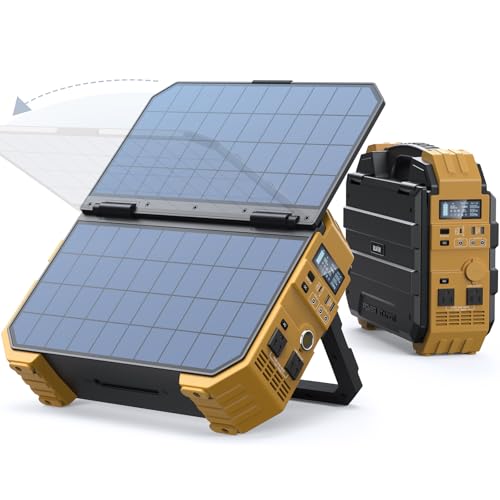
BLAVOR 1600W Solar Generator 1,024WhBest for Small AC UnitsBLAVOR 1600W Solar Generator 1,024Wh1,024 Wh LiFePO41,600 W, 3,200 W peakBuilt-in 40 W panel plus external inputn/a
DaranEner 1000W 576Wh LiFePO4 Power StationBest Ultralight for Mini ACDaranEner 1000W 576Wh LiFePO4 Power Station576 Wh LiFePO41,000 W, 2,000 W peak, 4 outletsn/a14.8 lb
Gidrox 10,000 BTU 12V DC RV Air ConditionerBest DC AlternativeGidrox 10,000 BTU 12V DC RV Air Conditionern/an/an/a54 lb

An air conditioner is the hardest appliance to run from a battery, because it asks for a large burst of power to start the compressor and then a steady draw for as long as it cools. Most listings advertise capacity and wattage as if they solved the problem, but runtime and starting surge are the two numbers that decide whether a unit actually works.

This guide explains how to size a power station to an air conditioner, how surge and soft start change the answer, and why runtime is measured in hours, not days. Start with the picks above for the shortlist, then read the reviews below to match a unit to your BTU rating, your electrical setup and your expectations for how long it must run.

Before you buy

6 Criteria to Look For Before Buying a Solar Generator That Can Power an Air Conditioner

  1. 01

    Air conditioner running watts

    Running watts depend on BTU rating and efficiency. A 5,000 BTU window unit draws roughly 450 to 500 watts, an 8,000 BTU unit about 700 watts, and a 13,500 BTU rooftop unit about 1,300 to 1,500 watts. Read the nameplate, which lists amps at 120 volts, and multiply. The BLAVOR 1600W suits the small end, the UDPOWER S2400 handles up to around 12,000 BTU, and the HomePower 3000 and PowerMax 3600 SE handle 13,500 BTU rooftop units.

  2. 02

    Starting surge

    A compressor can draw two to three times its running current for a fraction of a second on startup, and a rooftop unit can pull over 3,000 watts. The HomePower 3000 and PowerMax 3600 SE list 7,200 watt surge, the UDPOWER S2400 3,000 watts, the BLAVOR 3,200 watts and the DaranEner 2,000 watts. A soft start device reduces the demand. Without enough surge the station shuts down at startup, which is the most common failure.

  3. 03

    Runtime math

    Divide usable watt-hours by the AC's average draw. Take roughly 15 percent off for inverter losses, and note that the compressor cycles on and off, so a 700 watt AC may average 400 to 500 watts. A 3,072 Wh Jackery HomePower 3000 runs a 700 watt unit about 3.5 hours at full duty, and the 3,600 Wh PowerMax 3600 SE about 4 hours. A 1,024 Wh BLAVOR gives 1.5 hours of a 500 watt unit. All-night cooling needs far more battery.

  4. 04

    Recharge speed

    An AC drains a station fast, so refill speed matters. The UDPOWER S2400 refills in about 1.3 hours from 1,600 watts of AC, the PowerMax 3600 SE in about 1.44 hours with 3,000 watts combined, and the HomePower 3000 in about 2.2 hours from AC. Solar is slow: two 200 watt panels need about 9 hours to reach 80 percent on the Jackery. For AC duty, plan wall or generator recharging.

  5. 05

    Inverter AC versus fixed-speed AC

    Inverter air conditioners ramp the compressor speed up and down, which gives a lower running draw and a gentler start. Fixed-speed units cycle on and off with a hard start each time. A battery handles an inverter unit far better, so if you are buying an AC for use with a power station, choose an inverter model. Check the manual for the starting current.

  6. 06

    Safe connection and wiring

    Plug a window or portable AC directly into the station's outlet, using a short heavy cord, and avoid long thin extension cords that cause voltage drop. For an RV unit, use the TT-30 port found on the Jackery HomePower 3000 with a proper adapter. Never backfeed an RV or home through a dryer outlet. A 12 volt DC unit like the Gidrox needs correctly sized wire and fusing.

Detailed reviews

The 6 best solar generators that can power an air conditioner, explained

01
Jackery HomePower 3000 with 2x200W Panels
3,072 Wh LFP3,600 W (7,200 W surge)TT-30 port20 ms UPS
Check price on Amazon
Best for: Owners who need to run a window or RV air conditioner for a few hours with reliable surge headroom.

An air conditioner is the hardest load a portable station faces, and the HomePower 3000 is the best-matched machine in this group for it. The 3,600 watt rating clears the running draw of any window unit and most 15,000 BTU RV units, and the 7,200 watt surge covers a compressor starting, even without a soft starter. With 3,072 watt-hours stored, a typical 8,000 BTU window unit drawing about 700 watts runs for roughly 3.5 hours of compressor time, and longer because the compressor cycles.

The tradeoff is that no portable battery runs an AC all night at high loads. A 1,000 watt average draw empties the pack in about 2.5 hours after inverter losses. Compared with the PowerMax 3600 SE at 3,600 Wh, it has about 500 fewer watt-hours but a clearer brand record and the TT-30 port for a camper's 30 amp cord. Compared with the UDPOWER S2400, it carries about a thousand more watt-hours and a much higher surge rating.

Solar refill is slow: Jackery says two 200 watt panels reach 80 percent in about 9 hours, so for AC use you rely on wall or generator recharging. A hybrid AC and DC recharge in 1.7 hours is the strong point. The pack is LiFePO4, heavy and wheeled. Plan a stable spot, and treat it as a way to ride out hours of heat, not days.

What works

  • Seven thousand two hundred watt surge starts compressors easily
  • TT-30 port feeds an RV cord without adapters
  • Quoted 1.7 hour hybrid recharge is fast for 3 kWh
  • Rated 3,600 W clears nearly any single AC unit

Watch out for

  • Roughly 2.5 hours at a 1,000 W continuous AC draw
  • Solar recharge takes about 9 hours to reach 80 percent
  • Heavy wheeled unit not meant for hand carrying

Spec sheet

Capacity
3,072 Wh LiFePO4
AC output
3,600 W, 7,200 W surge
RV outlet
Built-in TT-30
AC recharge
About 2.2 h, 1.7 h hybrid
Solar
Two 200 W panels, 80% in about 9 h
UPS
20 ms or less
02
PowerMax 3600 SE with 200W Solar Panel
3,600 Wh LiFePO43,600 W (7,200 W surge)5 to 8 ms switchover200 W panel
Check price on Amazon
Best for: Buyers who want the biggest battery they can get for AC runtime and accept a newer brand.

The PowerMax 3600 SE has the largest battery of the AC-capable group at 3,600 watt-hours, enough for roughly 3.5 to 4 hours of compressor time on an 8,000 to 10,000 BTU window unit. The 3,600 watt output and 7,200 watt surge match the HomePower 3000's, and four AC outlets let you run the AC alongside a fridge. It also charges quickly: the maker says 1,800 watts of AC and 1,600 watts of solar together refill it in about 1.44 hours.

The weakness is brand depth. PowerMax is a newer name than Jackery, and the listing's five year warranty is its main assurance, so read the terms before buying. The 5 to 8 millisecond switchover is faster than the Jackery's 20 milliseconds, which helps computers and a router run alongside the AC. Compared with the UDPOWER S2400, it has 1,500 more watt-hours and a higher surge.

Only the 200 watt panel is included, which would take most of a day to recharge a quarter of the battery, so plan on wall or generator charging for AC duty. App control lets you watch load and set limits. Keep it ventilated, because the pack and inverter run warm when driving a compressor, and mount it so it cannot tip.

What works

  • Largest battery of the AC-capable picks at 3,600 Wh
  • Switches to battery in 5 to 8 ms, faster than most
  • Fast 1.44 hour refill combining AC and solar inputs
  • Five year warranty in the listing

Watch out for

  • Newer brand with less service history than Jackery
  • Included 200 W panel is small relative to the battery
  • Heavy unit that needs a secure, ventilated place

Spec sheet

Capacity
3,600 Wh LiFePO4
AC output
3,600 W, 7,200 W surge, 4 AC outlets
Charging
Up to 3,000 W combined AC and solar
Full charge
About 1.44 h with 1,800 W AC and 1,600 W solar
Switchover
5 to 8 ms
Warranty
5 years
03
UDPOWER S2400 2,083Wh Power Station
2,083 Wh LiFePO42,400 W (3,000 W surge)41 lb1.3 h full recharge
Check price on Amazon
Best for: Households who want a lighter 2 kWh station to run a bedroom window AC for a few hours.

The S2400 is the mid-size answer for a window air conditioner. Its 2,400 watt rating handles any 5,000 to 12,000 BTU window unit, and the 3,000 watt surge is just enough for a compressor start, though only a small margin if the unit is old or has no soft start. With 2,083 watt-hours it can run a 700 watt window unit for roughly 2 to 2.5 hours of compressor time, and extends that if the AC cycles off.

It is a lighter and more portable choice than the 3 kWh class, at 41 pounds with dual handles, and it refills from the wall in about 1.3 hours at 1,600 watts. Six AC outlets and a total of 15 ports mean the AC is not the only load you can power. Compared with the Jackery HomePower 3000, it has about 1,000 fewer watt-hours and half the surge. Compared with the BLAVOR 1600W, it adds 800 watts of output and about a thousand more watt-hours.

The 440 watt solar input is moderate. UDPOWER is a less established brand, so the warranty terms matter. For ownership, use the included settings to limit the output for a specific unit, and keep the vents clear. It is a good fit for a bedroom or a camper where you need a few hours of cooling at night.

What works

  • Rated 2,400 W covers any window AC up to 12,000 BTU
  • Refills from empty in about 1.3 hours on 1,600 W AC
  • Six AC outlets leave room for a fridge or fan too
  • Dual handles make a 41 pound unit easier to carry

Watch out for

  • Three thousand watt surge is a thin margin for older compressors
  • Roughly 2 to 2.5 hours of runtime on a 700 W window AC
  • Less established brand, so warranty terms need checking

Spec sheet

Capacity
2,083 Wh LiFePO4
AC output
2,400 W, 3,000 W surge, 6 AC outlets
Weight
41 lb
Recharge
0 to 100% in 1.3 h at 1,600 W AC
Solar
Up to 440 W
Switchover
0.01 s or less
04
BLAVOR 1600W Solar Generator 1,024Wh
1,024 Wh LiFePO41,600 W (3,200 W peak)Built-in 40 W panel4,000 cycles
Check price on Amazon
Best for: Buyers with a small 5,000 to 6,000 BTU window or portable AC who want a light 1 kWh unit.

The BLAVOR is for small air conditioners only, such as a 5,000 BTU window unit drawing about 450 to 500 watts, or a small portable unit. Its 1,600 watt rating and 3,200 watt peak can start these, and 1,024 watt-hours gives roughly 1.5 to 2 hours of compressor time. It will not start a 12,000 BTU unit reliably, and the margin is thin for anything over 8,000 BTU.

The builtin 40 watt panel is a convenience rather than a charging plan, since it unfolds from the unit to trickle charge. Compared with the UDPOWER S2400, it is a smaller, lighter option with half the capacity. Compared with the 576 Wh DaranEner unit, it carries about 450 more watt-hours and 600 more watts. It is best used as a bedroom, tent or camper cooler for an evening.

LiFePO4 cells are rated for more than 4,000 cycles, and four charging methods give flexibility. Treat the 1,600 watt figure as a ceiling, not a target, since heat and inverter losses reduce what you get at full load. Check the AC's nameplate running watts and starting current before you commit, and keep the vents clear while it carries a compressor.

What works

  • Rated 1,600 W with 3,200 W peak starts small compressors
  • Built-in 40 W panel needs no separate carry
  • Rated for more than 4,000 LiFePO4 cycles
  • Eight ports include a 100 W two-way USB-C

Watch out for

  • Only 1,024 Wh, so about 1.5 to 2 hours of small AC
  • Not suited to anything above about 8,000 BTU
  • Built-in 40 W panel recharges the pack very slowly

Spec sheet

Capacity
1,024 Wh LiFePO4
AC output
1,600 W, 3,200 W peak
Solar
Built-in 40 W panel plus external input
Ports
8, including 100 W USB-C
Cycle life
More than 4,000
Charging
Wall, car, built-in or external solar
05
DaranEner 1000W 576Wh LiFePO4 Power Station
576 Wh LiFePO41,000 W (2,000 W peak)14.8 lb300 W solar input
Check price on Amazon
Best for: Campers and renters with a tiny 3,000 to 5,000 BTU cooler who want a very light station.

This is a small 12 volt style cooling companion, not a window air conditioner machine. At 1,000 watts continuous and 2,000 peak it can run a tiny 3,000 to 5,000 BTU unit, a personal evaporative cooler or a fan and small portable AC for an hour or so. With 576 watt-hours, a 450 watt AC would drain it in about an hour, so be realistic. At 14.8 pounds it is by far the lightest pick in this guide.

Its value is in the fast solar input: it accepts up to 300 watts of MPPT solar, and the listing says 1.4 hours to reach 70 percent by solar or car. Compared with the BLAVOR 1600W, it holds just over half the battery at half the weight. Compared with the HomePower 3000, it is a clip-on helper, not a cooling plant. It has four AC outlets, a 100 watt USB-C port and nine ports in all.

The listing provides 12 months of coverage, extendable to 36, which is shorter than the Jackery's. LiFePO4 cells quoted at 4,000 plus cycles to 80 percent are a good sign. Use it where you need a personal cooling fan, a small mini-split trial or a tent cooler, and not for a living room AC. Check the AC's real running watts before you plug it in.

What works

  • At 14.8 pounds it is the lightest pick in this roundup
  • Accepts up to 300 W of MPPT solar for quick refills
  • Four AC outlets and nine ports total
  • LiFePO4 cells rated for 4,000 plus cycles to 80 percent

Watch out for

  • Only 576 Wh, which runs a 450 W AC for about an hour
  • Base coverage is 12 months, extendable to 36
  • One thousand watts cannot start most 8,000 BTU window units

Spec sheet

Capacity
576 Wh LiFePO4
AC output
1,000 W, 2,000 W peak, 4 outlets
Weight
14.8 lb
Solar input
300 W MPPT
AC recharge
240 W wall, 0 to 70% in 1.8 h
Cycle life
4,000 plus cycles to 80%
Coverage
12 months, extendable to 36
06
Gidrox 10,000 BTU 12V DC RV Air Conditioner
10,000 BTU cooling12 V DCAbout 350 W nighttime40 dB sleep mode
Check price on Amazon
Best for: Van and camper builders who want to cool a small space from a 12 V battery bank without an inverter.

Sometimes the smartest way to run an air conditioner from batteries is to buy an air conditioner that skips the inverter. This Gidrox is a 10,000 BTU rooftop unit that runs directly from a 12 volt DC system and, by the maker's figure, averages about 350 watts overnight in a 30 degree Celsius ambient. That is roughly a third of what a typical 13,500 BTU AC draws, which means a 3 kWh battery could carry it for most of a night.

It is not a solar generator and it is not a plug-in window unit. It mounts in a standard 14 inch by 14 inch roof cutout and needs a proper 12 volt wiring run and a large battery bank, so it is an RV or van project. Compared with the HomePower 3000 approach, it saves inverter losses and surge demand, but you lose the flexibility to move the cooling around. It weighs 54 pounds and has Turbo, ECO and Sleep modes, with Bluetooth app, remote and panel control.

The quoted 40 dB sleep mode noise is a maker figure. Its mount works on common roof cutouts, and a 19.7 foot power cable comes with it. Have the DC wiring sized by an RV technician, since a 350 watt draw at 12 volts is about 30 amps and needs proper gauge wire and fusing.

What works

  • Runs on 12 V DC directly, so no inverter loss or surge
  • Maker quotes about 350 W average overnight draw
  • Three control options include app, remote and panel
  • Fits the common 14 inch by 14 inch roof cutout

Watch out for

  • Needs proper 12 V wiring and a large battery bank
  • Not portable, so it cannot move between rooms
  • Power figures are the maker's and vary with heat

Spec sheet

Cooling
10,000 BTU, cooling only
Power
12 V DC, no inverter needed
Draw
About 350 W average at night (maker figure)
Noise
40 dB in Sleep mode
Weight
54 lb
Control
App, remote and panel

Spec sheet decoder

What the numbers on the box really mean

The specs manufacturers lead with, translated into what they tell you about real-world performance.

Running watts

The continuous power the inverter can supply. An AC's running draw must be below this figure with margin.

Watch forInverter output at full load runs hot. The BLAVOR's 1,600 W is a ceiling, not a target.

Surge watts

A short overload that lets the inverter start a compressor, typically held for a second or less.

Watch forCheck the surge against the AC's locked-rotor amps. The DaranEner's 2,000 W surge is too small for most window units.

Wh capacity

Total stored energy. Divide by average draw for hours.

Watch forUsable capacity is about 85 percent of the label because of inverter losses.

BTU

British thermal units per hour measure cooling capacity. More BTU means more compressor power.

Watch forBTU is not watts. An inverter 10,000 BTU unit can draw less than a fixed-speed 8,000 BTU unit.

Soft start

A device that limits the compressor's startup surge, often cutting it by half or more.

Watch forAdding a soft start may let a smaller station run a unit that otherwise trips it.

Methodology

How We Evaluated These Solar Generators That Can Power an Air Conditioner

Running and surge capability

We compared rated output and surge against typical AC loads. The HomePower 3000 and PowerMax 3600 SE at 7,200 W surge were treated as capable of 13,500 BTU units, and the DaranEner at 2,000 W as limited to mini units.

Runtime realism

We calculated hours of compressor time from watt-hours and a typical 700 watt window load, with a 15 percent inverter loss. That gives about 3.5 hours for the Jackery, 4 for the PowerMax, 2 to 2.5 for the UDPOWER and under 1.5 for the DaranEner.

Recharge behavior

We compared AC, solar and hybrid refill speeds, from the UDPOWER's 1.3 hours to the Jackery's 9 hours on solar. Faster refills are more useful for AC duty.

Connection and safety

We looked for outlet types such as the TT-30 on the HomePower 3000, outlet counts, UPS switchover and protection features. A larger number of outlets helps run the AC alongside other loads.

Brand and warranty

We compared warranty terms, with five years listed for the PowerMax, 12 months for the DaranEner and Jackery's long record. Newer brands were noted as higher risk.

Decision guide

How to Choose the Right Solar Generators That Can Power an Air Conditioner

By Air Conditioner Size

Match the station to the BTU rating.

Air conditionerRecommended pickWhy
3,000 to 5,000 BTU miniDaranEner 1000W 576Wh1,000 W and 14.8 lb
5,000 to 6,000 BTU windowBLAVOR 1600W1,600 W, 3,200 W peak
8,000 to 12,000 BTU windowUDPOWER S24002,400 W rated
13,500 BTU RV rooftopJackery HomePower 30007,200 W surge, TT-30 port
Longest cooling per chargePowerMax 3600 SE3,600 Wh
12 V rooftop in a vanGidrox 10,000 BTU 12V DCNo inverter loss

By Budget

Relative tiers only.

Budget tierRecommended pickWhy
LowestDaranEner 1000W 576WhSmall and light
Low to midBLAVOR 1600WSmall window AC
MidUDPOWER S24002 kWh class
Mid to upperPowerMax 3600 SELargest battery
HighJackery HomePower 3000Brand and RV port
Project costGidrox 10,000 BTU 12V DCNeeds battery bank and wiring

Battery Inverter Station vs 12V DC Air Conditioner

Two ways to cool from batteries.

Inverter station

The Jackery HomePower 3000, PowerMax 3600 SE, UDPOWER S2400, BLAVOR 1600W and DaranEner 1000W run any plug-in AC. They are flexible and portable, but inverter losses and surge limit runtime to hours.

12 V DC air conditioner

The Gidrox 10,000 BTU runs from a 12 V battery bank without an inverter and averages about 350 W per the maker. It needs wiring and a fixed roof install, so it suits vans and campers.

Choose a station for a window or portable AC. Choose a DC unit if you are building a van or camper.

By Runtime Needed

Hours of cooling per charge.

Cooling goalRecommended pickWhy
Hour or two on a hot eveningBLAVOR 1600W1,024 Wh
Two to three hoursUDPOWER S24002,083 Wh
Three to four hoursJackery HomePower 30003,072 Wh
Four hours or morePowerMax 3600 SE3,600 Wh
Overnight, DC systemGidrox 12V DCAbout 350 W draw

For a Bedroom Window AC Specifically

Look for

Check the AC's nameplate running amps and multiply by 120 for watts. Pick a station with a rated output at least 30 percent above that and a surge rating over 2.5 times running watts. Prefer an inverter AC.

In this comparison

For a 5,000 to 8,000 BTU unit the UDPOWER S2400 is the sensible choice, with BLAVOR 1600W for the smallest ones. The HomePower 3000 gives more surge and runtime.

When to Spend More

Spend more if

You need a few hours of cooling and a large unit starts reliably. The Jackery HomePower 3000 and PowerMax 3600 SE have the surge and battery, and the Jackery has the stronger brand.

Save if

You have a small window AC and need an hour or two. The BLAVOR 1600W or UDPOWER S2400 cover that, and the DaranEner suits mini coolers.

Ownership

Maintenance schedule

The upkeep that decides whether this machine lasts two seasons or ten.

TaskIntervalWhy it matters
Keep vents clear while coolingEvery useAn AC load makes the inverter run warm. Blocked vents cause derating and shutdowns.
Use short heavy cordsEvery useLong thin extension cords drop voltage and cause compressor stress. A short 12 gauge cord is better.
Recharge promptly after useAfter each AC sessionLeaving an empty LiFePO4 pack for weeks can lock it into protection. Refill within a day or two.
Clean the AC filterMonthly in seasonA clogged filter makes the AC work harder, raising draw and shortening battery runtime.
Update the app firmwareWhen promptedUpdates refine output limits and protections.
Check 12 V wiring on DC unitsEach seasonHigh current at 12 volts heats loose connections. Inspect fuses and terminals for discoloration.

FAQ

Frequently Asked Questions

How long will a solar generator run an air conditioner?

Divide usable watt-hours by the AC's average draw. A 3,072 Wh Jackery HomePower 3000 runs a 700 watt window AC for about 3.5 hours at full duty, and a 3,600 Wh PowerMax 3600 SE about 4 hours. Cycling extends this somewhat. A 1,024 Wh unit gives only about 1.5 hours of a small AC.

Can I run a 13,500 BTU RV AC on a power station?

Yes, with enough surge. A rooftop unit draws about 1,300 to 1,500 watts running and needs well over 3,000 watts to start. The HomePower 3000 and PowerMax 3600 SE, at 3,600 W and 7,200 W surge, can start it, but you get about two hours at full load. Add a soft start if you can.

Do solar panels run an air conditioner directly?

Not practically. A 13,500 BTU unit needs more than 1,300 watts continuously, which means 3 to 5 kilowatts of panels in good sun. Portable panels cannot do that. Panels refill the battery during the day, and the battery runs the AC in the evening.

What is a soft start and do I need one?

A soft start device limits the current spike when a compressor starts, often by half or more. It lets a smaller station run an AC that would otherwise trip it. If your station's surge is close to your AC's starting need, a soft start is worth adding.

Is a 12V DC air conditioner better than an inverter setup?

For a fixed install in a van or camper, often yes. The Gidrox avoids inverter losses and the starting surge, and its maker quotes an overnight draw around 350 watts. It needs a large 12 V battery bank and proper wiring, and it is not portable.

Why does my station shut down when the AC starts?

Usually the surge exceeded the station's limit, or the AC's startup current was higher than expected. Check the AC's locked-rotor amps and compare them with the station's surge rating. Use an inverter AC or add a soft start.

Bottom line

The short version

Browse more solar generators that can power an air conditioneron Amazon →
James Miller, Lead Machine Editor

About the author

James Miller

Lead Machine Editor, MachineFanatic

James Miller leads MachineFanatic's buying guides, turning spec sheets, manuals and owner feedback into clear verdicts on power tools, outdoor power equipment, shop machines and kitchen machines.

More from James →

Keep reading

Related guides