
Amazon affiliate links - we earn a commission.Affiliate disclosure

Buying guide · 12 min read · Updated 2026-11-07

Best RV Solar Panel Kits (2026)

Six RV solar panel kits from a 100W starter to 400W premium sets, compared on controller type, panel count, wiring needs and what each really includes.

James MillerBy James MillerLead Machine Editor6 machines comparedSpec-sheet verified
Best RV Solar Panel Kits

At a glance

Our top picks

Side by side

Spec comparison

MachineTotal powerControllerCell efficiencyDaily energy
Renogy 400W Premium Kit, 4x100W and 40A MPPTBest OverallRenogy 400W Premium Kit, 4x100W and 40A MPPT400W from four 100W panels40A MPPTn/an/a
ECO-WORTHY 400W Premium Kit With 40A MPPT and BluetoothBest Smart ControllerECO-WORTHY 400W Premium Kit With 40A MPPT and Bluetooth400W, four 100W panels40A MPPT with Bluetooth21%n/a
ACOPOWER 400W Kit With 4x100W and 40A MPPT LCDBest Build ClaimsACOPOWER 400W Kit With 4x100W and 40A MPPT LCD400W, four 100W panels40A MPPT, LCD23%, A+ cellsn/a
Renogy 200W N-Type Kit With Adventurer 30A ControllerBest 200W KitRenogy 200W N-Type Kit With Adventurer 30A Controller200WAdventurer 30A PWM, LCD22%About 800Wh in 4 sun hours
Topsolar 200W Kit, Two 100W Panels and 30A ControllerBest ValueTopsolar 200W Kit, Two 100W Panels and 30A Controller200W, two 100W panels30A, 12V or 24VUp to 22%About 800Wh in 4 sun hours
Renogy 100W Starter Kit With 30A PWM ControllerBest StarterRenogy 100W Starter Kit With 30A PWM Controller100W, one panel30A PWMn/aAbout 500Wh

A solar kit takes the guesswork out of matching panels, controller and wiring, which is where most first-time installs go wrong. The box usually holds panels, a charge controller, cables and brackets, but rarely a battery or a fuse, so the kit only solves part of the puzzle.

What separates kits is mainly the controller and the number of panels, since both set how much power you can harvest and how you wire it. Every kit here was weighed against its spec sheet and the patterns in owner feedback, looking at panel count, controller type and amp rating, included hardware and how well each kit scales up later.

Before you buy

6 Criteria to Look For Before Buying a RV Solar Panel Kit

  1. 01

    Total array watts

    A kit's panel total sets its daily harvest. Four 100W panels at 4 sun hours yield roughly 1.1 to 1.3kWh after losses, while a 100W starter yields about 300 to 350Wh. Add up your daily watt-hours first and then pick the kit tier, instead of buying the biggest box.

  2. 02

    Controller type and amps

    MPPT controllers, like the 40A units in the Renogy, ECO-WORTHY and ACOPOWER 400W kits, can convert voltage into extra current and allow series wiring. PWM controllers, like the Renogy Adventurer 30A, are simpler and cheaper but waste headroom. For anything over 200W, MPPT is the better choice.

  3. 03

    Series versus parallel wiring

    Series wiring adds voltage, allows thin wire and handles partial shade better, but needs an MPPT controller sized for the input voltage. Parallel wiring adds current and suits small PWM systems like the Topsolar 200W kit, but one shaded panel drags the others. Match the wiring plan to the controller before you buy.

  4. 04

    What is actually in the box

    Most kits omit the battery, inverter, fuses and roof-entry hardware. The ACOPOWER 400W includes Z-brackets, while the Renogy 100W starter is only panel, controller and cables. Make a parts list with fuses and breakers before you compare kit prices.

  5. 05

    Battery chemistry support

    Lithium iron phosphate batteries need a controller with a lithium profile, and lead-acid profiles can undercharge or overcharge them. The Renogy Adventurer controller lists several battery types, while others need checking in the manual. Wrong charge settings ruin batteries quietly.

  6. 06

    Roof space and weight

    Four 100W panels need mounting points for eight feet and clear space for routing. Two panels fit most short roofs, while four suit long trailers and Class A rigs. Leave room for roof access and for vent and AC clearance.

Detailed reviews

The 6 best rv solar panel kits, explained

01
Renogy 400W Premium Kit, 4x100W and 40A MPPT
4 x 100W mono panels40A MPPT controller32V max battery400W total
Check price on Amazon
Best for: Full-time and long-trip RVers who want a complete 400W house-bank charging system.

Four 100W panels and a 40A MPPT controller make this the kit I would hand a first-time installer who wants a proper house-bank charger. The MPPT controller allows series wiring of panels, which raises voltage, lets you use thinner wire and tolerates partial shade better than parallel runs. The listing gives a maximum battery voltage of 32V, which tells you the controller supports 12V and 24V banks.

The cost is complexity and roof area. Four panels need space for eight mounting points and careful wire routing, and a trailer roof with a vent and an AC unit may only fit three. The same 400W could come from two 200W panels with fewer connectors and fewer penetrations, which is why a kit this size is a deliberate choice.

Renogy's documentation and accessory ecosystem are the strongest among the kits here, which helps with troubleshooting years later. Check the sealant at each bracket yearly and verify that the controller's battery profile is set for your chemistry. Compared with the ECO-WORTHY 400W kit it is less feature-heavy but easier to support.

What works

  • 40A MPPT controller supports series wiring and 24V banks
  • Four panels give flexible placement around roof fixtures
  • Strong documentation and spare-part availability
  • Headroom for expansion within the controller's rating

Watch out for

  • Four panels need a lot of roof area and mounting points
  • No battery, fuse or inverter included

Spec sheet

Total power
400W from four 100W panels
Controller
40A MPPT
Max battery voltage
32V
Panel type
Monocrystalline
System
12V or 24V banks
02
ECO-WORTHY 400W Premium Kit With 40A MPPT and Bluetooth
4 x 100W panels40A MPPT controllerBluetooth monitoring1.6kWh daily claim
Check price on Amazon
Best for: Tech-minded owners who want to monitor charging from their phone.

ECO-WORTHY adds Bluetooth to a 40A MPPT controller, which lets you read charge current and battery voltage from a phone instead of squinting at a small screen under the bed. The kit has four 100W monocrystalline panels with 21% efficiency, and the listing claims 1.6kWh of output per day depending on sun. The controller's quoted tracking efficiency is as high as 99%.

The tracking figure and the 1.6kWh claim are best-case numbers, so plan on 60 to 80 percent of them for real roads and real weather. Bluetooth is a convenience, but it adds a failure point if the app or firmware is dropped. Next to the Renogy 400W kit, you get more screen features but a smaller support network.

Mount the controller near the battery, away from heat, and check its terminals after the first drive. Keep the four panels wired in a series and parallel mix that suits the controller's voltage limit. It is a good fit for owners who like data and plan to monitor their system.

What works

  • Bluetooth monitoring shows live charge data on a phone
  • 40A MPPT controller with high claimed tracking efficiency
  • Four 100W panels for flexible roof layouts
  • 1.6kWh daily claim gives a clear planning target

Watch out for

  • Daily energy and tracking figures are best-case claims
  • Smaller support ecosystem than the Renogy kit

Spec sheet

Total power
400W, four 100W panels
Controller
40A MPPT with Bluetooth
Daily energy claim
About 1.6kWh
Cell efficiency
21%
Tracking claim
Up to 99%
03
ACOPOWER 400W Kit With 4x100W and 40A MPPT LCD
4 x 100W A+ cells40A MPPT LCD23% efficiencyIP67 frame
Check price on Amazon
Best for: Owners who want published build details and bracket hardware in the box.

ACOPOWER leads on the printed specifications: 23% efficient A+ cells, an IP67 aluminum frame with low-iron anti-reflective glass, and a 40A MPPT controller with a 99.5% tracking claim. The listing also mentions an average daily output of 2 to 2.5kWh, which is a more optimistic figure than the ECO-WORTHY's 1.6kWh for the same 400W. The Z-brackets are included in the kit.

Those generous output numbers should be read with caution. Four 100W panels cannot make more than their rating times the sun hours, so 2.5kWh implies about 6 hours of full power, which only a desert summer delivers. The better guide is the panel's 23% efficiency and low-iron glass, which are verifiable build traits.

Because it includes Z-brackets, it is a more complete install box than some rivals. Seal each bracket foot, and check connectors at the start of each season. It competes closely with the Renogy 400W kit and tends to be the choice when you want higher cell efficiency on paper.

What works

  • 23% cell efficiency is higher than the other 400W kits
  • IP67 low-iron glass frame is built for outdoor use
  • Z-brackets are included in the kit
  • 40A MPPT controller with an LCD display

Watch out for

  • Daily output claim of 2 to 2.5kWh is very optimistic
  • Smaller aftermarket and support base than Renogy

Spec sheet

Total power
400W, four 100W panels
Cell efficiency
23%, A+ cells
Controller
40A MPPT, LCD
Tracking claim
99.5%
Frame
IP67, low-iron glass
04
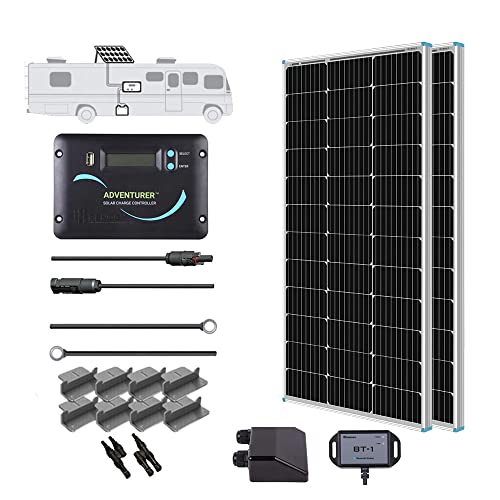
Renogy 200W N-Type Kit With Adventurer 30A Controller
200W N-type panelsAdventurer 30A PWM22% efficientFlush-mount controller
Check price on Amazon
Best for: Trailer and camper owners who want a neat, flush-mounted 200W starter system.

The Adventurer-Li controller in this kit has a flush-mount design for a clean look inside an RV or camper, and it is sold with N-type panels at 22% efficiency. The listing quotes 800Wh a day from four sun hours, which is a reasonable planning figure for a 200W array. It is a good fit for a trailer where the controller sits in a cabinet wall.

The controller is PWM, and that is the main compromise. On a 200W system the loss compared with MPPT is modest, but it grows if you expand the array or camp in cold weather. The kit also stops at 200W, so if you later add panels you may need to replace the controller.

The flush-mount plate saves cutting extra holes in interior panels. Keep the wire runs short and use correctly sized fuses near the battery. Compared with the Topsolar 200W kit, this one costs more but has a cleaner controller and a maker with broader support.

What works

  • Flush-mount controller gives a clean RV install
  • N-type panels at 22% efficiency
  • 800Wh daily energy claim is realistic for 200W
  • Maker offers broad documentation and support

Watch out for

  • PWM controller wastes some energy compared with MPPT
  • Expansion beyond 200W may need a new controller

Spec sheet

Total power
200W
Controller
Adventurer 30A PWM, LCD
Daily energy
About 800Wh in 4 sun hours
Cell efficiency
22%
Mounting
Flush-mount controller for RVs
05
Topsolar 200W Kit, Two 100W Panels and 30A Controller
2 x 100W mono panels30A controller12V and 24V22% efficient
Check price on Amazon
Best for: Budget buyers who want a flexible two-panel starter system.

Two 100W panels and a 30A controller that works on 12V or 24V banks make this a straightforward first kit. The listing gives 800Wh a day under four hours of sun, and the tempered glass and aluminum frames are rated for 2400Pa of wind and 5400Pa of snow. Cells reach up to 22% efficiency.

Two smaller panels are easier to place than one large 200W panel, since each can tuck into a different gap on the roof. They also give you a series or parallel choice when wiring. The controller is a basic design, and the listing does not name its type, so treat it as an entry-level unit and check the manual.

After installation, check the bracket seals and wiring at the start of the first season, then yearly. Owners who outgrow it can keep the panels and swap in a larger MPPT controller. It undercuts the Renogy Adventurer kit on price and gives up the premium controller.

What works

  • Two 100W panels fit into different roof gaps
  • 30A controller works on 12V or 24V systems
  • Frames rated for 2400Pa wind and 5400Pa snow
  • 800Wh daily output claim suits a small RV

Watch out for

  • Controller type is not named in the listing
  • Less documentation than the Renogy kits

Spec sheet

Total power
200W, two 100W panels
Controller
30A, 12V or 24V
Daily energy
About 800Wh in 4 sun hours
Cell efficiency
Up to 22%
Frame loads
2400Pa wind, 5400Pa snow
06
Renogy 100W Starter Kit With 30A PWM Controller
100W mono panel30A PWM controller500Wh daily claimUL 61730 certified
Check price on Amazon
Best for: Part-time campers adding solar for the first time with room to grow.

This is the entry point into the Renogy line, a single 100W panel with a 30A PWM controller sized for growth. The listing cites UL 61730 and IEC 61215 certification and a 10-year coverage claim on panel materials, both useful for peace of mind. It claims roughly 500Wh of daily output in good sun.

The controller rating of 30A is generous for a single panel, which means you can add more panels without replacing it. That is a thoughtful touch, but the PWM design will waste more energy as the array grows. For one panel on a small camper, it is fine.

A single panel is easy to install and easy to relocate, which suits a part-time RV owner. Seal the mounting feet and inspect the wiring each season. If you expect to add panels, the Topsolar 200W kit is a better start, while this one suits someone testing solar for the first time.

What works

  • 30A controller leaves room to add panels later
  • UL 61730 and IEC 61215 certifications are listed
  • Single panel is easy to install and move
  • Long materials coverage claim in the listing

Watch out for

  • 100W only offsets small loads
  • PWM controller wastes more energy as the array grows

Spec sheet

Total power
100W, one panel
Controller
30A PWM
Daily energy
About 500Wh
Certification
UL 61730, IEC 61215
Warranty
10 years on materials claimed

Spec sheet decoder

What the numbers on the box really mean

The specs manufacturers lead with, translated into what they tell you about real-world performance.

Daily Wh claim

The listing's estimate of energy made per day under a set number of sun hours. It assumes no wiring or heat losses.

Watch forACOPOWER claims 2 to 2.5kWh for 400W while ECO-WORTHY claims 1.6kWh for the same array.

MPPT tracking efficiency

How closely the controller holds the panel at its best operating point. Quoted figures of 98 to 99.5 percent are peak values, not daily averages.

Watch forACOPOWER lists 99.5 percent and ECO-WORTHY lists up to 99 percent.

Max battery voltage

The highest battery bank voltage the controller can charge. Controllers rated for 32V can serve 12V and 24V banks.

Watch forThe Renogy 400W lists 32V.

Pa wind and snow load

The pressure the panel frame can carry, with 2400Pa for wind and 5400Pa for snow being common ratings.

Watch forTopsolar and the Renogy 100W starter both list these values.

UL 61730 and IEC 61215

Safety and performance standards for photovoltaic modules. They apply to the panel, not to the controller.

Watch forOnly the Renogy 100W starter lists them explicitly here.

Methodology

How We Evaluated These RV Solar Panel Kits

Array size and scaling

We looked at total watts and how easily each kit can grow. The 400W kits ranked highest for capacity, and the 100W and 200W kits scored on headroom in the controller. The 30A controller on the 100W starter kit earned credit for expansion.

Controller capability

We compared type, amp rating and display or monitoring features. The 40A MPPT units on the Renogy, ECO-WORTHY and ACOPOWER kits scored above the PWM controllers. Bluetooth on the ECO-WORTHY earned extra credit for visibility.

Included hardware

We checked what each box contains, including brackets and cables. ACOPOWER's included Z-brackets counted in its favor. None of the kits includes a battery or fuses.

Build and certification

We looked at cell efficiency, frame ratings and standards. ACOPOWER's 23 percent cells and the Renogy 100W starter's listed certifications scored well. Claims without numbers were discounted.

Owner feedback patterns

Owner feedback patterns shaped our view of controller reliability and support quality, especially for makers with smaller service networks. We adjusted for optimistic output claims.

Decision guide

How to Choose the Right RV Solar Panel Kits

By Daily Energy Need

SituationPickWhy
Lights and phones onlyRenogy 100W starter500Wh daily claim
Lights, fan and a small fridgeTopsolar 200W kit800Wh daily claim
Full-time living with laptopsRenogy 400W PremiumFour panels and 40A MPPT
Heavy use, monitoring wantedECO-WORTHY 400WBluetooth and 1.6kWh claim

By Budget

TierPickWhy
Cheapest entryRenogy 100W starterOne panel and a 30A controller
Low to midTopsolar 200W kitTwo panels at a modest price
MidRenogy 200W N-type kitFlush-mount controller
PremiumRenogy 400W PremiumFull 400W with MPPT

PWM Kit vs MPPT Kit

PWM

The Renogy Adventurer 200W, Topsolar 200W and Renogy 100W starter use simple controllers. They are cheap and reliable for arrays up to about 200W, but waste voltage headroom.

MPPT

The Renogy 400W, ECO-WORTHY 400W and ACOPOWER 400W use 40A MPPT controllers that allow series wiring and recover more energy in cool or hazy weather.

Choose PWM for one or two panels, MPPT when you go to four.

Number of Panels

Roof situationPickWhy
One tidy slotRenogy 100W starterSingle panel
Two gaps near ventsTopsolar 200W kitTwo 100W panels
Long open roofACOPOWER 400WFour 100W panels with Z-brackets
Cabinet controller mountRenogy 200W N-type kitFlush-mount design

For Weekend Camping Specifically

Look for

Enough panel to cover a weekend's draw with a battery buffer, plus simple wiring. Do not oversize for a few nights of use.

In this comparison

The Topsolar 200W kit or the Renogy 200W N-type kit cover weekend use. The 100W starter works if you only run lights and charge phones.

When to Spend More

Spend more if

You live in the RV or camp off-grid for long periods. The Renogy 400W Premium or ACOPOWER 400W give you the array and the MPPT controller to match.

Save if

You camp in short trips with hookups. The Topsolar 200W or Renogy 100W starter provide enough without extra complexity.

Ownership

Maintenance schedule

The upkeep that decides whether this machine lasts two seasons or ten.

TaskIntervalWhy it matters
Inspect roof sealant and bracketsEvery yearUV and road vibration crack sealant and loosen brackets. A small leak under a panel foot can rot the roof deck.
Check controller terminalsAfter the first month, then yearlyLoose terminals heat up under 40A loads. Retorque to the manual's value and look for discolored insulation.
Clean the panelsMonthly in seasonDirt cuts output on every panel in a series string. Stick to plain water and a soft cloth.
Verify controller settingsEvery few monthsBattery type and voltage setpoints can change by mistake. A wrong profile damages batteries quietly.
Inspect wiring and fusesEvery seasonVibration chafes wire insulation, particularly at roof entry. Replace damaged wire and check fuse holders for corrosion.

FAQ

Frequently Asked Questions

Do solar kits include a battery?

Most do not, so check the listing. A kit that lists the panels and controller only needs a battery, an inverter if you want AC power, and fuses sized for the wire.

Is 400W enough for an RV?

For lights, a fridge, fans and device charging it is usually enough with a decent battery. Air conditioning and electric cooking need far more than any roof kit supplies.

Should I wire panels in series or parallel?

Series suits MPPT controllers and long wire runs, and handles shade better. Parallel suits small PWM kits, but you need fuses on each string.

Can I add panels to a kit later?

Yes, if the controller's amp and voltage limits have headroom. The Renogy 100W starter's 30A controller has plenty, while a 40A controller handles about 500W at 12V.

Why is my output below the kit's claim?

Daily output claims assume perfect sun hours and no losses. Heat, dust, tilt and wire loss usually reduce real output to 60 to 80 percent of the figure.

Is Bluetooth monitoring worth it?

It lets you check charging from inside the RV, which helps catch problems early. It is a convenience, not a requirement, and a basic LCD does the same job.

Bottom line

The short version

Browse more rv solar panel kitson Amazon →
James Miller, Lead Machine Editor

About the author

James Miller

Lead Machine Editor, MachineFanatic

James Miller leads MachineFanatic's buying guides, turning spec sheets, manuals and owner feedback into clear verdicts on power tools, outdoor power equipment, shop machines and kitchen machines.

More from James →

Keep reading

Related guides