
Amazon affiliate links - we earn a commission.Affiliate disclosure

Buying guide · 14 min read · Updated 2026-11-19

Best RV Water Pumps with Accumulator Tanks (2026)

Six RV water pump and accumulator tank kits compared on tank volume, flow, pressure and how each one cuts cycling, pulsing and noise at the tap.

James MillerBy James MillerLead Machine Editor6 machines comparedSpec-sheet verified
Best RV Water Pumps with Accumulator Tanks

At a glance

Our top picks

Side by side

Spec comparison

An accumulator is a small pressurized tank that sits on the pump's outlet and acts like a shock absorber for your water. A rubber bladder separates air from water, and when you open a tap the stored volume flows first, so the pump does not have to start for every short draw.

Buying a pump and accumulator as a kit removes the guesswork of matching ports, fittings and pre-charge. The kits here differ most in tank size, which decides how long the pump rests, and in pump flow, which decides how well the whole system serves your fixtures.

Before you buy

6 Criteria to Look For Before Buying a RV Water Pump with Accumulator Tanks

  1. 01

    Tank size and drawdown

    Only a fraction of an accumulator's total volume is usable, because the pressure falls as water leaves the tank. The SEAFLO 55 kit's 2 gallon tank gives a meaningful reserve, while the 0.2 gallon tanks in the GRahckv and SEAFLO 33 kits smooth pulses but store little. Match tank size to how long a typical draw lasts at your sink.

  2. 02

    Pre-charge pressure

    The air side should sit a few PSI below the pump's cut-in pressure, otherwise the tank is either empty of useful water or the pump cycles anyway. Most kits arrive charged, but shipping and temperature change the value. Check it with a tire gauge before you plumb the tank in. Do this with the water side empty and open to atmosphere, because a gauge reading taken with water inside the tank is meaningless. A lost charge shows up as a pump that cycles as often as it did before the upgrade, and the fix is a minute with a bicycle pump.

  3. 03

    Pump flow and pressure

    A good tank on the wrong pump still disappoints. The Kohree at 7.5 GPM and 70 PSI pushes past typical RV plumbing limits, while the Wassermann at 3.0 GPM and 55 PSI stays comfortable. Choose the pump first, then the tank.

  4. 04

    Mounting and noise

    Kits that add anti-vibration feet and a base plate, as the Kohree does, address the main noise path. A tank without isolation can drum against a cabinet wall. Use flexible hoses between the pump and the tank.

  5. 05

    Plumbing position

    The accumulator belongs on the pump's outlet, between the pump and the first fitting. A tee on a long branch gives less benefit because pressure waves have already travelled. Keep the tank upright with the air valve reachable. Many RV bays are tight, so confirm the tank's diameter and height against the available space and leave room to get a gauge onto the valve stem. If the only spot is across the bay from the pump, run a short flexible hose instead of rigid pipe, so the tank's weight is never carried by the pump ports.

  6. 06

    Power source

    Most kits here are 12V DC, but the SEAFLO 33 kit is 115V AC. Choose DC for travel and AC for fixed use. A mismatch means buying a second pump.

Detailed reviews

The 6 best rv water pumps with accumulator tanks, explained

01
SEAFLO 55 Series 12V 5.5 GPM 60 PSI with 2 gallon accumulator
5.5 GPM60 PSI2 gal tank12V DC
Check price on Amazon
Best for: Rigs with room for a larger tank that want the smoothest possible flow.

SEAFLO's system kit joins its 55 Series pump to a 2 gallon accumulator, and that pairing is what separates it from the smaller kits in this guide. A tank this large stores enough pressurized water to cover brief draws such as rinsing a glass or filling a pot, so the pump may sit idle for those events. The pump itself is rated at 5.5 GPM with a 60 PSI shut-off and can self-prime up to 6 ft.

The cost is physical size and price. Two gallons of tank needs real cabinet space, and the whole kit costs more than a pump with a pocket-sized accumulator. It also asks for a 12V supply able to feed a larger motor, which means a properly fused cable and a clean battery connection.

Ownership is simple but not zero. Check the tank's air valve each spring, because a bladder that loses its pre-charge cannot cushion anything. Keep the strainer clean, and use flexible hose so the tank's weight does not stress the pump ports.

What works

  • 2 gallon tank reduces cycling more than small units
  • 5.5 GPM serves multiple fixtures
  • Pump is stated to run dry without damage
  • System arrives matched, with fittings sized together

Watch out for

  • Takes real cabinet space
  • Costs more than small-tank kits
  • Heavy when full, so mount it securely

Spec sheet

Model
SFWSK1-055-060-0021
Flow
5.5 GPM
Shut-off
60 PSI
Accumulator
2 gallon
Priming
Self-priming to 6 ft, run-dry safe
02
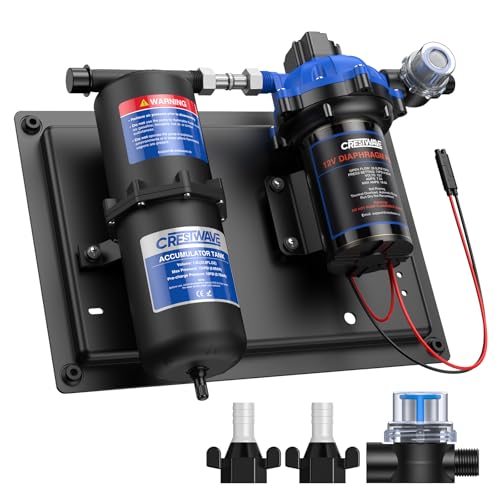
CrestWave 12V 7 GPM 70 PSI pump with 1L accumulator tank
7 GPM70 PSI1L tank5-chamber
Check price on Amazon
Best for: Larger rigs that want high flow and a quieter system at a moderate cost.

CrestWave packages a five-chamber 12V pump with a one-liter accumulator and a stated 45 dB quiet claim. The five chambers spread the pumping stroke, and the tank smooths what is left, which together should reduce the tap-to-tap pulse that cheaper pumps show. At 7 GPM and 70 PSI it is a high-flow system.

That 70 PSI cut-off is above what thin RV plumbing likes, so a regulator or an adjustable setup is a sensible add-on. Against the SEAFLO 55 kit it gives more flow and less tank, which means it cycles less than a bare pump but more than the 2 gallon system.

Install with heavy cable and a suitable fuse, and keep the tank upright with its air valve reachable. The 45 dB number is a manufacturer claim without a method, so judge it after a week of use and add rubber mounts if the cabinet drums.

What works

  • Five-chamber pump with a matched 1L accumulator
  • 7 GPM covers tankless heaters
  • Quiet operation claimed at 45 dB
  • Complete kit simplifies fitting

Watch out for

  • 70 PSI is high for typical RV plumbing
  • 1L tank is smaller than the SEAFLO's
  • Noise claim lacks a stated method

Spec sheet

Flow
7 GPM
Pressure
70 PSI
Chambers
5
Accumulator
1 liter
Noise
45 dB claimed
03
Kohree 12V 7.5 GPM 70 PSI pump with 1L accumulator
7.5 GPM70 PSI1L tank125 PSI rated tank
Check price on Amazon
Best for: High-demand rigs that want the highest flow with a mounting base included.

Kohree's set joins a five-chamber 12V pump rated at 7.5 GPM to a 1 liter pre-pressurized accumulator rated to 125 PSI. A shock-proof iron plate and anti-vibration rubber feet are part of the package, which is a rarity for a kit and a genuine help against drumming.

The flow is the highest here, and so is the potential for trouble. A 7.5 GPM pump on residential-size demand is more than most RVs can use, and the 70 PSI cut-off needs a regulator. The accumulator tames cycling but does not cure a mismatch between pump and plumbing.

Use it where volume matters, such as a large fifth wheel with a tankless heater or a tank-fill station. Check the tank pre-charge before installation, because a shipped tank can lose pressure in transit, and set it a few PSI below the pump's cut-in.

What works

  • Anti-vibration feet and iron plate included
  • 7.5 GPM is the highest flow in the group
  • Tank rated to 125 PSI gives margin
  • Five chambers smooth the pulse

Watch out for

  • 70 PSI needs a regulator in many RVs
  • Overkill for small trailers
  • Tank is small relative to the pump's output

Spec sheet

Flow
7.5 GPM
Pump pressure
70 PSI
Chambers
5
Accumulator
1 liter, 125 PSI rated
Mounting
Anti-vibration feet and iron base plate
04
GRahckv 12V 6 GPM 70 PSI pump with 0.2 gallon accumulator
6 GPM70 PSI0.2 gal tankNSK bearings
Check price on Amazon
Best for: First-time installers who want every fitting in one box.

This kit pairs a four-chamber 6 GPM pump with a 0.2 gallon pre-pressurized accumulator and includes installation parts: two 1/2 in hose barbs, PTFE sealant tape, hose clamps and a hose. The listing credits precision NSK bearings for low-noise rotation.

A 0.2 gallon tank is a pocket-sized buffer, so it softens pulses but does not store much water. It will reduce rapid cycling at a trickle but will not stop the pump for a long draw. The kit's real value is that you can install it in an afternoon without a trip to the hardware store.

Compared with the SEAFLO 55 kit it is cheaper and far less capable of smoothing cycles. That makes it a fit for owners who want a tidy install and moderate flow. Keep the tank upright and recheck clamps after the first few trips.

What works

  • Includes barbs, tape, clamps and hose
  • NSK bearings aimed at quieter running
  • 6 GPM at 70 PSI is a strong pump
  • Pre-pressurized tank arrives ready

Watch out for

  • 0.2 gallon tank buffers little water
  • 70 PSI cut-off calls for a regulator
  • Four chambers pulse more than five

Spec sheet

Flow
6 GPM
Pressure
70 PSI
Chambers
4
Accumulator
0.2 gallon, 125 PSI pre-pressurized
Extras
Barbs, PTFE tape, clamps, hose
05
WASSERMANN 12V 3.0 GPM 55 PSI pump with 0.75L accumulator
3.0 GPM55 PSI0.75L tank4-chamber
Check price on Amazon
Best for: Standard trailers that want smoother flow without changing flow or pressure.

The Wassermann kit matches factory-style specs: 3.0 GPM, a 55 PSI switch and a four-chamber diaphragm, paired with a 0.75 liter accumulator. It is the system to buy if you want to keep the performance your RV was designed around while smoothing the cycling.

Its moderate numbers are a strength. A 55 PSI cut-off sits inside typical RV plumbing limits and the 3.0 GPM output is gentle on batteries. The 0.75 liter tank is small, so cycling reduces but does not disappear for long draws.

For a weekend trailer it is a sensible upgrade over a bare pump. Install on rubber feet, use flexible hoses and verify the pre-charge before commissioning.

What works

  • 55 PSI and 3.0 GPM match typical RV plumbing
  • 0.75L accumulator reduces cycling
  • Four-chamber design
  • Corrosion-resistant materials

Watch out for

  • Small tank offers limited buffering
  • Less flow for tankless heaters
  • Lesser-known brand

Spec sheet

Flow
3.0 GPM
Pressure switch
55 PSI
Chambers
4
Accumulator
0.75 liter
Materials
Corrosion-resistant
06
SEAFLO 33 Series 115V 3.3 GPM 45 PSI with 0.2 gallon tank
3.3 GPM45 PSI115V AC0.2 gal tank
Check price on Amazon
Best for: Stationary AC installs where smooth flow matters.

This SEAFLO kit is the AC variant: a 115V pump with a 3.3 GPM open flow and a 45 PSI shut-off, paired with a 0.2 gallon accumulator that the listing says reduces pump cycling. It suits stationary installs such as a park model, a cabin or a workshop sink where shore power is a given.

The pump is self-priming to 6 ft and is described as run-dry safe. The tank holds 23.5 ounces, which is small, so it smooths cycles rather than eliminating them. In practice that means a short rinse at the sink may be served from the tank alone, while a shower or a dish-filling session will still bring the pump on.

It is not a choice for boondocking because it needs AC power. For a fixed install it is quiet, steady and gentle on fittings.

What works

  • No battery drain on shore power
  • Tank reduces cycling
  • Run-dry safe stated
  • Gentle 45 PSI shut-off

Watch out for

  • Requires AC power
  • Small tank buffer
  • Not for off-grid use

Spec sheet

Model
SFWSKA1-033-045-002
Flow
3.3 GPM open
Pressure
45 PSI
Accumulator
0.2 gallon (23.5 oz)
Priming
6 ft, run-dry safe

Spec sheet decoder

What the numbers on the box really mean

The specs manufacturers lead with, translated into what they tell you about real-world performance.

Tank volume

The total size of the accumulator, of which only a portion is usable water. Larger tanks give longer pump rest periods.

Watch forA 0.2 gallon tank equals about 23.5 oz and offers little reserve.

Pre-charge

The air pressure in the tank before water is added. It controls how much water the tank accepts and releases.

Watch forSeveral tanks list a 125 PSI rating, which is the maximum, not the working charge.

Cut-in and cut-off

Pressures at which the pump starts and stops. The accumulator works between them.

Watch forThe SEAFLO 55 kit stops at 60 PSI, the Kohree at 70.

Chamber count

More pump chambers mean a smoother stroke before the tank even acts.

Watch forFive chambers on the Kohree and CrestWave, four on the GRahckv and Wassermann.

Rated tank pressure

The maximum pressure the shell is designed to hold. It gives margin above the pump cut-off.

Watch forA 125 PSI rating comfortably exceeds the 70 PSI pumps here.

Methodology

How We Evaluated These RV Water Pumps with Accumulator Tanks

Buffer volume

We compared tank sizes from 0.2 gallons to 2 gallons. Larger volume lowers cycling more. The SEAFLO 55 kit led, and the 0.2 gallon kits scored lowest.

Pump-tank match

We checked whether pump pressure and tank rating suit each other. Tanks rated to 125 PSI cover the 70 PSI pumps with margin. Mismatches were penalized.

Install completeness

We looked at included fittings and mounting hardware. The GRahckv includes barbs, tape, clamps and hose, and the Kohree includes a base plate.

Flow and plumbing fit

We matched GPM and PSI to typical RV systems. The Wassermann at 3.0 GPM and 55 PSI matched best. The 70 PSI kits needed regulators.

Ownership support

We weighed warranty terms and documentation. SEAFLO states a 4-year warranty and run-dry safety. Lesser-known brands scored on clarity of specs.

Decision guide

How to Choose the Right RV Water Pumps with Accumulator Tanks

By Goal

SituationPickWhy
Smoothest flow, space availableSEAFLO 55 Series kit2 gallon tank
High flow on a budgetCrestWave 7 GPM kitFive chambers, 1L tank
Tankless heater, big rigKohree 7.5 GPM kitHighest flow, base plate
First-time installGRahckv 6 GPM kitFittings included
Match factory pressureWASSERMANN 3.0 GPM kit55 PSI, 3.0 GPM
Stationary ACSEAFLO 33 115V kitShore power

By Budget

TierPickWhy
Most economicalGRahckv 6 GPM kitAll parts in one box
ValueCrestWave 7 GPM kitFlow and quiet claim
Mid-rangeWASSERMANN 3.0 GPM kitFactory-matched
AC optionSEAFLO 33 115V kitBrand warranty
Higher outlayKohree 7.5 GPM kitMounting base included
PremiumSEAFLO 55 Series kit2 gallon tank

Small tank vs large tank

Small tank (0.2 to 1L)

The GRahckv, SEAFLO 33, Wassermann, CrestWave and Kohree kits smooth pulses and reduce rapid cycling. They fit tight bays but offer little reserve.

Large tank (2 gallon)

The SEAFLO 55 kit stores enough pressurized water to let the pump rest through short draws. It needs more room and weighs more when full.

Choose large if you have the space and dislike pump noise.

Pressure level

PreferencePickWhy
Factory-style 55 PSIWASSERMANN 3.0 GPM kitMatches typical RV systems
Gentle 45 PSISEAFLO 33 115V kitLow stress on fittings
Moderate 60 PSISEAFLO 55 Series kitBalance of flow and pressure
High 70 PSIKohree 7.5 GPM kitNeeds a regulator

For Noise Reduction Specifically

Look for

A tank with a decent volume, a pump with five chambers and mounting feet that isolate vibration. Soft hoses at the pump ports are essential.

In this comparison

The Kohree includes anti-vibration feet and a base plate, the CrestWave states 45 dB, and the SEAFLO 55 has the largest tank. Combine these features for the quietest install.

When to Spend More

Spend more if

You want the SEAFLO 55 kit's 2 gallon tank or the Kohree's mounting base. Full-time rigs benefit from fewer pump cycles.

Save if

Your pump already works and you only want smoother flow. A small kit like the GRahckv adds the benefit at low cost.

Ownership

Maintenance schedule

The upkeep that decides whether this machine lasts two seasons or ten.

TaskIntervalWhy it matters
Check accumulator pre-chargeEvery springThe bladder loses air slowly. Check with a tire gauge with the system depressurized and set it a few PSI below the cut-in.
Clean the pump strainerEvery 3 monthsA clogged screen starves the pump and increases cycling. Cleaning restores flow.
Inspect tank fittingsTwice a yearVibration loosens threads. A weeping fitting wastes water and corrodes metal.
Winterize the tankBefore freezing weatherWater trapped in the tank can freeze and burst the shell. Drain it fully or fill with antifreeze.
Listen for cycling with taps closedMonthlyShort bursts of pump noise point to a leak or a failed bladder. Fixing it early saves the pump.

FAQ

Frequently Asked Questions

Do I need an accumulator on my RV water pump?

It is not required, but it smooths flow and reduces how often the pump starts and stops. It helps most with pumps that lack an internal bypass. Many owners add one for noise and longevity.

How big should the accumulator be?

Larger tanks give longer pump rest periods but need more space. A 0.75 to 1 liter tank is a good compromise for most rigs, and a 2 gallon tank suits owners who want the quietest system.

What pre-charge should I set?

A few PSI below the pump's cut-in pressure, measured with the water pressure released. The exact number depends on the pump. Check it every year.

Is a kit better than buying parts separately?

A kit saves matching ports and sizing, and some include fittings and hoses. Buying separately gives you freedom to choose a bigger tank. Both work if the pressures match.

Why does my pump still cycle with an accumulator?

The bladder may have lost its charge, the tank may be too small or a leak is draining pressure. Check the air valve first and then look for drips. A slow leak anywhere downstream, even a dripping toilet valve, makes the pressure sag and calls the pump on every few minutes. Closing the water supply and watching whether the pump comes on is the quickest test, and it is worth giving it ten minutes before deciding anything.

Can I use an accumulator with a variable speed pump?

Usually not needed, because variable speed pumps hold pressure electronically. Check the manufacturer's advice, since some designs say an accumulator is unnecessary.

Bottom line

The short version

Browse more rv water pumps with accumulator tankson Amazon →
James Miller, Lead Machine Editor

About the author

James Miller

Lead Machine Editor, MachineFanatic

James Miller leads MachineFanatic's buying guides, turning spec sheets, manuals and owner feedback into clear verdicts on power tools, outdoor power equipment, shop machines and kitchen machines.

More from James →

Keep reading

Related guides