
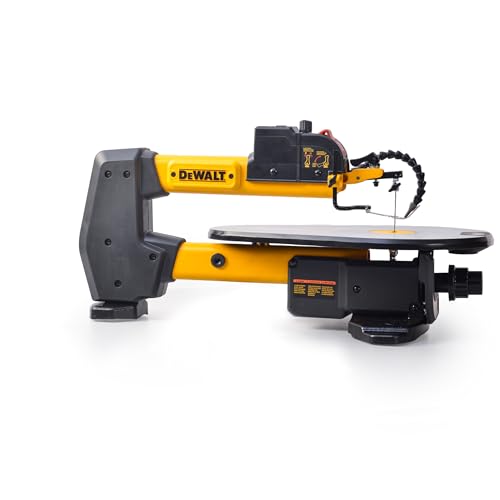

Throat depth is the distance from the blade to the rear arm, and an 18 inch throat lets you cut the center out of a board up to 36 inches wide. That is the largest throat in this roundup and the main reason to pay more. A die-cast aluminum table gives a flat, rigid surface that damps vibration, and a 1.6 amp motor provides steady power across a 500 to 1,500 stroke speed range.
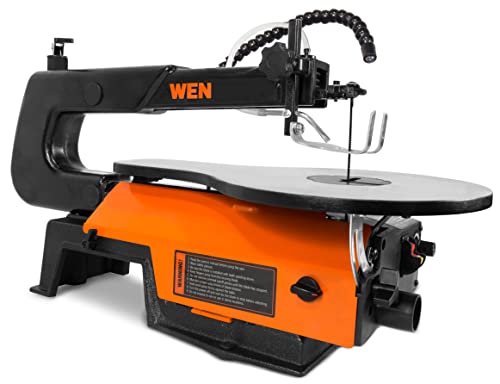
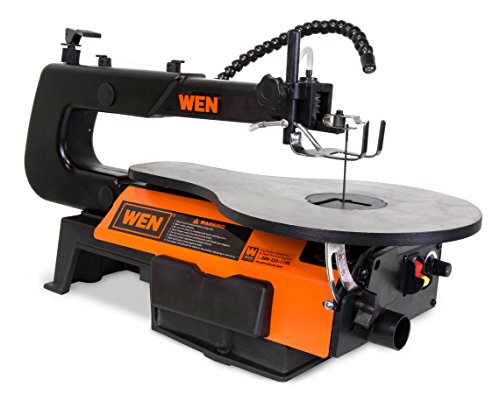
The tradeoff is that the listing says little about the arm design or tension system, which decide how much the saw vibrates at speed. Compared with the WEN 3923, the DeWalt has a deeper throat and a heavier table, but the WEN has a better-described blade change. A front-facing bevel scale lets you tilt the table 45 degrees left and 15 degrees right and read the angle without crouching, which is a handy detail for compound cuts. For ornament, marquetry and fretwork on larger panels, the throat depth is the feature that pays off.
Ownership: change blades often, because a dull blade burns and wanders. Keep the blade tension firm, which stops breakage and wandering. Blow dust from the table and wax it lightly, and bolt the saw to a bench or heavy board to cut vibration. Pinned and plain-end blades need different clamps, so confirm what the saw accepts.
What works
- 18 inch throat handles large panels and wide boards
- Die-cast aluminum table is flat and damps vibration
- 500 to 1,500 SPM range suits wood, plastic and thin metal
- Front bevel scale reads from 45 left to 15 right
Watch out for
- Listing gives little detail on tension and blade change
- Heavier than the 16 inch saws
- Highest relative price among the five
Spec sheet
- Throat depth
- 18 inches
- Motor
- 1.6 amp
- Speed
- 500 to 1,500 strokes per minute
- Table
- Die-cast aluminum
- Bevel
- 45 degrees left to 15 degrees right