
Amazon affiliate links - we earn a commission.Affiliate disclosure

Buying guide · 13 min read · Updated 2026-11-18

Best Shore Power and Generator Transfer Switches (2026)

Six switches that select between dock or campground shore power and a generator, from marine rotary selectors to automatic units with adjustable delay timers.

James MillerBy James MillerLead Machine Editor6 machines comparedSpec-sheet verified
Best Shore Power and Generator Transfer Switches

At a glance

Our top picks

Side by side

Spec comparison

A shore power selector solves a narrow, important problem. A boat or camper can draw from a dock or campground pedestal, or from its own generator, and a faulty or careless connection can send both sources into the same wiring.

The products here differ in how they prevent that: some are rotary dials with a mechanical break-before-make action, others are automatic relays with delay timers. The entries explain which suits a boat, which suits a trailer and which is merely a convenience.

Before you buy

6 Criteria to Look For Before Buying a Shore Power and Generator Transfer Switch

  1. 01

    Boat, trailer or coach

    Boats need corrosion-resistant hardware and a polarity warning, since dock wiring varies. Trailers and vans want automatic switching to keep the family out of the electrical box. Large coaches need sixty amps and 240 volts. Pick the vehicle type first, then the switch, because a marine rotary is the wrong tool for a camper that wants automation.

  2. 02

    Break-before-make action

    A good selector opens the first source before closing the second, so the two are never connected even for an instant. The Sekelo describes this explicitly, and the Lizixny achieves it with its off position. Automatic relays achieve it electronically. Check which approach the listing describes, and prefer a mechanical barrier on a boat.

  3. 03

    Reverse polarity warning

    Dock and campground pedestals sometimes have reversed hot and neutral, or no ground at all. The Sekelo and Ktolplao panels include a reverse polarity LED. A warning light does not fix the wiring, but it tells you not to plug in. Carry a plug-in tester regardless. A tester is also the only way to check for an open ground, which the lights on these panels do not necessarily show. Make the check part of the arrival routine, before the cord goes into the vehicle, and walk away from any pedestal that reads wrong.

  4. 04

    Generator delay

    A generator needs seconds to settle after starting. The PowerMax states twenty to thirty seconds, the HKJWUN has an adjustable timer, and the Go Power has a delay switch. Without a delay, an air conditioner sees unstable voltage and may trip or stall. Manual selectors let you supply the delay yourself. A simple rule is to let the generator run for a full minute with the dial on off, then select it. Listening to the engine settle is more reliable than a fixed number, and it costs nothing.

  5. 05

    Amperage and voltage

    Thirty amps at 120 volts is about 3,600 watts, which suits small coaches and boats. Sixty amps at 120/240 volts suits larger vessels and coaches. Match the switch to your shore cord and your generator, and do not rely on the biggest number in the listing. Read the shore inlet, the cord plug and the generator's outlet, and use the lowest rating among them as your real limit. A sixty amp switch on a thirty amp cord is a thirty amp system, however impressive the label looks.

  6. 06

    Installation and wiring care

    A shore power selector is part of a wiring system that includes a breaker panel, a shore inlet and a generator feed. Use stranded copper wire, support it every few inches and keep terminals tight. On a boat, follow marine wiring practice, and have a technician check the polarity and grounding after installation. A competent technician will check ground continuity, neutral isolation and polarity with a meter, which a listing cannot do for you. Keep the report with the vessel papers, because insurers and marinas sometimes ask for it.

Detailed reviews

The 6 best shore power and generator transfer switches, explained

01
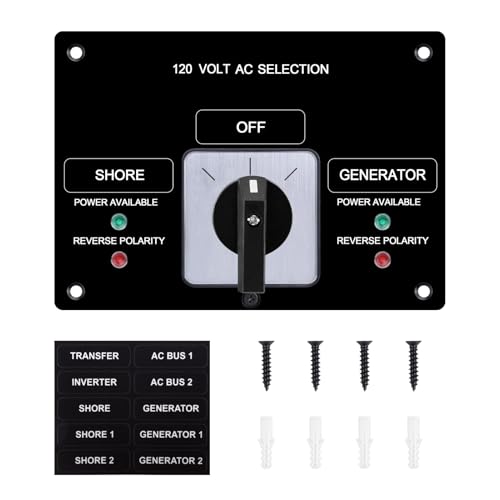
Sekelo 30A 120V 2-Position Marine Rotary Transfer Switch Panel
30A 120VBreak-before-makeReverse polarity LEDMarine
Check price on Amazon
Best for: Boats that switch between dock power and an onboard generator at 30 amps.

A rotary selector with a break-before-make action is what a marine installation wants: the dial disconnects one source before it connects the next, and a mechanical interlock prevents cross-connection. The listing adds reverse polarity warning lights that flag unsafe dock wiring before power is applied to the boat.

That last feature is the one boaters notice. Docks vary widely in wiring quality, and a pedestal with reversed polarity can energise equipment that should be dead. Compared with the Ktolplao marine rotary that follows, the Sekelo's listing puts more weight on the interlock and the safety warning, while both share the thirty amp, 120 volt rating.

Because it is manual, you decide when to switch, and the generator has time to settle first. Mount it in a dry location with a short, supported wire run, and leave room behind the panel for a terminal check each season. On a boat, humidity and salt air attack terminals first, so a light coat of terminal grease and annual re-tightening are the practical care. Turn the dial through every position when the boat is first commissioned each year, and label each position with a waterproof tag so a crew member can read it in poor light.

What works

  • Break-before-make rotary action
  • Mechanical interlock prevents cross-connection
  • Reverse polarity warning lights
  • Designed for dock and generator use

Watch out for

  • Thirty amp 120 volt only
  • Manual, so someone must turn it
  • No automatic delay for the generator

Spec sheet

Rating
30 amp, 120 volt
Action
Manual rotary, break-before-make
Interlock
Mechanical, prevents cross-connection
Warning
Reverse polarity lights for dock wiring
Use
Dock power and onboard generator
02
Go Power TS-30 30A Automatic Transfer Switch with Generator Delay
30A automaticTwo 30A sourcesDelay switchKnockouts
Check price on Amazon
Best for: Small campers and vans with a 30 amp shore cord and a portable generator.

Go Power's TS-30 handles two thirty amp sources and chooses between them automatically, with a delay switch designed for generators so that the load waits for stable voltage. Knockouts make the enclosure easy to fit to conduit or cable clamps.

This is the straightforward choice for a trailer or camper van with a thirty amp shore cord and a portable generator. Against the manual Sekelo, you gain convenience and a generator delay, and lose the mechanical break-before-make dial. Against the PowerMax PMTS-30, the delay and priority behaviour are less specified in the listing.

Because an automatic switch decides for you, the generator must be stable before it is selected. Test it once at home by starting the generator with the shore cord connected. Time the transfer with a watch and write the number inside the cover, so a change next season is easy to spot. A camper that sits for months can develop sticky relay contacts, and the quickest sign is a transfer that arrives late or with a loud clack, which calls for a look at the terminals and the supply voltage.

What works

  • Automatic selection between two 30A sources
  • Delay switch for generator start-up
  • Knockouts for easier installation
  • Well-known RV accessory brand

Watch out for

  • Delay times are not given in the listing
  • 30 amp coaches only
  • Less informative listing than some rivals

Spec sheet

Rating
30 amp
Inputs
Up to two 30-amp power sources
Delay
Delay switch for generators
Install
Knockouts for quick installation
Operation
Automatic dual-source
03
PowerMax PMTS-30 30A Automatic RV Transfer Switch, 120V AC
30A 120V20-30s delayGenerator priorityAutomatic
Check price on Amazon
Best for: 30 amp coaches whose owners want a stated delay and generator priority.

PowerMax states exactly what most owners want to know: a built-in twenty to thirty second delay so generator voltage can stabilise, and a priority rule that prefers the generator when both sources are present. Those two sentences make the behaviour predictable.

The priority rule matters in a campground. If the generator is running because you are testing it or running a heavy load, the switch will not drop back to a pedestal without being told, so you will not suddenly find the coach on weak park power. Compared with the Go Power, the PowerMax gives clear figures and a clear priority, with a similar thirty amp rating.

Check the coach's wiring diagram against the unit's terminals, and keep the delay in mind if you run sensitive electronics on the same circuit. The generator priority rule also means a forgotten generator keeps the coach on engine power, so build the habit of shutting the engine down before you leave the site. Over a few seasons the contacts wear, so a unit that chatters, hums or transfers late deserves a replacement rather than a shrug.

What works

  • Stated 20 to 30 second delay
  • Generator prioritised when both are present
  • Automatic shore and generator selection
  • Thirty amp RV design

Watch out for

  • Single 120 volt, 30 amp rating
  • No reverse polarity indicator listed
  • Not for 50 amp coaches

Spec sheet

Rating
30 amp, 120 volt AC
Delay
20 to 30 seconds built in
Priority
Generator preferred when both are present
Operation
Automatic shore and generator selection
Use
RV
04
HKJWUN 30A Automatic Transfer Switch with Adjustable Delay Timer
30A 120VAdjustable delay12V DC relayMetal housing
Check price on Amazon
Best for: Owners who want to tune the generator delay to their own engine.

The adjustable delay timer is the point of difference. Instead of a fixed pause, you set how long the unit waits before accepting a new source, which suits an owner who has learned how long their own generator takes to settle. It switches between two independent 120 volt inputs and runs a 12 volt DC relay.

That relay needs a 12 volt supply from the coach, so the unit depends on the house battery, which is a point to remember if the battery fails. Compared with the PowerMax, you get a tunable delay and a metal housing and lose a stated default.

Set the delay conservatively at first, and test with the air conditioner running. Make a note of the setting and keep it with the coach papers. Because the unit leans on the house battery, a weak battery in winter storage can leave it unable to switch, so add the supply to your pre-trip checklist. If your coach has a battery disconnect, make sure the unit's supply is on the same side of it as the converter, or it will not switch with the disconnect open.

What works

  • Adjustable delay timer
  • Metal housing
  • Works with inverters as well as generators
  • 12V DC relay for stable switching

Watch out for

  • Depends on a 12V supply
  • No default delay stated
  • Thirty amp only

Spec sheet

Rating
30 amp, two 120V AC inputs
Delay
Adjustable timer
Relay
12V DC
Housing
Metal
Use
RV, inverters
05
Ktolplao 30A 120V 2-Position Marine Rotary Switch Panel
30A 120VDouble poleReverse polarity LEDRotary
Check price on Amazon
Best for: Boats wanting a double-pole marine rotary panel with a polarity warning.

Ktolplao's marine panel offers double-pole switching, which opens both the hot and the neutral lines, and a reverse polarity LED to warn of incorrect dock wiring. It is a thirty amp, 120 volt rotary selector in a panel format.

Double-pole switching is a thoughtful touch on a boat, because breaking the neutral as well as the hot reduces stray current paths. Against the Sekelo, the listing is less specific about a mechanical interlock, though the dial format makes cross-connection unlikely in practice.

The two panels are close enough that the decision is about availability and which listing you trust more. Whichever you pick, mount it where it stays dry and wire it with marine-grade stranded copper. Solid household wire cracks under vibration and corrodes quickly in a damp locker. Tinned copper conductors, ring terminals with heat-shrink and a drip loop before every entry keep water out, and a short run keeps voltage drop low when the load is high.

What works

  • Double-pole switching opens hot and neutral
  • Reverse polarity LED
  • Rotary panel format for boats
  • Thirty amp marine rating

Watch out for

  • Interlock detail is thinner than the Sekelo's
  • Manual only
  • 30 amp 120 volt only

Spec sheet

Rating
30 amp, 120 volt AC
Switching
Double-pole
Indicator
Reverse polarity LED
Format
Rotary selector panel
Use
Marine shore and generator sources
06
Lizixny 60A 3-Position Shore-Off-Gen Rotary Switch, 120/240V
60A 120/240V3-position6-10 AWGScrew terminals
Check price on Amazon
Best for: Larger boats, trucks and coaches with 50 amp services.

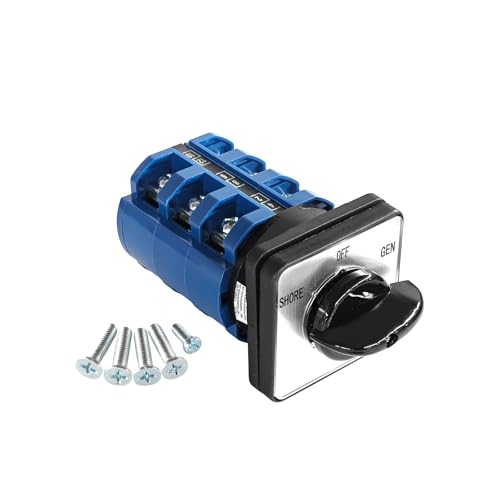
This is the heavy-duty option: a sixty amp, 120/240 volt rotary selector with a shore position, an off position and a generator position. The listing says it is designed to prevent electrical backfeed when switching between shore power and a generator, and that it accepts 6 to 10 gauge wire on screw terminals.

That capacity suits a larger boat, truck or coach with a 50 amp service, where the thirty amp panels cannot cope. The off position in the middle is a physical separation between sources, so the safety logic is mechanical.

Because it is manual, you control the timing. Check that the wire gauge you intend to use fits the terminals and that the coach's breaker panel protects the circuit downstream. Sixty amps is serious current, so loose terminals and undersized wire are the common faults. Look for heat discolouration at each lug after the first long run, and re-torque once the wire has settled into the terminals.

What works

  • Sixty amp capacity at 120/240V
  • Off position between sources
  • Accepts 6 to 10 AWG wire
  • Mechanical selector with no electronics

Watch out for

  • Manual operation
  • No indicators or delay
  • Heavier wiring to terminate

Spec sheet

Rating
60 amp, 120/240V AC
Positions
Shore, Off, Generator
Wire
6 to 10 AWG compatible
Terminals
Screw terminals
Purpose
Prevent backfeed between sources

Spec sheet decoder

What the numbers on the box really mean

The specs manufacturers lead with, translated into what they tell you about real-world performance.

Break-before-make

The switch disconnects one source before connecting the next, so the two are never joined.

Watch forDescribed for the Sekelo rotary.

Reverse polarity indicator

A light that shows hot and neutral are swapped on the incoming supply.

Watch forThe Sekelo and Ktolplao panels list one.

Double-pole

Both the hot and the neutral are switched, not just the hot.

Watch forListed for the Ktolplao panel.

Generator priority

The unit prefers the generator when both sources are present.

Watch forStated for the PowerMax PMTS-30.

Adjustable delay

A timer you set to match your generator's stabilisation time.

Watch forNamed for the HKJWUN.

Methodology

How We Evaluated These Shore Power and Generator Transfer Switches

Vehicle fit

We sorted products by marine, trailer and large-coach use, since each environment has different priorities.

Safety behaviour

We read for break-before-make action, polarity lights and priority rules, which come from listings, not from measurement.

Delay handling

We compared fixed, adjustable and absent delays, because generator start-up is where most automatic units reveal their weaknesses. A switch that moves too fast stresses compressors, and one that waits too long leaves the cabin dark, so the delay behaviour was weighed heavily in the ranking.

Amperage tiers

We kept thirty amp and sixty amp products distinct and said which vehicle each suits.

Home exclusion

We left out home panels and 15 amp relays, which have their own guides and do not address shore power.

Decision guide

How to Choose the Right Shore Power and Generator Transfer Switches

By Vehicle

SituationPickWhy
Boat on dock powerSekelo 30A Marine Rotary PanelMechanical interlock and polarity light
Trailer or van, 30AGo Power TS-30 Automatic SwitchAutomatic with generator delay
Large coach or truck, 50ALizixny 60A 3-Position RotarySixty amp 120/240V

By Budget

SituationPickWhy
Lower tierLizixny 60A 3-Position RotaryManual, simple
Middle tierKtolplao 30A Marine RotaryDouble-pole panel
Higher tierGo Power TS-30Established automatic brand

Rotary vs Automatic

Rotary

The Sekelo, Ktolplao and Lizixny need a hand on the dial. A mechanical off position or break-before-make action prevents cross-connection.

Automatic

The Go Power, PowerMax and HKJWUN decide for you. They wait for the generator to settle, and they suit trailers and vans.

Choose rotary on a boat; choose automatic if several people use the vehicle.

By Delay Behaviour

SituationPickWhy
Stated fixed delayPowerMax PMTS-3020 to 30 seconds
Tunable delayHKJWUN 30A Adjustable TimerSet to your generator
No delay, you decideSekelo 30A Marine RotaryManual selection

For Unfamiliar Docks and Campgrounds Specifically

Look for

A reverse polarity light, a mechanical barrier between sources, and your own plug-in tester. Never trust an unknown pedestal.

In this comparison

The Sekelo and Ktolplao panels have reverse polarity LEDs, and the Sekelo describes a mechanical interlock.

When to Spend More

Spend more if

You want a safety-focused marine panel such as the Sekelo, or an automatic unit with stated behaviour such as the PowerMax.

Save if

You will switch by hand. A simple rotary such as the Lizixny covers it.

Ownership

Maintenance schedule

The upkeep that decides whether this machine lasts two seasons or ten.

TaskIntervalWhy it matters
Check terminalsEach seasonVibration and humidity loosen terminals. Tighten them with power off and look for green corrosion.
Test polarityEach new dock or siteA plug-in tester takes seconds. A warning light is useful, but a tester confirms it.
Exercise the selectorEach seasonRotary contacts stiffen when idle. Turn them through every position with sources off.
Inspect wiring runsYearlyChafe points develop where wires cross edges. Add clamps and chafe guards where needed.
Check the 12V supplyEach seasonUnits with a DC relay need a healthy battery. Test the supply to the unit.

FAQ

Frequently Asked Questions

What does a shore power transfer switch do?

It selects between dock or campground power and an onboard generator so the two can never be connected at once.

Is automatic better than a rotary switch?

Automatic is convenient and adds a generator delay, while a rotary is simpler and has a mechanical barrier. Boaters often prefer rotary, and campers often prefer automatic.

Why does a reverse polarity light matter?

Docks and pedestals are sometimes wired backwards, which can energise parts that should be dead. A light is a warning, not a cure.

Do I need a technician?

A boat or large coach installation is best checked by a marine or RV electrician, since neutral and ground handling matter.

Can one of these power a house?

No. They are for boats and RVs. A house needs a panel or a service switch, covered in other guides.

Does the listing prove the safety rating?

No. Listing wording is a seller statement. Check the label on the unit and follow the manufacturer's wiring diagram.

Bottom line

The short version

Browse more shore power and generator transfer switcheson Amazon →
James Miller, Lead Machine Editor

About the author

James Miller

Lead Machine Editor, MachineFanatic

James Miller leads MachineFanatic's buying guides, turning spec sheets, manuals and owner feedback into clear verdicts on power tools, outdoor power equipment, shop machines and kitchen machines.

More from James →

Keep reading

Related guides