

Amazon affiliate links - we earn a commission.Affiliate disclosure

Buying guide · 14 min read · Updated 2026-11-09

Best Sliding Compound Miter Saws Under $500 (2026)

Five sliding compound miter saws at or under $500, from a cordless 12 inch DEWALT to 10 inch corded models, compared on crosscut width, bevel and rail design.

James MillerBy James MillerLead Machine Editor5 machines comparedSpec-sheet verified
Best Sliding Compound Miter Saws Under $500

At a glance

Our top picks

Side by side

Spec comparison

A sliding compound miter saw adds rails or arms that carry the blade forward and back, so a small blade can cut a board far wider than its radius. The extra reach is the whole point, but it comes with moving parts that must stay tight for the saw to cut square.

This guide explains what the upper end of a larger budget buys in a sliding saw, how rail design and bevel type change accuracy, and which spec sheet claims need a skeptical read. The picks are listed above, with the reviews below. Listing prices move, and the cap reflects prices when this guide was updated.

Before you buy

6 Criteria to Look For Before Buying a Sliding Compound Miter Saw Under $500

  1. 01

    Crosscut width

    Crosscut width is the widest board the saw can cut in one pass. The DEWALT DCS785B cuts up to 14 inches, while 10 inch sliders cut about 12. Capacity at 45 degrees drops by roughly a third. Many buyers forget that wide capacity is quoted at 0 degrees. Measure your widest board against the stated capacity with a margin of an inch, because the number assumes a flat board held tight against the fence.

  2. 02

    Rail design and play

    Rails carry the blade, and any play makes cuts wander. The KSEIBI uses twin linear rails, which resist twist. Check for wobble in the head at full extension. A sloppy rail ruins accuracy on wide cuts. To check a rail, extend the head fully, push sideways on the handle and watch the blade; more than a hair of movement means the saw will cut wide boards out of square.

  3. 03

    Single or double bevel

    A single bevel tilts one direction, so opposite angles require flipping the board. A double bevel tilts both ways. The DEWALT DCS785B and SKIL MS6305 are dual. Flipping long boards wastes time and risks errors. The cost of flipping boards adds up on a house of crown and base, which is why trim contractors usually pay for dual bevel.

  4. 04

    Blade size and tooth count

    A 12 inch blade cuts deeper and wider than 10 inch, and tooth count sets finish. A 36-tooth blade like the Marvtool's is rough, and 80 teeth cut trim cleanly. A saw is only as good as its blade. A cheap saw with a good 80-tooth blade often cuts better than an expensive saw with a rough blade, so budget for the blade first.

  5. 05

    Cordless or corded

    A cordless slider like the DCS785B avoids extension cords but needs large packs. Corded saws run forever. Choose cordless if you own the platform and move between jobs. A cordless slider is also quieter at idle, which matters in occupied homes.

  6. 06

    Fence height and baseboard support

    A tall fence supports base molding standing vertically. The DCS785B supports 6-1/2 inch baseboard. A short fence makes tall trim lean and cut crooked. For base molding taller than the fence, add a sacrificial auxiliary fence of plywood rather than letting the trim lean.

Detailed reviews

The 5 best sliding compound miter saws under $500, explained

01
DEWALT DCS785B 20V MAX XR 12 Inch Double Bevel Sliding Miter Saw (Tool Only)
20V MAX XR, 12 inch14 inch crosscutDouble bevelRegenerative braking
Check price on Amazon
Best for: Trim crews who own 20V MAX or FLEXVOLT batteries and want a 12 inch cordless slider.

Regenerative braking captures the blade's spin energy when you release the trigger and sends part of it back to the battery, which stretches runtime on a saw that starts and stops hundreds of times a day. A 12 inch blade on a sliding head crosscuts up to 14 inches horizontally, and it can cut 6-1/2 inch baseboard standing up against the fence. It is also the first 12 inch DEWALT miter saw compatible with the full range of 20V MAX and FLEXVOLT batteries.

The tradeoff is that the listing is bare tool, with no battery or charger, so the real cost depends on what you own. Compared with the corded saws in this guide, the DCS785B gives up nothing in capacity but adds weight when a large pack is on board. Versus the SKIL MS6305, it cuts a larger board with a larger blade and cuts the cord. For a trim crew that moves between rooms, it saves hours of extension-cord shuffling.

Ownership: keep a spare pack charged, since a 12 inch blade drains a pack on long cutting days. Check the fence square and the rails for play before critical cuts, and clean the rails of dust. Use a good 80-tooth blade for finish trim, and store batteries out of heat.

What works

  • 14 inch horizontal crosscut handles wide boards
  • Regenerative braking returns energy to the battery
  • Double bevel avoids flipping boards
  • Cordless design removes extension-cord hassle

Watch out for

  • Tool only, so batteries and a charger cost extra
  • Heavy with a large battery installed
  • Highest relative price in the roundup

Spec sheet

Platform
20V MAX, FLEXVOLT compatible
Blade
12 inch
Crosscut
Up to 14 inches horizontally
Baseboard
6-1/2 inches standing up
Package
Tool only
02
Evolution R185SMS+ 210mm Sliding Miter Saw, Cuts Wood and Metal
15 amp motor210mm bladeWood and metal45 bevel, 50 miter
Check price on Amazon
Best for: Fabricators and remodelers who cut conduit, angle iron and wood on one saw.

A multi-material blade and a high-torque gearbox let this saw cut steel, aluminum and wood without changing machines. Dry metal cutting produces less heat and fewer sparks than an abrasive chop saw, and the cut edge needs little cleanup. The 15 amp motor reduces load through gearing, and the sliding head extends crosscut width beyond the 210 millimeter blade's radius.

The tradeoff is scale. An 8-1/4 inch blade cuts less deep and less wide than a 10 or 12 inch saw, so it is not a trim saw for tall crown. Against the DEWALT DCS785B, this machine cuts metal that the DEWALT cannot, but finish cuts in wood are rougher. For a shop that cuts conduit, angle iron and framing, the versatility is the reason to buy.

Ownership: wear eye and ear protection, since metal cutting is loud. Metal chips collect around the base and rails, so clean them out after each session. Use the right blade for the material, and replace it when teeth dull. The sliding rails need light lubrication to stay smooth.

What works

  • Multi-material blade cuts steel, aluminum and wood
  • Dry cutting leaves a clean edge with fewer sparks
  • 15 amp high-torque gearbox handles metal
  • Sliding head extends crosscut width

Watch out for

  • 8-1/4 inch blade limits depth and width
  • Wood finish quality trails dedicated trim saws
  • Metal cutting is loud and throws chips

Spec sheet

Blade
210mm (about 8-1/4 inch) multi-material
Motor
15 amp, high-torque gearbox
Head
Sliding
Bevel
45 degrees
Miter
50 degrees
03
SKIL MS6305-00 10 Inch Dual Bevel Sliding Compound Miter Saw, 15 Amp
10 inch, 15 amp4,800 RPMDual bevelLED shadow line
Check price on Amazon
Best for: Home shops that want a dual bevel sliding saw at the lowest relative price.

A dual bevel head tilts both left and right with positive stops at 48 degrees and 45 degrees left, 0 degrees and 45 degrees right, which spares you from flipping a long board to cut an opposite angle. A 15 amp motor at 4,800 RPM drives the 10 inch blade through hardwood trim. An LED shadow line projects the blade's edge onto the wood, which shows the true kerf better than a laser dot.

Compared with the DEWALT DCS785B, the SKIL is smaller, corded and far lower in relative price, but it crosscuts less width. Compared with the KSEIBI and Marvtool, it offers a dual bevel where those are single bevel. For a home shop that builds shelving and trim, the SKIL is the best balance of features and cost.

Ownership: check the fence for square and adjust the bevel stops with a square before the first cut. Slide rails need dust cleaned from them, and the bearings may need tightening if the head wobbles. Use a better blade than the stock one for finish work, and clean the LED lens so the shadow line stays crisp.

What works

  • Dual bevel avoids flipping boards for opposite angles
  • 15 amp motor at 4,800 RPM cuts hardwood cleanly
  • LED shadow line shows the true kerf
  • Lowest relative price in the roundup

Watch out for

  • Narrower crosscut than the 12 inch DEWALT
  • Slide rails need setup to stay square
  • Stock blade is a basic one

Spec sheet

Blade
10 inch
Motor
15 amp, 4,800 RPM
Bevel
Dual, 48 and 45 degrees left, 45 right
Stops
Four positive bevel stops
Guide
LED shadow line
04
KSEIBI 10 Inch Sliding Compound Miter Saw, 15 Amp Dual Rail
15 amp, 1800WDual linear rails255mm blade45 bevel and miter
Check price on Amazon
Best for: Shops that crosscut wide boards and want dual rails on a corded 10 inch saw.

Twin linear slide rails carry the blade forward and back, and a dual-rail design resists twist better than a single arm. A 15 amp motor delivering about 1,800 watts gives strong corded power, and a 255 millimeter blade is the 10 inch standard. The miter table swings 45 degrees both ways while the head bevels in one direction.

The tradeoff is bevel and brand support. A single bevel means flipping boards for opposite cuts, which the SKIL MS6305 avoids. The brand is less established than DEWALT, so parts and service are thinner. Compared with the Marvtool, the KSEIBI's dual rails are a more robust slide, and the listing emphasizes strong consistent power. For a shop that crosscuts wide boards at a low tier, it is a sensible choice.

Ownership: check the rails for smoothness and the base for flatness on arrival. Keep the rails clean and lightly oiled, and tighten the fence bolts. A better blade than the stock one improves finish, and a stand or bench with clamps keeps the saw stable.

What works

  • Twin linear rails resist twist better than a single arm
  • 15 amp motor delivers about 1,800 watts
  • Miter swings 45 degrees both directions
  • Corded power runs indefinitely

Watch out for

  • Single bevel requires flipping boards for opposite angles
  • Brand support is thinner than DEWALT
  • Stock blade needs upgrading for finish work

Spec sheet

Motor
15 amp, about 1,800 watts
Blade
255mm (10 inch)
Slide
Twin linear rails
Bevel
Single, 45 degrees
Miter
45 degrees left and right
05
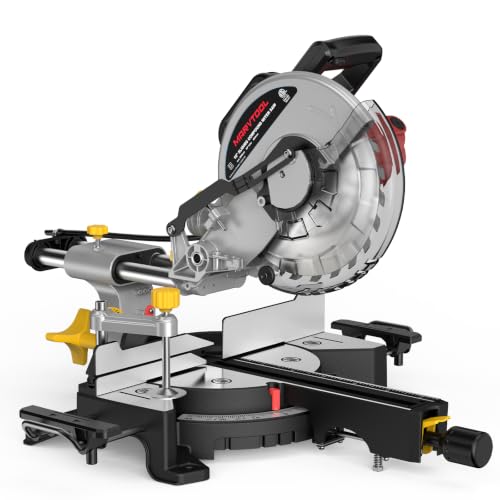
Marvtool 10 Inch Sliding Compound Miter Saw, 15 Amp, 5,000 RPM
15 amp motor5,000 RPM0 to 45 bevelExtension table
Check price on Amazon
Best for: Garage woodworkers who want a sliding saw for framing and shelving at the lowest tier.

A 36-tooth blade is a rough-cut blade, suited to framing and rough trim, and the saw spins it at 5,000 RPM, the fastest speed in this roundup. A transparent blade guard helps you see the cut line, and an extension table supports long boards. The listing describes left miter angles from 0 to 45 degrees and an adjustable base.

The tradeoff is finish. A 36-tooth blade tears the face of trim and plywood, so replace it with an 80-tooth blade for any finish work. Compared with the SKIL MS6305 it has a single bevel and fewer features, and compared with the KSEIBI it has a less robust slide. It is the lowest tier of the sliding saws, aimed at the garage woodworker.

Ownership: expect to spend time on setup, squaring the fence and checking the rails. Keep rails clean, and use the extension table for long boards. A better blade is the first upgrade, and clamping the saw to a bench makes it safer.

What works

  • 5,000 RPM is the fastest no-load speed in the roundup
  • Extension table supports long boards
  • Transparent blade guard improves sight lines
  • 15 amp motor with a sliding head at a low tier

Watch out for

  • 36-tooth blade tears trim and needs replacing
  • Single bevel limits angle options
  • Fewer refinements than the SKIL and DEWALT

Spec sheet

Motor
15 amp
Speed
5,000 RPM
Blade
10 inch, 36-tooth
Bevel
Single, 0 to 45 degrees
Extras
Extension table and transparent guard

Spec sheet decoder

What the numbers on the box really mean

The specs manufacturers lead with, translated into what they tell you about real-world performance.

Crosscut capacity

This is the maximum board width the saw cuts in one pass. It depends on blade size and slide length.

Watch forThe DEWALT's 14 inches is at 0 degrees, and it shrinks at bevels. Always measure crosscut capacity yourself on the first board.

Regenerative braking

This captures energy when the blade slows and returns it to the battery. It extends runtime.

Watch forThe gain depends on how often you stop the blade. Do not expect the same gain when you cut at full speed all day.

Dual rails

Twin rails carry the head, resisting twist. A single arm is lighter but flexes more.

Watch forThe KSEIBI lists dual rails, but quality of bearings matters. Rails need regular cleaning regardless of the brand.

Tooth count

Tooth count sets finish: fewer teeth cut fast and rough, more teeth cut slow and smooth.

Watch forThe Marvtool's 36-tooth blade is for rough work. A fine blade on a rough saw still gives rough results.

Bevel stops

Bevel stops are positive detents at common angles. They speed setup.

Watch forThe SKIL lists four, and other listings do not state their count. Count the stops before you buy, because they save minutes on every project.

Methodology

How We Evaluated These Sliding Compound Miter Saws Under $500

Crosscut capacity

We compared stated capacity, from the DEWALT's 14 inches to the 10 inch sliders. Capacity decides which boards fit. We cross-checked each claim against blade radius and slide length to see if it was plausible.

Slide quality

We looked at rail design, favoring dual rails. Twin rails earned credit, but we noted that bearing quality matters as much as rail count.

Bevel flexibility

We separated single and dual bevel saws, since flipping boards wastes time. Dual bevel saved more time in our analysis than any other feature for long trim runs.

Power and platform

We compared corded 15 amp motors and the cordless DCS785B. We counted battery requirements for the cordless saw as part of its cost.

Relative value

We used price tier to compare what extra spending buys. We compared tiers rather than amounts, and flagged where an extra tier adds only a convenience.

Decision guide

How to Choose the Right Sliding Compound Miter Saws Under $500

By Board Width

WorkPickWhy
14 inch wide boards and tall baseDEWALT DCS785B14 inch crosscut and 6-1/2 inch base
Wide shelving and trimSKIL MS6305Dual bevel
Wide boards with twin railsKSEIBI 10 inchDual rails
Framing and rough workMarvtool 10 inch5,000 RPM
Wood and metalEvolution R185SMS+Multi-material blade

By Budget

TierPickWhy
LowestEvolution R185SMS+Multi-material
LowMarvtool 10 inchBasic slider
Low-middleSKIL MS6305Dual bevel
MiddleKSEIBI 10 inchDual rails
UpperDEWALT DCS785BCordless 12 inch

Cordless vs Corded

Cordless

No extension cords, and mobility between rooms. The DEWALT DCS785B falls here. It needs large packs.

Corded

Runs indefinitely at full power. The SKIL, KSEIBI, Marvtool and Evolution fall here.

Choose cordless if you own the batteries and work on job sites.

By Bevel Needs

NeedPickWhy
Both-way bevelsSKIL MS6305Dual bevel
Both-way cordlessDEWALT DCS785BDouble bevel
One-way bevelKSEIBI 10 inchSingle bevel
Metal anglesEvolution R185SMS+45 bevel and 50 miter
Basic anglesMarvtool 10 inch0 to 45

For Cutting Wide Shelving Boards Specifically

Look for

Wide boards need slide reach, a rigid rail and a fence that supports the board. Support long boards on both sides.

In this comparison

The DEWALT DCS785B cuts the widest, and the SKIL MS6305 and KSEIBI cover most shelving. The Marvtool is a rough option.

When to Spend More

Spend more if

You cut trim daily. The DEWALT DCS785B shows what a pro cordless slider offers.

Save if

You build a few projects a year. The SKIL MS6305 or Marvtool covers that.

Ownership

Maintenance schedule

The upkeep that decides whether this machine lasts two seasons or ten.

TaskIntervalWhy it matters
Check the fence for squareBefore each projectA fence off square ruins miters. Use a square against the blade. Use a brush rather than compressed air if dust packs into the bearings.
Clean and lubricate railsMonthlyDust stiffens rails and hurts accuracy. Light oil keeps them smooth. A drop of light machine oil is enough.
Replace the bladeWhen cuts burn or tearA dull blade strains the motor. Fresh blades cut cleaner. Choose a blade with the right tooth count for the work.
Check head playEvery few monthsRail play makes cuts wander. Tighten bearings if needed. Mark the bearing adjustment before changing it.
Clean the dust portAfter each projectClogged ports reduce collection. Clear them with a rod. Check the dust hose for kinks.

FAQ

Frequently Asked Questions

Do I need a sliding saw?

If you cut boards wider than 6 inches, yes. For trim only, a fixed saw is stiffer. Choose by board width. A fixed saw plus a circular saw for wide boards is a common alternative.

What does the cap buy?

It buys a 10 inch corded slider or a cordless 12 inch bare tool. Listing prices move, so check the live cost. Prices vary between sellers, so compare tiers rather than a single listing.

How long do sliding saws last?

With care, many years. Rails and bearings wear first. Lubricate the rails and keep the saw covered in a dusty shop.

Is dual bevel worth it?

For long trim runs, yes. It saves flipping boards. It also reduces tear-out on the far side of the cut.

Can I cut metal?

Only with a saw and blade made for it, like the Evolution. Wood blades are not safe for metal. Wear eye and hearing protection regardless.

Do I need a stand?

A stable bench helps. Clamp the saw down. Without a stand, a sheet of plywood clamped to sawhorses works.

Bottom line

The short version

Browse more sliding compound miter saws under $500on Amazon →
James Miller, Lead Machine Editor

About the author

James Miller

Lead Machine Editor, MachineFanatic

James Miller leads MachineFanatic's buying guides, turning spec sheets, manuals and owner feedback into clear verdicts on power tools, outdoor power equipment, shop machines and kitchen machines.

More from James →

Keep reading

Related guides