
Amazon affiliate links - we earn a commission.Affiliate disclosure

Buying guide · 14 min read · Updated 2026-11-25

Best Solar Panel Kits Under $1000 (2026)

Five large solar panel kits that list for under $1000, from a battery-and-inverter system to big flexible arrays, with notes on voltage, wiring and real output.

James MillerBy James MillerLead Machine Editor5 machines comparedSpec-sheet verified
Best Solar Panel Kits Under $1000

At a glance

Our top picks

Side by side

Spec comparison

At the top of the budget range, solar stops being a single panel and becomes a system. Kits at this level either bundle a battery and inverter for an all-in-one plug-in setup, or ship a large array that you must pair with your own storage.

That split is the key decision. A complete kit saves wiring and sourcing but limits expansion. A bare array leaves you free to choose a battery chemistry and voltage, but you carry the design risk. We ranked each on how honestly the listing describes what arrives and how well the parts match. Prices move, and the $1000 cap reflects listing prices when this guide was updated.

Before you buy

6 Criteria to Look For Before Buying a Solar Panel Kit Under $1000

  1. 01

    System or array

    A complete kit, like the 1280 Wh system, gives you panels, a battery, a controller and an inverter in one box. An array, like the RVPOZWER five-panel set, gives you only panels. A system saves design effort but limits growth. An array saves money per watt but needs a battery bank, controller, fuses and cabling you must size yourself. Be honest about whether you want to design a power system or simply have power. Many first-time buyers underestimate the extras on an array: a controller, a battery, fuses, breakers, cable and mounting hardware can add a lot of cost and several weekends of work.

  2. 02

    Battery capacity against array size

    The 1,280 watt-hour battery in the complete kit takes about two sunny days to refill from its 240 watt array. Matching storage to generation matters as much as either one alone. A big battery with a tiny array never fills, and a big array with a tiny battery wastes energy. Divide battery watt-hours by array watts to see the minimum sun hours needed for a full recharge.

  3. 03

    System voltage and controller current

    A 1,000 watt array on a 12 volt bank needs over 80 amps of charge current, which is far beyond common 40 or 60 amp controllers. At 24 volts the current halves, and at 48 it halves again. The flexible 1,000 watt kits are far more usable on 24 volts. Check the controller's amp and input voltage limits before you buy panels. A simple rule is to divide the array watts by the battery voltage to get the amps the controller must handle, then add a safety margin.

  4. 04

    Panel voltage and current figures

    Only one kit here prints its panel output, 28.5 volts at 18.81 amps. That lets you check string voltage in series and total current in parallel against the controller. Cold weather raises panel voltage, so leave a margin. If a listing prints no voltage figures, ask before you design around it.

  5. 05

    Flexible or rigid

    Rigid panels like the RVPOZWER cost less per watt, run cooler and last longer. Flexible panels are lighter and fit curves, but heat trapped behind them speeds ageing, and many are only glued down. If you pick flexible, choose a kit with mounting holes or plan for marine-grade adhesive.

  6. 06

    Cell technology

    N-type cells degrade more slowly and handle heat better than older P-type PERC, which matters on a roof that sits in summer sun. The RVPOZWER quotes about 25 percent efficiency with 18 busbars. More busbars help with shade and cracks, but cell type matters more.

Detailed reviews

The 5 best solar panel kits under $1000, explained

01
1280Wh off-grid kit, 2x120W panels, 100Ah battery, 1000W inverter
2 x 120W panels100Ah 12.8V battery1000W pure sine20A MPPT
Check price on Amazon
Best for: Cabins and sheds that need ready AC power from day one.

This is the only kit in the list that includes storage and an inverter, so it produces household AC power straight away. The battery is a 100 amp-hour, 12.8 volt lithium iron phosphate style pack rated at 1,280 watt-hours, with a built-in battery management system. A 1,000 watt pure sine inverter runs laptops, small appliances and tools without the hum a modified sine unit can cause.

The weak link is the panel array: two 120 watt panels total 240 watts, which, at the usual four to five sun hours and roughly 70 percent system efficiency, gives only about 700 to 800 watt-hours a day. That is a bit more than half the battery's capacity, so a heavy user will drain it faster than the sun refills it. The 20 amp MPPT controller suits that array well, since MPPT recovers more energy from a small panel set than PWM.

Compared with the large flexible kits here, the pay-off is a complete working system and a protected lithium battery. In ownership terms, add panels later if you need a faster recharge, keep the battery out of freezing temperatures during charge and check the controller's lithium profile. A cabin, a shed or a weekend power backup is the natural home. Because the whole system is sold as a unit, support comes from one seller, which is easier than chasing five brands when something misbehaves.

What works

  • Battery, inverter and controller included
  • Pure sine inverter suits sensitive devices
  • Lithium pack with built-in BMS
  • MPPT controller matches the small array

Watch out for

  • Panel array is small for the battery size
  • Fixed system limits expansion without extra parts

Spec sheet

Panels
Two 120 watt rigid monocrystalline
Battery
100Ah 12.8V, 1280Wh, built-in BMS
Inverter
1000W pure sine wave
Controller
20A MPPT
Format
Complete off-grid kit
02
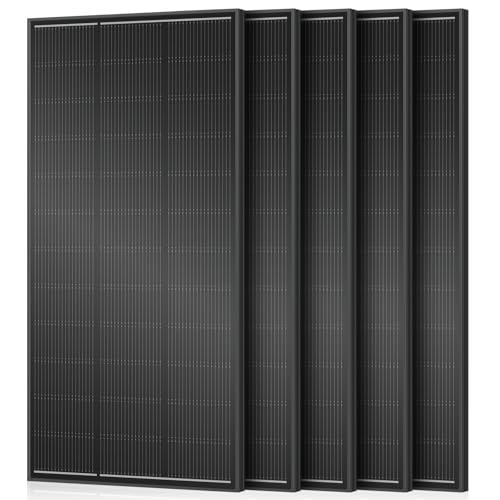
RVPOZWER 1000W kit, 5x200W N-type panels, 18BB cells
5 x 200WN-type25% efficiency12V/24V
Check price on Amazon
Best for: Owners who already have, or will build, a battery bank and MPPT controller.

RVPOZWER sells five rigid 200 watt panels with 18 busbar N-type cells. N-type technology, often called TOPCon, degrades more slowly and tolerates heat better than older P-type PERC, and the quoted 25 percent efficiency is high for a rigid panel. Extra busbars help with shade and small cell cracks, though cell type matters more than the busbar count.

It is an array and not a system, so you must supply a charge controller, wiring, fuses and a battery bank. That is both its advantage and its risk. Five panels can be wired in series, parallel or a mix, and the choice has to match your controller's input limits. Series raises voltage and eases wire sizing but needs an MPPT unit sized for the voltage, including the cold-weather rise.

Set beside the complete kit, you get four times the watts and a freer design but a much bigger installation. In ownership, mount the panels with an air gap, seal every roof penetration with a sealant like Dicor and inspect it each year. Fuse each parallel string and check connectors every season. Before drilling anything, lay the panels out on the ground, connect them to the controller and confirm that voltage and current look right in full sun.

What works

  • Five N-type panels for 1000 watts total
  • High cell efficiency in rigid form
  • Pre-drilled holes speed mounting
  • Flexible wiring options for 12 or 24 volts

Watch out for

  • No controller or battery included
  • Roof area and wiring work are substantial

Spec sheet

Total power
1000 watts
Panels
Five 200 watt N-type
Cell tech
18BB monocrystalline
Efficiency
About 25 percent
Mounting
Pre-drilled holes on the back
03
1000W flexible kit, 2x500W panels, 28.5V 18.81A output
2 x 500W28.5V / 18.81A3 mm thickFlexible
Check price on Amazon
Best for: Builders who want to match panel specs to a controller on paper.

This kit stands out for printing its electrical output: 28.5 volts at 18.81 amps per panel. Multiplied out, that is about 536 watts, so the 500 watt label is conservative. Having real voltage and current figures lets you check them against a controller's input limits, which most flexible-panel listings never allow.

The panels are around three millimeters thick and bendable, which suits curved roofs, boats and vans where rigid glass is impractical. The listing aims them at continuous generation in remote locations. A big caveat is the controller: at 28.5 volts per panel, two panels in series reach 57 volts and in parallel deliver 37.6 amps, so make sure your controller's voltage and current limits cover your wiring choice.

Measured against the other flexible kits in the list, it is more transparent but, like them, it ages faster than a framed panel because heat is trapped behind it. Use marine-grade adhesive, leave edges ventilated and check the bond each year. Because the printed figures are clear, it is also the easiest kit to pair with a specific controller. Work out the string voltage with a margin for cold mornings, and do not exceed the controller's maximum input.

What works

  • Panel voltage and current are stated
  • Flexible and about three millimeters thick
  • Large 1000 watt label in two panels
  • Suits curved and weight-limited roofs

Watch out for

  • No battery or inverter included
  • Flexible panels age faster than framed ones

Spec sheet

Total label
1000 watts
Panels
Two 500 watt flexible
Panel output
28.5 volt, 18.81 amp
Thickness
About 3 millimeters
Cells
Monocrystalline
04
1000W portable flexible kit, 2x500W panels with controller
2 x 500WBends 30 degreesController includedPortable
Check price on Amazon
Best for: Travelers who want a large flexible array with a controller included.

This kit pairs two 500 watt monocrystalline flexible panels with a charge controller. The listing says the panels bend up to 30 degrees, enough to follow a gently curved roof or to be laid over uneven ground. It is aimed at RV, camping and off-grid use where portability and shape matter more than the lowest weight per watt.

A controller in the box is convenient, but the listing does not make the controller type obvious, so verify whether it is PWM or MPPT and what amperage it supports. Panel watts add up quickly: 1,000 watts at 12 volts is more than 80 amps, which no small controller can use. As with every kit of this size, the label is a ceiling.

Compared with the transparent-spec kit, this one is more convenient but less documented. In ownership, protect the panels from foot traffic, avoid tight folds and check the junction boxes for water ingress. Store them flat if you take them off a roof for the winter. If you are tempted to run them in parallel on a 12 volt bank, budget for heavy cable and a large fuse, since the current is high. Dividing the system into two smaller banks, each with its own controller, is a cleaner way to use two big panels.

What works

  • Controller included with the panels
  • Bends up to thirty degrees
  • Large collecting area
  • Easy to carry compared with glass

Watch out for

  • Controller details are sparse
  • Label watts exceed a typical 12 volt limit

Spec sheet

Total label
1000 watts
Panels
Two 500 watt monocrystalline
Flex
Bends up to 30 degrees
Controller
Included
Use
RV roofs, curved surfaces, off-grid
05
1000W flexible kit, 2x500W bendable panels, 6 holes each
2 x 500WBendable6 mounting holesController included
Check price on Amazon
Best for: Moving vehicles where wind and vibration make fasteners worthwhile.

This kit's practical selling point is six pre-drilled mounting holes on each panel, so you can fasten the panels with screws or grommets as well as adhesive. Mechanical fastening helps flexible panels survive wind and vibration better than adhesive alone, which is a common failure point on a moving vehicle.

The panels are monocrystalline, bendable and lightweight, and a controller is included. Two 500 watt panels give a 1,000 watt label, but as with the others the arithmetic must work at your battery voltage: a 12 volt bank would demand well over 80 amps of charge current. Treat the label as a maximum and plan the battery bank and controller around real output of roughly 60 to 80 percent.

It is a good choice for a trailer roof or a flat-bed cover where you want a mix of glue and fasteners. Seal each screw hole, check the hardware each season and keep the cables clamped so they cannot rub through on the edge of a roof. Use stainless hardware with a rubber washer, since a plain steel screw rusts through the sealant in a few seasons. Recheck torque after the first month, because vibration settles everything.

What works

  • Six mounting holes per panel
  • Light and bendable monocrystalline
  • Controller included
  • Adhesive plus fasteners hold better

Watch out for

  • Controller type and amps are unclear
  • Each screw hole is a leak path to seal

Spec sheet

Total label
1000 watts
Panels
Two 500 watt monocrystalline
Mounting
Six pre-drilled holes per panel
Build
Ultra-flexible, lightweight
Controller
Included

Spec sheet decoder

What the numbers on the box really mean

The specs manufacturers lead with, translated into what they tell you about real-world performance.

Watt-hours

Stored energy in a battery, equal to amp-hours times voltage. It tells you how long it can run a load.

Watch forThe complete kit's battery is 1,280 Wh, while its panels add only about 700 to 800 per day.

Voltage and current

Panel output in volts and amps. Multiply them for watts and check them against the controller.

Watch forThe transparent flexible kit prints 28.5 V and 18.81 A per panel.

Pure sine

An inverter waveform that matches household power. It suits sensitive electronics and motors.

Watch forThe complete kit's 1,000 watt inverter is pure sine.

MPPT amps

The current an MPPT controller can pass to the battery. It limits usable panel power.

Watch forThe complete kit's 20 amp MPPT suits its 240 watt array.

Busbars

The thin lines on a cell that collect current. More busbars help with shade and cracks.

Watch forThe RVPOZWER uses 18BB cells.

Methodology

How We Evaluated These Solar Panel Kits Under $1000

System completeness

We checked what each box contains and what you must still buy. The complete kit scored for usability. The bare arrays scored for value per watt.

Electrical arithmetic

Panel labels were checked against typical controller limits and battery voltages. The 1,000 watt flexible kits lost points on 12 volts. The kit that prints voltage and current gained transparency.

Panel type and durability

Rigid, flexible and N-type cells were compared on heat and ageing. The RVPOZWER's N-type cells led. The flexible kits scored for fit, not lifespan.

Mounting and installation

Mounting holes, panel thickness and cable provisions were reviewed. Six holes per panel earned credit. Kits that rely on adhesive alone were noted.

Cap compliance

Every kit was verified under the $1000 cap at the time of writing. The notes rely on the spec sheet and owner feedback patterns. This guide shares no products with the lower-cap sibling.

Decision guide

How to Choose the Right Solar Panel Kits Under $1000

By System Type

SituationPickWhy
Cabin needing AC power now1280Wh complete kitBattery and pure sine inverter included
Existing battery bankRVPOZWER 5x200WRigid N-type array
Spec-driven designer1000W flexible kit 28.5VPrints voltage and current
Portable large array1000W portable flexible kitController included
Vehicle roof with fasteners1000W kit with 6 holesScrews plus adhesive

By Budget

TierPickWhy
Lowest in this list1000W flexible kit with 6 holesLarge label, low cost
Lower middle1000W portable flexible kitController included
Middle1000W flexible kit 28.5VDocumented output
Upper middleRVPOZWER 5x200WRigid N-type
Top of the cap1280Wh complete kitBattery and inverter included

Complete System vs Bare Array

Complete system (1280Wh kit)

Ready to power a laptop or a tool the day it arrives. The array is small and expansion needs more parts.

Bare array (RVPOZWER, flexible kits)

More watts per dollar and freedom to choose a battery. You must design and install the rest.

Choose the complete kit for convenience and an array for scale.

Battery Voltage

PreferencePickWhy
12 volt system1280Wh complete kitMatched 12.8 volt battery
24 volt systemRVPOZWER 5x200WSeries strings suit 24 volts
48 volt or higher1000W flexible kit 28.5VSeries strings reach high voltage
Station-based storage1000W portable flexible kitController supplied

For Off-Grid Cabins Specifically

Look for

Enough panel watts to refill the battery, an MPPT controller and a pure sine inverter. Cabins need reliability more than portability.

In this comparison

The 1280Wh kit is the fastest start. The RVPOZWER array is the better long-term base if you add a bigger battery.

When to Spend More

Spend more if

You want a larger lithium bank, a split-phase inverter or a branded system with a long warranty. Those come above this cap.

Save if

You only need to power lights and a laptop. A smaller kit from a lower tier covers it.

Ownership

Maintenance schedule

The upkeep that decides whether this machine lasts two seasons or ten.

TaskIntervalWhy it matters
Clean the panelsMonthlyDust and droppings cut output. Soft cloth and water are enough.
Check connectors and fusesEach seasonHeat cycles loosen terminals. Loose joints waste power and run hot.
Inspect adhesive and sealantAnnuallyFlexible panels depend on the bond. Screw holes need sealing.
Check battery stateQuarterlyCell imbalance and low charge shorten life. A monitor shows trends early.
Verify controller profileWhen changing batteriesA wrong profile damages lithium or lead-acid. Confirm it matches.

FAQ

Frequently Asked Questions

Can I run a 1000 watt array on a 12 volt battery?

Only with a very large controller. At 12 volts, 1,000 watts means over 80 amps, which exceeds common controllers. A 24 volt system halves that current. Alternatively, split the array across two controllers, each feeding the same bank, which is a common and tidy fix.

Is the complete kit enough for a cabin?

For lights, a laptop and small devices, yes. Its 240 watt array refills the battery slowly, so heavy loads will drain it. Plan on adding panels later if you find yourself running the battery low, and check that the controller can accept the extra current.

Why do some listings print panel volts and amps?

Because they let you size the controller and wiring. A listing with no electrical figures leaves you guessing.

Are flexible panels a good choice?

They suit curved or weight-limited roofs. They age faster because heat is trapped behind them, so rigid is better where possible.

Do I need an MPPT controller?

At this size, yes. MPPT harvests roughly 20 to 30 percent more than PWM and handles higher input voltage.

Does the $1000 cap change?

Listing prices move. The cap reflects prices when this guide was updated, so check the live listing.

Bottom line

The short version

Browse more solar panel kits under $1000on Amazon →
James Miller, Lead Machine Editor

About the author

James Miller

Lead Machine Editor, MachineFanatic

James Miller leads MachineFanatic's buying guides, turning spec sheets, manuals and owner feedback into clear verdicts on power tools, outdoor power equipment, shop machines and kitchen machines.

More from James →

Keep reading

Related guides