
Amazon affiliate links - we earn a commission.Affiliate disclosure

Buying guide · 13 min read · Updated 2026-11-25

Best Solar Panel Kits Under $500 (2026)

Five solar panel kits that list for under $500, spanning MPPT rigid kits, folding portables and flexible panels, with notes on real output and wiring.

James MillerBy James MillerLead Machine Editor5 machines comparedSpec-sheet verified
Best Solar Panel Kits Under $500

At a glance

Our top picks

Side by side

Spec comparison

The jump from an entry kit to a mid-range one is mostly about the controller and the panel count. MPPT tracking squeezes more energy from the same panels, and a larger array lifts the daily energy budget from a few lights to a fridge and a laptop.

This tier also contains the first flexible and large-label kits, where the headline wattage and the real hardware can diverge. We ranked by controller type, cell tech and how clearly the listing states what is in the box. Prices move, and the $500 cap reflects listing prices when this guide was updated.

Before you buy

6 Criteria to Look For Before Buying a Solar Panel Kit Under $500

  1. 01

    MPPT or PWM

    MPPT harvests roughly 20 to 30 percent more energy than PWM, most noticeably in cold weather or low light. The ECO-WORTHY kit includes MPPT, while the flexible kits do not clearly say. Vendor guidance is to avoid PWM above about 150 watts of panels. At 400 watts and up, MPPT usually pays for itself in saved panels. Another advantage is voltage headroom: an MPPT controller accepts a higher panel voltage than the battery, so you can wire panels in series and run thinner cable for the same loss. That matters on a van or boat where every metre of heavy cable adds weight and cost.

  2. 02

    Controller amps versus panel watts

    A controller's amp rating times the battery voltage gives the most panel power it can use. A 40 amp controller on 12 volts handles about 500 watts, but a 1,000 watt label will exceed that. Check this arithmetic before buying a big array. Extra panel watts beyond the controller's limit are simply wasted. Some controllers clip quietly, so the only sign is that the battery charges more slowly than the label suggests. If your array is larger than the controller can use, either add a second controller or choose a higher amp rating.

  3. 03

    Series or parallel wiring

    Series wiring raises voltage, allows thinner wire and handles partial shade better, but it needs an MPPT controller sized for the input voltage. Parallel wiring adds current and suits small PWM systems, but shade on one panel drags the others and each string needs fusing. The ECO-WORTHY's four panels let you choose, so read the controller's maximum input voltage. Cold weather raises panel voltage, so leave a margin below the limit rather than wiring right up to it. Fuse each parallel branch, because a fault in one panel can be fed by the others.

  4. 04

    Rigid, flexible or foldable

    Rigid panels cost less per watt and run cooler. Flexible panels fit curved roofs and save weight, but they age faster when heat is trapped behind them. Foldable panels suit power stations. Pick by where the panels will live. Rigid panels with an air gap behind them run cooler, and a cooler panel holds more of its rated output on a hot afternoon. Flexible panels glued flat to a roof have no gap, so they run hotter and need the best adhesive you can get.

  5. 05

    Connector fit for power stations

    Foldable panels use MC4, XT60, DC5521, DC5525, DC7909 and Anderson plugs. The LVYUAN ships with a bundle of adapters, while the CTOLITY relies on MC4. Check the station's input style, its maximum watts and its voltage window. A panel whose open-circuit voltage exceeds the station's limit can trip the input or damage it, so look up both numbers. When an adapter is needed, buy one rated for the current, since thin adapters overheat.

  6. 06

    Label watts and field output

    Panel watts are rated at standard test conditions. Real output is often 60 to 80 percent of the label, lower in winter or on a hot roof. Size the system from your daily watt-hours divided by four to five sun hours and about 0.7 for losses. For example, a fridge and lights using 800 watt-hours a day need roughly 230 watts of panels at four sun hours, before you add any margin. Add a cushion for cloudy days and for winter, when sun hours may drop well below four.

Detailed reviews

The 5 best solar panel kits under $500, explained

01
ECO-WORTHY 400W kit, 4x100W panels, 40A MPPT, Bluetooth
400W total4 x 100W40A MPPTBluetooth
Check price on Amazon
Best for: RV and cabin systems that want MPPT efficiency and monitoring.

ECO-WORTHY packages four 100 watt panels with a 40 amp MPPT controller and a Bluetooth module, which is the most complete system under the cap. The listing quotes an average of about 1.6 kilowatt-hours per day depending on sun, and about 25 percent cell efficiency. The MPPT tracking is described at up to 99 percent tracking efficiency, which is the figure that matters for squeezing output from cool or hazy days.

Four small panels can be wired in series, parallel or a combination, and that choice is not trivial. Series wiring raises voltage and lets you use thinner wire and handles shade better, but it needs the controller's input voltage to be respected. Parallel wiring adds current and suits small systems, though shade on one panel drags the others and each string needs fusing.

Measured against the cheaper rigid kits it brings monitoring through the app, which lets you see charge state without a meter. In ownership, keep the panels clean, check the connectors each season and match the controller profile to the battery. The 100 watt panel size is also easier to fit on a van roof than one big panel. If one small panel is damaged, the system keeps working at reduced output, which is more forgiving than losing a single large panel. Label every cable at install time so a later fault is quick to trace.

What works

  • MPPT controller recovers extra energy
  • Bluetooth monitoring of charge state
  • Four small panels fit awkward roofs
  • High stated cell efficiency

Watch out for

  • More connections to wire and fuse
  • Controller input limits shape the wiring plan

Spec sheet

Total power
400 watts
Panels
Four 100 watt monocrystalline
Controller
40A MPPT with Bluetooth
Cell efficiency
About 25 percent
Daily output
About 1.6 kWh in good sun
02
CTOLITY 400W foldable solar panel for power stations
400W23.4% cellsIP65MC4 connectors
Check price on Amazon
Best for: Power-station owners who need a large folding charger.

CTOLITY sells this as a foldable charger for a portable power station, with MC4 connectors, adjustable kickstands and an IP65 rating. The monocrystalline cells are quoted at about 23.4 percent efficiency. A foldable format gives you a large collecting area that packs down to a carry size, so you can set it where the sun is and keep the station in the shade.

It does not include a separate controller, because it relies on the power station's built-in solar input. That is the main thing to verify: the station must accept the panel's voltage and wattage, and the MC4 output needs an adapter for stations that use another plug. Set beside the ECO-WORTHY, you give up fixed-roof efficiency and monitoring but gain mobility.

Ownership follows the usual portable-panel routine. Prop it at an angle, keep it clear of shade and wipe it clean. Store it folded in its case, protect the connectors from dust and check the kickstands for wear after a few seasons of use. Because the panel is large, wind is the main hazard; peg or weigh it down before leaving it unattended. Never fold it while the cells are very hot, since stress on the laminate is higher then.

What works

  • Four hundred watts in a folding format
  • IP65 rating handles rain and dust
  • Adjustable kickstands for sun angle
  • MC4 outputs suit common adapters

Watch out for

  • No controller for bare batteries
  • Station input limits cap usable power

Spec sheet

Power
400 watts
Cell efficiency
About 23.4 percent
Protection
IP65 waterproof
Output
MC4 connectors
Stand
Adjustable kickstands
03
LVYUAN 500W foldable solar panel, IP65, adapter bundle
500W23.5% cellsIP65Adapter bundle
Check price on Amazon
Best for: Owners of several different power stations who want an adapter bundle.

LVYUAN's 500 watt panel uses an inward-folding design that protects the cell surface when packed, and it ships with an MC4 cable plus a bundle of adapters for XT60, DC5521, DC5525 and DC7909 connectors. That adapter set is the practical edge: connector mismatch is the most common frustration when pairing a folding panel with a power station.

The monocrystalline cells are quoted at about 23.5 percent efficiency, and the IP65 rating handles dust and rain. At 500 watts, it is also larger than the CTOLITY, so it needs a bigger flat area and a heavier carry. Always confirm your station's maximum solar input in watts and volts, because an oversized panel does not help beyond the station's limit.

In year three the folds and the connectors are the wear points. Avoid sharp creases, cap unused connectors and wipe the surface with water. Store it flat or loosely rolled. Check that the weight of the panel suits how you carry it, since a half-hundredweight of glass and frame is a real chore up a flight of stairs. If the output ever drops below what you saw in the first month, inspect for hairline cracks by eye in low light.

What works

  • Five connector styles in the box
  • Inward fold protects the cells
  • IP65 rated for outdoor use
  • Largest portable panel in this list

Watch out for

  • Bulky to carry and stow
  • Station input limit caps the benefit

Spec sheet

Power
500 watts
Cell efficiency
About 23.5 percent
Protection
IP65
Fold
Inward-folding design
Adapters
MC4 plus XT60, DC5521, DC5525, DC7909
04
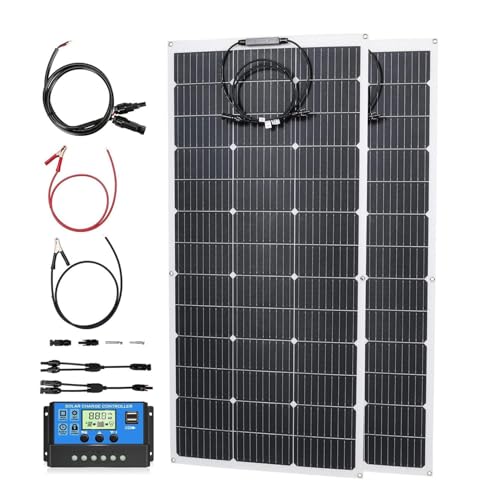
500W flexible solar kit, 2x250W panels, 40A controller
500W total2 x 250WFlexible40A controller
Check price on Amazon
Best for: Curved roofs and boats where rigid panels will not fit.

This kit uses two flexible monocrystalline panels with a 40 amp controller. Flexible panels bend to fit a curved roof, a boat cabin or a van with weight limits, which rigid glass panels cannot do. The listing targets RVs, sailboats and yachts and describes the cells as high-efficiency monocrystalline silicon.

Flexible panels come with trade-offs. They are lighter, but they are usually glued to the surface, and heat trapped behind them speeds ageing, so they typically age faster than a framed panel with an air gap. Marine-grade adhesive and a small standoff help. The controller type is not clearly stated, so confirm whether it is PWM or MPPT before wiring.

Against the ECO-WORTHY rigid kit, you gain weight savings and curved-surface fit but lose longevity and monitoring. Use it where weight or shape rules out rigid panels, and check the adhesive and cable seals each year. Lay the panels out and test them before gluing anything down, because a dead panel is hard to remove once bonded. Leave a drip loop in each cable where it enters the cabin so rain cannot track along the wire.

What works

  • Bends to curved surfaces
  • Light weight for weight-limited roofs
  • Two 250 watt panels and a controller
  • Suitable for marine and RV use

Watch out for

  • Flexible panels age faster in heat
  • Controller type is not clearly stated

Spec sheet

Total power
500 watts
Panels
Two 250 watt flexible
Cells
Monocrystalline silicon
Controller
40 amp
Use
Curved roofs, boats, RVs
05
1000W flexible solar kit, 2x500W panels, 40A controller
1000W label2 x 500WFlexible40A controller
Check price on Amazon
Best for: 24 volt off-grid systems with space for large flexible panels.

This kit lists two 500 watt flexible panels and a 40 amp controller for a combined 1,000 watt label. The listing describes monocrystalline cells and a lightweight, compact design compared with traditional rigid panels. It is the largest label in the tier, so it deserves a careful read.

The arithmetic is the issue: a 40 amp controller on a 12 volt battery handles roughly 500 watts of panel power, because watts equal amps times volts. At 24 volts it handles about 1,000, so this kit only delivers its full label on a 24 volt system. Panel watts are also rated at standard test conditions, and real output is often 60 to 80 percent of the label.

Next to the smaller 500 watt kit, you get more area but need a bigger battery bank and a matching voltage. Use it only if you have a 24 volt system or plan to use one panel on a 12 volt setup. Check the wiring and the adhesive each season. Size the cable for the higher current of a big array and fuse it close to the battery. A system this large deserves a proper battery monitor, so you can see whether the panels are really delivering.

What works

  • Largest panel area in this tier
  • Flexible and light for its size
  • Controller included in the kit
  • Suits boats and curved roofs

Watch out for

  • Controller limits a 12 volt system to about half
  • Flexible panels age faster with trapped heat

Spec sheet

Label power
1000 watts
Panels
Two 500 watt flexible
Cells
Monocrystalline
Controller
40 amp
Use
RV, camping, boat, off-grid

Spec sheet decoder

What the numbers on the box really mean

The specs manufacturers lead with, translated into what they tell you about real-world performance.

Tracking efficiency

How closely an MPPT controller follows the panel's best operating point. Higher is better.

Watch forThe ECO-WORTHY lists up to 99 percent.

Controller amps

The current the controller can pass to the battery. It caps usable panel power.

Watch forA 40 amp unit on 12 volts caps near 500 watts.

Cell efficiency

The share of light converted to power. Higher means more watts per square foot.

Watch forThe ECO-WORTHY quotes about 25 percent, the LVYUAN about 23.5.

IP rating

Dust and water protection. IP65 resists jets of water and dust.

Watch forThe CTOLITY and LVYUAN both list IP65.

Label wattage

Peak output under lab sunlight. Real output is lower.

Watch forThe 1,000 watt flexible kit needs 24 volts to use its label.

Methodology

How We Evaluated These Solar Panel Kits Under $500

Controller and arithmetic

We compared controller type and amp rating against each kit's total watts. The ECO-WORTHY MPPT scored best. The 1,000 watt flexible kit lost points for a mismatch between label and controller on 12 volts.

Panel type and ageing

Rigid, flexible and foldable designs were compared on heat behaviour and fit. Rigid panels lead on lifespan. Flexible ones lead on shape and weight.

Connector and compatibility

Connector styles and adapter bundles were checked. The LVYUAN's five connector types earned credit. Listings with a single MC4 output scored as needing an adapter.

Monitoring and protection

Bluetooth, IP ratings and similar features were weighed. The ECO-WORTHY's app and the IP65 portables stood out. Kits with no stated protection scored lower.

Cap compliance

Each kit was verified under the $500 cap at the time of writing. Notes rely on the spec sheet and owner feedback patterns. This guide reuses at most two kits from its lower-cap sibling.

Decision guide

How to Choose the Right Solar Panel Kits Under $500

By Use Case

SituationPickWhy
Fixed RV roof with monitoringECO-WORTHY 400WMPPT and Bluetooth
Portable power stationCTOLITY 400W foldableIP65 and kickstands
Multiple station brandsLVYUAN 500W foldableFive connector styles
Curved roof or boat500W flexible kitBends to fit
24 volt large array1000W flexible kitController matches at 24 volts

By Budget

TierPickWhy
Lowest in this listECO-WORTHY 400WBest value rigid MPPT kit
Lower middle500W flexible kitTwo flexible panels
Middle1000W flexible kitLargest label
Upper middleCTOLITY 400W foldableFolding with IP65
Top of the capLVYUAN 500W foldableLargest portable with adapters

Rigid vs Flexible

Rigid (ECO-WORTHY)

Runs cooler, lasts longer and costs less per watt. It needs a mounting frame and a roof with room.

Flexible (500W and 1000W kits)

Light and curve-friendly, but heat trapped behind the panel speeds ageing.

Choose rigid for longevity and flexible when weight or shape forces it.

System Voltage

PreferencePickWhy
12 volt battery bankECO-WORTHY 400W40 amp MPPT fits
24 volt battery bank1000W flexible kit40 amp reaches 1,000 watts
Power station inputCTOLITY 400W foldableStation handles the regulation
Mixed station fleetLVYUAN 500W foldableAdapters for each plug

For Van Builds Specifically

Look for

Panels that fit the roof, a controller with monitoring and wiring that can be fused. Roof space and weight decide the format.

In this comparison

The ECO-WORTHY suits a flat roof, and the 500W flexible kit suits a curved one. Skip the large flexible kit unless you run 24 volts.

When to Spend More

Spend more if

You need a pure-sine inverter and battery included, or panels from a bigger brand with a longer warranty. Those come above this cap.

Save if

You only need to top up a station. The CTOLITY covers it.

Ownership

Maintenance schedule

The upkeep that decides whether this machine lasts two seasons or ten.

TaskIntervalWhy it matters
Clean the panelsMonthlyDust, pollen and bird droppings cut output. A soft cloth and water suffice.
Check wiring and fusesEach seasonHeat and vibration loosen terminals. Loose terminals waste power and create hot spots.
Inspect adhesive and sealantAnnuallyFlexible panels rely on adhesive. Roof penetrations rely on sealant, and both can crack.
Verify controller settingsWhen changing batteriesThe wrong profile under or overcharges. Lithium needs its own setting.
Inspect folds and connectorsEvery tripCreases and dirty plugs shorten portable panel life. A quick look avoids a failed charge.

FAQ

Frequently Asked Questions

Is MPPT worth it at this level?

Yes for 400 watts and up. MPPT harvests roughly 20 to 30 percent more, most noticeably in cold or low light. That extra output often covers the cost of the controller. The gain is smallest on a hot, bright day with a nearly full battery and largest on a cold morning with a depleted bank.

Why is the label on the 1000W kit misleading?

A 40 amp controller on a 12 volt battery handles about 500 watts. The kit reaches its label only on a 24 volt system. Check the battery voltage first.

Are flexible panels as good as rigid ones?

They are lighter and fit curves, but they age faster because heat gets trapped behind them. Rigid panels with an air gap last longer. If weight or curvature forces you to go flexible, expect to replace the panels sooner and budget for that.

Can I connect these to a power station?

The foldable panels are designed for that, but you must match connector, voltage and watt limits. The LVYUAN bundles adapters for common plugs.

How much will I actually get?

Real output is usually 60 to 80 percent of the label. Plan your system from watt-hours per day, not from peak watts.

Does the $500 cap change?

Listing prices move. The cap reflects prices when this guide was updated, so check the live listing.

Bottom line

The short version

Browse more solar panel kits under $500on Amazon →
James Miller, Lead Machine Editor

About the author

James Miller

Lead Machine Editor, MachineFanatic

James Miller leads MachineFanatic's buying guides, turning spec sheets, manuals and owner feedback into clear verdicts on power tools, outdoor power equipment, shop machines and kitchen machines.

More from James →

Keep reading

Related guides