
Amazon affiliate links - we earn a commission.Affiliate disclosure

Buying guide · 13 min read · Updated 2026-11-15

Best Stainless Steel Food Processors (2026)

Six food processors with stainless steel bowls compared by capacity, motor, blade design and cleanup, from nested home sets to large bowl cutters.

James MillerBy James MillerLead Machine Editor5 machines comparedSpec-sheet verified
Best Stainless Steel Food Processors

At a glance

Our top picks

Side by side

Spec comparison

MachineBowlsSpeedsBest atMotor
OSTBA Food Processor with 3 Stainless Steel Bowls and Magnetic BladeBest OverallOSTBA Food Processor with 3 Stainless Steel Bowls and Magnetic Blade7.6, 8.5 and 10.6 cups, steel2Varied home prepn/a
Ganiza Dual-Bowl Food Chopper, 8-Cup Steel and 8-Cup GlassBest Steel and Glass PairGaniza Dual-Bowl Food Chopper, 8-Cup Steel and 8-Cup Glass8-cup steel, 8-cup glass2Meat and vegetables side by siden/a
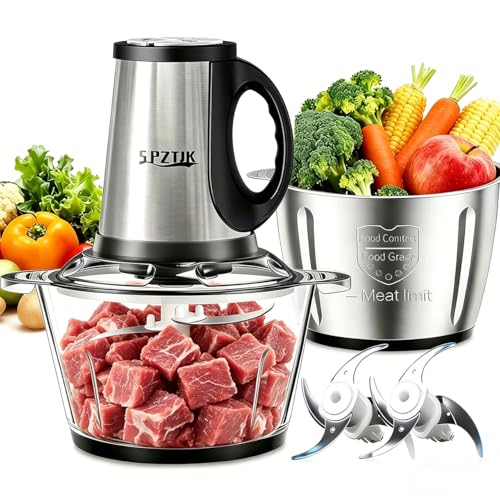
SPZTJK 3-Speed Electric Food Processor, 300 W, Steel and Glass BowlsBest Budget SteelSPZTJK 3-Speed Electric Food Processor, 300 W, Steel and Glass Bowls8-cup 304 steel and 8-cup glass3Light chopping and grinding300 W
Large 6 L Stainless Steel Food Processor, 1200 W, 4 BladesBest High-Volume Home UnitLarge 6 L Stainless Steel Food Processor, 1200 W, 4 Bladesn/an/aBatch grinding and mincing1200 W copper
VEVOR 9.5 Qt Commercial Food Processor, 1800 W, All SteelBest All-Steel BuildVEVOR 9.5 Qt Commercial Food Processor, 1800 W, All Steeln/an/aBulk prep1800 W universal

A steel bowl solves three problems that plastic cannot: it does not stain, it does not hold onto garlic or onion odors, and it does not cloud or craze after years of washing. The trade is weight, opacity and the fact that you cannot watch the food as it processes.

Most machines in this category are bowl choppers rather than disc processors, so the first job is understanding what you are buying. Capacity ranges from a family-size home bowl to an industrial vat, and the motor, blade layout and safety design change a lot across that spread.

Before you buy

6 Criteria to Look For Before Buying a Stainless Steel Food Processor

  1. 01

    Chopper or disc processor

    Every machine in this guide chops and minces in an open steel bowl. None is a disc processor, so none slices or shreds in the classic sense. If you want slicing and shredding discs, a plastic-bowl machine such as the Cuisinart or the Hamilton Beach is the right tool. Decide by the cuts you use before the bowl material. A useful sanity check is to write down the last five things you prepped, then mark which needed a slice or a shred. If more than two did, steel bowl choppers will frustrate you, and a plastic disc machine is the better main tool with a steel chopper as a companion.

  2. 02

    Steel grade and finish

    The SPZTJK lists 304 stainless, the most common food-grade steel, and the VEVOR lists an all-steel build. Lower grades can pit or discolor with salt and acid over time. Look for a stated grade, and expect a brushed finish to hide scratches better than a mirror one. Never leave bleach or chlorinated cleaners in a steel bowl, because chlorine is what causes the tiny pits that later catch food, and never scrub with steel wool, which leaves iron particles that rust.

  3. 03

    Bowl size and count

    The OSTBA gives three bowls of 7.6, 8.5 and 10.6 cups, the Ganiza and SPZTJK give two 8-cup bowls, the 6 L unit has one big bowl and the VEVOR holds 9 L. More bowls mean cleaner separation of foods. One big bowl suits batch work. Pick by how many different foods you process in one session. Two bowls matter most when raw meat and vegetables share a recipe, since a single bowl forces a full wash between them to avoid cross-contamination, and that wash is where the time goes on a busy evening.

  4. 04

    Motor and duty

    Ratings run from 300 W on the SPZTJK to 1800 W on the VEVOR. Low-rated machines suit soft foods and baby food, and high-rated ones suit meat and bulk work. A copper winding and a thermal cutoff are signs of intended duty. Match the rating to what you chop most. A larger motor does not make a gentler machine, so a 1800 W unit will turn soft herbs to paste in a second or two, and the way to avoid it is short pulses and a smaller batch rather than a longer run.

  5. 05

    Blade design

    The OSTBA uses a magnetic blade with no center post, the Ganiza and SPZTJK use stacked blades, and the 6 L unit uses four blades on two levels. Tiered blades chop at several heights for an even mince. A post-free design leaves fewer crevices to clean. Look for a design that matches your mess tolerance. Sharp blade edges should also lock firmly onto the shaft, since a blade that wobbles under load chips the bowl bottom, and a chipped steel bowl cannot be repaired.

  6. 06

    Weight, noise and storage

    Steel machines are heavy, and the big ones are loud. The nesting OSTBA stores in one stack, while the 6 L and VEVOR units need a permanent spot. Think about where the machine will live and whether you can lift it. A machine that is hard to move becomes a machine you avoid using. Put a silicone mat or a damp towel under heavy units, since the combination of steel bases and fast blades makes them vibrate across a smooth counter, and a vibrating machine will walk toward the edge.

Detailed reviews

The 5 best stainless steel food processors, explained

01
OSTBA Food Processor with 3 Stainless Steel Bowls and Magnetic Blade
3 steel bowlsMagnetic blade7.6, 8.5, 10.6 cups2 speeds
Check price on Amazon
Best for: Cooks who want steel bowls in three sizes that store in one stack.

Three stainless bowls that nest together is the idea that sets this machine apart. A small bowl handles sauces and dips, a middle bowl handles a normal family batch, and a large bowl handles meal prep, and because they stack you give up one cabinet footprint instead of three. Matching the bowl to the job matters more than it sounds, because a blade in an oversized bowl spins above a thin layer and leaves unevenly chopped food.

The blade mounts magnetically at the base rather than on a center post. A conventional post leaves gaps where food packs in and a hole through the bowl that can leak, and removing that post means fewer places for garlic and herb residue to hide. That is the claim behind the name anti-clog, and it is a sound design logic even if the benefit varies by recipe.

Ownership is easy. Steel bowls tolerate harsh scrubbing and go through the dishwasher, but the blade assembly deserves a gentle hand wash and thorough drying. Against the Ganiza, it offers three steel bowls instead of a steel and glass pair, and it is a chopper, not a disc processor, so slicing and shredding are not part of the job.

What works

  • Three nesting steel bowls cover small to large jobs
  • Magnetic blade avoids a food-trapping center post
  • Steel resists stains and odors
  • Compact to store

Watch out for

  • No slicing or shredding discs
  • Opaque bowls hide the texture
  • Two speeds only

Spec sheet

Bowls
7.6, 8.5 and 10.6 cups, steel
Blade
Anti-clog magnetic mount
Speeds
2
Storage
Bowls nest together
Best at
Varied home prep
02
Ganiza Dual-Bowl Food Chopper, 8-Cup Steel and 8-Cup Glass
8-cup steel bowl8-cup glass bowlOverheat protection2 speeds
Check price on Amazon
Best for: People who mince meat and chop vegetables and want both steel and glass.

Giving you a steel bowl and a glass bowl of equal size is a practical pairing, since each solves a different problem. Steel is tough and takes hot work, glass lets you watch the texture and rinses clean of smell. Two sets of blades are included, which means you can mince meat in one bowl and chop onions in the other without a wash between them.

Built-in overheat protection shuts the motor down when it works too hard, and that cutoff matters on a machine that is often used on dense meat. The ergonomic buttons are easy to press and the two speeds cover coarse to fine.

Compared with the OSTBA set, you get two bowls instead of three, but you gain a see-through option. It is also a chopper, so there are no discs. Hand wash the glass bowl if you want it to last, dry the blade shaft well and keep the second blade set in a safe spot. Parts support from a smaller brand is limited, so keep the packaging for returns.

What works

  • Steel and glass bowls in one box
  • Two blade sets avoid cross-flavor
  • Overheat protection guards the motor
  • Easy-press two-speed buttons

Watch out for

  • No slicing or shredding discs
  • Glass bowl is heavy and can break
  • Limited parts support

Spec sheet

Bowls
8-cup steel, 8-cup glass
Blades
Two sets
Safety
Overheat protection
Speeds
2
Best at
Meat and vegetables side by side
03
SPZTJK 3-Speed Electric Food Processor, 300 W, Steel and Glass Bowls
8-cup 304 steel bowl8-cup glass bowl300 W3 speeds
Check price on Amazon
Best for: Light users who want steel and glass bowls at the lowest cost.

This is the lowest-cost route into steel bowls. A 300 W motor drives three speeds, and the kit includes an 8-cup bowl of 304 stainless steel and an 8-cup glass bowl, with the listing positioning it for meat grinding, vegetable chopping and baby food. Three speeds give you a finer ramp than two.

The 300 W motor is the weakest in this guide, and it shows on dense loads. Meat should be cold and cut into small cubes, vegetables in even pieces, and batches kept to about half the bowl. Run short pulses rather than long holds so the motor stays cool.

As a light-duty tool it is sensible. Compared with the Ganiza it has a stronger speed range but less motor protection and less brand support. Use it for baby food and small batches, wash the bowls by hand and expect to replace it after several years of steady use. For purees, steam the vegetables first until a fork slides through them, since soft food puts far less load on a 300 W motor and gives a smoother result than raw pieces.

What works

  • Lowest cost way to get a steel bowl
  • Three speeds for finer control
  • 304 stainless steel bowl
  • Handles baby food and small meat batches

Watch out for

  • 300 W motor limits dense loads
  • Limited brand support
  • No slicing or shredding discs

Spec sheet

Bowls
8-cup 304 steel and 8-cup glass
Motor
300 W
Speeds
3
Uses
Meat, vegetables, baby food
Best at
Light chopping and grinding
04
Large 6 L Stainless Steel Food Processor, 1200 W, 4 Blades
6 L steel bowl1200 W motor4 blades2 speeds
Check price on Amazon
Best for: Large households that mince meat and vegetables in batches.

Six liters of steel and a 1200 W copper motor make this the big brother of the home choppers. Four sharp blades arranged on two levels reach the food at different heights, and the maker says it can grind about seven to eight pounds of meat in one batch. That volume is for stuffing sausage, filling dumplings or batch-prepping for a large family.

The design is a heavy-duty chopper with two speeds, and it behaves as a mincer rather than a slicer. A copper-wound motor is a sign of intended sustained duty, and 1200 W is the highest home-use rating in this guide.

Compared with the OSTBA, you trade the nesting set for one large vessel. It takes real counter space and needs a lift to move. Wash the steel bowl and blades promptly, keep the blades dry and store them where nobody reaches in by accident. A reasonable choice if you cook in batches several times a month. Plan a lift-and-store routine from the first week, because a 6 L steel bowl full of food is heavy, and the usual accident is a wet handle slipping while you carry it to the sink. Empty it by scooping rather than inverting.

What works

  • 6 L steel bowl for large batches
  • 1200 W copper motor
  • Four blades on two levels
  • Handles several pounds of meat

Watch out for

  • Heavy and takes counter space
  • No slicing or shredding discs
  • Limited service network

Spec sheet

Bowl
6 L stainless steel
Motor
1200 W copper
Blades
Four on two levels
Capacity claim
7 to 8 lb of meat per batch
Best at
Batch grinding and mincing
05
VEVOR 9.5 Qt Commercial Food Processor, 1800 W, All Steel
9 L steel bowl1800 W motor9.84 in chuteSteel body
Check price on Amazon
Best for: Small food businesses that need an all-steel machine for bulk prep.

The VEVOR commits to steel everywhere: a food-grade bowl, an all-stainless body, steel blades and a steel handle. An 1800 W universal motor spins S-shaped blades at high speed, and a chute almost ten inches wide takes whole ingredients such as a head of cabbage, so large-batch prep needs less cutting first.

Universal motors are fast and powerful but loud, and they are meant for bursts rather than hours. The brass-and-steel feel signals a machine meant to be wiped clean and left on a bench.

Over the 6 L unit, it adds three liters and a wider chute. The cost is size and a service network that is thin for a commercial machine. Keep fingers away from the chute, use the supplied pusher and read the manual for the duty cycle before using it for bulk shifts.

What works

  • All-steel bowl, body and blades
  • 1800 W motor
  • Wide 9.84 inch chute
  • 9 L bowl for bulk

Watch out for

  • Loud universal motor
  • Heavy and needs a bench
  • Limited service network

Spec sheet

Bowl
9.5 qt / 9 L
Motor
1800 W universal
Chute
9.84 in wide
Build
All-stainless body and blades
Best at
Bulk prep

Spec sheet decoder

What the numbers on the box really mean

The specs manufacturers lead with, translated into what they tell you about real-world performance.

304 stainless steel

A common food-grade steel that resists rust and acid. It is the grade most kitchens expect.

Watch forThe SPZTJK states 304, so check the others for a grade.

Magnetic blade

A blade held to the base by magnets instead of a center post.

Watch forThe OSTBA uses it, which removes a food-trapping post.

Tiered blades

Blades set at two heights on one shaft to cut at different levels.

Watch forThe 6 L unit lists four blades on two levels.

Universal motor

A fast, powerful, loud motor type used for short bursts of high output.

Watch forThe VEVOR uses one at 1800 W.

Overheat protection

A thermal cutoff that stops the motor before damage.

Watch forThe Ganiza includes it.

Methodology

How We Evaluated These Stainless Steel Food Processors

Material and grade

We checked whether each listing states a steel grade and how much of the machine is steel. The SPZTJK's 304 steel and the VEVOR's all-steel build stood out. Unstated grades were noted.

Capacity and bowl count

We compared bowl sizes from 7.6 cups to 9 L and weighed how many separate foods each setup handles. The OSTBA's three bowls scored well for flexibility.

Motor and cutoffs

We read 300 W to 1800 W ratings against the intended jobs and credited thermal cutoffs. High ratings only counted with a build to match.

Cleanup and storage

We looked at nesting bowls, dishwasher tolerance and the weight of each machine. Compact, easily cleaned designs scored higher.

Support and feedback

We weighed brand support and read owner feedback patterns for noise, blade dulling and seal wear. Those themes informed the cons without being treated as measurements.

Decision guide

How to Choose the Right Stainless Steel Food Processors

By Main Task

SituationPickWhy
Mixed home prepOSTBA 3-Bowl SetThree steel bowls nest together
Meat and vegetables side by sideGaniza Dual-BowlSteel and glass with two blade sets
Baby food and small batchesSPZTJK 300WLow-cost steel bowl and three speeds
Pounds of meat per batchLarge 6L 1200WBig steel bowl and strong motor
Bulk vegetables for a businessVEVOR 9.5 QtWide chute and all-steel build

By Budget

Budget tierPickWhy
Lowest tierSPZTJK 300WCheapest steel bowl
Low-mid tierGaniza Dual-BowlTwo bowls and a cutoff
Mid tierOSTBA 3-Bowl SetThree sizes and a magnetic blade
Upper tierLarge 6L 1200WCapacity and torque
Top tierVEVOR 9.5 QtCommercial scale

Steel Bowl vs Glass Bowl

Steel bowl

The OSTBA, 6 L and VEVOR use steel only. Steel is tough, takes hot or hard work and does not break. It is opaque, so you cannot watch the food.

Glass bowl

The Ganiza and SPZTJK pair steel with glass. Glass shows the texture and rinses clean of odor. It is heavy and can break if dropped.

Choose pure steel for durability. Choose a steel and glass pair for visibility and variety.

By Counter Space

Space situationPickWhy
Tight cabinetOSTBA 3-Bowl SetBowls nest together
Open counter, family cookingLarge 6L 1200WOne big steel bowl
Dedicated benchVEVOR 9.5 QtLarge commercial footprint
Drawer and shelfSPZTJK 300WLight and compact

For Grinding Meat Specifically

Look for

A strong sustained motor, tiered blades and a thermal cutoff. Keep the meat very cold and cut into small cubes.

In this comparison

The Large 6L 1200W is the strongest home option, and the Ganiza adds overheat protection. The SPZTJK suits small batches only.

When to Spend More

Spend more if

You prep in bulk or run the machine often. The Large 6L and VEVOR 9.5 Qt offer the motor and capacity to justify it.

Save if

You chop a few times a week. The SPZTJK 300W and Ganiza Dual-Bowl cover the basics at a low tier.

Ownership

Maintenance schedule

The upkeep that decides whether this machine lasts two seasons or ten.

TaskIntervalWhy it matters
Wash steel bowlsAfter every useSalt and acid left on steel can pit it over time. Soft cloth, warm water and a drop of dish soap do the job.
Hand wash the bladesAfter every useDishwasher heat dulls edges. A brush keeps fingers clear.
Dry the blade shaft and sealsAfter every washTrapped water causes odor and rust. Dry fully before storing.
Wipe the motor housingWeeklySplatter and flour clog vents. A damp cloth is enough, and the base never goes in water.
Rest the motorDuring heavy useDense meat loads heat the windings. Stop for a minute every few minutes.

FAQ

Frequently Asked Questions

Why choose a stainless steel bowl?

Steel does not stain, hold odors or cloud. It is tough and takes hard work. The trade-off is weight and an opaque bowl.

Can these slice and shred?

No. All six are bowl choppers or cutters, so they chop, mince and grind. For slicing and shredding discs choose a plastic-bowl disc processor.

Which is best for meat?

The Large 6L 1200W for volume, and the Ganiza for smaller batches with overheat protection. Keep the meat cold and cubed.

Are steel bowls dishwasher safe?

Usually, but check the manual. Hand wash the blades to keep edges sharp. Never put the motor base in water.

Is a commercial machine too much for home?

For batch cooking it can be a good fit, but it needs bench space and a service plan. The home-size machines are easier to live with.

How long will one last?

Steel bowls last for years. Blades, seals and motors are the wear parts. Smaller brands rarely sell spares.

Bottom line

The short version

Browse more stainless steel food processorson Amazon →
James Miller, Lead Machine Editor

About the author

James Miller

Lead Machine Editor, MachineFanatic

James Miller leads MachineFanatic's buying guides, turning spec sheets, manuals and owner feedback into clear verdicts on power tools, outdoor power equipment, shop machines and kitchen machines.

More from James →

Keep reading

Related guides