
Amazon affiliate links - we earn a commission.Affiliate disclosure

Buying guide · 12 min read · Updated 2026-11-07

Best Stand Mixers (2026)

Six stand mixers compared by gearing, bowl design, rated capacity and noise, from a 4 quart budget model to an 8.4 quart heavy-duty unit.

James MillerBy James MillerLead Machine Editor6 machines comparedSpec-sheet verified
Best Stand Mixers

At a glance

Our top picks

Side by side

Spec comparison

A stand mixer is a gearbox with a bowl attached. What separates a good one from a frustrating one is not the headline wattage but how the motor is geared down, how rigidly the head is held, and whether the beater actually reaches the bottom of the bowl. Those details decide whether a stiff dough stalls the machine or a thin batter leaves a pocket of flour untouched.

The category splits into two body styles, tilt-head and bowl-lift, plus a growing group of oversized, inexpensive units that promise professional capacity. This guide sorts the lineup by what each design is genuinely good at, so you can match the machine to the dough and batch size you really make.

Before you buy

6 Criteria to Look For Before Buying a Stand Mixer

  1. 01

    Bowl-lift versus tilt-head

    A tilt-head hinges the whole head, so dough resistance travels through a latch and a pivot. A bowl-lift keeps the head fixed and raises the bowl instead, which is why the KitchenAid KSM55 handles stiff dough with less flex than the Artisan or the Cuisinart. Buyers who mostly make cake and cookies often choose a bowl-lift they do not need and then live with the slower bowl access.

  2. 02

    Rated quarts versus real dough

    Bowl volume is the headline number, but the dough hook can only knead a fraction of it. The ZACME states a 3 kilogram dough maximum for its 8.4 quarts, and a 4 quart Hamilton Beach is realistically a one-loaf machine. Treat the rated quarts as the whipping capacity and the stated dough weight as the kneading capacity.

  3. 03

    Motor watts and gearing

    A 300 watt motor behind good reduction gearing can out-knead a 500 watt motor behind weak gearing, and brands rate watts differently. The 800 watt ZACME and the 300 watt Hamilton Beach differ by a wide margin, but compare them with dough capacity and housing material before reading much into the number alone.

  4. 04

    Speed range and the slow end

    More speeds are only useful at the bottom of the dial, where flour is added without clouding the kitchen. The Cuisinart and Martha Stewart offer 12 steps, the KSM55 offers 11 including a half-speed fold, and the Hamilton Beach gives 7. If you add dry ingredients often, a gentle first step matters more than a high top speed.

  5. 05

    Body material and stability

    Metal bodies add mass, which stops walking at medium speed and damps noise. The KitchenAid units and the die-cast ZACME carry that weight, while the lighter Hamilton Beach is the one most likely to creep across the counter during a long whip. If the mixer will live in a cupboard, weigh how often you can lift it.

  6. 06

    Attachments and the hub

    A power outlet on the head lets the mixer drive a pasta roller or grinder, but only if the maker sells compatible accessories. The KitchenAid KSM55 and the Cuisinart both offer an attachment outlet, while the budget models do not. Check the accessory catalog before assuming the hub will be useful.

Detailed reviews

The 6 best stand mixers, explained

01
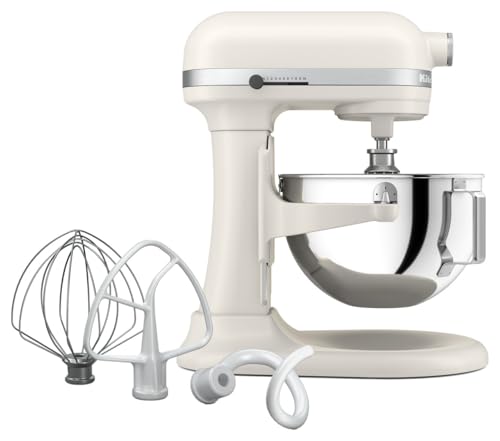
KitchenAid KSM55 5.5-Qt Bowl-Lift Stand Mixer
5.5 qt bowl-lift11 speeds3-point bowl lockMetal build
Check price on Amazon
Best for: Bakers who knead bread or bagel dough every week.

The KSM55 raises the bowl on two arms until it meets the beater, and a three-point lock holds it there. That geometry is the whole story: the head never has to carry the load of a stiff dough through a hinge, so the machine stays planted when a heavy batch pushes back. The maker markets it as having roughly twice the in-bowl power of its own tilt-head line, and the 11 speeds include a half step that folds delicate ingredients without deflating whipped whites.

Against the Artisan 5 quart tilt-head in this lineup, the KSM55 gives up easy access to the bowl in exchange for stability. You crank a lever to lower the bowl, which is slower than flipping a head up, and the taller body can struggle to fit under standard upper cabinets. Anyone who kneads a double batch of sandwich dough or a stiff bagel dough more than once a week will notice the difference; occasional cake bakers will not.

Ownership comes down to the gear train. Bowl-lift mixers like this one are built around metal gearing that a service technician can open, and the attachment hub accepts the maker's pasta and grinder add-ons. Keep the bowl lift pivot points clean of dried flour, wipe the beater shaft, and run dough at the low speeds the manual recommends. At this weight, plan a permanent counter spot rather than a cupboard shelf.

What works

  • Bowl-lift geometry stays rigid under stiff dough
  • Three-point lock keeps the bowl from shifting
  • Half speed folds in delicate ingredients
  • Attachment hub opens up pasta and grinder add-ons

Watch out for

  • Raising and lowering the bowl is slower than tilting a head
  • Tall body may not fit under low cabinets
  • Heavy enough that it rarely leaves the counter

Spec sheet

Bowl
5.5 quart
Design
Bowl-lift
Speeds
11
Bowl lock
3-point
Best use
Weekly bread
02
KitchenAid Artisan KSM150PS 5-Qt Tilt-Head Mixer
5 qt tilt-head10 speedsPouring shieldMetal build
Check price on Amazon
Best for: Home bakers who mostly make cakes, cookies and one-loaf bread.

The Artisan is the machine most people picture when they say stand mixer. A hinged head lifts back so you can drop in the bowl or scrape the beater, and the maker's design traces 59 touchpoints around the bowl during each rotation. The metal construction gives it a low center of mass, and the 5 quart bowl handles roughly nine dozen cookies in a batch.

The tilt-head is the Artisan's strength and its limit at once. Access is effortless, which makes it the better choice than the KSM55 for people who scrape and add ingredients constantly. But the head is held by a hinge and a latch, so a very stiff dough is better kept to the low speeds and modest batch sizes, one or two loaves rather than five.

The pouring shield included in the box sits over the bowl rim and keeps flour from escaping at the first turn. Over years of use, the part to watch is the beater-to-bowl gap: a clearance adjustment screw lets you restore it if the flat beater starts leaving a ring of batter. Hand wash the bowl and attachments if the finish is coated, and wipe the head housing, which collects flour dust at the hinge.

What works

  • Tilt-head makes bowl swaps and scraping effortless
  • Metal body keeps the mixer stable at medium speed
  • Pouring shield keeps flour off the counter
  • Large user base means easy access to spare beaters

Watch out for

  • Stiff doughs stress the hinged head
  • Heavier doughs need low speeds and smaller batches

Spec sheet

Bowl
5 quart
Design
Tilt-head
Speeds
10
Bowl contact
59 touchpoints
Best use
Cakes and cookies
03
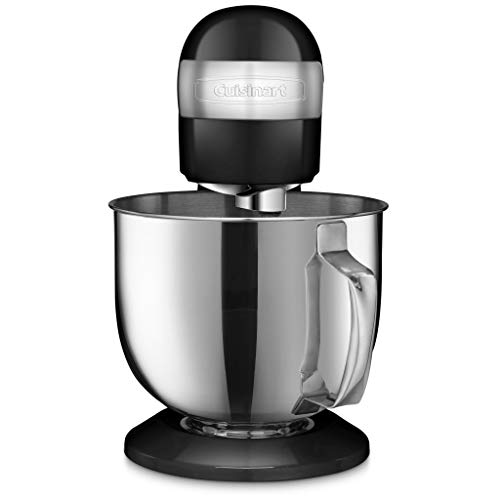
Cuisinart 5.5-Qt 12-Speed Tilt-Back Stand Mixer
5.5 qt bowl12 speedsTilt-back headAttachment outlet
Check price on Amazon
Best for: Cooks who want a large bowl and fine speed steps without paying for the top-tier brand.

Cuisinart gives this mixer a tilt-back head, a polished stainless steel bowl, and a single power outlet for optional attachments. The 12 speed dial spreads the range finer than most competitors in this lineup, which helps at the low end when you want a slow start that does not throw flour. A chef's whisk, flat paddle, dough hook and a splash guard with a pour spout come in the box.

Compared with the Artisan, the Cuisinart offers a slightly larger bowl at 5.5 quarts and an extra two speeds, but it carries a less proven reputation for parts support over many years. The attachment outlet is useful if you plan to add a pasta roller or grinder, though you should confirm which accessories are sold for it before counting on that.

Maintenance is straightforward. Wipe the head and the speed dial after each batch, avoid stuffing the bowl past its dough capacity because the rated 5.5 quarts overstates what the hook can knead, and listen for the motor note changing under load. If it labors, drop to a lower speed instead of pushing on.

What works

  • 12 speeds give finer control at the slow end
  • Large stainless bowl suits double batches
  • Accessory outlet for optional attachments
  • Splash guard with pour spout included

Watch out for

  • Heavy doughs push a tilt-back design to its limit
  • Accessory range is narrower than the market leader

Spec sheet

Bowl
5.5 quart
Design
Tilt-back head
Speeds
12
Attachment port
Yes, one outlet
Includes
Whisk, paddle, hook, shield
04
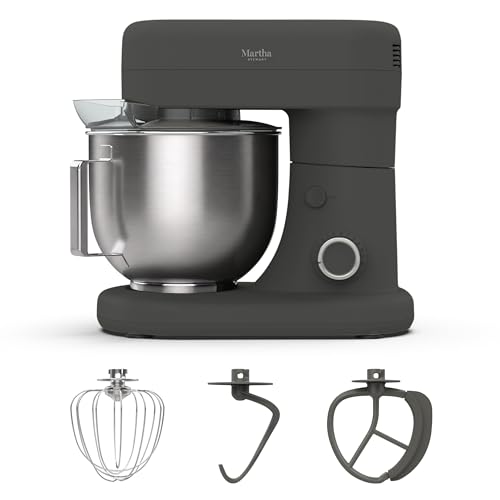
Martha Stewart 5.3-Qt 12-Speed Tilt-Head Mixer
5.3 qt bowl12 speedsSilicone-edge beater3 attachments
Check price on Amazon
Best for: Cookie and cake bakers who hate stopping to scrape the bowl.

The standout feature on this mixer is the flat beater with a silicone edge. The flexible rim sweeps the bowl wall as it orbits, which does the work of a spatula and reduces how often you stop to scrape. For creaming butter and sugar or building cookie dough, that edge cuts down the stop-and-scrape rhythm that slows a batch.

At 5.3 quarts it sits close to the Artisan in bowl size, and the stainless whisk and dough hook round out the three-piece set. It is a tilt-head, so the same advice applies: keep bread dough to one or two loaves at modest speeds. Where it differs from the Cuisinart is the silicone beater, which can pick up scratches if the bowl has any rough weld seam, so check it when you first unbox the unit.

The silicone edge wears over time, which is the part you will eventually replace. Wash the beater by hand, avoid heat from a dishwasher's drying cycle, and wipe the hinge area. Listen for any rattle in the head, which can signal a loosened bolt.

What works

  • Silicone-edge beater scrapes the bowl wall automatically
  • 12 speeds cover gentle folding to fast whipping
  • Stainless whisk and hook included
  • Bowl size matches the Artisan class

Watch out for

  • Silicone rim is a wear part
  • Not meant for large bread batches

Spec sheet

Bowl
5.3 quart
Design
Tilt-head
Speeds
12
Beater
Silicone-edge flat
Includes
Whisk, hook, beater
05
Hamilton Beach 4-Qt 7-Speed Planetary Mixer
4 qt bowl7 speeds300 watt motorCarry handle
Check price on Amazon
Best for: Occasional bakers who want a stand mixer that stores in a cupboard.

Hamilton Beach pairs a 300 watt motor with planetary action, meaning the beater orbits the bowl while spinning in the opposite direction, so one pass covers the whole bowl without a scraper. The 4 quart stainless steel bowl keeps batches small, and an easy-carry handle on the body means you can store it in a cabinet and bring it out on baking day.

Its position in this lineup is simple: it is the lightest and least expensive of the six, and it does one job well, which is cake batters, whipped cream and one loaf of dough. Against the ZACME 8.4 quart, it has nothing to offer in capacity or kneading power, but it takes a fraction of the counter space and a fraction of the shelf weight.

A smaller motor like this one rewards patience. Add flour in stages, keep dough to a single loaf, and let the motor rest between long kneads if the housing gets warm. The stainless bowl and splash guard clean easily, and the lighter body means the unit can walk across the counter at high speed, so stay close.

What works

  • Planetary action covers the whole bowl
  • Light body with a carry handle suits storage
  • Stainless bowl with a splash guard included
  • Seven speeds are enough for most batter work

Watch out for

  • 4 quart bowl limits batch size
  • Small motor works hard on a full dough load
  • Lightweight body can walk at high speed

Spec sheet

Bowl
4 quart
Motor
300 watt
Speeds
7
Action
Planetary
Handle
Easy-carry
06
ZACME 8.4-Qt 800W Commercial-Style Stand Mixer
8.4 qt bowl800W motorLED timer displayDie-cast aluminum
Check price on Amazon
Best for: Large-batch bakers and small home bakeries.

The ZACME is the oversized outlier in this guide. An 800 watt motor, an 8.4 quart bowl and a stated maximum of 3 kilograms of dough put it in a different capacity class from every other pick here. The body is die-cast aluminum, a digital display shows speed and a timer, and the maker lists a noise figure of 48 dBA or less in first gear.

The case for it is dough volume. If you run a home bakery, a pizza night for ten, or large holiday batches, this machine stays composed where the 4 quart Hamilton Beach or the 5 quart Artisan would be at their limits. The case against it is size: it is a countertop appliance that takes real space, and it is a tilt-head design, so ownership at the top of its capacity depends on how well the hinge holds.

Treat the rated maximum as a ceiling, not a daily target. Keep batches below it to spare the gearing, keep the die-cast body wiped clean of flour, and check that the head latch closes with a firm click before each run. The timer is a real convenience for longer kneads.

What works

  • 800 watt motor and 8.4 quart bowl lead this lineup
  • Digital display includes a timer
  • Die-cast aluminum body adds mass
  • Low-gear noise stated at 48 dBA or less

Watch out for

  • Large footprint demands a permanent counter spot
  • Tilt-head hinge is the stress point at full capacity

Spec sheet

Bowl
8.4 quart
Motor
800 watt
Max dough
6.6 lb (3 kg)
Noise, low gear
48 dBA or less
Body
Die-cast aluminum

Spec sheet decoder

What the numbers on the box really mean

The specs manufacturers lead with, translated into what they tell you about real-world performance.

Quart capacity

The bowl's liquid volume at the rim. The hook and flat beater cannot knead or cream a full bowl, so usable capacity is lower.

Watch forExpect the 4 quart Hamilton Beach to handle one loaf while the 8.4 quart ZACME is built for several.

Watts

Electrical input to the motor, not torque at the hook. Two mixers with the same wattage can knead very differently depending on gearing.

Watch forThe 300 watt Hamilton Beach and the 800 watt ZACME differ in capacity class, not just in a number.

Planetary action

The beater spins on its own axis while orbiting the bowl in the opposite direction, covering the full bowl per revolution.

Watch forCheck the beater-to-bowl gap, since a wide gap leaves unmixed batter even on planetary models.

Speed count

The number of discrete dial steps. More steps allow gentler transitions between folding and whipping.

Watch forThe 12 speeds on the Martha Stewart help for slow starts, while the KSM55 adds a dedicated half-speed fold.

Noise in dBA

Sound pressure measured at a set distance, usually at first gear. Higher gears are louder.

Watch forOnly the ZACME states a noise figure in this lineup, so compare other units by body mass and motor type.

Methodology

How We Evaluated These Stand Mixers

Dough capacity versus bowl size

We compared stated bowl quarts with any stated dough maximum and the bowl design. The ZACME's 3 kilogram maximum was weighed against the 4 quart Hamilton Beach's modest bowl, and the lineup was ordered by how much dough each can realistically handle.

Head design and rigidity

We separated bowl-lift from tilt-head and tilt-back designs because the hinge decides how a mixer behaves under load. The KSM55's fixed head was weighed against the hinged heads of the Artisan, Cuisinart and Martha Stewart.

Control range

Speed counts, slow-start behavior and extras like a half-speed fold were reviewed from each spec sheet. Ranking leaned on the usefulness of the bottom of the dial rather than the top speed.

Build and ownership

We looked at body material, bowl material, included attachments and parts support. Metal housings and larger user bases ranked higher than bare spec chasing.

Fit to the real buyer

Each pick was matched to a defined buyer, from the occasional baker with the Hamilton Beach to the bakery-scale user with the ZACME, so the order reflects who each machine suits rather than a single score.

Decision guide

How to Choose the Right Stand Mixers

By Baking Habit

SituationPickWhy
Weekly multi-loaf breadKitchenAid KSM55Fixed head and locked bowl hold up under stiff dough
Cakes, cookies, one loafKitchenAid Artisan KSM150PSTilt-head access and 5 quart bowl suit varied batters
Heavy cookie doughMartha Stewart 5.3-QtSilicone-edge beater scrapes as it mixes
Large family or bakery batchesZACME 8.4-Qt800 watt motor and 3 kilogram dough limit

By Budget

TierPickWhy
Lowest cost of entryHamilton Beach 4-QtLight, planetary, enough for one loaf
Mid tier with a large bowlCuisinart 5.5-QtLarger bowl and 12 speeds for less than the market leader
Mid tier, cookie focusMartha Stewart 5.3-QtSilicone beater and full attachment set
Premium, long-termKitchenAid KSM55Strongest build for years of heavy use

Tilt-Head vs Bowl-Lift

Tilt-head

The head lifts on a hinge, which gives easy access to the bowl and beater. The Artisan, Cuisinart, Martha Stewart and ZACME all use variants of it. It suits cakes, cookies and one or two loaves of bread.

Bowl-lift

The head stays fixed and a lever raises the bowl on two arms. The KSM55 uses this layout with a three-point lock. It carries stiff dough with less flex but is taller and harder to access.

Choose a tilt-head if you value access and bake varied recipes; choose the bowl-lift if bread dough dominates your week.

By Counter Space

SituationPickWhy
Cupboard storageHamilton Beach 4-QtLight with a carry handle
Permanent spot under cabinetsKitchenAid ArtisanModerate height, tilt-head clears cabinets when open
Tall open counterKitchenAid KSM55Taller body suits bowl-lift geometry
Dedicated baking cornerZACME 8.4-QtLarge footprint and weight

For Bread Dough Specifically

Look for

A stated dough weight, a spiral or sturdy hook, and a design that holds under load. Bowl-lift geometry and metal gearing matter more than the bowl's quart number.

In this comparison

The KitchenAid KSM55 is the proven choice for repeat loaves, while the ZACME 8.4-Qt states a 3 kilogram dough limit for large batches. The Artisan is a one-loaf option at low speeds.

When to Spend More

Spend more if

You bake bread weekly, want parts support for a decade, or plan to add pasta or grinder attachments to the KitchenAid KSM55's hub.

Save if

You mostly whip cream and mix cake batter once a month. The Hamilton Beach 4-Qt or the Martha Stewart 5.3-Qt will cover that for much less.

Ownership

Maintenance schedule

The upkeep that decides whether this machine lasts two seasons or ten.

TaskIntervalWhy it matters
Wipe the head and hingeAfter each useFlour dust collects at the pivot and in the speed dial. A dry cloth prevents buildup that stiffens the head latch.
Check the beater-to-bowl gapEvery few monthsA wide gap leaves unmixed batter at the bottom. Many tilt-heads, including the Artisan, have an adjustment screw to restore clearance.
Hand wash coated attachmentsAfter each useCoated hooks and silicone-edge beaters wear faster in dishwashers. Dry them before storing.
Inspect the power cord and plugTwice a yearCords on busy counters take abuse. A frayed cord is a fire risk and should be replaced.
Listen for gear noiseEvery long kneadA change in motor note or a grinding sound under load signals dry gearing. Stop and have it serviced rather than pushing through.

FAQ

Frequently Asked Questions

Should I buy a tilt-head or a bowl-lift mixer?

If you bake bread every week or knead stiff dough, a bowl-lift like the KitchenAid KSM55 holds up better. For cakes, cookies and occasional bread, a tilt-head such as the Artisan is easier to use and cheaper.

Is a higher wattage always better?

No. Watts measure electrical input, not torque at the hook. The 800 watt ZACME offers real extra capacity, but a 300 watt unit with good gearing can outperform a 500 watt unit with weak gearing.

How big a bowl do I need?

Four quarts handles one loaf or a small cake. Five to 5.5 quarts handles double batches, and 8 quarts or more is for bakery volume. Remember the dough capacity is smaller than the bowl rating.

Why do some stand mixers walk across the counter?

Lighter bodies and high speeds create vibration. Heavy metal bodies resist it, and rubber feet help. Keep dough to low speeds on light models like the Hamilton Beach.

Do all stand mixers fit attachments like a pasta roller?

No. Only models with an attachment outlet, such as the KitchenAid KSM55 and Cuisinart, accept add-ons, and then only compatible ones. Confirm before buying.

Can a stand mixer knead bread dough every day?

A bowl-lift with metal gearing is built for it. Tilt-heads can knead one or two loaves but run hot if pushed. The ZACME 8.4-Qt is designed for larger loads.

Bottom line

The short version

Browse more stand mixerson Amazon →
James Miller, Lead Machine Editor

About the author

James Miller

Lead Machine Editor, MachineFanatic

James Miller leads MachineFanatic's buying guides, turning spec sheets, manuals and owner feedback into clear verdicts on power tools, outdoor power equipment, shop machines and kitchen machines.

More from James →

Keep reading

Related guides