
Amazon affiliate links - we earn a commission.Affiliate disclosure

Buying guide · 12 min read · Updated 2026-11-19

Best Streaming Mixers Under $50 (2026)

Six streaming mixers and sound cards listed at or below $50, with XLR gaming mixers and effects cards, compared on inputs, phantom power and controls.

James MillerBy James MillerLead Machine Editor6 machines comparedSpec-sheet verified
Best Streaming Mixers Under $50

At a glance

Our top picks

Side by side

Spec comparison

Streaming mixers at this cap fall into two groups: small gaming mixers with one XLR input and live sound cards with effects. They solve different problems.

This guide compares what each style offers: faders per source, phantom power and effects. A streamer who talks and plays needs routing more than a long effects list. Prices move, so the $50 cap reflects listing prices when this guide was updated.

Before you buy

6 Criteria to Look For Before Buying a Streaming Mixer Under $50

  1. 01

    USB loopback and routing

    Loopback lets you capture computer audio, such as a caller, music or game sound, alongside your mic without a feedback loop. Some mixers offer a full mix to USB, others give separate channels, and a few only a stereo pair. MAILANGSHI XLR mixer and PUPGSIS gaming mixer differ on this in the lineup. Choose the routing that matches how you edit: one mixed track is simple, separate tracks give room to fix mistakes.

  2. 02

    Noise, hiss and grounding

    Cheap mixers use small switch mode power sources that can add hiss or hum, and a USB ground loop can add a buzz that gain cannot fix. Balanced XLR cables, a short run and a separate power adapter help. MAILANGSHI XLR mixer and PUPGSIS gaming mixer are the picks to watch for noise complaints. Record a short test with the gain at your normal level before committing to a show.

  3. 03

    Preamp gain for dynamic mics

    Broadcast dynamic mics are low output and want roughly 60 to 70 dB of clean gain. A weak preamp makes you turn the knob to the end, which adds hiss, or forces an inline booster. MAILANGSHI XLR mixer (48 V XLR, noise reduction) and PUPGSIS gaming mixer (XLR only, no 48 V) sit at different points on that curve. Check the stated gain, and be wary of a listing that gives none.

  4. 04

    Faders versus knobs

    Sliding faders give finer level control and a quick feel for the balance of voices, while rotary knobs are cheaper and take less room. A gaming or streaming mixer often has per source faders, while a basic sound card has knobs. MAONO G1 NEO (48 V phantom, RGB) and voijump RGB mixer (XLR, RGB) show the two styles. If you ride levels during a live show, favour faders.

  5. 05

    Headphone outputs and monitoring

    One headphone jack means one monitor, so a two host show needs an amplifier or a second output. Direct monitoring on an analog mixer has no delay, while monitoring through the computer can lag and make you talk oddly. MAILANGSHI XLR mixer (48 V XLR, noise reduction) and PUPGSIS gaming mixer (XLR only, no 48 V) are the picks to compare. Plan the monitoring chain before you buy.

  6. 06

    Effects you will actually use

    Many live sound cards advertise voice changers, reverb and sound pads, which suit streamers but rarely help a podcast. A noise gate and a compressor are the effects that matter for speech. MAONO G1 NEO and voijump RGB mixer are the lineup examples to compare on extras. Do not pay for a long effects list you will switch off after the first week.

Detailed reviews

The 6 best streaming mixers under $50, explained

01
MAONO MAONOCASTER G1 NEO gaming audio mixer, 48 V
48 VPro preampRGB
Check price on Amazon
Best for: Streamers who want phantom power on a budget

The MAONO G1 NEO is a gaming audio mixer with a pro preamp and 48 V phantom power. It adds Bluetooth and RGB lighting. It is a streaming interface with a few faders.

Phantom power makes it usable with condenser mics. It is a solo host box. Its 48 V phantom and pro preamp beat the PUPGSIS.

Use balanced XLR cables and record a test. Keep it dust free. Before the first episode, record a two minute test with the MAONO G1 NEO at your normal speaking distance and listen for hiss, because gain set too low and boosted later is the most common cause of noisy audio.

What works

  • 48 V phantom power
  • Pro preamp
  • Bluetooth input
  • USB interface

Watch out for

  • One mic channel
  • RGB is cosmetic

Spec sheet

Preamp
Pro preamp
Phantom
48 V
Connection
USB audio interface
Wireless
Bluetooth
Look
RGB lighting
02
MAILANGSHI gaming audio mixer with 48 V XLR and noise reduction
48 VXLRNoise reduction
Check price on Amazon
Best for: Streamers who want faders and phantom

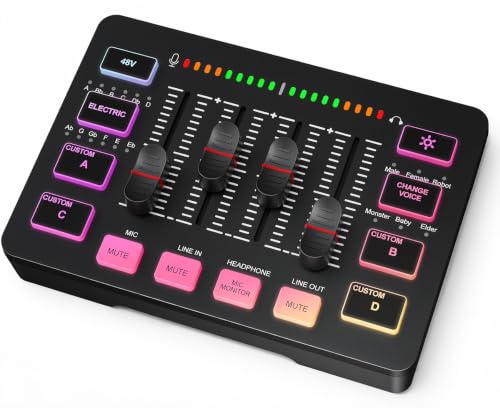
The MAILANGSHI is a gaming mixer with four faders, 48 V XLR support and noise reduction. It lets you control audio without switching software windows. It targets headset upgraders.

Four faders give per source control. Phantom power makes it usable with condensers. It has four faders and 48 V where the G1 NEO has fewer.

Use balanced cables and test your levels. Treat the MAILANGSHI XLR mixer as a desk tool that wants a boom arm, a pop filter and a short balanced cable, since those cheap extras improve a recording more than any menu setting.

What works

  • Four faders
  • 48 V XLR
  • Noise reduction
  • Hands on control

Watch out for

  • One mic
  • Noise reduction can colour voice

Spec sheet

Mic input
XLR with 48 V
Faders
Four
Noise
Noise reduction
Use
Streaming
Form
Gaming mixer
03
Best for: Solo streamers who want an XLR input

The voijump is a gaming audio mixer with an XLR mic input, individual channel control and RGB. It has a mute button. It targets PC streamers.

It is a simple solo host box. The RGB is cosmetic. It has an XLR input and a mute button, plainer than the MAILANGSHI.

Use a dynamic mic and test your levels. If you plan to add a guest later, ask whether the voijump RGB mixer can grow with you, because a second voice is where input counts and monitoring start to matter.

What works

  • XLR mic input
  • Individual volume control
  • Mute button
  • RGB look

Watch out for

  • One mic
  • RGB is cosmetic

Spec sheet

Mic input
XLR
Control
Individual channel volume
Extra
Mute button
Look
RGB
Use
Streaming
04
PUPGSIS gaming audio mixer with voice changer, XLR only
XLRNo 48 VVoice changer
Check price on Amazon
Best for: Streamers with a dynamic XLR mic

The PUPGSIS is a gaming mixer with a voice changer that supports XLR dynamic mics. The listing states it is not compatible with 48 V mics or USB mics. That limit shapes who should buy it.

A dynamic mic is fine, and a condenser will not work. It is a cheap soundboard. It works only with dynamic XLR mics.

Use a dynamic mic and test your levels. Keep a spare USB cable and the manual for the PUPGSIS gaming mixer, as drivers and routing options are the usual cause of a session that will not start.

What works

  • Works with dynamic XLR mics
  • Voice changer
  • Cheap
  • Soundboard

Watch out for

  • No 48 V phantom power
  • USB mics will not work

Spec sheet

Mic input
1/4 in TRS and XLR dynamic
Phantom
Not compatible with 48 V mics
Effects
Voice changer
Form
Soundboard
Use
PC streaming
05
Bonkyo F999 live streaming sound card professional audio mixer
F999Voice changerInterface
Check price on Amazon
Best for: Streamers who sing or chat

The Bonkyo F999 is a live streaming sound card sold as a professional mixer for singing streams. It includes a voice changer and an audio interface. It targets mobile and PC users.

It is a cheap card with many effects. A podcast needs fewer effects. It leans on a voice changer rather than inputs.

Keep the knobs clean and test levels. Look at where the Bonkyo F999 card will sit on the desk, because knobs and faders that you cannot reach comfortably get ignored and levels drift during a long recording.

What works

  • Voice changer
  • Detailed controls
  • USB interface
  • Cheap

Watch out for

  • Basic mic input
  • Effects are novelty

Spec sheet

Form
Live streaming sound card
Effects
Voice changer
Controls
Detailed adjustment
Connection
USB
Use
Streaming, singing
06
Facmogu F998 live sound card audio mixer
7 knobs2 fadersDSP
Check price on Amazon
Best for: Streamers who want knobs and effects cheaply

The Facmogu F998 is a live sound card with seven independent volume knobs and two faders. It uses digital DSP for effects and noise handling. It aims at streamers and podcasters on a tight budget.

It is the cheapest style of mixer in the lineup. Its effects list is long and its mic input is basic. Its seven knobs and two faders are the cheapest controls here.

Keep the knobs clean and record a test before a show. Use a short USB cable. Write down your gain and fader settings for the Facmogu F998 mixer once they sound right, so a reset or a new cable never costs you a session.

What works

  • Seven knobs and two faders
  • Digital DSP effects
  • Cheap to buy
  • Simple desktop size

Watch out for

  • Basic mic input
  • Effects are mostly novelty

Spec sheet

Controls
7 volume knobs, 2 faders
Processing
Digital DSP
Form
Live sound card
Use
Streaming and podcast
Extras
DJ style effects

Spec sheet decoder

What the numbers on the box really mean

The specs manufacturers lead with, translated into what they tell you about real-world performance.

USB loopback

A route that sends computer audio back into the mix without a feedback loop. It is how a caller, music or game audio reaches your recording.

Watch forRead how PUPGSIS gaming mixer describes its USB modes.

Mix minus

A feed that sends a remote caller everything except their own voice. It prevents echo on remote interviews.

Watch forConfirm that MAONO G1 NEO offers it as a real output, not a software workaround.

Sample rate and bit depth

Most of these units record at 44.1 or 48 kHz and 16 or 24 bit, which is fine for speech. Higher numbers add file size, not clarity, for spoken word.

Watch forNote the stated rate for MAILANGSHI XLR mixer.

DSP effects

Digital effects such as reverb, voice change and noise reduction built into the mixer. Useful ones for speech are the gate and the compressor.

Watch forLook at which effects MAONO G1 NEO offers beyond the novelty ones.

Bluetooth input

A wireless input for taking phone calls or music, at lower quality than USB or analog. It is a convenience, not a recording path.

Watch forCheck whether voijump RGB mixer lets you mix a phone call into the stream.

Methodology

How We Evaluated These Streaming Mixers Under $50

Value inside the lineup

We ranked each mixer by what its inputs and features cost relative to the other picks. Facmogu F998 mixer is the cheapest option and MAONO G1 NEO is the dearest, and we asked whether the premium buys a real upgrade.

Controls and ergonomics

We compared faders, knobs and any digital display, preferring controls you can reach without looking. MAILANGSHI XLR mixer and voijump RGB mixer represent opposite approaches in the lineup.

Routing and loopback

We looked at USB modes, loopback and any mix minus feature. A mixer that routes a remote guest cleanly earns more credit. MAONO G1 NEO was set against the others on this point.

Owner feedback patterns

Recurring themes in owner feedback mattered to us, not a single headline number. Repeated complaints about drivers, noise or build lowered a pick. Ratings and review tallies are deliberately absent, and they played no part in the order here.

Noise and grounding

We read owner patterns about hiss, hum and USB buzz and treated repeated complaints as a lowered score. No single noise number is quoted. PUPGSIS gaming mixer was the example for this check.

Decision guide

How to Choose the Right Streaming Mixers Under $50

By Show Format

Before reading the table, decide whether your show lives on a desk or on a computer. A mixer with faders suits live level riding, while a plain interface suits a set and forget recording. Also decide who talks at once, since that sets the input count. The rows below map common situations to the picks in this lineup, with MAONO G1 NEO as one of the main reference points.

SituationPickWhy
You stream solo with a condenserMAONO G1 NEOPhantom and preamp
You stream with a condenserMAILANGSHI XLR mixerFaders and phantom
You stream solovoijump RGB mixerXLR and channel control
You own a dynamic micPUPGSIS gaming mixerXLR dynamic only
You stream music or chatBonkyo F999 cardEffects card
You want the cheapest mixerFacmogu F998 mixerKnobs, faders and DSP

Remember that the microphone and the room usually matter more than the mixer, so leave budget for a pop filter, an arm and a few foam panels.

By Budget

Every pick here is listed at or below the $50 cap, so the tiers below are relative to each other, not to the cap.

Budget positionPickWhy
Spending the least this lineup allowsFacmogu F998 mixerFacmogu F998 mixer (7 knobs, 2 faders) costs the least in this lineup, so it suits a first show that needs the basics.
The middle of the lineupBonkyo F999 cardBonkyo F999 card (F999 card) sits mid lineup on cost, balancing inputs and extras.
The top of the lineupMAONO G1 NEOMAONO G1 NEO (48 V phantom, RGB) costs the most in this lineup, so it needs to earn that premium on inputs, routing or build.

Treat the budget tiers as relative: the cheapest pick suits a first show, and the top of the lineup suits a show that has already outgrown a basic box.

XLR Microphone Input vs 3.5 mm Bundle Mic

XLR input and phantom power

The group of MAONO G1 NEO, MAILANGSHI XLR mixer, voijump RGB mixer, and PUPGSIS gaming mixer offers an XLR input. It lets you use a real dynamic or condenser mic, which is the biggest quality step in the category. It suits hosts who plan to upgrade their mic.

3.5 mm or bundled mic

The group of Bonkyo F999 card and Facmogu F998 mixer relies on a 3.5 mm input or a bundled mic. That is cheaper and simpler, but it limits mic choice and usually sounds thinner. It suits a first show or a phone based stream.

Pick the XLR route if you care about voice quality and expect to add a guest. Pick the bundle route if you want the cheapest complete start.

By Mixer Style

SituationPickWhy
You want a cheap live sound card with effects for a solo showBonkyo F999 card and Facmogu F998 mixerA live sound card is a small USB box with a 3.5 mm mic jack, effects and a few knobs, which is enough for one voice but not for a multi host table.
You stream games and want per source volume knobsMAONO G1 NEO, MAILANGSHI XLR mixer, voijump RGB mixer, and PUPGSIS gaming mixerA gaming mixer focuses on faders for game, chat and music, with usually one XLR input for a single host.

For Two Person Remote Shows Specifically

Look for

Look for two real XLR inputs with phantom power, clean gain for a dynamic mic, USB loopback and, if you take remote callers, a mix minus route. A headphone output for each host is a bonus. Those features matter more than effects or lighting.

In this comparison

MAONO G1 NEO is the pick that best matches those points here, with 48 V phantom, RGB. MAILANGSHI XLR mixer and voijump RGB mixer are the nearest alternatives if you want a different balance of inputs, controls and extras.

When to Spend More

Spend more if

Spend more if you record several people at once or take remote guests regularly. Stepping up to MAONO G1 NEO (48 V phantom, RGB) buys the inputs, routing or build that cheaper units lack.

Save if

Save if you are a solo host starting out. Facmogu F998 mixer (7 knobs, 2 faders) covers the basics, and a small difference in features rarely justifies a larger premium.

Ownership

Maintenance schedule

The upkeep that decides whether this machine lasts two seasons or ten.

TaskIntervalWhy it matters
Update drivers or firmware if offeredTwice a yearSome mixers need a driver on certain systems and receive fixes from the maker. Check the support page before an important show.
Clean the faders and knobsEvery few monthsDust and skin oils make controls scratchy. A short burst of air and a dry cloth keep them smooth, and no liquid should be sprayed inside.
Check the USB cable and portEach seasonA worn cable causes dropouts that sound like a fault in the mixer. Swap in a short, good cable before blaming the unit.
Cover the mixer when not in useAfter sessionsDust and spilled drinks are the main hazards on a desk. A simple cover protects the controls.
Use balanced XLR cablesWhen buying cablesBalanced cables reject hum over a short run. A cheap unbalanced adapter is the usual source of noise.

FAQ

Frequently Asked Questions

Does an XLR mic need phantom power?

Condenser mics do, and dynamic mics do not. The mixer must supply 48 V on the input you use, which only some entry level units do on every channel. Check the listing for voijump RGB mixer before pairing a condenser.

How many XLR inputs do I need?

One for each person who speaks at the same time, plus extras only if you plan to grow. A solo host needs one, and a two person show needs two. Count the real XLR inputs on PUPGSIS gaming mixer, not the channel total.

Is a bundle mic good enough?

Bundle mics are usually small condensers that pick up room noise, so a dynamic mic on XLR sounds cleaner in an untreated room. Use the bundle to start and upgrade the mic first. MAILANGSHI XLR mixer is a bundle style pick in this guide.

Can I use a mixer for streaming and podcasting?

Yes, many units do both, with faders for game or chat and a USB mix for recording. The routing is the difference, so check loopback and separate tracks. voijump RGB mixer is a lineup example that suits both uses.

Why do I hear hiss from my mixer?

Hiss usually comes from too little gain at the mixer and too much in software, or from a noisy power adapter. Turn the gain up at the preamp, keep levels sensible and use balanced cables. A weak preamp, such as the one on a very cheap card, makes it worse.

Why does this guide stop at $50?

The $50 cap is the search keyword shoppers use, and every pick here was listed at or below it when this guide was updated. Facmogu F998 mixer is the cheapest option in this lineup and MAONO G1 NEO is the dearest, so the spread inside the cap is real. Prices move, so check the listing before you buy.

Bottom line

The short version

Browse more streaming mixers under $50on Amazon →
James Miller, Lead Machine Editor

About the author

James Miller

Lead Machine Editor, MachineFanatic

James Miller leads MachineFanatic's buying guides, turning spec sheets, manuals and owner feedback into clear verdicts on power tools, outdoor power equipment, shop machines and kitchen machines.

More from James →

Keep reading

Related guides