
Amazon affiliate links - we earn a commission.Affiliate disclosure

Buying guide · 12 min read · Updated 2026-11-07

Best Submersible Sump Pumps (2026)

Six submersible sump pumps compared on cooling, seals, intake height, cord length and discharge size, so you pick one that survives a long storm.

James MillerBy James MillerLead Machine Editor6 machines comparedSpec-sheet verified
Best Submersible Sump Pumps

At a glance

Our top picks

Side by side

Spec comparison

A submersible sump pump lives under water, which is the whole point: the water around the motor carries heat away, muffles noise and keeps the pump primed without a separate suction line. That design also puts the seals, the switch and the power cord in the one place nobody wants to inspect, so build quality shows up as years of service rather than as a spec on the box.

Shopping this category means separating pit pumps from drain-and-transfer utility pumps that happen to float. Both can empty a basement, but only one is meant to sit through a thousand cycles a year. We sort the field by how each pump is cooled, sealed, switched and cabled.

Before you buy

6 Criteria to Look For Before Buying a Submersible Sump Pump

  1. 01

    How the motor is cooled

    A submersible motor is cooled by the water around it, so the housing material matters. The Zoeller M53 and Wayne CDU800 use cast iron to move heat into the pit; the Lanchez 1.6 HP uses a stainless casing and the thermoplastic units rely on their oil fill alone. A pump that cycles for hours in a storm needs that thermal path.

  2. 02

    Pit pump or drain pump

    Pit pumps are built to sit submerged for years with an automatic float. Hose-kit pumps like the SEESII at 4,755 GPH are built to be dropped in, run and pulled out. Using a drain pump as a permanent pit pump is the most common category mistake.

  3. 03

    Minimum start and stop level

    Float geometry decides how much water stays in the pit. The Lanchez 1.6 HP starts at around 5.3 inches, while some utility pumps drain to a thin film. A higher start level protects the motor but leaves a puddle.

  4. 04

    Discharge size and lift

    A 1-1/2 inch outlet carries far more flow than a 1 inch outlet at the same pressure. The Superior 91250 lifts 25 feet but moves only 1,800 GPH at zero lift, so check the pump curve at your height.

  5. 05

    Cord and strain relief

    The cord is where moisture creeps into a motor. The Superior has a 10 ft cord, which can be short for a deep pit. Never use a cheap extension cord inside a damp pit. Also check that the cord exits through a sealed strain relief and not a bare grommet. If the pit sits under a living space, mount the pump on a small base so a thermoplastic body does not rattle against the pit wall.

  6. 06

    Warranty as a signal

    Manufacturers that stand behind the switch and seals offer longer terms. The Wayne CDU800 is covered for three years and lists a float cycle rating, while hose-kit pumps usually offer little. That tells you which are meant for pits. A short warranty is not a reason to reject a spare pump, but it is a reason to keep it off primary duty in a finished basement. Ask whether the maker publishes a switch cycle rating, because that single number tells you more than the horsepower does.

Detailed reviews

The 6 best submersible sump pumps, explained

01
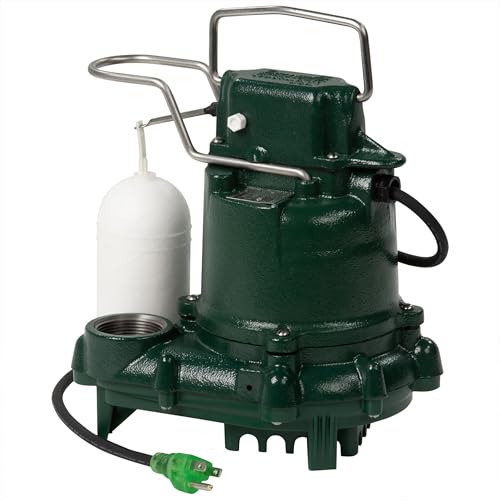
Zoeller M53 Mighty-mate 1/3 HP cast iron submersible
1/3 HPCast ironVortex impellerAutomatic float
Check price on Amazon
Best for: Permanent residential pits where long life matters more than headline flow.

The Mighty-mate is the archetype of the cast iron submersible. The motor, switch case and pump housing are all iron, so the whole assembly acts as a heat sink in the pit water, and the vortex impeller sits recessed from the flow path so it passes small debris without chewing itself up. That combination is why contractors have specified it for decades.

The trade is that 1/3 HP is the smallest motor in a group that includes 1 HP and 1.6 HP hose-kit pumps. If your pit is deep and the discharge climbs a long way, the Zoeller can be outrun on paper by units like the Lanchez 1.6 HP at 6,000 GPH. On a real pit, though, cooling and switch reliability decide survival more than rated flow.

Ownership means fewer surprises. Keep the pit free of gravel, check the float annually and replace the check valve on schedule. It is a pump you buy once, which is the best argument for its higher cost.

What works

  • All-iron body cools the motor in pit water
  • Vortex impeller passes small debris cleanly
  • Automatic float needs no separate controller
  • Long service record in residential pits

Watch out for

  • Smallest motor in the group at 1/3 HP
  • Costs more than thermoplastic rivals
  • No garden hose adapters for utility use

Spec sheet

Motor
1/3 HP
Housing
Cast iron motor, switch case and pump
Impeller
Non-clogging vortex
Switch
Float-activated automatic
Use
Permanent basement pit
02
Wayne CDU800 1/2 HP cast iron submersible, 5,100 GPH
1/2 HP5,100 GPH maxCast ironFloat rated 1M cycles
Check price on Amazon
Best for: Homeowners who want more motor than a 1/3 HP pump and a stated switch life.

The CDU800 pairs a 1/2 HP motor with a cast iron and stainless body and a vertical float switch rated for one million cycles. That number is unusual, because most manufacturers say nothing about switch life, and the switch is the part most likely to leave a pit flooded.

Against the Zoeller M53 at 1/3 HP, the Wayne gives you more motor and a stated cycle rating at a lower price. Against the Lanchez 1.6 HP at 6,000 GPH, it moves less on paper but is built as a pit pump rather than a drain pump. The vertical float also fits narrow pits where a tethered float would hang up on the wall.

At three years the warranty is shorter than the CDU980E's five, so this is the value pick rather than the premium one. Clean the screen, test the float and check valve twice a year, and it is a sound primary.

What works

  • Float switch rated for a million cycles
  • Vertical float fits narrow pits
  • Cast iron body at a moderate cost
  • 1/2 HP gives real headroom over 1/3 HP

Watch out for

  • Three-year warranty is shorter than the CDU980E's
  • Heavier to pull than a thermoplastic pump
  • Flow rating is a zero-lift figure

Spec sheet

Motor
1/2 HP
Max flow
5,100 GPH (zero lift)
Housing
Cast iron and stainless steel
Float
Vertical, rated 1 million cycles
Warranty
3 years
03
Lanchez 1.6 HP stainless submersible, 6,000 GPH
1.6 HP6,000 GPH maxStainless casing1-1/2 inch NPT
Check price on Amazon
Best for: Draining flooded areas, pools and large pits where volume matters most.

This is the big number in the lineup, a 1.6 HP motor in a full stainless casing, rated at 6,000 GPH with a 1-1/2 inch discharge that can actually carry it. The stainless body will not corrode, and the integrated float starts the pump at a minimum water level of about 5.3 inches.

That start level is the catch for a pit pump. The pump will not begin until water is above roughly five inches, and it will leave some water behind. A big motor also pulls substantial current at startup, so it needs a properly sized circuit. Compared with the Wayne CDU800 at 1/2 HP, the Lanchez moves more on a hose and less on a documented service record.

It is best as a heavy drain and transfer pump or a pit pump in a large flood-prone space. For a quiet residential pit, the iron pumps are the better long-term bet.

What works

  • Stainless casing resists corrosion
  • 1.6 HP and 6,000 GPH rating for fast drainage
  • 1-1/2 inch NPT outlet suits high flow
  • Comes with several hose and pipe adapters

Watch out for

  • Float starts around 5.3 inches of water
  • High current draw at startup
  • Little documented service history

Spec sheet

Motor
1.6 HP
Max flow
6,000 GPH (zero lift)
Casing
Stainless steel
Discharge
1-1/2 inch NPT with adapters
Float start
About 5.3 inch minimum
04
SEESII 1 HP submersible pump 4,755 GPH with filter bag
1 HP4,755 GPH max36 ft lift23 ft hose
Check price on Amazon
Best for: Portable drainage jobs with a long hose or a high discharge point.

The SEESII is built around a 36 foot lift rating and a 23 foot hose, which makes it a good fit for draining a window well or cellar to a distant or elevated spot. The built-in filter bag keeps small debris out of the pump, and the 1 HP motor gives it reasonable muscle.

The 36 foot figure is a maximum head at which flow reaches zero, not a number at which it pumps well, so real output at a 10 foot rise will be a fraction of the 4,755 GPH label. Against the AQUASTRONG-style 1 HP utility pumps it is similar; against the Zoeller M53 it trades a lot of durability for a lot of rated horsepower.

Treat it as a flexible portable. Use it for flooded areas and pools, and keep the filter bag clean because a clogged bag chokes the intake.

What works

  • 36 ft rated lift for elevated discharge
  • Filter bag keeps small debris out
  • Includes a 23 ft hose to start work
  • 1 HP motor at a low priceTier

Watch out for

  • Rated lift is a shutoff figure, not working flow
  • Filter bag clogs and needs cleaning
  • Not designed as a permanent pit pump

Spec sheet

Motor
1 HP
Max flow
4,755 GPH (zero lift)
Max lift
36 ft rated
Hose
23 ft included
Filter
Anti-clogging bag
05
Superior Pump 91250 1/4 HP utility pump 1,800 GPH
1/4 HP1,800 GPH max25 ft lift10 ft cord
Check price on Amazon
Best for: A small pit, window well or emergency spare.

The Superior 91250 is a modest 1/4 HP thermoplastic utility pump that moves up to 1,800 GPH and can lift water up to 25 feet. A 1-1/4 inch NPT discharge and a garden hose adapter make it easy to set up for a window well, a stock tank or a hot tub drain.

It is not a primary basement pump. A 1/4 HP motor has little margin when a storm fills the pit fast, and the thermoplastic body sheds heat less well than the Wayne CDU800's iron one. For a small, dry pit that sees a few inches of water a year, it is adequate and cheap.

Its best role is a second pump: keep it on a shelf with a hose and it saves a flooded floor if the primary dies.

What works

  • Brand-name 1/4 HP pump at a low cost
  • 1-1/4 inch NPT and hose adapter included
  • Rated to lift water 25 feet
  • Light enough to carry one-handed

Watch out for

  • 1/4 HP leaves little storm headroom
  • Thermoplastic body runs hotter than iron
  • Only 10 ft of cord

Spec sheet

Motor
1/4 HP
Max flow
1,800 GPH (zero lift)
Max lift
25 ft vertical
Body
Thermoplastic
Cord
10 ft
06
6699 1/4 HP 1,500 GPH thermoplastic submersible pump
1/4 HP1,500 GPH maxThermoplastic10 ft cord
Check price on Amazon
Best for: Occasional draining of tubs, patios and window wells.

The 6699 is the cheapest pump in the group, a 1/4 HP thermoplastic unit rated at 1,500 GPH with a corrosion-resistant shell and both a 1 inch and a 3/4 inch garden hose adapter. It is the pump you buy to drain a tub, a flooded patio or a shallow window well.

Compared with the Superior 91250 at 1,800 GPH and 25 foot lift, it gives up flow and name recognition for a lower cost. Neither is a pit pump you can rely on during a prolonged storm, and the 1,500 GPH rating falls quickly with any lift.

Buy it for occasional use, check the float and strainer before each job, and do not leave it as the only protection for a finished basement. The thermoplastic shell is light enough to hang from its own hose or cord for short jobs. Store it dry and upright after use so the float and seals are not left sitting in silt.

What works

  • Lowest cost in the lineup
  • Corrosion-resistant thermoplastic shell
  • Garden hose and 1 inch adapters included
  • Light and easy to move

Watch out for

  • 1,500 GPH rating drops fast with lift
  • Small motor has no storm headroom
  • Unknown service record

Spec sheet

Motor
1/4 HP
Max flow
1,500 GPH (zero lift)
Body
Thermoplastic shell
Adapters
1 inch and 3/4 inch garden hose
Cord
10 ft

Spec sheet decoder

What the numbers on the box really mean

The specs manufacturers lead with, translated into what they tell you about real-world performance.

Housing material

Cast iron and stainless conduct heat; thermoplastic is light and corrosion-proof.

Watch forThe Zoeller M53 is iron; the Superior 91250 is thermoplastic.

Max lift

The height at which flow falls to zero, not a working head.

Watch forThe SEESII 36 ft lift does not mean 4,755 GPH at 36 ft.

Impeller type

Vortex impellers sit out of the flow path and pass small debris; closed impellers are more efficient with clean water.

Watch forThe M53 uses a vortex design.

Float type

Vertical floats need less pit width; tethered floats swing wider.

Watch forThe CDU800 uses a vertical float.

Discharge size

Outlet pipe diameter, which limits flow and friction.

Watch forThe Lanchez uses a 1-1/2 inch NPT outlet; the 6699 starts at 1 inch.

Methodology

How We Evaluated These Submersible Sump Pumps

Cooling and body

We compared cast iron, stainless and thermoplastic housings for how well each moves motor heat into the water. The M53 and CDU800 lead on that metric.

Switch life

We looked for published switch ratings and float designs. The CDU800 lists a one million cycle rating, which most rivals omit.

Rated output versus lift

We read each pump's flow and lift numbers and judged how much of the rating survives at a realistic ten-foot rise. The Lanchez at 6,000 GPH and the 6699 at 1,500 GPH differ by a factor of four on paper.

Use-case fit

We separated permanent pit pumps from portable drain pumps. The Superior 91250 and 6699 are portable, the Zoeller M53 is a pit pump.

Cost versus service life

We weighed price tier against warranty and build, rather than rewarding the lowest cost or the highest rated flow.

Decision guide

How to Choose the Right Submersible Sump Pumps

By Use

UsePickWhy
Permanent basement pitZoeller M53All-iron build and vortex impeller
Pit that needs more motorWayne CDU8001/2 HP with a rated float
Flooded yard or pool drainLanchez 1.6 HP6,000 GPH and 1-1/2 inch outlet
Elevated dischargeSEESII 1 HP36 ft rated lift with hose included
Window well or hot tubSuperior 912501/4 HP with 25 ft lift

By Budget

TierPickWhy
Cheapest6699 1/4 HPLowest cost for occasional draining
LowSuperior 91250Brand-name 1/4 HP utility pump
Mid-lowSEESII 1 HPMore motor at a low cost
MidWayne CDU800Iron body and float rating
UpperZoeller M53Long-service cast iron pit pump

Pit Pump vs Drain Pump

Pit pump

The Zoeller M53 and Wayne CDU800 have iron bodies, automatic floats and are made to sit under water for years. Choose these for a permanent basement install.

Drain pump

The SEESII, Lanchez, Superior and 6699 are built for portable drain-and-transfer jobs and often include hose adapters. Choose these for flooded areas.

If a finished basement depends on it, pick a pit pump. If you need a flood-day drain, pick a drain pump.

Cord and Power

SituationPickWhy
Deep pit with distant outletZoeller M53Cord and strain relief designed for pit service
Shared circuitSuperior 912501/4 HP draws less at startup
Dedicated circuit availableLanchez 1.6 HPLarge motor needs its own supply
Short run to an outlet6699 1/4 HP10 ft cord is enough for small jobs

For Window Wells Specifically

Look for

A low start level, a small footprint and enough discharge hose to clear the foundation, since window wells collect water briefly and then drain.

In this comparison

The Superior 91250 with 25 ft of lift and a garden hose adapter fits a window well well, and the 6699 works for the lightest duty.

When to Spend More

Spend more if

The pump is the primary for a finished basement. The Zoeller M53 or Wayne CDU800 are cheaper than replacing carpet.

Save if

You need a spare or a utility drain. The 6699 or Superior 91250 cover that.

Ownership

Maintenance schedule

The upkeep that decides whether this machine lasts two seasons or ten.

TaskIntervalWhy it matters
Test the floatEvery 3 monthsPour water into the pit and watch the pump start and stop. Most failures are a stuck float.
Rinse the intake screenEvery 6 monthsDebris reduces flow and strains the motor. Rinse it clean while the pump is out.
Inspect the cordYearlyDamaged insulation is both a shock risk and a motor failure risk. Check the strain relief.
Replace the check valveEvery 3 to 5 yearsValves wear and cause backflow and short cycling. Replace before it fails.
Clean filter bag or pitAfter each useSilt in a bag or pit chokes the pump. Rinse the bag and scoop the pit.

FAQ

Frequently Asked Questions

What is the difference between submersible and pedestal pumps?

A submersible pump sits in the pit and is cooled and quieted by the water, while a pedestal pump keeps its motor above the pit. Submersibles are easier to seal under a lid; pedestals are easier to service.

Is a bigger motor always better?

No. A big motor can short cycle a small pit and pulls heavy startup current. Match the motor to inflow and lift, and use the pump curve.

Can I use a utility pump as a sump pump?

Only for occasional use. Utility pumps lack the switch life and cooling of a pit pump, and they are not meant to sit under water for years.

How much does lift reduce flow?

A common rule is about 10 percent per five feet of rise, though many pumps lose more. Always check the pump curve at your head height. A 6,000 GPH pump on a long, narrow discharge line can move less than a smaller pump on a short, wide one. Compare pump curves, not box labels.

Do submersible pumps need maintenance?

Yes. Test the float, rinse the screen and check the check valve. Most failures are switch or valve problems, not motors.

Should I buy cast iron or thermoplastic?

Cast iron for a permanent pit pump because it cools the motor better. Thermoplastic suits spares and utility drains.

Bottom line

The short version

Browse more submersible sump pumpson Amazon →
James Miller, Lead Machine Editor

About the author

James Miller

Lead Machine Editor, MachineFanatic

James Miller leads MachineFanatic's buying guides, turning spec sheets, manuals and owner feedback into clear verdicts on power tools, outdoor power equipment, shop machines and kitchen machines.

More from James →

Keep reading

Related guides