
Amazon affiliate links - we earn a commission.Affiliate disclosure

Buying guide · 13 min read · Updated 2026-11-07

Best Telescoping Pole Saws (2026)

Telescoping pole saws compared on shaft material, lock design, stiffness at full extension and real reach, with powered saws and two manual alternatives.

James MillerBy James MillerLead Machine Editor6 machines comparedSpec-sheet verified
Best Telescoping Pole Saws

At a glance

Our top picks

Side by side

Spec comparison

A telescoping pole saw changes length in the field, which is useful when the limbs you need to reach are at different heights. The price of that flexibility is stiffness: every extension joint and every foot of length adds flex.

The shaft material, the lock design and the head weight decide whether a pole saw feels precise or whippy at full reach. The sections below focus on those mechanical details, which matter more than the motor for how a saw behaves overhead.

Before you buy

6 Criteria to Look For Before Buying a Telescoping Pole Saw

  1. 01

    Shaft material

    Carbon fiber, as on the EGO and DOBEN, is stiffer and lighter than aluminum or fiberglass. Aluminum, on the Notch, is cheaper but conducts electricity and flexes more. Whatever the material, never use any pole near power lines. Also remember that a stiffer shaft transmits less flex but more of the head's vibration, which is something you notice after ten minutes of overhead work.

  2. 02

    Lock design

    Cam collar locks on the Notch clamp quickly and hold better than friction twist locks. The DOBEN adds an anti-retraction system to stop sections sliding back. A lock that creeps under load is the main failure of telescoping poles. Test every lock by extending the pole, setting it on the ground and leaning on it before each session. Do this at the length you intend to cut, because a lock that holds at five feet can slip at fifteen under the added leverage of the head.

  3. 03

    Stiffness at full extension

    Every extra foot of pole increases flex. The WEN 4019 has a short 5.3 to 7.3 foot pole and feels stiff, while the DOBEN at 27 feet reaches far but bends. Pick the shortest pole that reaches your highest limb. A pole that is two feet too long is two feet of unnecessary lever on your wrists.

  4. 04

    True reach versus listed reach

    Listed reach usually includes the user's height and arm span. The WEN lists 12 feet from a 7.3 foot pole. The ECHO X Series shaft reaches 12.1 feet. Measure your highest limb and subtract your standing reach. Pole length also changes how the saw balances, so hold it at the length you will really use before you commit. A typical adult reaches about six to seven feet with arms raised, which is how much a listed reach overstates the pole.

  5. 05

    Head weight

    Gas and cordless heads are heavier than manual blades, and the weight sits at the far end. At full extension, a heavier head is harder to hold steady. The WEN's listed 6.7 pounds is light for a powered saw. A gas head sits well above that, and cordless heads are heavier again once a battery is attached at the base.

  6. 06

    Powered versus manual

    Manual telescoping saws cost less and have no motor, but they need effort. Powered saws cut thicker limbs quickly. Use a manual saw for limbs under 2 inches and a powered saw for anything larger. Manual saws also win when you must work quietly, near sleeping neighbors or in a quiet garden.

Detailed reviews

The 6 best telescoping pole saws, explained

01
EGO Power+ cordless pole saw, telescopic carbon fiber shaft
Carbon fiber shaft56V cordless100 cuts/chargeLED cut line
Check price on Amazon
Best for: Users who want a stiff, light shaft and a quiet saw.

The EGO uses a telescopic carbon fiber shaft, a cordless motor on the EGO Power+ battery platform and an LED cut line indicator. The battery supports up to 100 cuts per charge on the included 2.5Ah pack.

The tradeoff is cost and platform lock-in. Carbon fiber has a higher stiffness-to-weight ratio than aluminum or fiberglass, so at full extension the shaft bends less and the head is easier to place on the limb. Compared with the ECHO X Series, the EGO is quieter and requires no fuel, but has less raw cutting stamina over a long day.

Telescoping joints should be kept clean, since grit in a lock collar causes slip. Wipe the shaft after use and store the saw with the battery removed. In year three, expect the lock collars to be the first thing that needs attention, and wipe them with a dry cloth rather than oil, which attracts grit. Extend the shaft only as far as the cut requires; running it at full length for light work wastes the stiffness advantage the carbon shaft gives you.

What works

  • Carbon fiber telescopic shaft
  • LED cut line indicator
  • Up to 100 cuts per charge
  • Quiet cordless operation

Watch out for

  • Premium cost
  • Battery platform lock-in

Spec sheet

Shaft
Telescopic carbon fiber
Power
EGO Power+ battery
Cuts
Up to 100 per charge
Aid
LED cut line indicator
Kit
2.5Ah battery included
02
ECHO X Series 25.4cc gas pole saw, loop handle, 12.1 ft shaft
25.4cc gas12 in bar12.1 ft shaftLoop handle
Check price on Amazon
Best for: Frequent pruners who want a pro gas engine and long reach.

The ECHO X Series power pole saw has a 25.4cc two-stroke engine, a 12 inch bar and a telescoping shaft that extends to 12.1 feet. A loop handle gives a different grip option than the in-line handle on other ECHO models.

The tradeoff is the telescoping mechanism on a gas saw: the engine adds vibration and weight at the base, which the shaft joints must handle. A professional engine and a well-made shaft make this one more durable than cheaper gas saws. Compared with the EGO, it has more stamina and a longer reach, but it is louder and needs fuel.

Check shaft locks before each cut, mix fuel fresh and clean the air filter. Because engine vibration travels down the shaft, a telescoping joint on a gas saw works harder than the same joint on a quiet cordless one, so inspect the clamps for wear each season. A well-adjusted collar should hold the section with a firm squeeze and no rattle when you shake the pole.

What works

  • Professional 25.4cc engine
  • Shaft extends to 12.1 feet
  • 12 inch bar
  • Loop handle option

Watch out for

  • Loud and needs fuel
  • More vibration through the shaft

Spec sheet

Engine
25.4cc 2-stroke
Bar
12 inches
Shaft
Telescoping to 12.1 feet
Handle
Loop handle
Series
X Series
03
ECHO 25.4cc 12 inch gas telescoping pole pruner, in-line handle
25.4cc gas12 in bar20.6 oz tankIn-line handle
Check price on Amazon
Best for: Users who prefer a trimmer-style grip.

The in-line ECHO pruner shares the 25.4cc engine and 12 inch bar with the X Series but uses an in-line, trimmer-style handle with a rubber rear grip and a large 20.6 fluid ounce fuel tank.

The tradeoff is handling: an in-line handle keeps the hands close together, which puts more bending load on the shaft than a wider grip does. For many users it feels more natural, like a string trimmer. Compared with the loop-handle X Series, it offers a different ergonomics choice for the same engine.

Keep the telescoping lock clean, and use fresh mixed fuel. If you use this saw at the longer end of its range, brace the pole against your hip or a stable surface to reduce fatigue, and let the chain do the work. The large tank means you can finish a job without refueling, which is a real advantage on a big tree.

What works

  • Same pro engine as the X Series
  • Large 20.6 oz tank
  • In-line handle
  • Telescoping shaft

Watch out for

  • Hands close together stress the shaft
  • Needs fuel and upkeep

Spec sheet

Engine
25.4cc professional 2-stroke
Bar
12 inches
Tank
20.6 fl oz
Handle
In-line, trimmer-style
Shaft
Telescoping
04
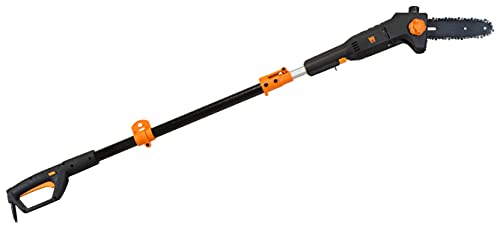
WEN 4019 6A corded telescoping pole saw, 5.3 to 7.3 ft shaft
6A corded8 in bar5.3-7.3 ft shaft6.7 lb
Check price on Amazon
Best for: Low-to-medium reach pruning on a corded budget.

The WEN 4019 has a 6 amp motor, an 8 inch bar and a telescoping pole that adjusts from 5.3 to 7.3 feet for up to 12 feet of overhead reach. It weighs a listed 6.7 pounds and the chain runs up to 36 feet per second.

The tradeoff is the small adjustment range of 2 feet. It is not a long-reach saw, but the short pole means less flex and easier control. Compared with the EGO, it has no battery to buy but a cord.

Keep the cord clear of the chain and check the lock before each cut. The short two foot adjustment range means you set the length once and leave it, which keeps the joint tight. It is the pole saw to buy when most of your limbs are below 10 feet and you want the lightest powered tool for the job.

What works

  • 6.7 pound listed weight
  • 36 ft/s chain speed
  • Short pole is stiff
  • No battery needed

Watch out for

  • Only 12 feet of reach
  • Cord management

Spec sheet

Motor
6A corded
Bar
8 inches
Shaft
Telescopes 5.3 to 7.3 feet
Reach
Up to 12 feet overhead
Weight
6.7 pounds listed
05
Notch Sentei 4-section aluminum telescoping manual pole saw, 21 ft
Manual4 sections21 ft total15.4 in blade
Check price on Amazon
Best for: Thin limbs and quiet work where a motor is unnecessary.

The Notch Sentei is a manual four-section aluminum telescoping pole saw that extends to 21 feet including the blade, with a 15.4 inch hard chrome-plated blade and improved cam collar locks. There is no motor, so it is a hand saw on a long pole.

The tradeoff is effort. A manual saw cuts thin limbs well but tires your shoulders on anything above a couple of inches. Cam collar locks are quick to set and release and are less prone to slipping than twist locks. Compared with the powered saws, it is silent, light and maintenance-free, but slow on thick limbs.

Wipe the blade after use and keep it dry to avoid rust. Sharpen the teeth with a tapered file every season, and put a sheath on the blade for storage so it cannot cut you or the pole bag. A manual saw is best used with long, steady strokes that let the teeth do the work, not short, forced ones.

What works

  • Cam collar locks
  • Hard chrome-plated blade
  • Four-section aluminum pole
  • No fuel, battery or cord

Watch out for

  • Manual effort on thicker limbs
  • Aluminum conducts electricity

Spec sheet

Type
Manual, no motor
Sections
4-section aluminum
Length
Extends to 21 feet with blade
Blade
15.4 inch hard chrome-plated
Locks
Cam collar locks
06
DOBEN 27 ft carbon fiber manual telescoping pole saw
Manual27 ft reachCarbon fiberAnti-retraction lock
Check price on Amazon
Best for: Long-reach manual pruning where weight matters.

The DOBEN is a manual pole saw with a 100 percent carbon fiber telescoping pole listed at 27 feet, with an anti-retraction safety lock system designed to stop the sections from sliding back. Carbon fiber gives high strength at low weight.

The tradeoff is that retraction under load is the classic failure of telescoping poles, and a carbon pole can still bend or splinter under side load. The anti-retraction system addresses that, which is a real improvement over simple friction locks. Compared with the Notch, it reaches further with a lighter pole, but the long reach makes it harder to control.

Inspect the carbon sections for cracks and never use any pole near power lines. Retract the sections fully for storage and avoid leaning the pole against a hard edge, where the tubes can chip. Carbon is not a safe insulator, particularly when wet or dirty, so treat it like metal around power lines.

What works

  • Carbon fiber pole is light and strong
  • Anti-retraction lock
  • Up to 27 ft listed reach
  • No motor to maintain

Watch out for

  • Very long reach is hard to control
  • Carbon can crack under side load

Spec sheet

Type
Manual, no motor
Pole
100 percent carbon fiber
Reach
Up to 27 feet
Lock
Anti-retraction safety lock
Use
Tree trimming

Spec sheet decoder

What the numbers on the box really mean

The specs manufacturers lead with, translated into what they tell you about real-world performance.

Shaft material

The pole's construction: carbon fiber, aluminum, fiberglass.

Watch forEGO and DOBEN are carbon, Notch is aluminum.

Lock type

How the sections hold position.

Watch forNotch uses cam collars, DOBEN an anti-retraction lock.

Listed reach

Max height including the user.

Watch for12 feet for WEN 4019, 27 feet for DOBEN.

Section count

More sections mean more joints and flex.

Watch forNotch has 4 sections.

Head weight

Weight at the working end.

Watch forWEN lists 6.7 pounds total.

Methodology

How We Evaluated These Telescoping Pole Saws

Shaft stiffness

We compared carbon, aluminum and short-pole designs and judged flex at full extension.

Lock quality

We compared cam collars, anti-retraction systems and twist locks.

Reach honesty

We separated listed reach from true pole length. Where a maker published the pole length, we used it; where it did not, we assumed the reach figure included the operator.

Power source

We weighed gas, cordless, corded and manual trade-offs.

Ownership

Based on the spec sheet and owner feedback patterns, we weighed joint cleaning, blade or chain care and brand support.

Decision guide

How to Choose the Right Telescoping Pole Saws

By Height

SituationPickWhy
Up to 12 feet, poweredWEN 4019Short stiff pole
Up to 12 feet, gasECHO X Series12.1 ft shaft
Up to 14 feet, quietEGO Power+Carbon shaft
Up to 20 feet, manualNotch Sentei21 ft
Up to 27 feet, manualDOBEN carbonListed 27 ft

By Budget

TierPickWhy
LowestNotch SenteiManual
LowDOBEN carbonManual, carbon
MidWEN 4019Corded
Mid-highECHO in-linePro engine
HighestEGO Power+Platform

Powered vs Manual

Powered

The EGO, ECHO and WEN cut thicker limbs quickly. They add weight at the head and need power or fuel.

Manual

The Notch and DOBEN are silent and light and need no power. They suit thin limbs.

Powered for limbs over 2 inches. Manual for thin work.

Handle Style

PreferencePickWhy
Trimmer-style gripECHO in-lineIn-line handle
Wider gripECHO X SeriesLoop handle
Light and simpleWEN 4019Short pole
BalancedEGO Power+Carbon shaft
Manual, quick lockNotch SenteiCam collars

For Mixed Heights Specifically

Look for

Look for a lock you can set quickly and a shaft that does not bend at your usual length.

In this comparison

The Notch with cam collars and the EGO with a carbon shaft are the best fit.

When to Spend More

Spend more if

Spend more if you prune often. The EGO and ECHO justify it.

Save if

Save if you prune thin limbs. The Notch or WEN is enough.

Ownership

Maintenance schedule

The upkeep that decides whether this machine lasts two seasons or ten.

TaskIntervalWhy it matters
Clean telescoping jointsEach sessionGrit makes locks slip and wears the collar, so a quick wipe after each session extends the life of the joint.
Inspect shaft for cracksEach seasonCarbon and fiberglass can crack under side load, so look for hairline marks and a rough, splintery feel when you run a gloved hand along the tube.
Check locksBefore each cutA slipping section can drop the head, and a falling saw head is dangerous to anyone below.
Oil chain or wipe bladeEach sessionPrevents wear and rust.
Store dryOff seasonMoisture corrodes locks and blades, and hang the pole vertically with the sections retracted.

FAQ

Frequently Asked Questions

Does a longer pole flex more?

Yes. Every foot adds flex. Choose the shortest pole that reaches, and use a ladder or a shorter pole for low limbs. Keep your feet planted and your elbows bent, and avoid stepping backward while looking up at the cut.

Carbon or aluminum?

Carbon is stiffer and lighter. Aluminum is cheaper and conducts electricity.

Why does my pole slip?

Grit or wear in the lock collar. Clean and tighten it, and if the collar is worn out, replace the section rather than relying on friction.

Are manual saws any good?

For thin limbs they are quiet and cheap. For anything thick they are slow, and the effort rises sharply with limb diameter, so a manual saw suits limbs up to about 2 inches.

Can I use any near power lines?

No. Keep well away from lines, whatever the material.

How do I measure real reach?

Add your standing reach to the pole length and compare with the limb height.

Bottom line

The short version

Browse more telescoping pole sawson Amazon →
James Miller, Lead Machine Editor

About the author

James Miller

Lead Machine Editor, MachineFanatic

James Miller leads MachineFanatic's buying guides, turning spec sheets, manuals and owner feedback into clear verdicts on power tools, outdoor power equipment, shop machines and kitchen machines.

More from James →

Keep reading

Related guides