
Amazon affiliate links - we earn a commission.Affiliate disclosure

Buying guide · 12 min read · Updated 2026-11-07

Best Through-the-Wall Air Conditioners (2026)

Six through-the-wall air conditioners compared on sleeve fit, EER, 115V supply, heat options and room coverage, with sleeve and installation notes for 2026.

James MillerBy James MillerLead Machine Editor6 machines comparedSpec-sheet verified
Best Through-the-Wall Air Conditioners

At a glance

Our top picks

Side by side

Spec comparison

A through-the-wall air conditioner lives in a framed opening in an exterior wall, held in a metal sleeve, rather than sitting in a window. That frees the glass, seals better against drafts and hides the unit in the building, which is why apartments and additions use them.

The catch is the sleeve. The wall opening has to match the chassis, the supply has to match the plug and the unit must be built for wall use, not just a window. Check all three before you pick a model.

Before you buy

6 Criteria to Look For Before Buying a Through-the-Wall Air Conditioner

  1. 01

    Sleeve compatibility first

    A through-the-wall unit slides into a metal sleeve set in the wall, and the chassis must match the sleeve dimensions. The LG listings state that these units are not made for window installation, and the OLMO 8,000 BTU heat unit lists a sleeve with it. Measure your existing opening before choosing a model. If the old sleeve is rusted or sagging, replace it at the same time, because a new unit in a bad sleeve will leak.

  2. 02

    EER as an efficiency check

    The LG 10,000 BTU states an EER of 10.7 and the LG 11,800 BTU states 10.6. EER is cooling output divided by power draw at fixed conditions. Units without a stated figure, such as the OLMO and Keystone, leave you to guess, so favor a stated EER when running cost matters.

  3. 03

    Voltage and receptacle

    All six here run on 115V, but at 11,800 or 12,000 BTU the current is high enough to need a dedicated circuit. The OLMO listing warns to verify the receptacle, and that is good advice for every unit. A wrong plug type turns an easy install into an electrician visit. If the circuit is shared with lights or outlets, an 11,800 or 12,000 BTU unit can trip the breaker on the hottest afternoons.

  4. 04

    Heat as a bonus

    The TCL and Keystone each list 4,200 BTU of heat, about 1,230 watts, while the OLMO 8,000 BTU heat unit gives no figure. That output takes the chill off a bedroom but does not heat a cold room. Treat it as supplemental.

  5. 05

    Sealing the sleeve

    A wall sleeve that leaks air wastes more cooling than a poor EER. Caulk the outside, insulate the gap and use the unit's gasket. Many owners find a sleeve leak is the cause of a unit that never catches up. A line of foam tape between the sleeve and the framing also quiets rattles and blocks drafts.

  6. 06

    Capacity versus coverage

    The LG 10,000 BTU covers up to 440 square feet and the 11,800 BTU unit up to 530, which is about 22 BTU per square foot. The 8,000 BTU units suit about 350 square feet. Oversizing makes a room cold and clammy, so match the room.

Detailed reviews

The 6 best through-the-wall air conditioners, explained

01
LG 10,000 BTU Through-the-Wall AC, 115V, EER 10.7
9,800 BTUEER 10.7115V440 sq ft
Check price on Amazon
Best for: A bedroom or living room up to 440 square feet with an existing wall sleeve.

LG's wall unit lists 9,800 BTU of cooling, an EER of 10.7 and R-32 refrigerant, with coverage up to 440 square feet on a 115V supply. EER is cooling output divided by power at fixed conditions, so a 10.7 is a respectable figure for a wall unit of this size.

The listing is clear that it is suited to a through-the-wall installation and is not made for a window, which matters because a sleeve unit has a different chassis. Against the 11,800 BTU LG it covers 90 fewer square feet but is easier on the electrical supply, and against the OLMO units it has a stated EER and a larger service network.

Ownership is the wall-unit routine: a washable filter, a coil clean in spring and checking the sleeve seal each year. The sleeve is a separate purchase, so confirm the size before ordering. If you are replacing an older unit, take the old chassis dimensions and the sleeve depth to the store or compare them against the listing, because a few inches of difference decides whether it fits.

What works

  • Stated EER of 10.7
  • Covers up to 440 square feet
  • Runs on a 115V circuit
  • Wide LG service network

Watch out for

  • Wall sleeve is not included
  • Not suitable for a standard window
  • Cool-only, with no heat mode

Spec sheet

Cooling capacity
9,800 BTU
Efficiency
EER 10.7
Coverage
Up to 440 sq ft
Supply
115V
Refrigerant
R-32
02
LG 11,800 BTU Through-the-Wall AC, 115V, EER 10.6
11,800 BTUEER 10.6115V530 sq ft
Check price on Amazon
Best for: A large bedroom or open area up to 530 square feet.

The larger LG lists 11,800 BTU, EER 10.6 and coverage up to 530 square feet on a 115V supply with R-32 refrigerant. It is built for through-the-wall installation and is not recommended for a window.

The difference from the 10,000 BTU model is capacity and a one-tenth EER drop, which is normal as the compressor grows. It suits a large bedroom or a small open living area. Against the OLMO 12,000 BTU it has a stated EER and a stronger brand, but the OLMO adds a smart kit.

As with all of these, the sleeve is a separate item, the opening must match the chassis and a dedicated 115V circuit is wise because current at this size is high. Clean the filter every few weeks and the coil each spring. Because it is heavy, plan for two people and a temporary support so the unit does not drop onto the sleeve edge during installation.

What works

  • Covers up to 530 square feet
  • EER 10.6 at a larger size
  • 115V supply
  • Brand service network

Watch out for

  • Wall sleeve is not included
  • Needs a dedicated circuit at this current
  • Cool-only

Spec sheet

Cooling capacity
11,800 BTU
Efficiency
EER 10.6
Coverage
Up to 530 sq ft
Supply
115V
Refrigerant
R-32
03
OLMO 12,000 BTU 115V Through-the-Wall AC, Built-In Smart Kit
12,000 BTU115VBuilt-in smart kitR-32
Check price on Amazon
Best for: A large room where the most 115V capacity and app control are wanted.

OLMO's 12,000 BTU wall unit is cooling only, runs on 115V single phase at 60Hz, uses R-32 refrigerant and has a built-in smart kit for app control. The listing asks you to verify that you have the right receptacle, which is a real warning at this size.

It does not state an EER in the data, so efficiency is a gap compared with the LG units. It does offer the highest cooling capacity here on a standard supply, and the smart kit adds scheduling. The wall sleeve is not part of the listing, so budget for one.

Ownership is the usual wall-unit routine. Check the receptacle before you buy, keep the filter clean and inspect the sleeve seal each year, because a leaky sleeve wastes much of the cooling. The built-in smart kit is convenient for scheduling, but keep the manual controls reachable so you can run the unit if the app is unavailable.

What works

  • 12,000 BTU on a 115V supply
  • Built-in smart kit
  • R-32 refrigerant
  • Cooling-only simplicity

Watch out for

  • No EER stated in the data
  • Sleeve and receptacle must be checked
  • Newer name in wall units

Spec sheet

Cooling capacity
12,000 BTU/h
Supply
115V, 1 phase, 60Hz
Refrigerant
R-32
Control
Built-in smart kit
Mode
Cooling only
04
OLMO 8,000 BTU 115V Through-the-Wall AC and Heater, with Wall Sleeve
8,000 BTU coolingHeatingWall sleeve included115V
Check price on Amazon
Best for: A room of about 350 square feet that needs cooling, some heat and a complete install kit.

This OLMO combines 8,000 BTU of cooling with a heating function, a built-in smart kit and a remote, on a 115V single-phase supply. The listing title names a wall sleeve, which makes it one of the few options here that can be installed without a separate sleeve purchase.

Including the sleeve removes a common point of confusion, since sleeve size has to match the chassis. The data does not give a heating capacity or an EER, so treat the heat as supplemental. Against the TCL and Keystone it offers the sleeve bundle, and against the LG it has less capacity.

Ownership is routine. Seal the sleeve to the wall, keep the filter clean and check the supply receptacle, since the listing explicitly warns to verify it. Because the bundle includes a sleeve, check that its depth matches the thickness of your wall before you start cutting.

What works

  • Sleeve is part of the listing
  • Cooling and heating in one unit
  • Smart kit and remote
  • 115V supply

Watch out for

  • No heating capacity or EER in the data
  • Smaller capacity than the 11,800 BTU LG
  • Newer name in wall units

Spec sheet

Cooling capacity
8,000 BTU/h
Function
Cooling and heating
Supply
115V, 1 phase, 60Hz
Control
Built-in smart kit and remote
Sleeve
Listing includes wall sleeve
05
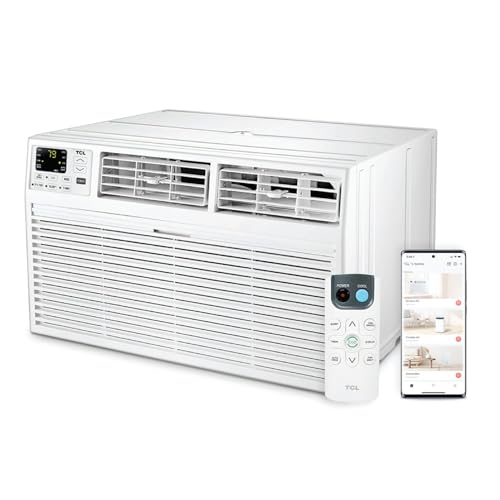
TCL 8,000 BTU Smart Through-the-Wall AC with 4,200 BTU Heater
8,000 BTU4,200 BTU heaterWi-Fi115V
Check price on Amazon
Best for: A bedroom of about 350 square feet that wants app control and some heat.

TCL pairs 8,000 BTU of cooling with a 4,200 BTU heater, a built-in dehumidifier mode and Wi-Fi control on a 115V supply. The stated 4,200 BTU of heat is the useful number: it is about 1,230 watts of resistance heat, a little under a standard space heater, so it takes the chill off a room, not warms a cold one.

Its role is the smart, mid-capacity wall unit. Compared with the Keystone, which lists the same 4,200 BTU of heat, it adds Wi-Fi and voice, and compared with the OLMO heat unit it states its heating capacity.

Ownership is routine. The sleeve is separate, so check the opening size before you order, and keep the filter and coil clean. Use the dehumidifier mode in shoulder seasons when the air is damp but the temperature is mild, which saves running the full cooling cycle.

What works

  • Stated 4,200 BTU heater
  • Wi-Fi app and voice control
  • Built-in dehumidifier mode
  • 115V supply

Watch out for

  • Heater is supplemental only
  • Wall sleeve is a separate item
  • Smaller capacity than the LG units

Spec sheet

Cooling capacity
8,000 BTU
Heating capacity
4,200 BTU
Supply
115V
Control
Wi-Fi app and voice
Extra
Built-in dehumidifier mode
06
Keystone 8,000 BTU Wall AC with 4,200 BTU Supplemental Heat
8,000 BTU4,200 BTU heatDehumidifier115V
Check price on Amazon
Best for: A bedroom of about 350 square feet that needs cooling and light heat at a lower price tier.

Keystone's wall unit lists 8,000 BTU of cooling and 4,200 BTU of supplemental heat, with dehumidification and fan modes on a 115V supply. It is the plain version of the combo wall unit, without the app features of the TCL.

That simplicity is the value. It cools and heats an average bedroom, uses a standard circuit and has fewer electronics to fail. Compared with the TCL it gives up Wi-Fi, and compared with the LG it has less capacity and no stated EER.

Ownership is the wall-unit routine: a sleeve is required, the filter needs regular washing and the sleeve seal needs a yearly check. Confirm the sleeve opening before you order. Because it has few electronics, it is a reasonable choice for a rental or a seldom-used guest room where simplicity beats features.

What works

  • Cooling plus 4,200 BTU of supplemental heat
  • Standard 115V supply
  • Dehumidify and fan modes
  • Fewer electronics to fail

Watch out for

  • No EER stated in the data
  • No smart features
  • Wall sleeve is a separate item

Spec sheet

Cooling capacity
8,000 BTU
Heating capacity
4,200 BTU supplemental
Supply
115V
Modes
Cool, heat, dehumidify, fan
Design
Space-saving wall unit

Spec sheet decoder

What the numbers on the box really mean

The specs manufacturers lead with, translated into what they tell you about real-world performance.

EER

Energy Efficiency Ratio, cooling BTU per watt at fixed conditions. Higher means lower running cost.

Watch forThe LG units state 10.7 and 10.6, and the others do not.

Wall sleeve

A metal housing installed in the wall opening that holds the unit and seals it to the building.

Watch forThe LG units do not include it, and the OLMO 8,000 BTU heat listing names one.

Supplemental heat

A heating function that adds warmth but does not replace a heater. It is usually resistance heat.

Watch forThe TCL and Keystone state 4,200 BTU.

115V single phase

A standard household supply. Large wall units need a dedicated circuit at this size.

Watch forThe OLMO listing asks you to verify the receptacle.

R-32

A refrigerant with lower global warming potential than older R-410A. It is now common in new units.

Watch forThe LG and OLMO units list R-32.

Methodology

How We Evaluated These Through-the-Wall Air Conditioners

Wall-unit suitability

We checked that each unit was built for a wall sleeve and noted which listings include one. The LG units are explicit about not being window units, and the OLMO 8,000 BTU heat unit names a sleeve.

Efficiency evidence

We gave credit to stated EER figures, 10.7 on the LG 10,000 BTU and 10.6 on the LG 11,800 BTU, and discounted units that give none.

Electrical fit

We counted the supply requirements and the risk of a wrong receptacle. All six use 115V, but the larger units need a dedicated circuit.

Heat and features

We compared the 4,200 BTU heaters on the TCL and Keystone with the unstated figure on the OLMO. Stated numbers scored higher.

Support

We considered brand service networks based on owner feedback patterns. LG scored highest, TCL and Keystone were in the middle and OLMO lost points for newness.

Decision guide

How to Choose the Right Through-the-Wall Air Conditioners

By Room Size

SituationPickWhy
Bedroom near 350 sq ftKeystone 8,000 BTU8,000 BTU with heat
Bedroom near 350 sq ft with appTCL 8,000 BTUWi-Fi and 4,200 BTU heater
Living room up to 440 sq ftLG 10,000 BTUEER 10.7
Large room up to 530 sq ftLG 11,800 BTULargest stated coverage

By Budget

SituationPickWhy
Lowest costKeystone 8,000 BTUPlain combo unit
Mid-range with sleeveOLMO 8,000 BTU HeatSleeve included
Mid to upperTCL 8,000 BTUSmart and heater
Higher for efficiency and brandLG 10,000 BTUStated EER

Cool-Only vs Cool and Heat

Cool-only

The LG 10,000 BTU, LG 11,800 BTU and OLMO 12,000 BTU only cool. They cost less per BTU and have fewer parts, but you need another heater.

Cool and heat

The TCL, Keystone and OLMO 8,000 BTU heat unit add supplemental heat. The TCL and Keystone state 4,200 BTU, enough to take the chill off.

Choose cool-only for capacity and simplicity, and combo units for a bedroom that needs both.

Smart vs Simple

SituationPickWhy
Want app and voiceTCL 8,000 BTUWi-Fi and voice
Want a built-in smart kit with big capacityOLMO 12,000 BTU12,000 BTU on 115V
Want no app at allKeystone 8,000 BTUPlain controls
Want a known brand with a stated EERLG 10,000 BTUService network

For Replacing an Old Sleeve Unit Specifically

Look for

A chassis that matches the existing sleeve, the same electrical receptacle and a similar capacity. Measure the sleeve opening, depth and any front trim before ordering.

In this comparison

The LG units are the safest swap for an older through-the-wall unit, and the OLMO 8,000 BTU heat unit is the easiest if you have no sleeve at all.

When to Spend More

Spend more if

The room is large or you want a stated efficiency. The LG 10,000 BTU or LG 11,800 BTU repays that spend with EER and service.

Save if

The room is an average bedroom. The Keystone 8,000 BTU does cooling and heat for less.

Ownership

Maintenance schedule

The upkeep that decides whether this machine lasts two seasons or ten.

TaskIntervalWhy it matters
Wash the filterEvery 2 to 4 weeksA clogged filter cuts airflow and freezes the coil. Dry it fully before refitting. Wall units sit in a fixed spot, so a monthly habit is easy to keep.
Check the sleeve sealEach yearA leaking sleeve loses cooling and lets in insects. Re-caulk the outside and replace the gasket.
Clean the coilsEach springDust films the coils and cuts efficiency. A soft brush and a fin comb restore airflow.
Check the receptacleEach seasonA warm plug signals a poor connection at high load. Replace damaged outlets.
Clear the drainEach springWall units drain through the base pan. A blocked drain causes drips on the wall.

FAQ

Frequently Asked Questions

Can I put a through-the-wall unit in a window?

Not safely. The LG listings state that these are not made for window installation, because the chassis and weight distribution differ from a window unit. Use a unit designed for a sash instead.

Do I need a sleeve?

Yes. The sleeve holds the unit and seals it to the wall. The OLMO 8,000 BTU heat listing includes one, and the others require a separate purchase sized to the chassis. The sleeve size must match the chassis, so check dimensions in the listing carefully.

What is a good EER?

For a wall unit around 10 to 11 is typical, and the LG units state 10.7 and 10.6. Higher EER means lower running cost, but it matters most if you run the unit for months. A stated EER lets you estimate running cost, which is worth the effort for a unit that runs all summer.

Can through-the-wall units heat?

Some can. The TCL and Keystone list 4,200 BTU of heat, which is supplemental. It will take the chill off a bedroom but not heat a cold one. A separate space heater is more effective when real warmth is the goal.

What circuit do I need?

Check the receptacle before you buy, and remember that sleeve wiring is often older than the unit going into it. Verify the receptacle and plug type before you order.

How long do wall units last?

Often ten years or more with regular filter and coil cleaning, since they are not carried in and out each season. A leaking sleeve is the usual cause of early trouble. Keeping the outside louvers clear of leaves and nests also protects the condenser from overheating.

Bottom line

The short version

Browse more through-the-wall air conditionerson Amazon →
James Miller, Lead Machine Editor

About the author

James Miller

Lead Machine Editor, MachineFanatic

James Miller leads MachineFanatic's buying guides, turning spec sheets, manuals and owner feedback into clear verdicts on power tools, outdoor power equipment, shop machines and kitchen machines.

More from James →

Keep reading

Related guides