
Amazon affiliate links - we earn a commission.Affiliate disclosure

Buying guide · 13 min read · Updated 2026-11-18

Best Transfer Switches for a 7000 Watt Generator (2026)

Five transfer switches that match a 7,000 watt portable generator, from 30 amp circuit panels to a meter-mounted 40 amp unit, sized to its real running output.

James MillerBy James MillerLead Machine Editor5 machines comparedSpec-sheet verified
Best Transfer Switches for a 7000 Watt Generator

At a glance

Our top picks

Side by side

Spec comparison

A mid-size portable generator is usually labelled with its peak output, while its running output sits noticeably lower. Most carry a thirty amp locking outlet, which suggests the switch size: that current at full household voltage roughly matches both the outlet and the engine.

Larger switches do not make the engine stronger, and smaller ones leave capacity unused. The sections below match thirty and forty amp switches to this size of generator, and explain how many circuits it can carry before the engine labours.

Before you buy

6 Criteria to Look For Before Buying a Transfer Switch for a 7000 Watt Generator

  1. 01

    Running versus peak watts

    A 7,000 watt label often means peak output, with running output closer to 5,500 or 6,000 watts. The switch is sized to the outlet, not the label, and thirty amps at 240 volts is about 7,200 watts. Plan the loads against the running figure, and treat the extra as short-term surge for motor starts. A quick way to find the running figure is the generator's data plate, which lists rated watts and amps separately from the maximum. If only a peak number appears on the box, assume the running output is about eighty percent of it and plan with a margin below that.

  2. 02

    Outlet type on the generator

    Most 7,000 watt portables carry a thirty amp, four-prong L14-30 locking outlet, which suits the thirty amp panels. A few carry an L5-30 at 120 volts only, which suits the Joinfworld. Look at the generator panel before buying, because a mismatch means an adapter, and adapters are where overloaded circuits begin.

  3. 03

    How many circuits you can really run

    With about 5,500 running watts, a refrigerator at 700, a furnace blower at 600, a sump pump at 800 and lighting at 300 leave roughly 3,000 watts for rotation. Twelve circuits therefore exceed what the engine can run at once. The Nature's Generator twelve-circuit panel is a rotation tool, and the six-circuit panels are enough for a simple plan. Start the largest motor first, such as the well pump, then add smaller loads in descending size, because a compressor starting last asks the most from an engine that is already working. Many owners write that order on a card and tape it beside the inlet.

  4. 04

    Panel work or meter mount

    A panel kit means wiring into the main panel, which needs a permit and usually an electrician. A meter-mounted switch such as the GenerLink avoids that, but it energises the whole house and may need utility approval. Weigh the avoidance of panel work against the loss of circuit selection. If you rent or your panel is full, the meter mount is attractive, and if you own and plan to keep the house, the panel kit repays its wiring cost in control. Ask your utility about its policy before ordering, since some prohibit devices that attach to the meter.

  5. 05

    240 volt loads

    A well pump, a 240 volt furnace and a few other loads need both legs. The POOAMY panel and the Nature's Generator twelve-circuit panel are 120/240 volt capable, while the six-circuit Nature's Generator panel and the Joinfworld are 120 volt only. List your 240 volt loads before you pick. Pumps and furnaces on 240 volts take two positions each on a panel, which shrinks the usable count, so a six-circuit panel with two 240 volt loads leaves only four single-pole circuits for the rest.

  6. 06

    Permits and labels

    Any tie-in to house wiring is regulated electrical work in most places. Listing words such as UL Listed in a title are seller statements, so read the label on the unit. This guide cannot confirm compliance for any product, and an inspector decides what is accepted. Keep the permit and a photograph of each nameplate together, since both may be asked for after a claim or at a house sale.

Detailed reviews

The 5 best transfer switches for a 7000 watt generator, explained

01
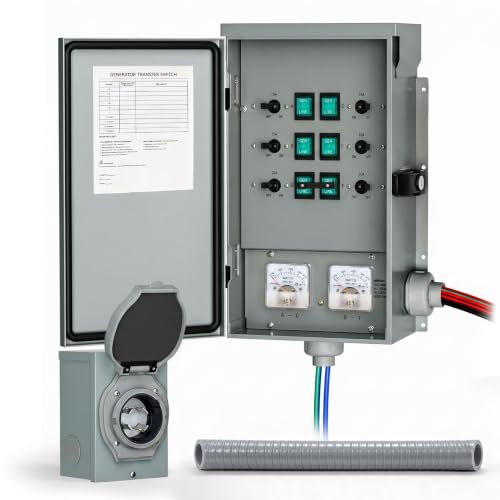
Nature's Generator 30A 12-Circuit Home Backup Panel
30A 120/240V12 circuitsLit rockersSteel box
Check price on Amazon
Best for: A 7,000 watt portable with a thirty amp locking outlet and a household that rotates loads.

Thirty amps is the natural partner for a 7,000 watt portable. At 240 volts the switch can pass about 7,200 watts, which is slightly more than the generator's running output, so the switch is never the bottleneck. Twelve circuits and illuminated rockers let you see what is live and rotate loads through an evening.

The arithmetic is the important part. If the engine runs near 5,500 watts, a refrigerator, a furnace blower, lighting and a sump pump use perhaps 2,500, leaving room for a microwave or a window air conditioner in turn. Twelve positions mean you will always have more circuits than watts, so the list is a rotation plan, not a wishlist.

Against the six-circuit panels below, this gives more flexibility for the same amperage and a longer wiring job. Verify the title's UL claim on the label, plan an electrician and a permit, and give each rocker a clear label. Over a few years the lit rockers are the part most worth checking, since a dead lamp can hide a stuck contact, so press each one during the twice-yearly exercise and note any that stays dark. A 7,000 watt engine also benefits from a routine of running at a steady load for ten minutes before anything heavy is switched on, which the rocker panel makes easy to manage.

What works

  • Thirty amp rating matches the outlet
  • Twelve circuits for load rotation
  • Lit rockers show live circuits
  • Pre-wired steel enclosure

Watch out for

  • Twelve circuits take longer to wire
  • Cannot run every position at once
  • Label claims need checking

Spec sheet

Rating
30 amp, 120/240V
Circuits
12
Controls
Illuminated rocker switches
Enclosure
Steel, pre-wired
Generator match
30A locking outlet class
02
Nature's Generator 30A 6-Circuit 120V Manual Transfer Switch
30A 120V6 circuitsManualPre-wired
Check price on Amazon
Best for: Households with all-120V essentials and a mid-size portable.

This panel is a simpler way to use the same thirty amp inlet. Six circuits at 120 volts with a selector for each means a shorter wiring day and a smaller list to manage. For a 7,000 watt generator it is generous, since six circuits rarely add up to more than the engine can carry.

Its limit is the 120 volt rating: a well pump or a 240 volt furnace needs a different panel. Compared with the twelve-circuit sibling, you give up six positions and the lit rockers, and you save labour. Compared with the POOAMY panel, it is 120 volt only and lacks the 240 volt layout.

Plan the six circuits on paper first and label each one. Keep the cord short and heavy, thirty amps, and mount the inlet where the generator can sit well away from windows. This panel is the one most households can understand in an afternoon, and its smaller circuit count makes the written priority list short enough to memorise. Year three brings the usual checks: tight lugs, a clean inlet and a cord with sound insulation, plus a fresh label if any appliance has changed.

What works

  • Six circuits with selector switches
  • Pre-wired for a quicker install
  • Thirty amp capacity matches the outlet
  • Simple, no electronics

Watch out for

  • 120V circuits only
  • Six positions limit rotation
  • UL claim needs a label check

Spec sheet

Rating
30 amp, 120V
Circuits
6
Control
Manual selector switches
Wiring
Pre-wired
Claim
Title says UL Listed; verify
03
POOAMY 30A 6-Circuit Manual Transfer Switch, 7,500W, NEMA 3R
30A 120/240V6 circuits7,500W maxNEMA 3R
Check price on Amazon
Best for: A 7,000 watt portable feeding a 240 volt pump or furnace plus a few 120V circuits.

POOAMY states a 7,500 watt maximum, which brackets a 7,000 watt generator neatly, and adds 120/240 volt capability that the Nature's Generator six-circuit panel lacks. A heavy-duty steel enclosure with a protective finish and a NEMA 3R rating suits a garage or an exterior wall.

Six circuits with a 240 volt option mean a well pump or a 240 volt furnace can have its own position while lights and a refrigerator keep theirs. That mixture is a common essentials list in a rural house.

The listing mentions pre-drilled holes and easy-to-follow instructions, though a generic seller's documentation is thinner than a big brand's. Ask the electrician to review it, and confirm the breaker sizes against the wire. A powder-coated steel box shrugs off garage dust and condensation better than plastic, but scratches should be touched up so rust does not start. The kit is sized so that a seven thousand watt engine can run it near its limit for hours, so keep a margin and never let the load list creep upwards without checking the generator's nameplate.

What works

  • Stated 7,500W maximum fits the generator
  • 120/240V capable
  • NEMA 3R steel enclosure
  • Pre-drilled mounting holes

Watch out for

  • Six circuits only
  • Seller documentation is limited
  • Thirty amp ceiling

Spec sheet

Rating
30 amp, 120/240V
Capacity
7,500W maximum
Circuits
6
Enclosure
Heavy-duty steel, NEMA 3R
Install
Pre-drilled holes, instructions
04
GenerLink 40A Automatic Transfer Switch, Meter-Mounted, Non-Surge
40A 240VMeter-mountedAutomaticOutdoor
Check price on Amazon
Best for: Homeowners who want no panel work and whose utility allows meter-mounted devices.

A meter-mounted switch avoids opening the main panel altogether. This forty amp automatic unit plugs into the meter socket and takes power from a portable generator through a cord, with the listing stating support for service up to 200 amps. At 240 volts, forty amps is about 9,600 watts, comfortably above a 7,000 watt generator.

The tradeoff is that the whole house is live, so there is no circuit selection, and the generator must be managed by switching big loads off at the panel first. The utility may need to approve a device that attaches to its meter, so ask before ordering.

Compared with the Nature's Generator panels, it needs no wiring in the house, which suits renters or anyone who does not want panel work, and it costs more. Use a manual load list and start loads one at a time. With the whole house live, switch off the range, the dryer and the water heater at their breakers before connecting, then add them back only when the engine is stable. Because the device hangs on the meter, treat it gently: a bumped cord or a loose plug can arc at the socket, so strain-relieve the cable and check the cover seal after every use.

What works

  • No panel wiring required
  • Forty amp capacity exceeds the generator
  • Weather-resistant outdoor design
  • Supports up to 200 amp service per listing

Watch out for

  • Whole house is live, no circuit selection
  • Utility approval may be needed
  • Higher price tier

Spec sheet

Rating
40 amp, 240V
Mount
Meter socket
Operation
Automatic transfer
Service
Supports up to 200 amp service
Environment
Weather-resistant outdoor design
05
Joinfworld 30A 125V L5-30P Manual Transfer Switch
30A 125VL5-30P inletBreaker built inSteel box
Check price on Amazon
Best for: One heavy 120V circuit, such as a freezer or an air conditioner, on a generator with an L5-30 outlet.

On a 7,000 watt generator a single 120 volt circuit is a small fraction of the output, and this switch is the most economical way to use that fraction. It has an L5-30 inlet, an internal breaker and labelled terminals in a powder-coated steel box.

Thirty amps at 125 volts is about 3,750 watts, so it can feed a large single load such as a window air conditioner or a chest freezer with surge headroom. It cannot feed multiple circuits, and the generator needs an L5-30 outlet, which not every model has.

Compared with the panels above, it is a limited tool, but it avoids the main panel altogether when you only need one circuit kept alive. Dedicate it to that circuit and label it clearly. Because the generator needs a matching outlet, check the panel before you buy, and if it lacks an L5-30 plan on a short adapter-free cord of the right type instead of improvising one. The box itself needs almost no maintenance beyond a dry cover and a yearly look at the terminals, which is why it suits owners who want the least possible work.

What works

  • Breaker and switch in one steel box
  • Engraved L, N and GND terminals
  • About 3,750W capacity on one circuit
  • Gasketed covers for a garage

Watch out for

  • One circuit only
  • Needs an L5-30 generator outlet
  • Manual operation

Spec sheet

Rating
30 amp, 125V
Inlet
L5-30P
Protection
Internal circuit breaker
Enclosure
Powder-coated steel, gasketed covers
Terminals
Labeled L, N and GND

Spec sheet decoder

What the numbers on the box really mean

The specs manufacturers lead with, translated into what they tell you about real-world performance.

7,000W rating

Usually a starting or peak figure. Running output is lower, often by about twenty percent.

Watch forRead the generator nameplate for continuous watts.

30A at 240V

About 7,200 watts of switch capacity, matching the typical outlet.

Watch forApplies to the Nature's Generator panels and the POOAMY.

40A at 240V

About 9,600 watts, far above a 7,000 watt generator's output.

Watch forStated for the GenerLink.

L14-30

A four-prong 120/240 volt locking connector common on mid-size portables.

Watch forCheck that your generator has one.

Meter-mounted

A device that plugs into the utility meter socket instead of wiring into the panel.

Watch forThe GenerLink only; utility approval may apply.

Methodology

How We Evaluated These Transfer Switches for a 7000 Watt Generator

Size match

We kept products whose ratings suit a 7,000 watt generator: thirty amp panels, a forty amp meter-mounted unit and a single-circuit thirty amp switch. Fifty amp and larger kits were left to other guides, because they presuppose a bigger engine and a bigger outlet than this class of generator offers. The aim was to show what actually fits, not to list every product that mentions the word generator.

Outlet and voltage fit

We separated 120 volt only products from 120/240 volt products because the generator's outlet and your loads decide which is usable.

Load realism

We compared circuit counts against a realistic running wattage, using standard electrical relationships and listing ratings, not measurements.

Install burden

A panel kit needs main panel work, a meter-mounted switch needs utility consent and a single-circuit box needs one feed. Burden shaped the picks. A weekend project that needs three inspections is not a weekend project, so we gave credit to products whose install is easy to explain to an electrician.

Claim caution

UL words in titles are repeated as seller statements and not endorsed, with a reminder to read labels.

Decision guide

How to Choose the Right Transfer Switches for a 7000 Watt Generator

By Generator Outlet

SituationPickWhy
L14-30 four-prong outletNature's Generator 30A 12-Circuit PanelMatches the outlet and the output
L5-30 120V outletJoinfworld 30A L5-30P SwitchSame inlet type
Wants 240V pump circuitPOOAMY 30A 6-Circuit Kit120/240V capable

By Budget

SituationPickWhy
Lower tierJoinfworld 30A L5-30P SwitchSingle-circuit box
Middle tierPOOAMY 30A 6-Circuit KitSix circuits with steel enclosure
Higher tierGenerLink 40A Meter-MountedNo panel work

Panel Kit vs Meter Mount

Panel kit

The Nature's Generator and POOAMY kits move chosen circuits. You pick what runs, and a 7,000 watt engine is not overloaded.

Meter mount

The GenerLink needs no panel work but energises the whole house. Easier to install, harder to manage.

Choose a panel for control; choose a meter mount for speed and no wiring in the house.

By Number of Circuits

SituationPickWhy
One heavy circuitJoinfworld 30A L5-30P SwitchSingle feed
Six essentialsNature's Generator 30A 6-CircuitCompact panel
Twelve for rotationNature's Generator 30A 12-CircuitMost positions

For Running Well Pumps and Furnaces Specifically

Look for

A 240 volt position for the pump, a furnace blower circuit that stays on and a generator with surge headroom for the pump's start.

In this comparison

The POOAMY kit lists 120/240 volt capability and the Nature's Generator twelve-circuit panel lists the same.

When to Spend More

Spend more if

You want no panel work, which points to the GenerLink, or maximum flexibility, which points to the twelve-circuit Nature's Generator panel.

Save if

You only need a handful of circuits. The six-circuit panel or the Joinfworld covers it.

Ownership

Maintenance schedule

The upkeep that decides whether this machine lasts two seasons or ten.

TaskIntervalWhy it matters
Run the generator under loadEvery 3 monthsA 7,000 watt engine that sits idle gums its carburetor. Run it for twenty minutes with the switch in generator position.
Exercise the switchesEvery 6 monthsContacts stiffen when idle. Operate each position with the generator off.
Inspect inlet and cordBefore storm seasonA thirty amp cord and inlet carry real current. Replace any cracked jacket or discoloured pin.
Re-torque terminalsYearlyThermal cycling loosens lugs. An electrician should tighten to label torque.
Rotate stored fuelEvery 6 monthsOld fuel degrades and starves the engine. Use stabiliser and rotate the supply.

FAQ

Frequently Asked Questions

What size transfer switch does a 7000 watt generator need?

A thirty amp switch matches the typical locking outlet and about 7,200 watts at 240 volts. A fifty amp switch is unnecessary unless the generator has a fifty amp outlet.

Can a 7000 watt generator run my whole house?

Not at once. Running output is nearer 5,500 watts, so central air, an electric range and a dryer together will exceed it. Pick essentials and rotate the rest. Gas appliances help a great deal, since a gas furnace, range and water heater need only small electric loads. An electric heat pump or resistance heat changes the picture and may call for a larger generator or a different strategy.

Is a meter-mounted switch better than a panel kit?

It avoids panel work, but it energises the whole house and may need utility approval. A panel kit gives circuit control.

How long will these switches last?

Manual switches have few failure points. Lug tightness, contact wear and the inlet are the usual issues, so inspect them yearly. The generator engine is the more likely failure point, so keep fuel fresh and run it quarterly.

Do I need a permit?

Almost always, and many places require a licensed electrician. Ask your local authority first.

Does UL Listed in a title prove approval?

No. It is a seller statement. Read the label and ask the inspector.

Bottom line

The short version

Browse more transfer switches for a 7000 watt generatoron Amazon →
James Miller, Lead Machine Editor

About the author

James Miller

Lead Machine Editor, MachineFanatic

James Miller leads MachineFanatic's buying guides, turning spec sheets, manuals and owner feedback into clear verdicts on power tools, outdoor power equipment, shop machines and kitchen machines.

More from James →

Keep reading

Related guides