
Amazon affiliate links - we earn a commission.Affiliate disclosure

Buying guide · 14 min read · Updated 2026-11-25

Best Transfer Switches Under $500 (2026)

Five transfer and changeover switches that list for under $500, with 125A automatic units, a 63A 4-pole, a rotary changeover and a 200A manual.

James MillerBy James MillerLead Machine Editor5 machines comparedSpec-sheet verified
Best Transfer Switches Under $500

At a glance

Our top picks

Side by side

Spec comparison

More budget buys higher amperage, an enclosure and a better chance of covering more than a single circuit. The core purpose has not changed: only one source at a time may feed the wiring, so a generator can never push power back onto the utility lines.

The variety is wide at this price. Some switches are pre-mounted in enclosures, some are bare DIN-rail modules and one is a simple rotary selector. We ranked them by amperage, clarity of the listing, enclosure and the installation effort they imply. Prices move, and the $500 cap reflects listing prices when this guide was updated.

Before you buy

6 Criteria to Look For Before Buying a Transfer Switch Under $500

  1. 01

    Amp rating and what it serves

    A 63 amp switch handles a sub-panel or a workshop. A 125 amp switch covers a typical essential-loads panel. A 200 amp switch is service-level and serves an entire house. Buy for the loads you want to run during an outage, not for the largest label. The limit is always the generator behind the switch, since a 7,000 watt portable cannot power a 200 amp service at full load. Think in watts: a 125 amp, 240 volt circuit could carry up to about 30,000 watts, which no portable generator supplies. The switch's rating is therefore a ceiling on safety margins and growth, and it should never be mistaken for the amount of power you will have. A written list of essential circuits, with their wattage, makes the right choice obvious.

  2. 02

    Split phase, three phase and poles

    North American homes use 120/240 volt split-phase service, which needs a two-leg switching scheme with a neutral handled correctly. Three-pole and four-pole modules suit three-phase supplies or special cases. The Heschen's four poles also switch the neutral. Do not guess: confirm the service type and let an electrician pick the pole count. A switched neutral prevents stray currents in some installations, while an unswitched neutral is standard in many split-phase homes. The manual of the specific switch and the code in your area settle which applies, and mixing them up can leave metal parts energised.

  3. 03

    Enclosure and environment

    A switch in a pre-installed enclosure saves work and meets mounting rules. A bare DIN-rail module needs a box. The EBILNVKE includes an IP65 box for dust and spray, the 200A switch has a galvanized steel shell, and the 125A panel arrives enclosed. Outdoor use needs at least a weather-rated enclosure. Indoor locations still need clearance in front of the panel for safe working, and the switch should not sit above a washing machine or beside a water heater valve. Pick a spot that stays dry and is easy to reach in the dark.

  4. 04

    Manual versus automatic

    Manual switches have no electronics and rely on you being home. Automatic switches transfer on their own and suit unattended sites, but they need a generator that can start itself. Neither type replaces a proper backfeed-free design. Choose the one that matches how you will actually use it. A cabin that sits empty over winter with a freezer to protect is a good case for automatic, while a house where someone is always home is a good case for manual. Whichever you pick, test it before the storm rather than during it.

  5. 05

    Safety listing and inspection

    Many generic switches carry CE or similar marks rather than UL or ETL. Inspectors and insurers often expect a UL or ETL listing for equipment tied to a house. A permit and inspection are required in many places for inlet boxes and transfer switches. Verify before you buy. The listing mark is usually printed on the product label, so ask the seller for a photograph of it. If the answer is vague, treat that as a warning rather than a detail.

  6. 06

    Transfer speed and protection

    The Heschen quotes under 500 milliseconds, and the DIN-rail modules list over and under voltage protection. Faster transfer helps sensitive equipment, but any switch causes a brief interruption. A small battery backup keeps computers alive through it. Motors, such as a furnace blower or a pump, will restart after the interruption, so check that they can handle the sudden loss and return of power. Some owners add a short time delay on sensitive loads to avoid a double surge.

Detailed reviews

The 5 best transfer switches under $500, explained

01
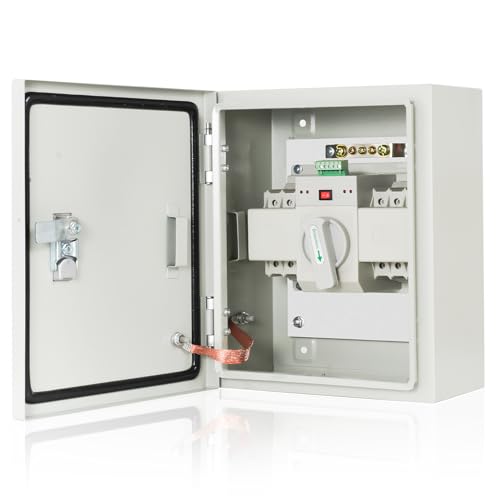
125A automatic transfer switch, 3P 120/240V, enclosure, auto and manual
125A120/240VAuto and manualEnclosure
Check price on Amazon
Best for: A house sub-panel with a portable or standby generator.

This switch is rated for 125 amps on three poles at 120/240 volts, which matches a split-phase North American service. It offers automatic and manual operation, and it comes pre-installed in an enclosure, which saves buying and mounting a box. A 125 amp rating suits a sub-panel with the circuits you want to run during an outage, such as the furnace, fridge, sump pump and some lighting.

An automatic switch watches the utility and moves the load to the generator when the utility fails. That only helps if the generator can start itself, since the switch cannot start an engine. For a portable generator that you start by hand, the manual mode gives the same isolation with a lever.

Set beside the smaller 63A modules, it gives a split-phase rating and an enclosure. It is not a plug-in item: it needs wiring by an electrician, a proper inlet box and a generator receptacle that matches. A 30 amp generator inlet is typical for portables, and the switch must be sized above the largest load. Check for a UL or ETL listing, label every circuit and test the transfer under a safe load. The pre-installed enclosure also means the wiring is a matter of landing conductors on clearly marked lugs, which shortens the electrician's visit.

What works

  • 125 amp three-pole split-phase rating
  • Automatic and manual modes
  • Pre-installed enclosure
  • Suits a typical essential-loads panel

Watch out for

  • Needs an electrician and permit
  • Certification must be confirmed before use

Spec sheet

Rating
125 amps, 3 pole
Voltage
120/240 volt split phase
Operation
Automatic and manual
Enclosure
Pre-installed durable enclosure
Use
Dual power transfer for a generator
02
200A manual generator transfer switch, 120/240V double throw
200A120/240VManualGalvanized steel
Check price on Amazon
Best for: Whole-house backup where simplicity and a service-rated switch matter.

The 200 amp manual switch is a service-level device. A single handle moves the load between the utility and the generator, and it is mechanically impossible to select both. The listing says the connections are aluminum and the switch contains no electronic components, so there is nothing to fail in storage.

The galvanized steel enclosure has a 1.5 millimeter shell and a protective coating, which suits a utility room or an exterior wall. A 48,000 watt label describes the service capacity, but the realistic source behind it is a portable generator in the 5,000 to 10,000 watt range, and the load must be managed to match.

Measured against the 125A automatic panel, it handles the whole service but needs you to be present during an outage. Because it connects directly to the main panel, installation needs a licensed electrician in most jurisdictions, with a permit and an inspection. Confirm a UL or ETL listing, since unlisted switches may fail inspection or insurance requirements. A manual switch is also easy to teach to a family member: handle down for utility, handle up for generator, and never leave it in the middle position. Practise the routine once in daylight.

What works

  • Service-level 200 amp rating
  • No electronics to fail
  • Heavy galvanized enclosure
  • Mechanical selection prevents backfeed

Watch out for

  • Needs you present to operate it
  • Requires professional installation

Spec sheet

Rating
200 amps, 120/240 volt
Type
Manual double throw
Label
48,000 watts
Contacts
Aluminum, no electronics
Enclosure
Galvanized steel, 1.5 mm shell
03
110V 125A 3-pole automatic transfer switch, DIN rail, LED display
125A110V 3-poleDIN railPriority selectable
Check price on Amazon
Best for: Hybrid solar and grid systems where priority selection matters.

This DIN-rail automatic switch transfers loads between a primary and a secondary source and lets you designate either input as the priority. That flexibility suits a setup where you prefer solar or battery power first and the grid second, or the reverse. The LED display shows the state, and the listing cites overvoltage protection with a 140 volt maximum, along with undervoltage and overcurrent protection.

It is a component, not a complete installation. A DIN-rail module needs an enclosure, breakers, wiring and a design that someone competent has checked. It also lists a 110 volt rating on three poles, a configuration worth reading carefully, since split-phase 120/240 volt services use different wiring than a three-pole 110 volt module implies.

Against the 125A panel in an enclosure, it is more configurable and less ready to install. It suits an off-grid or hybrid system built by an electrician or an experienced designer. Confirm the certification, label every wire and test with a small load first. Setting the priority input incorrectly can cause the system to run on the more expensive source, so check the logic after wiring and again after any change to the supply.

What works

  • Priority input is selectable
  • LED status display
  • Overvoltage, undervoltage and overcurrent protection
  • DIN-rail mounting for custom cabinets

Watch out for

  • No enclosure included
  • Three-pole 110 volt rating needs careful wiring review

Spec sheet

Rating
125 amps, 3 pole, 110 volt
Mounting
DIN rail
Display
LED
Priority
Any input selectable as primary
Protection
Overvoltage (140V max), undervoltage, overcurrent
04
Heschen 63A 4P 220V dual power automatic transfer switch
63A4-pole 220VUnder 500 msMechanical interlock
Check price on Amazon
Best for: Three-phase workshops and farm buildings with a standby generator.

Heschen's 4-pole switch is rated for 63 amps at 220 volts and quotes a transfer time under 500 milliseconds. A built-in microchip monitors the stability of the line and triggers a transfer when a brownout or low voltage appears. A dual-mode selector offers hands-free automatic switching or a manual lever, and an internal mechanical interlock prevents both sources from connecting at once.

A four-pole switch also switches the neutral, which suits three-phase supplies and some systems that need a fully isolated neutral. The listing describes transferring three-phase loads between a utility feed and a standby generator. That makes it a better fit for a workshop or a farm building with three-phase service than for a typical North American house.

Next to the 125A panel, it is smaller, faster and aimed at a different type of installation. It is not a casual retrofit, and the rating and phase arrangement must match your service. Ask an electrician to specify the exact model and check the listing for a recognised safety mark. For three-phase motors, remember that a phase loss can damage a running motor, so phase monitoring is worth discussing at the design stage. Keep spare fuses of the right rating in the panel.

What works

  • Transfer in under 500 milliseconds
  • Four poles switch the neutral
  • Microchip monitoring of line stability
  • Mechanical interlock prevents dual connection

Watch out for

  • Aimed at three-phase installations
  • Not a common fit for a typical house

Spec sheet

Rating
63 amps, 4 pole, 220 volt
Transfer time
Under 500 milliseconds
Monitoring
Microchip line stability monitoring
Selector
Automatic or manual lever
Safety
Internal mechanical interlock
05
EBILNVKE 63A rotary changeover switch with IP65 box, 3 position
63AON-OFF-ON8 terminalsIP65 box
Check price on Amazon
Best for: Small outbuildings or circuits where a manual selector is enough.

This is a rotary cam selector with three positions, source 1, off and source 2, which is the simplest way to guarantee that two sources cannot connect together. It has eight terminals, a thermal current rating of 63 amps, an operating voltage of 500 volts and an insulation voltage of 660 volts. The kit includes an IP65 exterior box that resists dust and water spray.

A rotary changeover is purely mechanical: a handle turns a cam, and the contacts open before they close. There are no sensors, no electronics and no automatic function, so you must be present to operate it. It suits a small outbuilding, a cabin or a dedicated circuit group where you choose the source by hand.

Set beside the automatic units, it is less convenient and more robust. It is a component and still needs a qualified installer, proper overcurrent protection and the right wire size. Check the rating against your load and make sure the OFF position is used when you shut down. Because it has no indicators, label the handle positions so that anyone can read which source is live. Check the box gasket for cracks each year, since a failed seal lets moisture into the terminals.

What works

  • Three-position latching selector
  • Purely mechanical, no electronics
  • IP65 box included
  • Rated 63 amps at 500 volts

Watch out for

  • No automatic function
  • Component only, needs a qualified installer

Spec sheet

Thermal current
63 amps
Operating voltage
500 volt
Insulation voltage
660 volt
Action
3 position latching, 8 terminals
Enclosure
IP65 impact-resistant box

Spec sheet decoder

What the numbers on the box really mean

The specs manufacturers lead with, translated into what they tell you about real-world performance.

Pole count

How many conductors the switch operates. More poles can include the neutral.

Watch forThe Heschen is 4-pole, the 125A units are 3-pole.

Thermal current

The continuous current a switch can carry without overheating.

Watch forThe EBILNVKE lists 63 amps.

IP rating

Dust and water protection of an enclosure. IP65 resists dust and spray.

Watch forThe EBILNVKE box is IP65.

Transfer time

How long the changeover takes. Shorter means a smaller interruption.

Watch forThe Heschen lists under 500 milliseconds.

Priority selection

Choosing which source is primary when both are healthy.

Watch forThe DIN-rail 125A module lists selectable priority.

Methodology

How We Evaluated These Transfer Switches Under $500

Rating and scope

We compared amp ratings and pole counts with typical service types. The 125A split-phase panel and the 200A switch lead for houses. The 63A units suit smaller loads.

Enclosure and install readiness

Pre-installed enclosures and IP-rated boxes were credited. The 125A panel and the EBILNVKE scored well. Bare DIN-rail modules scored as components.

Listing clarity

We prioritised listings that state thresholds, transfer time and poles. The Heschen's under 500 millisecond figure stood out. Vague listings lost points.

Certification honesty

We noted which listings mention a safety mark and flagged the need for a UL or ETL listing in a house. No listing was given credit for a mark it did not state.

Cap compliance

Every switch was verified under the $500 cap at the time of writing. We reused only one product from the lower-cap sibling. Notes rely on the spec sheet and owner feedback patterns.

Decision guide

How to Choose the Right Transfer Switches Under $500

By Service Type

SituationPickWhy
Split-phase house sub-panel125A 3P 120/240V ATSEnclosed, auto and manual
Whole house, manual200A manual switchService-level
Hybrid solar and grid110V 125A DIN-rail ATSSelectable priority
Three-phase workshopHeschen 63A 4PFour poles and fast transfer
Small outbuildingEBILNVKE rotary switchMechanical selector

By Budget

TierPickWhy
Lowest in this listEBILNVKE rotary switchSimple selector
Lower middleHeschen 63A 4PAutomatic, fast
Middle110V 125A DIN-rail ATSPriority control
Upper middle200A manual switchService-level
Top of the cap125A 3P 120/240V ATSEnclosed split-phase unit

Manual vs Automatic

Manual (200A switch, rotary selector)

No electronics and simple to understand. It needs a person present when the power fails.

Automatic (125A panel, DIN-rail ATS, Heschen)

Transfers on its own, which suits unattended sites. It needs a generator that starts itself.

Choose manual for a home you occupy and automatic for a pump house or cabin.

Installation Effort

PreferencePickWhy
Least work125A 3P 120/240V ATSPre-installed in an enclosure
Electrician and permit200A manual switchService-level work
Custom cabinet110V 125A DIN-rail ATSComponent build
Simple outbuildingEBILNVKE rotary switchIP65 box included

For Home Backup Specifically

Look for

A split-phase rating, a listed switch and a generator inlet that matches your generator. Choose the circuits first, then the switch.

In this comparison

The 125A split-phase panel suits essential loads and the 200A manual switch suits the whole service. Both need an electrician.

When to Spend More

Spend more if

You want a UL-listed automatic switch with generator start signalling or a service-rated ATS. Those start at a higher cap.

Save if

You only need to isolate a small circuit. The rotary selector covers it.

Ownership

Maintenance schedule

The upkeep that decides whether this machine lasts two seasons or ten.

TaskIntervalWhy it matters
Test the transferEvery few monthsA switch that has not operated may stick. Testing proves it works.
Inspect terminalsAnnuallyHeat cycles loosen connections. Loose terminals run hot.
Check the enclosure sealsAnnuallyMoisture and insects damage contacts. A sealed box protects them.
Review the load listWhen adding appliancesNew loads can overload the generator. A written list prevents it.
Run the generator under loadMonthlyThe switch needs a healthy source. A monthly run keeps it ready.

FAQ

Frequently Asked Questions

Do I need a transfer switch for a portable generator?

Yes if you connect it to house wiring. A switch or an approved interlock isolates the utility, preventing dangerous backfeed to the grid.

Can an electrician use these switches?

Many will, if the product carries the listing their inspector expects. Ask before buying, since some jurisdictions require UL or ETL.

What is the difference between a transfer switch and an interlock?

A transfer switch moves selected circuits to the generator. An interlock kit on the main panel mechanically prevents the main and generator breakers from both being on.

Does an automatic switch start the generator?

No. It senses the outage and transfers, but the generator must start by itself or be started by you.

How do I pick the amp rating?

Size it above your largest load and match the generator and receptacle. A bigger switch than the generator can supply adds cost and no capability.

Does the $500 cap change?

Listing prices move. The cap reflects prices when this guide was updated, so check the live listing before you plan the wiring around any one of these switches.

Bottom line

The short version

Browse more transfer switches under $500on Amazon →
James Miller, Lead Machine Editor

About the author

James Miller

Lead Machine Editor, MachineFanatic

James Miller leads MachineFanatic's buying guides, turning spec sheets, manuals and owner feedback into clear verdicts on power tools, outdoor power equipment, shop machines and kitchen machines.

More from James →

Keep reading

Related guides