
Amazon affiliate links - we earn a commission.Affiliate disclosure

Buying guide · 12 min read · Updated 2026-11-07

Best Trolling Motors (2026)

Six electric trolling motors compared by thrust, voltage, shaft length, mounting style and controls, from a 30 lb transom motor to GPS bow-mount models.

James MillerBy James MillerLead Machine Editor6 machines comparedSpec-sheet verified
Best Trolling Motors

At a glance

Our top picks

Side by side

Spec comparison

A trolling motor is an electric outboard, quiet and slow, that moves a boat at fishing speed without scaring the water. It is built around three numbers: thrust in pounds, which decides how much boat it can push; voltage, which sets how many batteries it needs; and shaft length, which decides whether the propeller stays under the surface in waves.

The mistakes buyers make are predictable. They buy too little thrust for a loaded boat, they forget that a heavier motor needs more battery, and they pick a shaft that is too short for the bow height. This guide ranks the lineup by how well each motor fits a clear use and by the details that decide ownership, from corrosion protection to controls.

Before you buy

6 Criteria to Look For Before Buying a Trolling Motor

  1. 01

    Thrust for your boat

    A common rule is at least 2 pounds of thrust per 100 pounds of loaded boat weight, including people and gear. A 30 pound Endura C2 suits about 1,500 pounds, a 55 pound motor about 2,750 and a 70 pound motor about 3,500. Wind and current call for more, and extra thrust costs only battery.

  2. 02

    Voltage and batteries

    A typical breakdown is 12 volts for up to about 55 pounds, 24 volts for roughly 68 to 80 pounds and 36 volts above that. The Newport NV 62 runs on 12 volts but draws heavily, while a 70 pound motor normally uses two batteries. Each added battery adds weight and cost.

  3. 03

    Shaft length

    Measure from the mounting point to the waterline and add enough shaft to keep the propeller at least 12 inches under the surface. The Endura C2's 30 inch and Edge's 36 inch shafts suit low bows, while the PowerDrive's 54 inch shaft suits taller bows and chop. When between sizes, take the longer shaft.

  4. 04

    Transom versus bow mount

    Transom motors, like the Endura C2 and Newport NV models, clamp to the stern and are simple. Bow mounts, like the Edge and PowerDrive, pull the boat and steer with a foot pedal or remote. Bow mounts give better control but require installation space.

  5. 05

    Saltwater and corrosion

    The Newport NV motors are saltwater-rated, the Riptide has marine corrosion protection and the Endura C2 and Edge are freshwater. A freshwater motor in salt will corrode quickly. Rinse any motor after use.

  6. 06

    Controls and extras

    The Newport NV has eight speeds and an LED battery meter, the Edge a foot pedal and directional indicator, and the PowerDrive and Riptide GPS Spot-Lock. Variable speed saves battery compared with fixed steps. Choose features you will use.

Detailed reviews

The 6 best trolling motors, explained

01
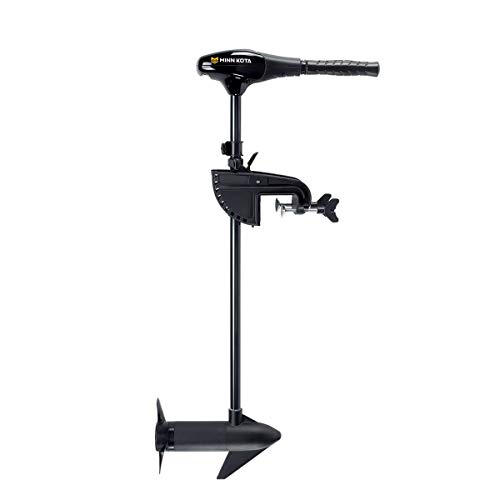
Minn Kota Endura C2 30 lb Transom-Mount Trolling Motor
30 lb thrust30 in shaftFreshwaterTelescoping tiller
Check price on Amazon
Best for: Small freshwater boats that need a simple, proven motor.

The Endura C2 is the simplest and best-known transom motor: 30 pounds of thrust, a 30 inch shaft, a 6 inch telescoping tiller and a 10-position lever lock bracket that lets you adjust and secure the motor quickly. A Power Prop designed for heavy vegetation is part of the package, and the motor is rated for freshwater.

The thrust is the thing to judge honestly. A common rule is at least 2 pounds of thrust for every 100 pounds of fully loaded boat weight, which means 30 pounds suits a boat and load up to roughly 1,500 pounds, such as a small jon boat, a canoe or a small skiff with one or two anglers. Against the Newport motors in this guide, the Endura C2 is freshwater-only and has fewer speeds, but it carries a manufacturer's long support record.

The lever lock bracket is a quiet convenience, since you can tilt and lock the motor without tools. Rinse the unit after use, check the prop for fishing line, and store the motor out of the sun. Use a deep cycle battery, and connect it with heavy-gauge cable, because a thin cable drops voltage and robs thrust. A 30 pound motor draws a modest current, so a single group 27 deep cycle battery gives a full day of slow trolling, and a fuse or breaker near the battery is a worthwhile safety addition for any installation.

What works

  • 10-position lever lock bracket
  • Power Prop sheds vegetation
  • Telescoping tiller for comfortable control
  • Long record of support and parts

Watch out for

  • Freshwater rating only
  • 30 lb thrust limits boat size
  • Fewer speeds than the Newport motors

Spec sheet

Thrust
30 pounds
Shaft
30 inch
Mount
Transom, 10-position lever lock bracket
Control
6-inch telescoping tiller
Water
Freshwater
02
Newport NV-Series 55 lb Saltwater Transom Trolling Motor, 12V
55 lb thrust12V30 in shaft8 speeds
Check price on Amazon
Best for: Small saltwater boats and skiffs on a single 12 volt battery.

Newport's NV 55 delivers 55 pounds of thrust from a 12 volt battery, has a 30 inch shaft, a 5 LED battery meter, a 6 inch telescoping tiller and a 3-blade propeller. It offers eight speeds, five forward and three reverse, and is rated for saltwater.

The corrosion-resistant build is the notable feature. Saltwater destroys a freshwater motor within a few seasons, so a saltwater rating matters if you fish brackish or coastal water. The 55 pounds is also the upper end of what a 12 volt system can deliver, as typical guides stop at about 55 pounds for 12 volts. A 3-blade prop gives extra bite for heavier boats.

The battery meter takes the guesswork out of runtime. Keep the motor rinsed with fresh water, grease the tilt hardware and check the prop for line. Because it runs on a single 12 volt battery, you can power a jon boat or a small skiff without the weight of two batteries, which is the sweet spot for this thrust class.

What works

  • 55 lb thrust on 12 volts
  • Saltwater-rated construction
  • 5 LED battery meter
  • Eight speeds with a 3-blade prop

Watch out for

  • 30 inch shaft is short for tall bows
  • Less brand history than Minn Kota
  • 12 volt limits runtime at full speed

Spec sheet

Thrust
55 pounds
Voltage
12 volt
Shaft
30 inch
Speeds
8, five forward and three reverse
Extras
5 LED battery meter, 3-blade prop
03
Newport NV-Series 62 lb Saltwater Transom Trolling Motor, 12V
62 lb thrust12VSaltwater3-blade prop
Check price on Amazon
Best for: Jon boats and heavier boats on a 12 volt system.

The NV 62 is the high-output 12 volt motor in the lineup, listed at 62 pounds of thrust with a large 3-blade propeller for maximum push and control. It is saltwater-rated and aimed at jon boats and larger fishing boats.

It is the push you pay for. The 2 pounds per 100 pounds rule puts 62 pounds of thrust at a loaded boat weight near 3,000 pounds, which covers a 14 to 16 foot jon boat with two anglers and gear, and leaves a margin for wind. A bigger prop moves more water at low speed, which suits dragging a loaded boat across a lake. Against the 55 pound model, it gives more thrust for heavier boats on the same 12 volt platform.

The trade-off is battery draw. More thrust pulls more current, so runtime at high speed is shorter, and some guides move to 24 volts above this class. Use a large deep cycle or lithium battery and heavy cable, and keep the connections clean. Rinse after saltwater use and check the shaft and bracket for wear.

What works

  • 62 lb thrust on 12 volts
  • Large 3-blade prop for push and control
  • Saltwater-rated
  • Suited to jon boats and larger craft

Watch out for

  • High current draw shortens runtime
  • Needs a strong battery and heavy cable
  • Newer brand than the market leader

Spec sheet

Thrust
62 pounds
Voltage
12 volt
Use
Jon boats and larger fishing boats
Prop
Large 3-blade
Water
Saltwater-rated
04
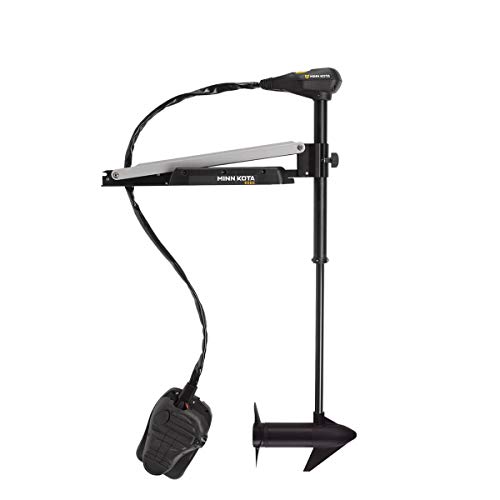
Minn Kota Edge 45 lb Bow-Mount Trolling Motor, Foot Pedal
45 lb thrust36 in shaftFoot pedalFreshwater
Check price on Amazon
Best for: Anglers who want hands-free steering from a bow mount.

The Edge is a bow-mount motor with a heel-toe, cable-steer foot pedal that includes speed control and momentary and constant-on switches, 45 pounds of thrust and a 36 inch shaft. A latch and door bracket secures the motor when stowed, and a built-in directional indicator shows which way the motor points.

A foot pedal frees both hands for fishing, which is why bow mounts are the standard for serious anglers. Cable steering is simple and tough, with no electronics to fail, and the heel-toe action steers by rocking the foot. A 36 inch shaft suits a bow that is not too high above the water, so check your bow height before ordering.

Against the Endura C2, the Edge costs more and installs on the bow rather than the transom, which gives you better boat control and lets the motor pull the boat instead of push it. Deploy and stow it carefully, lubricate the cables per the manual and rinse the unit after use. Pair it with a 12 volt battery and heavy cable. The foot pedal needs a flat, uncluttered deck in front of you, so plan the layout before you drill, and keep the cable lubricated so steering stays smooth. Practice with it in open water before a tournament, because the heel-toe motion takes an hour or two to learn.

What works

  • Cable-steer foot pedal frees both hands
  • 45 lb thrust with a 36 inch shaft
  • Latch and door bracket for secure stowing
  • Built-in directional indicator

Watch out for

  • Bow mount needs a clear deck and installation
  • 36 inch shaft is short for tall bows
  • Freshwater rating only

Spec sheet

Thrust
45 pounds
Shaft
36 inch
Mount
Bow, with latch and door bracket
Control
Heel-toe cable-steer foot pedal
Indicator
Built-in directional indicator
05
Minn Kota PowerDrive 55 lb Bow-Mount With GPS, 54 In. Shaft
55 lb thrust54 in shaftGPS Spot-LockDeploy-Assist
Check price on Amazon
Best for: Anglers who want to hold position hands-free with GPS.

The PowerDrive combines 55 pounds of thrust with a 54 inch shaft and an advanced GPS system. Spot-Lock holds your precise position, and the system controls speed and steering from a remote. A Deploy-Assist lever lowers and raises the motor with a push, and the shaft is composite with a Power Prop.

Spot-Lock is the reason to buy it. The motor uses GPS to hold the boat in place against wind and current, which keeps you over a structure while you fish, and that feature used to belong to much costlier machines. The 54 inch shaft suits a higher bow and keeps the prop submerged in chop. The composite shaft resists bending if you hit an obstacle.

It is a bigger, more complex motor than the Edge, and costs more. Charge the battery fully, check the GPS signal before relying on Spot-Lock and keep the remote dry. For anglers who value holding a spot, it changes how a day on the water works. Spot-Lock does not replace an anchor in a strong current, and it uses battery to hold position.

What works

  • Spot-Lock GPS holds position
  • 54 inch shaft for taller bows and chop
  • Deploy-Assist lever eases stowing
  • Composite shaft resists bending

Watch out for

  • Costs more than basic motors
  • GPS needs a clear signal and care
  • Freshwater rating

Spec sheet

Thrust
55 pounds
Shaft
54 inch
GPS
Spot-Lock position hold
Deploy
Deploy-Assist lever
Build
Composite shaft, Power Prop
06
Minn Kota Riptide PowerDrive 70 lb Bow-Mount With Remote, 54 In.
70 lb thrust54 in shaftGPS Spot-LockMarine protection
Check price on Amazon
Best for: Saltwater anglers with larger boats who want GPS hold.

The Riptide PowerDrive is the flagship in this guide: 70 pounds of thrust, a 54 inch shaft, GPS Spot-Lock with a wireless remote, a Deploy-Assist lever and marine corrosion protection in which the lower unit housings are grit-blasted and coated in aluminum to prevent oxidation. It is built for saltwater.

The thrust matters on bigger boats. A 70 pound motor is the class where the common thrust-to-voltage breakdown moves to 24 volt systems, so expect to run two batteries and to check the listing for the exact requirement. At 2 pounds of thrust per 100 pounds of boat, 70 pounds covers a loaded boat of around 3,500 pounds, with margin for current.

Against the freshwater PowerDrive, the Riptide adds more thrust and saltwater protection, and costs more. Rinse the entire unit with fresh water after every saltwater trip, inspect the prop for line and keep the remote charged. Set up the battery bank with matched batteries and heavy-gauge cable. A marine charger that handles multiple batteries keeps the bank balanced, and a battery monitor takes guesswork out of runtime. Saltwater anglers should also coat terminals with a dielectric grease and check connections for green corrosion every month.

What works

  • 70 lb thrust for larger boats
  • Marine corrosion protection on the lower unit
  • GPS Spot-Lock with a wireless remote
  • 54 inch shaft

Watch out for

  • Higher voltage and battery cost
  • Costs the most in this guide
  • Needs rinsing after every saltwater trip

Spec sheet

Thrust
70 pounds
Shaft
54 inch
GPS
Spot-Lock position hold
Control
Wireless remote
Protection
Grit-blasted, aluminum-coated lower unit

Spec sheet decoder

What the numbers on the box really mean

The specs manufacturers lead with, translated into what they tell you about real-world performance.

Thrust in pounds

The pushing force of the motor, which decides how much boat it can move.

Watch forThe Endura C2 lists 30, the NV 55, the NV 62, the Riptide 70.

Voltage

Battery system voltage, with higher voltage drawing fewer amps for the same power.

Watch forThe NV models list 12 volts.

Shaft length

The length from mount to motor head, which keeps the prop submerged.

Watch forThe Edge is 36 inches, the PowerDrive 54.

Spot-Lock

A GPS feature that holds the boat in place.

Watch forThe PowerDrive and Riptide list it.

Saltwater rating

Corrosion protection for use in salt or brackish water.

Watch forThe Newport NV models and the Riptide have it.

Methodology

How We Evaluated These Trolling Motors

Thrust fit

We matched thrust to boat weight using the 2 pounds per 100 pounds rule.

Voltage and battery load

We compared voltage requirements and current draw.

Shaft and mount

We compared shaft lengths and mount styles.

Corrosion protection

We credited saltwater ratings and marine coatings.

Controls

We looked at tillers, pedals, remotes and GPS.

Decision guide

How to Choose the Right Trolling Motors

By Boat Type

SituationPickWhy
Canoe or small jon boat, freshwaterMinn Kota Endura C230 lb thrust and simple transom mount
Skiff in saltwaterNewport NV 5555 lb saltwater-rated
Heavier jon boatNewport NV 6262 lb on 12 volts
Bass boat with a clear bowMinn Kota Edge 45 lbFoot pedal control

By Budget

TierPickWhy
LowestMinn Kota Endura C2Simple transom motor
Low-midNewport NV 55Saltwater-rated 55 lb
MidMinn Kota Edge 45 lbBow mount with foot pedal
HigherMinn Kota PowerDrive GPSSpot-Lock

Transom Mount vs Bow Mount

Transom mount

The Endura C2 and Newport NV motors clamp to the stern, install in minutes and suit small boats.

Bow mount

The Edge, PowerDrive and Riptide pull the boat from the bow with foot or remote control, which gives better handling and hands-free fishing.

Pick a transom motor for simplicity and small boats; pick a bow mount for control and serious fishing.

By Water Type

SituationPickWhy
Freshwater lakesMinn Kota Endura C2Freshwater-rated
Brackish waterNewport NV 55Saltwater-rated
Saltwater and larger boatMinn Kota Riptide 70 lbMarine protection
Freshwater with GPSMinn Kota PowerDrive GPSSpot-Lock

For Holding Position Specifically

Look for

GPS Spot-Lock, a long shaft and enough thrust for wind. A remote or pedal that lets you adjust quickly.

In this comparison

The PowerDrive and Riptide hold position with GPS, and the Riptide adds saltwater protection.

When to Spend More

Spend more if

You fish structure or need to hold a spot, where GPS and a bow mount pay off.

Save if

You troll slowly in a small boat. An Endura C2 is enough.

Ownership

Maintenance schedule

The upkeep that decides whether this machine lasts two seasons or ten.

TaskIntervalWhy it matters
Rinse with fresh waterAfter each use in salt or brackish waterSalt corrodes metal and electrical connections. A rinse extends life.
Check the prop for lineEvery tripFishing line wraps behind the prop and damages seals.
Inspect battery cables and terminalsMonthlyCorroded terminals and thin cable cause voltage drop.
Lubricate steering cables and pivotsEach seasonDry cables bind and wear.
Charge the battery fullyAfter each tripDeep cycle batteries last longer when kept charged.

FAQ

Frequently Asked Questions

How much thrust do I need?

At least 2 pounds of thrust per 100 pounds of loaded boat weight, counting the boat, motor, batteries, people and gear. Add margin if you fish in wind or current, because the rule is a minimum for calm water. A motor with extra thrust costs only a little more battery, since you can run it at low speed and save current.

How many batteries do I need?

One for 12 volt motors, two wired in series for 24 volt motors and three for 36 volt systems. Check the listing for the voltage of the exact model, since similar-looking motors differ. Use matched deep cycle or lithium batteries of the same age and capacity, and wire them with heavy-gauge cable and clean, tight connections.

What shaft length do I need?

Measure from the mounting point to the waterline and add enough to keep the prop at least 12 inches under the surface, since a prop near the surface churns air and loses thrust. Choose the longer shaft if you fall between sizes, because a shaft that is too short cavitates in waves, while a slightly long one only costs a little leverage.

Can I use a freshwater motor in salt?

It will corrode quickly, because salt attacks the metal housing, the electrical connections and the seals. Choose a saltwater-rated motor for coastal water, and rinse any motor with fresh water after every trip, including the cables and the bracket. Dry the unit and store it out of the sun.

Transom or bow mount?

A transom mount is simpler, quicker to install and fine for small boats, but it pushes the boat and you steer by hand. A bow mount pulls the boat, handles wind better and lets you steer with a foot pedal or remote so your hands stay free to fish. Bow mounts need a clear deck and a solid mounting area.

How long will the battery last?

It depends on thrust, speed and battery capacity, and the answer ranges from an hour at full power to a full day at low speed. Current draw rises sharply with speed, so running at half speed can more than double runtime. A battery meter, such as the LED meter on the Newport motors, helps you avoid running flat.

Bottom line

The short version

Browse more trolling motorson Amazon →
James Miller, Lead Machine Editor

About the author

James Miller

Lead Machine Editor, MachineFanatic

James Miller leads MachineFanatic's buying guides, turning spec sheets, manuals and owner feedback into clear verdicts on power tools, outdoor power equipment, shop machines and kitchen machines.

More from James →

Keep reading

Related guides