
Amazon affiliate links - we earn a commission.Affiliate disclosure

Buying guide · 13 min read · Updated 2026-11-07

Best UV Water Purifiers (2026)

Six UV water purifiers compared: four pen-style travel units and two whole-house systems, with notes on clear-water limits, lamp life and flow rate.

James MillerBy James MillerLead Machine Editor6 machines comparedSpec-sheet verified
Best UV Water Purifiers

At a glance

Our top picks

Side by side

Spec comparison

Ultraviolet purifiers disinfect water with light instead of chemicals. They come in two very different forms: a pen that treats a bottle at a time, and a chamber plumbed into the supply line of a house.

Both share the same strengths and the same blind spots. UV neutralizes bacteria, viruses and protozoa, leaves no taste and adds nothing to the water, yet it removes nothing and it needs clear water to work. This guide sorts six units by use, and it spells out where each one fails.

Before you buy

6 Criteria to Look For Before Buying an UV Water Purifier

  1. 01

    What UV does and does not do

    UV-C light damages the DNA of bacteria, viruses and protozoa so they cannot reproduce. It does not remove chemicals, metals, salt, sediment or taste. A unit that makes biological water safe can still leave lead or pesticides untouched. Match the technology to the hazard you actually face, and test well water before you decide. A lab test for coliform bacteria, nitrates and metals costs little next to the equipment. Retest every year, and again after flooding or repairs to the well.

  2. 02

    Clear water requirement

    UV light must reach the microbes, and cloudy or tea-colored water shades them. The pens list clear water, and whole-house units sit after a sediment filter and often a carbon filter. A pen used on silty water can leave live organisms. Pre-filter turbid water through a cloth or filter first. Let sediment settle and pour off the clear top layer when you can. If the water still looks hazy, treat it with a different method or find another source.

  3. 03

    Pen versus whole house

    The four SteriPens treat one bottle at a time at about 90 seconds a liter and weigh a few ounces. The iSpring units treat all the water in a house at up to 12 gallons per minute. They share the same physics but are built for different jobs. Buy a pen for travel and a chamber for a well. A pen cannot protect a kitchen tap, and a chamber cannot go in a pack. Some households own both, using the chamber at home and the pen on trips.

  4. 04

    Lamp life and replacement

    The pens list lamps rated for 8,000 treatments, which a traveler will rarely exhaust, but a dead lamp gives little warning without an indicator. Mercury lamps in plumbed units need replacement about yearly. The LED unit claims up to 11 years. Mark the replacement date on a calendar. A lamp that still glows may have lost much of its UV output, so do not judge by light alone. Keep a spare lamp on the shelf if the supply is remote.

  5. 05

    Power and batteries

    The Ultra and Ultralight charge over USB, the Classic 3 uses four AA cells with about 25 alkaline or 150 lithium treatments, and the Adventurer Opti uses two CR123 cells. Plumbed units need mains power, and a power cut stops disinfection. Pick the power source that suits your trip or your supply. Cold weather drains batteries quickly, so keep the pen warm in a pocket. A small power bank and a USB lead add little weight.

  6. 06

    Flow rate and sizing

    Dose depends on flow and contact time. The iSpring units list up to 12 gallons per minute, and a house that demands more at peak will under-dose. Size to the largest simultaneous demand. Flow sensors and shutoff delays protect against low-dose water. A unit with no flow control relies on you to keep demand within its rating. Check the fixtures that run together, such as a shower and a washing machine.

Detailed reviews

The 6 best uv water purifiers, explained

01
SteriPen Ultra USB rechargeable UV water purifier with OLED display
8,000 L lampUSB rechargeableOLED display90 sec per liter
Check price on Amazon
Best for: Hikers and travelers who want proof of each treatment and USB charging.

The SteriPen Ultra is the pen that tells you what it is doing. A high-contrast OLED display shows each treatment automatically and tracks use, which matters because a pen gives no other proof that the lamp is still working. It uses UV-C light to purify clear drinking water, and the lamp is rated for up to 8,000 liters.

An internal rechargeable battery charges over USB, so it suits solar chargers and power banks on a trip. A pen treats a liter in roughly 90 seconds, and you stir or swirl the bottle so all the water passes the lamp. Compared with the Ultralight, you gain the display and give up a little weight.

The limit is clarity. UV needs clear water, so silty or tea-colored water must be filtered through a cloth or filter first, and the pen removes no chemicals, metals or taste. Keep it charged, carry a backup method and never look at the lamp while it runs. It suits hikers, travelers and emergency kits.

What works

  • OLED display tracks each treatment
  • USB rechargeable for off-grid trips
  • Lamp rated for up to 8,000 liters
  • Treats a liter in about 90 seconds

Watch out for

  • Needs clear water or a pre-filter
  • Removes no chemicals or metals
  • Dead battery means no treatment

Spec sheet

Lamp life
Up to 8,000 liters
Power
USB rechargeable internal battery
Display
High-contrast OLED
Treatment
UV-C, clear water
Use
Hiking, travel and emergency
02
SteriPen Ultralight USB rechargeable UV water purifier, 3 oz
3 ozWater-activatedUSB rechargeable90 sec per liter
Check price on Amazon
Best for: Ultralight backpackers who count ounces and want automatic start and stop.

At 3 ounces, the Ultralight is the smallest pen in the group. It activates on contact with water and stops automatically, so there is no button to forget and no lamp running in the air. A UV-C lamp rated for 8,000 treatments purifies clear water in about 90 seconds a liter.

Water activation is a real convenience, because pressing a button at the wrong time is a common way to under-treat water. USB charging suits trips with a small solar panel. There is no display listed, so you rely on the lamp indicator and your own count of treatments.

Compared with the Ultra, it is lighter and simpler and gives less feedback. Stir the bottle, hold the pen steady and wait for the signal. It suits ultralight backpackers who count ounces.

What works

  • 3 oz pen-style body
  • Water-activated with automatic stop
  • USB rechargeable
  • 8,000-treatment lamp

Watch out for

  • No full display for treatment tracking
  • Needs clear water
  • Removes no chemicals

Spec sheet

Weight
3 oz
Activation
Water-activated, stops automatically
Power
USB rechargeable
Lamp life
8,000 treatments
Treatment
1 L in about 90 seconds
03
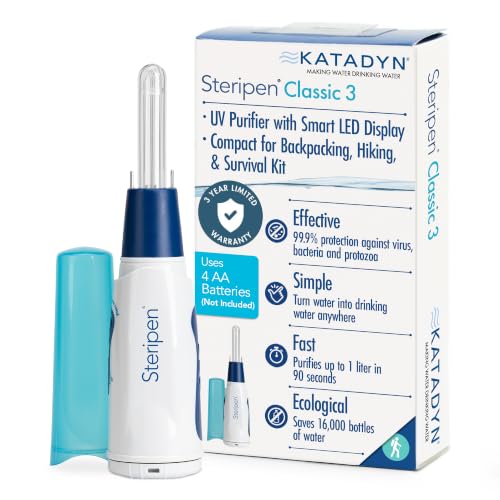
SteriPen Classic 3 AA-powered UV water purifier with LED indicator panel
AA powered8,000 treatmentsLED panel90 sec per liter
Check price on Amazon
Best for: Remote travel where replaceable AA cells beat a rechargeable battery.

The Classic 3 runs on four AA batteries, which can be bought almost anywhere. The listing quotes about 25 treatments on alkaline cells and about 150 on lithium, so the cell type changes how long a trip lasts. An LED indicator panel shows treatment size, battery level and lamp life remaining.

AA power is the reason to choose it for remote travel, since you can swap cells instead of finding a charger. The lamp is rated for 8,000 treatments and purifies a liter in about 90 seconds. The unit is larger than the rechargeable pens.

Compared with the Ultra, it trades USB charging for easy cell swaps. Carry spare lithium cells for long trips and keep a few in a warm pocket in the cold. It suits expeditions and regions where chargers are scarce.

What works

  • AA batteries are available almost anywhere
  • About 150 treatments on lithium cells
  • LED panel shows battery and lamp life
  • 8,000-treatment lamp

Watch out for

  • Larger and heavier than rechargeable pens
  • About 25 treatments on alkaline cells
  • Needs clear water

Spec sheet

Power
4 AA batteries
Treatments
25 alkaline, 150 lithium
Lamp life
8,000 treatments
Panel
LED treatment size, battery and lamp life
Treatment
1 L in 90 seconds
04
SteriPen Adventurer Opti CR123-powered UV water purifier with optical sensor
CR123Optical sensorIncluded batteries90 sec per liter
Check price on Amazon
Best for: Emergency kits that sit unused and need long-storing lithium cells.

The Adventurer Opti is powered by two CR123 lithium batteries that are included. An optical sensor detects when the lamp is submerged and starts the cycle, so you do not press a button. The listing targets backpacking and emergency kits.

CR123 lithium cells keep their charge for years in storage, which makes this pen a good fit for a go-bag that sits in a closet. They are widely available for travel. Treatment time is about 90 seconds a liter, with the usual need to stir.

Compared with the Classic 3, it uses fewer, more compact cells and starts automatically. Replace the cells on a schedule rather than waiting for a failure. It suits emergency kits and light travel.

What works

  • CR123 lithium cells included
  • Optical sensor starts automatically
  • Cells store well in a go-bag
  • Compact pen design

Watch out for

  • CR123 cells cost more than AAs
  • Needs clear water
  • Removes no chemicals

Spec sheet

Power
2 CR123 lithium batteries included
Sensor
Optical, detects submersion
Use
Backpacking and emergency kits
Treatment
Clear water in about 90 seconds a liter
Shelf life
Lithium cells store well
05
iSpring UVF55FS whole house UV water purifier, 55W, 12 GPM, 1 in ports
55W12 GPM1 in MNPTStainless
Check price on Amazon
Best for: Private wells that need a plumbed, chemical-free bacteria barrier.

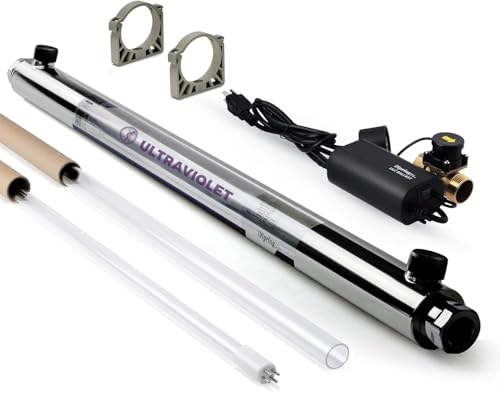
The UVF55FS is a plumbed UV chamber for an entire house. A 55 watt lamp treats water as it passes at up to 12 gallons per minute, and 1 inch ports match common supply lines. It is the unit to choose for a private well, where a bacteria barrier matters.

UV works only when the water is clear and the contact time is long enough. That means a sediment filter ahead of it, and a flow rate that stays under the rated limit. If the house demands more than the unit's rating at peak, the dose falls, so size it to your fixtures, not your average use.

The lamp is a mercury type that normally needs replacing about once a year, and the quartz sleeve fouls with scale. Hard water needs a softener ahead of the unit. A power cut stops disinfection, so a shutoff or alarm is a useful safety. It suits well owners who want a chemical-free barrier.

What works

  • 12 GPM suits a typical house
  • 55W lamp with 1 in ports
  • No chemicals or taste change
  • Stainless chamber

Watch out for

  • Needs a sediment pre-filter
  • Lamp replacement about yearly
  • Removes no chemicals or metals

Spec sheet

Lamp power
55W
Flow rate
Up to 12 GPM
Ports
1 in MNPT inlet and outlet
Role
Whole-house bacteria barrier
Install
After a sediment filter
06
iSpring UVF20 whole house LED UV water filter, 3/4 in ports, 12 GPM
LED lamp12 GPM3/4 in MNPTMercury-free
Check price on Amazon
Best for: Owners who want to avoid yearly lamp changes and mercury lamps.

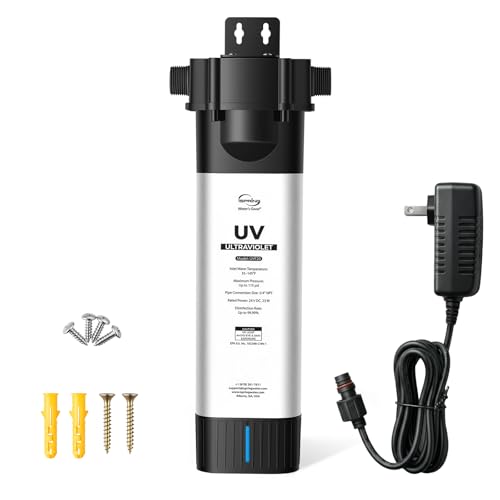
The UVF20 uses an LED lamp in place of a mercury lamp, and the maker claims up to 11 years of life. That removes the yearly lamp change that is the main upkeep of a conventional unit. The ports are 3/4 inch, and the flow rating is up to 12 gallons per minute.

A mercury-free design also avoids a hazardous-waste step at disposal. LED UV is a newer technology, so a long track record is not yet available, and the claimed life is a manufacturer figure. The usual rules still apply: clear water, a pre-filter and a flow rate within the rating.

Compared with the UVF55FS, it has smaller ports and a longer claimed lamp life. Check that 3/4 inch plumbing suits your main line. It suits owners who dislike annual lamp swaps.

What works

  • LED lamp is mercury-free
  • Claimed life up to 11 years
  • 12 GPM flow rating
  • No yearly lamp change

Watch out for

  • Long-term track record is short
  • 3/4 in ports may need adapters
  • Still needs a pre-filter

Spec sheet

Lamp
LED, mercury-free
Flow rate
Up to 12 GPM
Ports
3/4 in MNPT inlet and outlet
Lamp life
Up to 11 years claimed
Role
Whole-house disinfection

Spec sheet decoder

What the numbers on the box really mean

The specs manufacturers lead with, translated into what they tell you about real-world performance.

UV-C

Short-wave ultraviolet light that damages microbial DNA. It disinfects but removes nothing.

Watch forAll six units use it.

8,000 treatments

The rated life of the pen's lamp in treatments. It is long for a traveler.

Watch forThe Ultra, Ultralight and Classic 3 list it.

GPM

Gallons per minute of water the chamber can treat at its design dose. A higher rating suits a bigger house.

Watch forThe iSpring units list up to 12 GPM.

LED UV lamp

An LED source in place of a mercury lamp. It claims longer life and no mercury.

Watch forThe UVF20 lists it.

Water-activated

The pen starts when the lamp touches water and stops when it leaves. It prevents a lamp running in air.

Watch forThe Ultralight and Adventurer Opti list activation by water or an optical sensor.

Methodology

How We Evaluated These UV Water Purifiers

Class split

We grouped four pen-style purifiers and two whole-house chambers. A countertop reverse osmosis unit and several carbon systems that appeared in related searches were left out. UV had to be the disinfection method.

Feedback and safety

We looked at displays, indicators and sensors. The Ultra has an OLED display, the Classic 3 has an LED panel and the Opti has an optical sensor. Proof of treatment weighed heavily.

Power

We compared USB, AA, CR123 and mains power. The Classic 3 lists about 150 lithium treatments. Power suited to the use case scored higher.

Lamp life

We compared lamp ratings. The pens list 8,000 treatments, and the UVF20 claims up to 11 years. Replacement burden counted.

Ownership signals

Owner complaints keep returning to cloudy water, dead batteries and missed lamp changes as the common failures. Pre-filtering and a calendar reminder prevent most of them. We also noted that UV leaves no residual disinfectant in stored water. Treat water close to the time you drink it.

Decision guide

How to Choose the Right UV Water Purifiers

By Situation

SituationPickWhy
BackpackingSteriPen Ultralight3 oz and water-activated
Travel with proof of treatmentSteriPen UltraOLED display
Remote trips with no chargerSteriPen Classic 3AA cells
Emergency go-bagSteriPen Adventurer OptiCR123 cells store well
Private welliSpring UVF55FS12 GPM and 1 in ports

By Budget

TierPickWhy
LowestSteriPen Classic 3AA powered
Low to midSteriPen Adventurer OptiBatteries included
MidSteriPen UltralightLight and rechargeable
Upper midSteriPen UltraDisplay
HighestiSpring UVF55FSPlumbed chamber

Mercury vs LED Lamp

Mercury lamp

The UVF55FS uses a conventional lamp that needs yearly replacement. The technology is proven. Disposal needs care.

LED lamp

The UVF20 claims up to 11 years and no mercury. It avoids the yearly swap. The track record is shorter.

Pick mercury for a proven design. Pick LED to skip yearly swaps.

By Power Source

PreferencePickWhy
USB and solarSteriPen UltraRechargeable
Swappable cellsSteriPen Classic 3AA batteries
Long storageSteriPen Adventurer OptiCR123 lithium
Mains plumbediSpring UVF55FS55W lamp
Mains plumbed LEDiSpring UVF20LED lamp

For Well Water Specifically

Look for

Well water needs a sediment filter, a unit sized to peak flow, a lamp replacement plan and a yearly bacteria test. UV does not remove chemicals.

In this comparison

The iSpring UVF55FS suits a typical house at 12 GPM. The UVF20 suits owners who want fewer lamp changes.

When to Spend More

Spend more if

You depend on the unit daily or want proof of treatment. The Ultra and plumbed units earn their cost.

Save if

You travel occasionally. A simple pen covers clear water.

Ownership

Maintenance schedule

The upkeep that decides whether this machine lasts two seasons or ten.

TaskIntervalWhy it matters
Charge or replace batteriesBefore each tripA dead pen cannot treat water. Carry a spare or a backup method.
Check the lamp indicatorEach useA failed lamp gives little warning. Watch the indicator or display.
Replace the mercury lampAbout yearlyUV output fades with hours. Mark the date on a calendar.
Clean the quartz sleeveEvery few monthsScale and film block UV. Wipe it with mild acid cleaner as directed.
Replace the pre-filterAs directedA clogged filter reduces flow and clarity. Keep water clear for the lamp.

FAQ

Frequently Asked Questions

Does UV remove chemicals or lead?

No. UV disinfects bacteria, viruses and protozoa only. Chemicals, metals and salt need a filter or reverse osmosis. Test your water to know which you need. Many households pair UV with a carbon filter for taste and chemicals. Reverse osmosis handles dissolved salts and metals that neither can.

Can I use a UV pen on cloudy water?

Not directly. Cloudy water shades microbes from the light. Filter it through a cloth or filter first, then treat it.

How do I know the pen worked?

The Ultra shows each treatment on its display, and the Classic 3 shows lamp life on a panel. Others use an indicator. Never assume without a signal. Stir or swirl the bottle throughout the cycle so all the water passes the lamp. Keep the lamp fully submerged and avoid touching the sides of the bottle.

Do whole-house UV units need a filter?

Yes, a sediment filter ahead of them. Clear water lets the light reach microbes. Hard water may also need a softener to protect the sleeve.

How often do UV lamps need changing?

Mercury lamps typically need replacement about yearly. The LED unit claims up to 11 years. Pens list 8,000 treatments.

How long do UV purifiers last?

Expect several years, with lamps, batteries and sleeves as the wear points. Keep water clear and follow the lamp schedule. Store pens dry with the cap on and charge them every few months. Plumbed units should be drained and protected from freezing in an unheated space.

Bottom line

The short version

Browse more uv water purifierson Amazon →
James Miller, Lead Machine Editor

About the author

James Miller

Lead Machine Editor, MachineFanatic

James Miller leads MachineFanatic's buying guides, turning spec sheets, manuals and owner feedback into clear verdicts on power tools, outdoor power equipment, shop machines and kitchen machines.

More from James →

Keep reading

Related guides