
Amazon affiliate links - we earn a commission.Affiliate disclosure

Buying guide · 14 min read · Updated 2026-11-19

Best Variable Speed RV Water Pumps (2026)

Six variable speed RV and marine fresh water pumps compared on constant-pressure control, soft start, voltage, flow and whether you still need an accumulator.

James MillerBy James MillerLead Machine Editor6 machines comparedSpec-sheet verified
Best Variable Speed RV Water Pumps

At a glance

Our top picks

Side by side

Spec comparison

MachineModelFlowControlPressure
SEAFLO 56A Series 12V 5.0 GPM 70 PSI variable speed smart pumpBest OverallSEAFLO 56A Series 12V 5.0 GPM 70 PSI variable speed smart pumpSFDP1-050-070-56A5.0 GPMn/an/a
Remco Aquajet ARV variable speed RV water pumpBest Established DesignRemco Aquajet ARV variable speed RV water pumpn/an/aElectronic speed controln/a
Kitvance Smart RV 12V 5.5 GPM 70 PSI app-controlled pumpBest Smart FeaturesKitvance Smart RV 12V 5.5 GPM 70 PSI app-controlled pumpn/a5.5 GPM maximumSmartphone app on/off and schedules70 PSI maximum
Aquatec ARV/AES variable speed water pump 5.3 GPMBest for MotorhomesAquatec ARV/AES variable speed water pump 5.3 GPMn/a5.3 GPMVariable speedConstant-pressure control
Jabsco Sensor-Max II V50AJ 5 GPM variable speed freshwater pumpBest No-Accumulator DesignJabsco Sensor-Max II V50AJ 5 GPM variable speed freshwater pumpV50AJ-115N-3A5 GPM (19 LPM)Pressure sensing speed controln/a
IPW 5853-GE12 variable speed pump 1.0 GPM 60 PSI 115VBest Compact Variable SpeedIPW 5853-GE12 variable speed pump 1.0 GPM 60 PSI 115V5853-GE12-V81D1.0 GPMVariable speed60 PSI

A conventional RV pump is either on at full speed or off. A variable speed pump reads pressure and changes motor speed to match the demand, so a trickle at the tap gets a slow gentle pump and a full shower gets full power. The result is steady pressure without the thump of constant cycling.

That electronics-driven behavior costs more and adds parts to fail, so it is worth buying only when the benefits are real. This guide explains what variable speed actually changes, which pumps do it well and where a plain pump with an accumulator is the smarter spend.

Before you buy

6 Criteria to Look For Before Buying a Variable Speed RV Water Pump

  1. 01

    What variable speed really changes

    A variable speed pump slows the motor when demand is low and speeds it up when demand rises, so pressure stays steady and the pump does not start and stop. The SEAFLO 56A and Jabsco both describe this. Buyers sometimes expect higher peak flow, but the gain is smoothness and lower current spikes. A practical test is to open a faucet a crack: a conventional pump will thump on and off every few seconds, while a speed-controlled one hums at low revs and holds the stream. If you rarely use water in small amounts, that benefit shrinks.

  2. 02

    Need for an accumulator

    The Jabsco Sensor-Max II says it removes the need for an accumulator, and the SEAFLO 56A achieves a similar effect electronically. A conventional pump needs a tank to smooth cycling. If you already own an accumulator, a variable speed pump adds less value. Some makers still recommend a small tank to absorb hose expansion and thermal swings, so read the installation sheet before you remove one. Removing a working accumulator to save space is a poor trade if the pump later needs it.

  3. 03

    Voltage and power source

    Most RV onboard systems run 12V, while the IPW is a 115V unit and the Jabsco model number carries a 115 designation. Confirm voltage before you buy, because a mismatch means a return. The SEAFLO 56A and Kitvance are 12V.

  4. 04

    Peak current

    Soft start reduces the surge current of a conventional pump. The SEAFLO 56A states a 10 amp maximum draw at 5.0 GPM, which is modest. A smaller battery bank benefits from that more than a large one. Voltage sag at startup can trip low-voltage cut-outs on inverters and sensitive electronics, so a gentler start also protects the rest of the system. Wire the pump with cable sized for its maximum draw regardless, because soft start does not change what the motor needs at full power.

  5. 05

    Pressure ceiling

    A 70 PSI ceiling, as on the SEAFLO 56A and Kitvance, suits residential-style plumbing but can stress thin RV PEX. Check your fittings or use a regulator. Variable speed does not lower the top pressure, it only controls it.

  6. 06

    Electronics and serviceability

    More electronics means more to fail, and a controller can rarely be repaired in the field. A longer warranty such as the SEAFLO 56A's 4 years reduces the risk. Keep a spare conventional pump if you travel far from service. A basic diaphragm pump is cheap, stores easily and can be wired in as a temporary replacement in under an hour. That small insurance policy matters more for variable speed owners, since a failed controller leaves you without water while a plain pump can usually be rebuilt on the spot.

Detailed reviews

The 6 best variable speed rv water pumps, explained

01
SEAFLO 56A Series 12V 5.0 GPM 70 PSI variable speed smart pump
5.0 GPM70 PSIVariable speed4-yr warranty
Check price on Amazon
Best for: 12V rigs that want steady pressure and a long warranty without an accumulator.

The 56A Series uses intelligent electronics that adjust motor speed in real time to match water demand, aiming for stable, uninterrupted pressure. The listing gives a 5.0 GPM flow, a 70 PSI shut-off, a 10 amp maximum draw and a 6 ft self-priming lift, with a 4-year warranty from the maker.

The benefit shows up in the shower: when a second tap opens or the heater cycles, the pump ramps instead of surging. The electronics also soften the start, which reduces the current spike that a conventional diaphragm pump creates every time it starts.

The 70 PSI shut-off is above what thin RV plumbing likes, so confirm your fittings or use a regulator. The 10 amp ceiling is modest for this flow, which is a real selling point on a small battery bank. Keep the strainer clean, because a clogged inlet confuses a speed-controlled pump more than a plain one.

What works

  • Speed adjusts in real time to demand
  • 10A maximum draw is modest for 5.0 GPM
  • 4-year warranty stated
  • Soft start reduces current spikes

Watch out for

  • 70 PSI exceeds many RV plumbing limits
  • More electronics than a plain pump
  • 6 ft priming lift limits mounting height

Spec sheet

Model
SFDP1-050-070-56A
Flow
5.0 GPM
Shut-off
70 PSI
Max draw
10A
Self-priming
6 ft stated
02
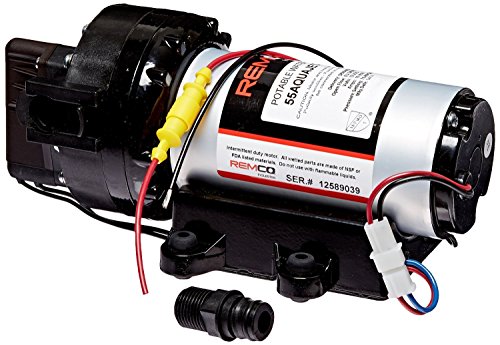
Remco Aquajet ARV variable speed RV water pump
Variable speedSoft start5-valve designARV series
Check price on Amazon
Best for: Owners who value a long-running variable speed design with soft start.

The Aquajet is the older name in this space and the listing leans on three ideas: electronics that automatically control the motor, a soft start that removes the rapid cycling, and a five-valve design that the maker says delivers more flow. It is aimed at RV systems where several fixtures run at once and pressure normally sags.

The listing does not publish a GPM or PSI figure in the text we reviewed, so confirm the specifications for your model before ordering. Compared with the SEAFLO 56A it has a longer history and a different valve layout, but less documented numbers.

For ownership, soft start is the most visible daily benefit because the pump stops thumping. Use a good strainer, mount it on rubber and read the manual for the pressure setting procedure, since variable speed pumps often have a set-up sequence that plain pumps do not.

What works

  • Soft start eliminates rapid cycling
  • Five-valve design aimed at higher flow
  • Electronics maintain pressure with several fixtures
  • Long history in RV use

Watch out for

  • Key specifications are not stated on the listing
  • More expensive than plain pumps
  • Setup is more involved than a demand pump

Spec sheet

Series
Aquajet ARV
Control
Electronic speed control
Start
Soft start
Valves
Exclusive 5-valve design
Aim
Overcome pressure drops with several fixtures
03
Kitvance Smart RV 12V 5.5 GPM 70 PSI app-controlled pump
5.5 GPM70 PSIApp control3 pressure levels
Check price on Amazon
Best for: Owners who want remote control and scheduling for a stored or seasonal rig.

This Kitvance pump adds a smartphone layer to the variable pressure idea. The listing describes remote on and off control, smart schedules and an intelligent pressure system that adjusts between three levels to hold stable flow. It delivers up to 5.5 GPM and 70 PSI.

App control is genuinely useful for a rig in storage: you can switch the pump off remotely or check its status without a trip to the basement. It is also the most complex pump in this guide, with more electronics and a wireless link that can fail or drop.

Compared with the SEAFLO 56A it offers a smarter interface but a shorter track record. Treat it as a convenience product, set the pressure to a level your plumbing can take, and keep a manual switch available as a backup.

What works

  • App on/off and schedules
  • Three automatic pressure levels
  • 5.5 GPM maximum flow
  • Self-priming demand design

Watch out for

  • Wireless link adds a failure point
  • 70 PSI maximum needs care with old plumbing
  • Newer product with limited history

Spec sheet

Flow
5.5 GPM maximum
Pressure
70 PSI maximum
Control
Smartphone app on/off and schedules
Pressure levels
Three automatic levels
Priming
Self-priming demand pump
04
Aquatec ARV/AES variable speed water pump 5.3 GPM
5.3 GPMVariable speedARV/AESMotorhome fit
Check price on Amazon
Best for: Motorhomes that want constant-pressure flow for two fixtures at once.

Aquatec is a name found on many motorhome and marine variable speed pumps, and this listing identifies the ARV/AES model at 5.3 GPM. The listing text is brief, so most of what we can say comes from the model type and the flow rating.

The point of an ARV/AES style pump is constant pressure across several fixtures with minimal cycling, and 5.3 GPM is enough for two showers or a tankless heater. Next to the SEAFLO 56A it offers slightly more flow, and compared with the Remco it comes from a different but equally established lineage.

Before buying, verify voltage, port style and mounting footprint against your current pump. Plan for a strainer upstream and a gentle pressure setting. Motorhome pump bays are often tight and warm, so leave airflow around the controller and avoid stacking items against it. If the unit uses a pressure setting screw or a button sequence, photograph the setup menu and keep the notes with your maintenance records so the next owner knows how it was tuned.

What works

  • 5.3 GPM suits two fixtures
  • Variable speed for steady pressure
  • Established motorhome pump family
  • Smooth pressure with minimal cycling

Watch out for

  • Listing gives few details
  • Must verify voltage and fittings
  • Premium cost

Spec sheet

Series
Aquatec ARV/AES
Flow
5.3 GPM
Control
Variable speed
Target
RV and motorhome systems
Pressure
Constant-pressure control
05
Jabsco Sensor-Max II V50AJ 5 GPM variable speed freshwater pump
5 GPMVariable speedNo accumulator needed5 outlets
Check price on Amazon
Best for: Systems with up to five outlets that want to skip the accumulator.

Jabsco's Sensor-Max II states that variable speed technology eliminates water hammer and pressure cycling and that advanced pressure sensing adjusts motor speed automatically, removing the need for an accumulator. It is rated at 5 GPM and can supply up to five outlets.

The model number carries a 115 designation, so confirm that you are ordering the voltage your rig needs before you buy, since most onboard RV systems are 12V. Set beside the SEAFLO 56A, it is a marine-heritage design with a strong reputation but a different power option.

Not needing an accumulator saves space, but you should still use a strainer and mount the pump on rubber. Read the installation sheet for the correct pressure setting and keep spare filter screens aboard.

What works

  • Eliminates the accumulator tank
  • Quiet, smooth delivery
  • Supports up to five outlets
  • Marine-grade lineage

Watch out for

  • Model suggests a 115V version, verify before ordering
  • Premium price class
  • Fewer RV-specific mounting guides

Spec sheet

Model
V50AJ-115N-3A
Flow
5 GPM (19 LPM)
Control
Pressure sensing speed control
Outlets
Up to 5
Accumulator
Not required
06
IPW 5853-GE12 variable speed pump 1.0 GPM 60 PSI 115V
1.0 GPM60 PSI115VVariable speed
Check price on Amazon
Best for: Low-flow AC systems such as a cabin sink or small bathroom.

IPW's variable speed pump is a compact 115 volt unit rated at 1.0 GPM and 60 PSI. At that flow it serves a sink or a small bathroom, not a family shower, and the listing provides only these basic figures.

Its value is as a low-flow, low-noise pump for stationary installs such as a cabin, a workshop or a tiny home on shore power. Compared with the SEAFLO 56A it moves a fifth of the water and runs on AC, which makes it a different tool for a different job.

Use it where flow is small and pressure should be steady. Add a strainer, mount it dry and confirm the circuit protection. Because it is a mains-powered pump, the wiring should be done to local code, with a ground-fault protected supply where water is nearby. Its steady low flow makes it quiet enough for a bedroom wall, and it pairs well with a small pressure tank if you want extra smoothing on a long pipe run.

What works

  • Steady pressure at low flow
  • 60 PSI is a sensible cut-off
  • Compact size
  • Variable speed control

Watch out for

  • 1.0 GPM is too little for a shower
  • AC power only
  • Few published details

Spec sheet

Model
5853-GE12-V81D
Flow
1.0 GPM
Pressure
60 PSI
Voltage
115V
Control
Variable speed

Spec sheet decoder

What the numbers on the box really mean

The specs manufacturers lead with, translated into what they tell you about real-world performance.

Variable speed

The motor speed changes with demand using a pressure sensor and a controller. It replaces on-off cycling with smooth modulation.

Watch forThe Jabsco and SEAFLO 56A describe it, the IPW only lists the term.

Soft start

The motor ramps up gradually instead of slamming on. It lowers the starting current and the thump.

Watch forThe Remco Aquajet lists soft start as a headline feature.

Max amp draw

The highest current the motor pulls at full load. It sets fuse and wire size.

Watch forThe SEAFLO 56A lists 10A.

Pressure levels

Preset pressure targets the controller chooses between. They tune shower feel and plumbing safety.

Watch forThe Kitvance lists three automatic levels.

Outlet count

How many fixtures the pump can serve at once without a pressure collapse. It reflects flow and control quality.

Watch forThe Jabsco lists up to five outlets.

Methodology

How We Evaluated These Variable Speed RV Water Pumps

Control quality

We read how each pump describes its speed control and soft start. The SEAFLO 56A and Jabsco give the clearest descriptions. Vague listings scored lower.

Current draw

We looked at stated amps. The SEAFLO 56A at 10A leads for 12V. Pumps that did not state it were scored cautiously.

Voltage clarity

We checked whether the voltage is obvious in the listing. The 115V IPW is clear, while the Jabsco model number needs checking.

Flow range

We compared 1.0, 5.0, 5.3 and 5.5 GPM ratings to typical RV use. Most RVs are comfortable at 5 GPM.

Support

We weighed warranty terms and brand history. SEAFLO states 4 years and Jabsco and Remco have long histories.

Decision guide

How to Choose the Right Variable Speed RV Water Pumps

By System

SituationPickWhy
12V rig, shower and heaterSEAFLO 56A Series5.0 GPM, 10A, 4-year warranty
Established design, soft startRemco AquajetSoft start, five valves
Remote controlKitvance SmartApp and schedules
Motorhome with two fixturesAquatec ARV/AES5.3 GPM
No accumulator, many outletsJabsco Sensor-Max IIUp to five outlets
Low-flow AC cabinIPW 58531.0 GPM at 60 PSI

By Budget

TierPickWhy
Lowest outlayIPW 5853Compact low-flow unit
Mid-rangeKitvance SmartFeatures at moderate cost
Upper-midSEAFLO 56A SeriesWarranty-backed
EstablishedRemco AquajetLong-running design
PremiumAquatec ARV/AESMotorhome grade
HighestJabsco Sensor-Max IINo accumulator needed

Variable speed vs pump plus accumulator

Variable speed

The SEAFLO 56A and Jabsco give steady pressure with no tank. They cost more and add electronics, but they save space and smooth every draw.

Pump plus accumulator

A plain pump with a tank is cheaper and easier to repair. It reduces cycling but cannot match the constant pressure of a variable speed design.

Choose variable speed if you value steady pressure and space; choose the accumulator route for simplicity and cost.

Voltage

PreferencePickWhy
12V DCSEAFLO 56A SeriesStated 12V
12V smartKitvance Smart12V with app
115V ACIPW 5853Stated 115V
Verify firstJabsco Sensor-Max IIModel number carries 115

For Several Fixtures at Once Specifically

Look for

A pump that holds pressure when a second or third tap opens, with enough flow headroom. Variable speed control matters most when demand changes quickly.

In this comparison

The Jabsco lists up to five outlets, the SEAFLO 56A handles a shower plus a sink, and the Aquatec offers 5.3 GPM. The IPW is too small for this job.

When to Spend More

Spend more if

You hate pump noise, want to skip the accumulator or run a tankless heater that dislikes pressure swings. The SEAFLO 56A is the best balance.

Save if

You camp occasionally. A conventional pump with a small accumulator gives most of the benefit.

Ownership

Maintenance schedule

The upkeep that decides whether this machine lasts two seasons or ten.

TaskIntervalWhy it matters
Clean the inlet strainerEvery 3 monthsA partly blocked inlet can confuse the controller, which may read the pressure drop as demand. Clean screens keep the control stable.
Check wiring and connectorsTwice a yearElectronics are sensitive to voltage drop and corrosion. A clean, tight connection prevents erratic behavior.
Verify pressure settingEach seasonControllers can drift or be reset after a power loss. Confirm the pressure with a gauge.
Protect from moistureEach seasonA damp bay can corrode controller contacts. Keep the pump area dry and ventilated.
Winterize with antifreezeBefore freezing weatherIce cracks the head and can damage controller parts. Run antifreeze through and drain the lines.

FAQ

Frequently Asked Questions

Is a variable speed pump worth it?

It is worth it if you dislike cycling noise, want steady pressure or run a tankless heater. It adds cost and electronics, so a conventional pump with an accumulator is the cheaper alternative.

Do I still need an accumulator?

Usually not. The Jabsco states that it removes the need, and the SEAFLO 56A smooths pressure electronically. Check the manual, since some installs still benefit from a small tank.

Do variable speed pumps use less power?

They reduce the starting surge and run slower at low demand, which can lower average current. A pump like the SEAFLO 56A states a 10A maximum. Real savings depend on how you use water. A household that runs many short draws sees the biggest gain, because a conventional pump pays the startup surge each time, whereas a long shower looks about the same for either design. Do not buy a variable speed pump purely to save power, since the bigger win is comfort and quiet.

Are they more reliable?

Soft starts reduce wear, but electronics add a failure point. A longer warranty, such as the 4 years on the SEAFLO 56A, helps. Carry a spare plan for remote trips.

Will a variable speed pump fit my plumbing?

Port styles and footprints vary, so check your current pump and the listing. Most use 1/2 inch ports. Voltage must also match.

Can I use a variable speed pump on 70 PSI plumbing?

Only if your fittings are rated for it. Many RV systems prefer 40 to 55 PSI, and a regulator or a lower setting solves the problem.

Bottom line

The short version

Browse more variable speed rv water pumpson Amazon →
James Miller, Lead Machine Editor

About the author

James Miller

Lead Machine Editor, MachineFanatic

James Miller leads MachineFanatic's buying guides, turning spec sheets, manuals and owner feedback into clear verdicts on power tools, outdoor power equipment, shop machines and kitchen machines.

More from James →

Keep reading

Related guides