
Amazon affiliate links - we earn a commission.Affiliate disclosure

Buying guide · 13 min read · Updated 2026-11-28

Best Vertical Log Splitters (2026)

Six gas log splitters that split vertically as well as horizontally, compared on tonnage, engine, log capacity and towing for heavy and oversized rounds.

James MillerBy James MillerLead Machine Editor6 machines comparedSpec-sheet verified
Best Vertical Log Splitters

At a glance

Our top picks

Side by side

Spec comparison

A vertical log splitter stands the round on end and lowers a wedge onto it, or drives the beam upright so the log rests on the ground. The advantage is simple: you do not lift a heavy round onto a beam. You roll it into place, split it and move on, which protects your back on large rounds.

Most machines sold for this job are dual-orientation units that work horizontally for small logs and vertically for heavy ones. This guide explains how to choose between them, what the tonnage and engine numbers actually mean and ranks six machines by who they suit.

Before you buy

6 Criteria to Look For Before Buying a Vertical Log Splitter

  1. 01

    Why vertical matters

    Vertical splitting lets you roll a heavy round into place and split it where it stands, which avoids lifting 100 pound or heavier pieces onto a beam. For small rounds, horizontal is faster, and most dual-orientation machines let you switch. A common mistake is buying a vertical-only machine for small logs, where a horizontal splitter is quicker. The real benefit shows up with rounds over about 18 inches across, which can weigh well over 100 pounds when green. Rolling such a piece onto the ground beneath the wedge takes seconds and leaves your spine alone, while a horizontal machine would need a log lift or a second person to raise it.

  2. 02

    Tonnage and wood type

    Tonnage is hydraulic force and matters most with knotty, green or oversized rounds. A 20 ton Full Boar handles seasoned wood, a 27 to 33 ton machine handles mixed hardwood and a 37 ton SuperHandy deals with the heaviest rounds. Do not buy more tonnage than your wood requires, because larger cylinders cycle slower. A good rule is to size for the toughest rounds you split every season, not the rare monster, since an oversized machine costs more to buy, burns more fuel and takes longer to move a ram through easy wood. If one or two huge rounds a year are the only problem, a splitting maul and wedges are cheaper than extra tonnage.

  3. 03

    Engine size and start

    The engine drives the pump, so displacement sets how well the machine holds speed under load. The 389cc SuperHandy has the most reserve, while the 209cc engines in the BILT HARD 27 and the Full Boar 20 work harder. Recoil start on a large engine is hard work, so check whether an electric start is offered. Also confirm that the engine has a low-oil shutdown, because a hydraulic pump keeps the engine under steady load for long periods and a splitter run low on oil on a hot afternoon is one of the quickest ways to destroy a small engine.

  4. 04

    Cycle time

    Cycle time is the total time for the ram to go out and return. The Full Boar 33 quotes 14.3 seconds, slower than smaller machines, because the cylinder is bigger. Faster is not always better: a two-stage pump runs fast when load is light and shifts to high force when needed.

  5. 05

    Log capacity

    The SuperHandy models list logs up to 24 inches in diameter and 24 inches in length, which is larger than typical small splitters. Check both stroke length and maximum diameter, because a machine that splits tall rounds but not long ones is not as flexible as it looks. Think about the awkward cases too, such as forked rounds, burls and pieces with a bowed end, because those are the ones that tip over on the beam and force you to wrestle them into position. A machine with a wide base and a stable vertical stance deals with these better than one that relies on you to steady the log.

  6. 06

    Towing and mobility

    The BILT HARD 30 ton and 27 ton have DOT tires and a 2 inch ball hitch for towing. A large machine is difficult to push by hand across soft ground. Check tire pressure, safety chains and local rules before towing on a public road. Even if the machine is only moved around your own land, tires age and flat-spot when left sitting under load, so inflate them before each season and use a jack stand or blocks if the machine will sit idle for months.

Detailed reviews

The 6 best vertical log splitters, explained

01
BILT HARD 30-Ton Full Beam Horizontal Vertical Gas Log Splitter 223cc
30 ton223cc 7.5HPVertical and horizontal16 in DOT tires
Check price on Amazon
Best for: Owners who split large rounds regularly and want one machine that handles all sizes.

The BILT HARD 30 ton uses a 7.5HP, 223cc OHV engine to drive a 30 ton hydraulic system on a full beam frame. It converts between horizontal and vertical modes, so you can split small logs at waist height or tip the beam upright to handle large rounds without lifting. Sixteen inch DOT-certified tires make it simple to move around a property or tow behind a vehicle.

The tradeoff is weight and cycle speed. A 30 ton full-beam unit is heavy, so it is not a machine to push by hand across soft ground, and the larger cylinder takes longer to cycle than a 20 ton unit. Compared with the 35 ton BILT HARD it gives up five tons of force for a lighter and cheaper frame, and compared with the 27 ton towable it adds three tons and a larger engine.

Ownership centers on hydraulic care. Check fluid before every season, change the engine oil, grease the beam and keep the wedge clean of sap. Vertical use needs a stable surface, so set it on level ground and chock the tires before every split.

What works

  • 30 ton force handles most hardwood
  • Vertical mode saves lifting heavy rounds
  • DOT tires allow towing
  • 223cc OHV engine is easy to service

Watch out for

  • Heavy and hard to push by hand
  • Slower cycle than lighter units
  • Needs level ground for vertical splitting

Spec sheet

Splitting force
30 tons
Engine
223cc OHV, 7.5HP
Orientation
Horizontal or vertical
Tires
16 inch DOT
Frame
Full beam
02
Full Boar 33-Ton Gas Log Splitter 223cc 49-State
33 ton223cc OHV14.3 sec cycleAuto-return
Check price on Amazon
Best for: Owners with large or knotty rounds who want strong force and an easy return.

The Full Boar 33 ton runs a 223cc OHV engine and quotes a 14.3 second cycle, with an auto-return control valve and an adjustable detent that lets the ram retract without you holding the lever. That combination makes repeated splitting less tiring and more consistent over a long session. Thirty-three tons gives headroom for knotty, green or oversized rounds.

The tradeoff is cycle time. A 14.3 second cycle is slower than the 10.9 seconds of the Full Boar 28 ton, which is the price of the larger cylinder. Next to the BILT HARD 30 ton it adds three tons and a faster auto-return behavior but lacks the heavy DOT-tire pitch.

Ownership is routine: check hydraulic fluid and engine oil, grease the beam, keep the wedge clean and store the machine with fresh or stabilized fuel. Set the detent so the ram stops just short of the end of the stroke to reduce stress.

What works

  • 33 tons for tough rounds
  • Auto-return valve with adjustable detent
  • 223cc OHV engine
  • Horizontal and vertical modes

Watch out for

  • 14.3 second cycle is slow for easy wood
  • Heavy to move by hand
  • Costs more than 20 to 28 ton units

Spec sheet

Splitting force
33 tons
Engine
223cc OHV
Cycle time
14.3 seconds
Return
Auto-return with detent
Orientation
Horizontal and vertical
03
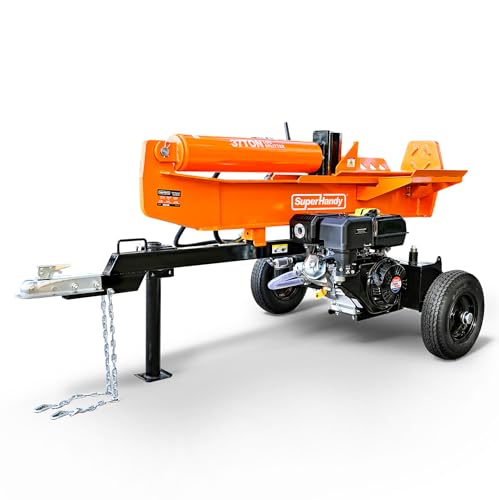
SuperHandy 37-Ton 389cc Full Beam Gas Log Splitter Vertical Horizontal
37 ton389cc engine24 in logsRecoil start
Check price on Amazon
Best for: Landowners splitting oversized green rounds.

The SuperHandy 37 ton is the strongest machine in this lineup, with a 389cc recoil-start engine and a 37 ton rating on a full beam frame. It is built for logs up to 24 inches in diameter and 24 inches long, which covers rounds that would be too large for most homeowner machines.

The tradeoff is size, weight and fuel use. A 389cc engine and a large cylinder make it heavy and thirsty, and it is overkill for anyone who mostly splits 10 to 12 inch rounds. Against the 35 ton BILT HARD it adds two tons and a bigger engine at the cost of simplicity.

Expect more upkeep than a small machine: engine oil, air filter, hydraulic fluid and beam grease. Plan on towing or a heavy-duty yard cart because it is not a machine you carry. Because it is the thirstiest machine here, fill the tank before each session and carry a spare can, since running a large engine dry while the pump is under load can introduce air into the hydraulic system and cause a jerky ram that needs bleeding before it works properly again.

What works

  • 37 tons of force
  • 389cc engine
  • 24 inch log capacity
  • Vertical and horizontal modes

Watch out for

  • Heavy and thirsty
  • Overkill for small rounds
  • Recoil start on a large engine is hard work

Spec sheet

Splitting force
37 tons
Engine
389cc recoil start
Log capacity
24 inch diameter and length
Beam
Full beam
Orientation
Vertical and horizontal
04
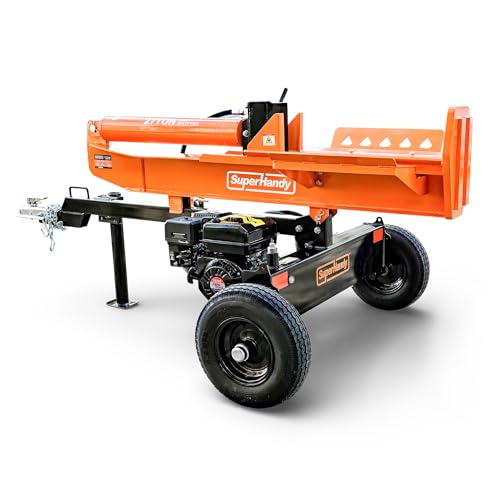
SuperHandy 27-Ton 223cc Full Beam Gas Log Splitter Vertical Horizontal
27 ton223cc recoil start24 in logsFull beam
Check price on Amazon
Best for: Mixed hardwood on a moderate budget.

The SuperHandy 27 ton pairs a 223cc recoil-start engine with a full beam frame that works horizontally or vertically. It is designed to handle logs up to 24 inches, which makes it a serious machine for the price class. It sits in the middle of the lineup in force and size.

The tradeoff is that 27 tons is enough for most firewood but not for the heaviest rounds. Compared with the BILT HARD 30 ton it gives up three tons and some tow-ready hardware, and compared with the SuperHandy 37 ton it is easier to manage.

Keep fluid and oil fresh, grease the beam and let the engine warm before heavy use in cold weather.

What works

  • 27 tons covers most hardwood
  • 223cc engine
  • 24 inch logs
  • Vertical and horizontal modes

Watch out for

  • Lower force than the 30 ton class
  • Recoil start only
  • Heavy for hand moving

Spec sheet

Splitting force
27 tons
Engine
223cc recoil start
Log capacity
24 inch logs
Beam
Full beam
Orientation
Vertical and horizontal
05
BILT HARD 27-Ton Towable Gas Log Splitter 209cc 7HP
27 ton209cc 7HP2 in ball hitchVertical and horizontal
Check price on Amazon
Best for: Owners who tow the splitter between work sites.

The BILT HARD 27 ton is built to be towed, with a standard 2 inch ball hitch and a 209cc OHV engine producing 7HP. It splits horizontally or vertically, which makes it a good match for owners who move a splitter between a woodpile and a remote lot.

The tradeoff is engine size. A 7HP engine pushing 27 tons works harder than the 223cc and 389cc engines in larger machines, which means slower cycles on the toughest rounds. Against the SuperHandy 27 ton it offers towing hardware but a smaller engine.

Check the hitch, tires and safety chains before every trip. Maintain fluid and oil on the usual schedule. A towable splitter also lives outdoors more than a garage machine, so cover the engine and the hydraulic reservoir, keep the breather clear and check the hitch ball and coupler for rust each spring, because a failed coupler on a heavy machine is a serious hazard on any slope.

What works

  • Standard 2 inch ball hitch
  • 27 ton force
  • Horizontal and vertical modes
  • 209cc OHV engine

Watch out for

  • Engine works hard at full load
  • Slower on tough rounds
  • Requires a tow vehicle

Spec sheet

Splitting force
27 tons
Engine
209cc OHV, 7HP
Hitch
2 inch ball hitch
Orientation
Horizontal and vertical
Use
Demanding jobs
06
Full Boar 20-Ton Gas Log Splitter 209cc Auto-Return 10.5 GPM
20 ton209cc EPA10.5 GPM pumpAuto-return
Check price on Amazon
Best for: Seasoned firewood in moderate volumes.

The Full Boar 20 ton is the smallest vertical-capable machine here, with a 209cc EPA-certified engine, a 10.5 GPM two-stage pump and an auto-return valve. Its force suits seasoned hardwood and softwood.

The tradeoff is force. At 20 tons it stalls on knotty or green rounds that the 30 ton class handles easily. Against the Full Boar 33 ton it saves cost and weight but gives up headroom.

Upkeep follows the same pattern as larger machines: fluid, oil, wedge and grease.

What works

  • Auto-return valve
  • EPA-certified engine
  • Two-stage pump
  • Horizontal and vertical modes

Watch out for

  • 20 tons stalls on tough rounds
  • Smaller log capacity
  • Less headroom for large rounds

Spec sheet

Splitting force
20 tons
Engine
209cc EPA-certified
Pump
10.5 GPM two-stage
Return
Auto-return with detent
Orientation
Horizontal and vertical

Spec sheet decoder

What the numbers on the box really mean

The specs manufacturers lead with, translated into what they tell you about real-world performance.

Splitting force

The hydraulic force of the ram in tons. Larger force handles harder rounds.

Watch forThe lineup runs from 20 tons to 37 tons.

Engine displacement

The engine size in cubic centimeters. It is a guide to the power available to the pump.

Watch forThe SuperHandy 37 ton uses 389cc while the BILT HARD 27 ton uses 209cc.

Cycle time

The time for the ram to extend and retract. Shorter cycles split more logs per hour.

Watch forThe Full Boar 33 quotes 14.3 seconds.

Auto-return

A valve that retracts the ram without holding the lever.

Watch forThe Full Boar models list an adjustable detent.

Log capacity

The maximum diameter and length of log the machine will take.

Watch forThe SuperHandy models list 24 inch capacity.

Methodology

How We Evaluated These Vertical Log Splitters

Force and engine

We compared rated force with engine displacement. A machine that promised high tonnage with a small engine was marked down. The 20 to 37 ton range shaped the ranking.

Vertical usability

We looked at how each machine converts to vertical mode and how stable it is. Full-beam designs scored higher. Convenience features like log lifts were a minor plus.

Cycle and return

We compared quoted cycle times and return valves. The Full Boar models list auto-return detents. Claims are treated as claims.

Mobility

We checked tires, hitches and weights. DOT tires and ball hitches scored higher. Heavy machines lost points for moving by hand.

Ownership

We considered fluid care, engine upkeep and parts access from owner feedback patterns. Simpler machines scored better. Support from established sellers was a minor factor.

Decision guide

How to Choose the Right Vertical Log Splitters

By Round Size

SituationPickWhy
Oversized green roundsSuperHandy 37-Ton37 tons and 389cc engine
Heavy mixed roundsFull Boar 33-Ton33 tons with auto-return
Large seasoned roundsBILT HARD 30-Ton30 tons, towable
Mixed hardwoodSuperHandy 27-Ton27 tons at moderate size
Towed work sitesBILT HARD 27-TonBall hitch
Seasoned firewoodFull Boar 20-TonEntry vertical

By Budget

TierPickWhy
Lowest tierFull Boar 20-TonEntry machine
Low-mid tierBILT HARD 27-TonTowable at 27 tons
Mid tierSuperHandy 27-Ton223cc engine
Upper mid tierBILT HARD 30-TonDOT tires and 30 tons
High tierFull Boar 33-Ton33 tons
Highest tierSuperHandy 37-TonMaximum force

Vertical vs Horizontal Splitting

Vertical

Vertical mode on the BILT HARD 30 and Full Boar 33 lets you roll heavy rounds into place and split them where they stand. It saves your back on large rounds but is slower for small logs.

Horizontal

Horizontal mode is faster for small rounds and easier to load at waist height. It requires lifting logs onto the beam.

Choose a dual-mode machine so you can use each mode where it works best.

By Mobility

NeedPickWhy
Tow between sitesBILT HARD 27-Ton2 inch ball hitch
Tow with DOT tiresBILT HARD 30-Ton16 inch tires
Stay in the yardSuperHandy 27-TonFull beam, no tow focus
Heavy rounds on a large lotSuperHandy 37-TonLarge capacity
Smaller yardFull Boar 20-TonLighter unit

For Oversized Rounds Specifically

Look for

Look for 24 inch log capacity, 30 tons or more, an engine over 220cc and a stable vertical mode. A log lift or a table helps with very heavy pieces.

In this comparison

The SuperHandy 37 ton and Full Boar 33 ton are the strongest. The BILT HARD 30 ton offers a more balanced size and tow-ready design.

When to Spend More

Spend more if

Spend more if your rounds are large, green or knotty, where the 33 and 37 ton machines earn their cost.

Save if

Save if you mostly split seasoned wood under 12 inches. The Full Boar 20 ton or SuperHandy 27 ton is enough.

Ownership

Maintenance schedule

The upkeep that decides whether this machine lasts two seasons or ten.

TaskIntervalWhy it matters
Check hydraulic fluidBefore each seasonLow fluid starves the pump and causes jerky motion.
Change engine oilPer manualLarge engines run hot under load and need clean oil.
Grease the beam and pivotsEach seasonDry slides wear quickly and stiffen the ram.
Check tires and hitchBefore towingUnderinflated tires and loose hitches are tow hazards.
Stabilize fuelEnd of seasonOld fuel gums carburetors and causes hard starts.

FAQ

Frequently Asked Questions

Do I need vertical splitting?

If you split large, heavy rounds, yes. Lifting a 100 pound round onto a beam is a recipe for injury. For small rounds, horizontal is fine.

How many tons do I need?

For seasoned wood, 20 to 27 tons is enough. For knotty or green hardwood, 30 tons or more. Larger machines cycle slower.

Can I tow it on a road?

DOT tires and a ball hitch allow it, but check local rules and use safety chains. Many splitters are designed for property use only.

Is recoil start a problem?

On a large engine it can be hard work. Warm the engine and use the choke correctly. Some models offer electric start.

Why is the cycle slow?

Large cylinders take longer to fill. A two-stage pump helps. Cycle time of 14 seconds is normal for 30 ton machines.

Is it safe?

Only with good habits. Keep hands clear of the wedge, use the control lever correctly and wear eye and foot protection. Shut off the engine before adjusting.

Bottom line

The short version

Browse more vertical log splitterson Amazon →
James Miller, Lead Machine Editor

About the author

James Miller

Lead Machine Editor, MachineFanatic

James Miller leads MachineFanatic's buying guides, turning spec sheets, manuals and owner feedback into clear verdicts on power tools, outdoor power equipment, shop machines and kitchen machines.

More from James →

Keep reading

Related guides