
Amazon affiliate links - we earn a commission.Affiliate disclosure

Buying guide · 13 min read · Updated 2026-11-07

Best Walk-Behind Leaf Blowers (2026)

Walk-behind leaf blowers compared on engine, impeller, CFM and MPH, wheels and control, with picks for big lawns, driveways and light commercial work.

James MillerBy James MillerLead Machine Editor6 machines comparedSpec-sheet verified
Best Walk-Behind Leaf Blowers

At a glance

Our top picks

Side by side

Spec comparison

MachineEngineClassAirflowAir speed
Billy Goat F902H Honda GX270 CommercialBest OverallBilly Goat F902H Honda GX270 CommercialHonda GX270Commercialn/an/a
Champion 212cc 1200 CFM Walk-BehindBest Homeowner PickChampion 212cc 1200 CFM Walk-Behind212cc gasn/a1200 CFMn/a
YARDMAX YF1565 209cc Walk-BehindBest ValueYARDMAX YF1565 209cc Walk-Behind209cc OHVHomeowner1200 CFM max150 MPH max
Landworks 7HP 212cc Jet Sweep Walk-BehindBest Jet Sweep StyleLandworks 7HP 212cc Jet Sweep Walk-Behind7 HP 212cc 4-stroke OHVSuper duty homeownern/an/a
SuperHandy 7HP 209cc 1270 CFM Walk-BehindBest Documented ValueSuperHandy 7HP 209cc 1270 CFM Walk-Behind7 HP 209cc 4-stroken/a1270 CFM150 MPH
SuperHandy Jet Sweep 7HP 212cc 2000 CFM 200 MPHBest High-Output ClaimSuperHandy Jet Sweep 7HP 212cc 2000 CFM 200 MPH7 HP 212cc 4-stroke OHVn/a2000 CFM claimed200 MPH claimed

A walk-behind blower is a small engine and a big fan on wheels. Instead of carrying a nozzle, you steer a machine that pushes a wide, powerful column of air ahead of it, which clears leaves, grass clippings and debris from open ground far faster than a handheld can. It is closer to a lawn tool than a hand tool.

Because the machine rolls, weight is not the limit. The factors that matter are engine size, fan design, wheel quality and how well the discharge can be aimed. This guide compares those in six walk-behind models and explains why the headline airflow numbers need cautious reading.

Before you buy

6 Criteria to Look For Before Buying a Walk-Behind Leaf Blower

  1. 01

    Engine class and service

    A Honda GX270, as on the Billy Goat F902H, is a commercial engine with wide service support. Generic 209 to 212cc engines on the Champion, YARDMAX, Landworks and SuperHandy deliver similar power on paper but have thinner service coverage. If the machine earns money, pay for the engine. Ask whether you will still be using the machine in ten years; if yes, an engine with parts support is cheap insurance.

  2. 02

    How to read the CFM claims

    The Champion and YARDMAX list 1200 CFM, the SuperHandy lists 1270 and the Jet Sweep SuperHandy claims 2000 from the same 7 HP class engine. Real airflow cannot double from the same power, so treat claims as unreliable across brands. A fair comparison is to look at engine horsepower first, then treat airflow as an unproven extra. If a seller will not give the engine model number, assume a generic engine.

  3. 03

    Impeller material

    A plastic impeller, as on the SuperHandy 14.2-inch, is light and cheap but can chip if it ingests stones. Metal impellers resist damage better. If you blow gravel drives, choose accordingly. Pick up a handful of gravel and ask whether your drive sheds stones into the lawn; if so, favor a stronger impeller.

  4. 04

    Wheels and steering

    Never-flat 12-inch wheels, as on the Champion, eliminate punctures. A locking, swiveling front wheel helps both straight runs and turns. Large pneumatic wheels, as on the Billy Goat, roll better over rough ground. Roll the machine across your own lawn mentally: soft ground and ruts punish small wheels.

  5. 05

    Airflow control

    The Billy Goat's fingertip lever aims airflow up or down, and the Champion has an adjustable throttle. Fixed-output machines blow mulch out of beds. Control matters on mixed terrain. Aiming the air downward helps with wet leaves and aiming it up helps with deep piles on a driveway.

  6. 06

    Size, weight and storage

    These machines weigh as much as a push mower and have a long handle. Measure your garage and ramp before buying. Fold-down handles help, though not all models have them. Many of these have no folding handle, so measure the garage door and the truck bed before you order.

Detailed reviews

The 6 best walk-behind leaf blowers, explained

01
Billy Goat F902H Honda GX270 Commercial
Honda GX270Fingertip air aimingPneumatic wheelsCommercial
Check price on Amazon
Best for: Landscapers and large properties that run a blower for hours each week.

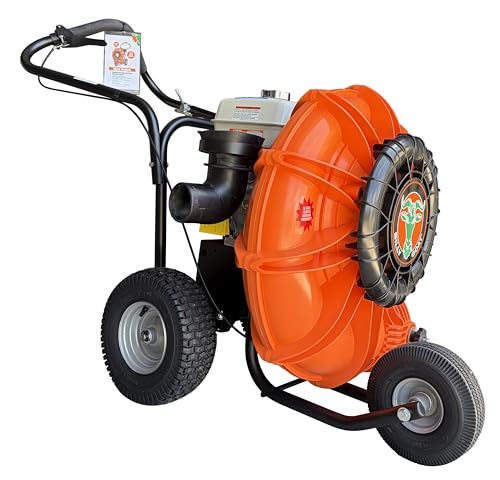
Billy Goat is a long-standing commercial blower maker, and the F902H pairs a Honda GX270 with a rounded housing designed to reduce noise by removing air voids. A fingertip lever aims the airflow up or down, which is a practical advantage when you move between flat lawn and heaped debris.

Large pneumatic rear wheels reduce rolling resistance on rough terrain, and thicker padded handles lower vibration and fatigue. A Honda GX270 is the common commercial engine and is well supported.

This is a professional machine at a professional price tier. It is more than a homeowner needs, but for landscapers, schools and campuses it earns its keep. Standard oil and filter service apply. Because it is built for daily service, a dealer can supply belts, wheels and gaskets years from now. Budget for a trailer ramp, since it is not a machine you lift by hand. Its rounded housing is also easier to clean after wet leaf jobs.

What works

  • Honda GX270 engine with wide service support
  • Fingertip control aims airflow up or down
  • Rounded housing reduces noise
  • Pneumatic wheels roll over rough ground

Watch out for

  • Highest price tier
  • Heavy to load into a truck
  • Overkill for a typical yard

Spec sheet

Engine
Honda GX270
Control
Fingertip lever directs airflow up or down
Housing
Smooth rounded design reduces noise
Wheels
Large pneumatic rear wheels
Class
Commercial
02
Champion 212cc 1200 CFM Walk-Behind
212cc engine1200 CFM12 in. wheelsAdjustable throttle
Check price on Amazon
Best for: Homeowners with one to three acres of open lawn.

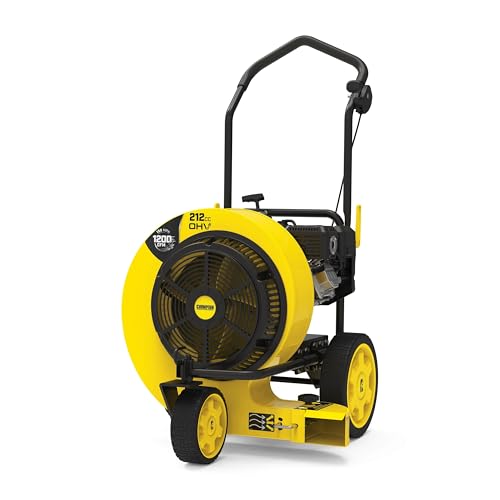
Champion builds this around a 212cc engine, an adjustable throttle and 12-inch never-flat rear wheels. A solid wheel cannot puncture on a stick or thorn, which solves the most common tire complaint on yard equipment. The front wheel locks for straight runs or swivels 360 degrees for turns.

The adjustable throttle lets you reduce power near beds and plants. The handle height adjusts, which is a real comfort feature for tall or short users.

Compared with the Billy Goat, it has a generic engine and a lower price tier, though Champion has a larger service network than most importers. Expect the usual upkeep of oil, plug and fuel care. Keep the throttle low when you work near beds, then open it up in the open lawn. Check the handle height each time a different person uses it. Because it has no tires to inflate, storage is easier.

What works

  • Never-flat 12-inch rear wheels
  • Front wheel locks or swivels
  • Adjustable throttle and handle height
  • 1200 CFM for large areas

Watch out for

  • Generic engine
  • Heavy to store without a ramp
  • Less airflow control than the Billy Goat

Spec sheet

Engine
212cc gas
Airflow
1200 CFM
Wheels
12-inch never-flat rear wheels
Front wheel
Locks or swivels 360 degrees
Handle
Adjustable height, soft grip
03
YARDMAX YF1565 209cc Walk-Behind
209cc OHV150 MPH1200 CFMWalk-behind
Check price on Amazon
Best for: Budget buyers with open lawns who want walk-behind capacity.

YARDMAX offers a 209cc overhead-valve engine with 150 MPH and 1200 CFM listed as maximums, a spec sheet that matches the Champion's on paper. The listing is sparse, but the core hardware is the same recipe as the rest of the class.

The point of buying it is price, as it sits at a lower tier than the Champion and Billy Goat. In return you get less documentation and a thinner support network.

For an acre or two of open lawn it moves a lot of leaves quickly. Maintain it like any four-stroke engine, with oil changes and fresh fuel. Because the listing is sparse, confirm the return policy and parts availability before buying. Check all fasteners after the first hour of use, as vibration loosens bolts on budget machines. It makes sense mainly for seasonal use.

What works

  • 209cc OHV four-stroke engine
  • 1200 CFM and 150 MPH listed
  • Lower price tier
  • No fuel mixing

Watch out for

  • Sparse listing detail
  • Thin service network
  • Numbers are maximums

Spec sheet

Engine
209cc OHV
Air speed
150 MPH max
Airflow
1200 CFM max
Format
Wheeled walk-behind
Class
Homeowner
04
Landworks 7HP 212cc Jet Sweep Walk-Behind
7HP 212cc4-stroke OHVJet SweepManual-propelled
Check price on Amazon
Best for: Large lawns and gardens with leaves and light debris.

Landworks calls this a Jet Sweep blower, a term for walk-behind units with a large impeller housing that directs a wide stream of air ahead of the wheels. A 7 horsepower, 212cc OHV engine drives it, with manual propulsion.

The design is aimed at garden and lawn applications, with enough power to move leaves, grass clippings and light debris across a large area. The listing focuses on safety, so follow the manual and keep bystanders away.

It competes with the YARDMAX on paper and sits near it on price. Parts are generic, so basic upkeep is simple. Read the safety section before first use, since a machine this size can throw debris far. Wear eye and hearing protection and keep bystanders and pets away. Rinse out debris from the housing after use.

What works

  • 7 HP 212cc four-stroke engine
  • Jet Sweep housing moves wide stream
  • No fuel mixing
  • Generic engine parts

Watch out for

  • Manual-propelled, so you push it
  • Thin brand support
  • Loud and heavy

Spec sheet

Engine
7 HP 212cc 4-stroke OHV
Design
Jet Sweep wheeled blower
Drive
Manual-propelled
Use
Leaf and debris clearing
Class
Super duty homeowner
05
SuperHandy 7HP 209cc 1270 CFM Walk-Behind
7HP 209cc1270 CFM150 MPH14.2 in. impeller
Check price on Amazon
Best for: Buyers who want a well-documented mid-priced walk-behind.

SuperHandy documents its machine well: a 7 horsepower, 209cc four-stroke engine, 150 MPH, 1270 CFM and a 14.2-inch plastic impeller on a powder-coated steel frame. A plastic impeller reduces weight and cost, and for leaf and grass clippings it is adequate, though hard debris like stones can chip it.

Two large 12-inch rear wheels and an 8-inch swivel front wheel handle most lawns. The maker specifies unleaded 87-octane fuel, with 10 percent ethanol or less recommended.

It competes with the Champion on airflow. The tradeoff is service coverage and the plastic impeller. If you blow gravel edges, clear loose stones first to protect the plastic impeller. Store it under cover, because the frame coating is good but the engine hates moisture. Check the impeller for chips each season.

What works

  • 1270 CFM listed
  • Well-documented specs
  • Powder-coated rust-resistant frame
  • Large 12-inch rear wheels

Watch out for

  • Plastic impeller can chip on stones
  • Thin service network
  • Manual-propelled

Spec sheet

Engine
7 HP 209cc 4-stroke
Airflow
1270 CFM
Air speed
150 MPH
Impeller
14.2-inch plastic
Frame
Rust-resistant powder-coated steel
06
SuperHandy Jet Sweep 7HP 212cc 2000 CFM 200 MPH
7HP 212cc2000 CFM200 MPH3600 rpm
Check price on Amazon
Best for: Buyers who want a Jet Sweep style blower and accept inflated claims.

This SuperHandy model claims 2000 CFM and 200 MPH from a 7 horsepower, 212cc engine at 3600 rpm, far above the 1200 to 1270 CFM claims of similar-engine rivals. A larger engine is not behind that gap; the difference is more likely in how the figures are measured.

Treat the numbers as marketing ceilings. The same 7 HP class engine drives the Champion at 1200 CFM, and an engine cannot produce twice the air from the same power without a different test method.

The machine is a capable Jet Sweep style blower. Buy it for the build and price, not for the 2000 CFM. Compare it with the Landworks on engine and price, since the hardware is nearly identical. Run the first tank gently and check the oil level before every session. Do not buy it on the 2000 CFM number alone.

What works

  • 7 HP 212cc engine
  • Jet Sweep housing
  • Wheeled walk-behind format
  • No fuel mixing

Watch out for

  • 2000 CFM claim is not credible next to rivals
  • Thin service network
  • Manual-propelled

Spec sheet

Engine
7 HP 212cc 4-stroke OHV
Airflow
2000 CFM claimed
Air speed
200 MPH claimed
Engine speed
3600 rpm
Design
Wheeled Jet Sweep

Spec sheet decoder

What the numbers on the box really mean

The specs manufacturers lead with, translated into what they tell you about real-world performance.

CFM

Air volume per minute at the nozzle. It is maker-measured, so compare within a class. Think of it as a rough ranking tool only.

Watch for1200 CFM on the Champion versus a claimed 2000 CFM on the Jet Sweep SuperHandy.

MPH

Air speed at the nozzle. Higher speed lifts wet debris. A faster stream lifts wet leaves but scatters mulch.

Watch for150 MPH on most, 200 MPH claimed on the Jet Sweep.

OHV four-stroke

An overhead valve engine that runs on straight gasoline. It avoids fuel mixing. No fuel and oil mixing, which simplifies ownership.

Watch forAll the units here use it.

Never-flat wheels

Solid wheels that cannot puncture. They avoid flats from sticks and thorns. They also keep rolling after a long storage, with no pump or valve to fail.

Watch forChampion's 12-inch rear wheels.

Jet Sweep

A design with a wide impeller housing for a wide airstream. It is the common walk-behind layout.

Watch forLandworks and SuperHandy use the term.

Methodology

How We Evaluated These Walk-Behind Leaf Blowers

Engine and support

We compared the Honda GX270 on the Billy Goat with generic 209 to 212cc engines. Service coverage earned the biggest bonus. Commercial engine support was weighted heavily because downtime is the real cost in service.

Airflow credibility

We treated claimed CFM as marketing and penalized claims that exceeded what a 7 HP engine plausibly produces. The 2000 CFM claim scored poorly. We applied a plausibility check to every airflow claim, comparing it to engine horsepower.

Chassis and wheels

We looked at wheel size, puncture resistance and frame coating. The Champion and Billy Goat earned the most credit. Never-flat wheels and large pneumatic tires were compared on rolling resistance and puncture risk.

Controls

We weighed throttle control and airflow aiming, noting the Billy Goat's fingertip lever. Handles and controls were compared for vibration comfort over a long session.

Value fit

We separated the YARDMAX as the value pick from the Billy Goat as the professional pick. Owner feedback patterns on generic imports shaped the scoring. We also noted listing completeness, since sparse listings make verification harder.

Decision guide

How to Choose the Right Walk-Behind Leaf Blowers

By Property Size

SituationPickWhy
1 to 2 acres open lawnYARDMAX YF1565Low-cost capacity
2 to 4 acresChampion 212ccNever-flat wheels and throttle
Leaf and debris gardensLandworks Jet SweepWide stream
Commercial acreageBilly Goat F902HHonda GX270

By Budget

TierPickWhy
LowestYARDMAX YF1565209cc OHV
Low-midLandworks Jet Sweep7 HP 212cc
MidSuperHandy 1270 CFMDocumented specs
PremiumChampion 212cc or Billy Goat F902HSupport or commercial engine

Generic vs Commercial Engine

Generic

The Champion, YARDMAX, Landworks and SuperHandy models use 209 to 212cc engines with similar output and thin service coverage.

Commercial

The Billy Goat F902H uses a Honda GX270 with wide service support and a refined housing.

Pick generic if you blow occasionally, commercial if the machine pays for itself.

By Terrain

TerrainPickWhy
Thorny or stick-strewn groundChampion 212ccNever-flat wheels
Rough groundBilly Goat F902HPneumatic wheels
Flat lawnsSuperHandy 1270 CFM12-inch rear wheels
Mixed beds and lawnChampion 212ccAdjustable throttle

For Large Leaf Cleanups Specifically

Look for

Look for a wide stream, an engine with torque and wheels that roll easily. Work with the wind and push leaves into a line.

In this comparison

The Billy Goat F902H and Champion 212cc are the most controllable, and the Jet Sweep models give a wide stream.

When to Spend More

Spend more if

Spend more if you blow weekly over several acres or for pay, which points to the Billy Goat F902H.

Save if

Save if you only blow in autumn. The YARDMAX or Landworks handle seasonal use at a lower price.

Ownership

Maintenance schedule

The upkeep that decides whether this machine lasts two seasons or ten.

TaskIntervalWhy it matters
Change engine oilEach seasonEngines run hard in dusty work. Fresh oil protects bearings.
Clean the air filterEvery 10 to 20 hoursDust clogs filters fast and starves the engine.
Inspect the impellerEach seasonChips or cracks cause vibration. Replace damaged impellers.
Check tire pressureEach seasonPneumatic tires on the Billy Goat need even pressure.
Stabilize or drain fuelEnd of seasonOld ethanol fuel gums the carburetor.

FAQ

Frequently Asked Questions

Walk-behind or backpack?

Walk-behind for open lawns of one acre or more, where you can push a machine. Backpack for tight areas, steps and beds.

Are the CFM claims reliable?

No. Similar 7 HP engines claim anywhere from 1200 to 2000 CFM. Use engine class and brand as your guide. Ask the seller for the engine model and check that the horsepower is realistic for the claimed airflow before you pay.

Do walk-behind blowers need mixed fuel?

No. These use four-stroke engines on straight unleaded gasoline.

Can they clear wet leaves?

They move wet leaves better than most handhelds thanks to volume, but speed matters too, so go slower.

Are they loud?

Yes, they are as loud as any gas engine. Wear hearing protection. Hearing damage is cumulative, so use earmuffs or plugs on every session even for short jobs.

How long do they last?

Many seasons with oil changes and fuel care. Commercial engines last longest.

Bottom line

The short version

Browse more walk-behind leaf blowerson Amazon →
James Miller, Lead Machine Editor

About the author

James Miller

Lead Machine Editor, MachineFanatic

James Miller leads MachineFanatic's buying guides, turning spec sheets, manuals and owner feedback into clear verdicts on power tools, outdoor power equipment, shop machines and kitchen machines.

More from James →

Keep reading

Related guides