
Amazon affiliate links - we earn a commission.Affiliate disclosure

Buying guide · 12 min read · Updated 2026-11-11

Best Wet-Dry Vacuums (2026)

Five corded wet-dry shop vacuums compared by tank size, real airflow, filter design, blower port and upkeep, so you buy the right size the first time.

James MillerBy James MillerLead Machine Editor5 machines comparedSpec-sheet verified
Best Wet-Dry Vacuums

At a glance

Our top picks

Side by side

Spec comparison

A wet-dry vacuum is a plain machine: a motor and fan on top of a tank, with a filter between them. It pulls air, water and debris into the drum and stops anything wet from reaching the motor. The hard part of buying one is that the marketing numbers describe the motor, not the cleaning.

Most people buy the wrong size. A drum that is too small gets emptied constantly, and one that is too big stays in a corner because it is a chore to move. This guide ranks five corded units by what they actually do in a garage, shop or basement, and explains where the label numbers mislead.

Before you buy

6 Criteria to Look For Before Buying a Wet-Dry Vacuum

  1. 01

    Real airflow versus peak HP

    Peak horsepower is the motor's surge figure measured without a load, so a 6.5 peak HP rating does not mean 6.5 sustained horsepower. What moves debris is airflow in cubic feet per minute and what lifts it is sealed water lift. The Vacmaster VDK811PW lists an 84 inch water lift, which says more about its suction than the 5 peak HP on the DEWALT DXV09PA says about its airflow. Compare CFM and water lift when a spec sheet provides them, and ignore peak HP across brands.

  2. 02

    Tank size you will actually move

    Gallons are nominal, and usable volume is smaller, especially for wet pickup, which should stay under about 80 percent full. A 6 gallon drum like the Stanley SL18116P fills quickly on a basement leak, while a 16 gallon Craftsman 17595 is heavy and slow to carry. The 8 to 10 gallon range, such as the DEWALT 9 gallon, is where most homes balance capacity against effort. Buy the smallest tank that avoids mid-job emptying.

  3. 03

    Filter type for your dust

    A standard cartridge handles dirt, leaves and sawdust but clogs on drywall and concrete dust, and paper must never be used for wet pickup. A dust bag and cartridge pair, like the Vacmaster VDK811PW includes, keeps fine dust out of the filter. For wet work remove the dry filter and fit a foam sleeve. The most common mistake is vacuuming water through a paper filter, which ruins it in one use.

  4. 04

    Hose diameter and length

    A 2.5 inch hose moves chunky debris and leaves, while a 1.25 inch hose raises suction for fine dust and is easier to handle. Most small vacs here ship with 1.25 to 1.5 inch hoses and a 7 ft length, so your real reach depends on the 10 ft cord too. If a hose stiffens in cold weather you will drag the drum around the garage. Check that the hose locks on and the adapters fit common attachments.

  5. 05

    Drain and blower features

    An oversized drain, as on the Craftsman 17590 and 17595, lets you empty a wet tank without lifting it, which is the difference between a ten second job and a back strain. A blower port, found on the DEWALT DXV09PA and both Craftsman units, turns the vac into a leaf and sawdust blower. The exhaust is dirty, so pull the filter or stay away from fine dust if you use it. Neither feature adds to suction, but both change daily convenience.

  6. 06

    Corded power and cord reach

    All five machines here are corded, which means unlimited runtime and consistent suction, unlike battery shop vacs that run roughly 10 to 25 minutes. The trade is cord length: the DEWALT DXV09PA has about 10 ft of cord plus a 7 ft hose, so a large garage needs a 14 or 12 gauge extension. Underpowered extension cords starve the motor and run it hot. Plan the outlet position before you plan the vacuum.

Detailed reviews

The 5 best wet-dry vacuums, explained

01
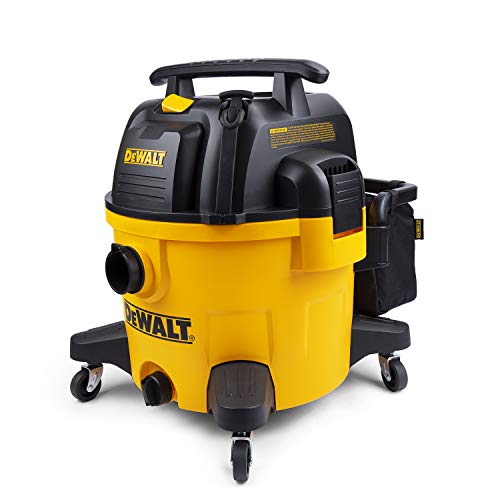
DEWALT DXV09PA 9 Gallon Wet/Dry Vac with Blower
9 gallon tank5 peak HPBlower port10 ft cord
Check price on Amazon
Best for: Garages and workshops that need one machine for spills, sawdust and blowing out leaves.

The DXV09PA puts a 5 peak HP motor on a 9 gallon poly drum, which is the size where a shop vac stops being a bucket and starts handling a whole garage floor. It has a rear blower port and several nozzle adapters, so the same machine that sucks up a water heater leak can also push sawdust out of a corner. The hose is a revised, more flexible design than the older DEWALT shop vacs, and that matters more than it sounds because stiff hoses fight you all day.

The trade-off is weight and bulk. A 9 gallon tank is heavy when it holds wet debris, and the 10 ft cord is short enough that you will want a heavy-gauge extension cord for a large garage. Compared with the 6 gallon DEWALT DXV06P it moves more air and holds a third more, but it costs more and takes longer to empty into a drain. The 5 peak HP figure is a surge rating, so judge it by the hose diameter and the filter instead.

In ownership, the rubberized casters roll over a cracked garage slab without catching, and the poly tank does not rust or dent. Expect to buy a fine dust bag for drywall and sanding work, since a plain cartridge clogs quickly there. A foam sleeve for wet pickup is the cheap part that most buyers forget to fit before sucking up water.

What works

  • 9 gallon drum covers a full garage cleanup
  • Blower port clears sawdust and leaves
  • Flexible upgraded hose is easy to drag
  • Rubber casters roll over rough concrete

Watch out for

  • 10 ft cord needs an extension for big spaces
  • Heavy to carry when full of wet debris
  • Paper cartridge clogs fast on drywall dust

Spec sheet

Tank
9 gallon poly
Motor
5 peak HP
Blower
Built-in port
Cord
10 ft
Power
Corded
02
Stanley SL18116P 6 Gallon 4 HP Wet/Dry Vac
6 gallon tank4 peak HPPoly tankWet and dry
Check price on Amazon
Best for: A home garage where the vac comes out a few times a month.

The Stanley SL18116P is the entry-level machine you buy when you want a real drum and a decent motor without paying for brand-name extras. The 6 gallon tank is large enough for a cleaned-out workbench or a flooded laundry corner, and the 4 peak HP motor handles everyday dry debris like sawdust, dirt and leaves. It handles wet and dry pickup and can also be used as a blower with the correct port, so it covers the basics.

What you give up compared with the DEWALT DXV09PA is capacity, hose quality and long-run durability. At 6 gallons it fills sooner on a bigger job, and a lower-priced build means thinner plastics and fewer included nozzles. It is a fine second vacuum for a car or a hobby shop, but it is not the machine to run for hours of demolition cleanup.

Ownership is simple: empty it after wet use, wash the foam sleeve, and replace the dry filter when airflow drops. The small footprint stores on a shelf or in a cabinet corner, which is why it suits a home garage better than a job site. Replacement filters and bags are widely available for this size, so parts are not a problem.

What works

  • Affordable way into a proper 6 gallon drum
  • Small footprint stores easily
  • Handles wet spills and dry debris
  • Replacement filters are easy to find

Watch out for

  • Thinner hose and accessories than premium units
  • Fills sooner than the 9 gallon picks
  • Not built for daily jobsite use

Spec sheet

Tank
6 gallon
Motor
4 peak HP
Blower
Rear port
Tank type
Poly
Power
Corded
03
Vacmaster Professional VDK811PW 8 Gallon Wet/Dry Vac
8 gallon tankSelf-cleaning filter84 in water liftDust bag included
Check price on Amazon
Best for: Woodworkers and renovators who vacuum fine dust more than water.

The VDK811PW is built around a self-cleaning filter system, where a lever or pulse clears the cartridge so airflow stays up through a long cleanup. That addresses the single biggest complaint about shop vacs, which is that suction collapses once the filter loads with fine dust. It ships with a cartridge filter and a dust bag rated for fine particles down to about 1 micron, and the 84 in water lift figure points to a motor tuned for suction rather than just airflow.

The drawback is that this is a dry-dust specialist first. It does handle liquids, but self-cleaning mechanisms add parts, and the dust bag and cartridge must be swapped out for wet jobs. Against the 9 gallon DEWALT, you gain filter performance and lose the blower convenience and the larger drum. If your work is sanding, drywall or woodshop dust, that trade is worthwhile.

Expect to buy replacement bags and eventually a cartridge. The self-cleaning feature extends filter life but does not remove the need to empty the tank before it reaches the filter. It is a good machine to attach to a sander or saw with an adapter hose because the airflow stays consistent.

What works

  • Self-cleaning filter keeps airflow steady
  • Dust bag and cartridge capture fine particles
  • 84 in water lift suits suction-heavy work
  • 8 gallon tank balances size and portability

Watch out for

  • Wet pickup needs filter changes first
  • No blower is the main selling point
  • Extra bags are a recurring cost

Spec sheet

Tank
8 gallon
Filter
Cartridge, self-cleaning
Lift
84 in water lift
Fine dust
Down to 1 micron
Power
Corded
04
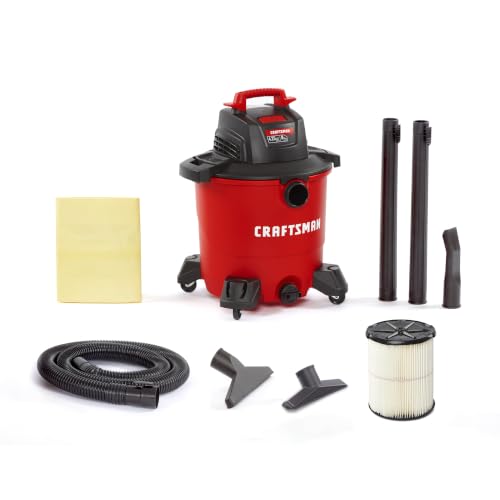
Craftsman CMXEVBE17590 9 Gallon 4.25 Peak HP Wet/Dry Vac
9 gallon tank4.25 peak HPBlower portOversized drain
Check price on Amazon
Best for: General garage and basement use where emptying water easily matters.

The CMXEVBE17590 is the straightforward garage vacuum in this lineup: a 9 gallon tank, a 4.25 peak HP motor, a rear blower port and an oversized drain. The drain is the feature to notice, because emptying 9 gallons of wet debris by tipping the drum is how people strain a back. A drain plug lets you let water run out at the floor drain instead.

It gives up a little power to the DEWALT DXV09PA, which is rated at 5 peak HP, and it does not come with a self-cleaning filter like the Vacmaster. For a home garage that is acceptable, since 4.25 peak HP on a 9 gallon drum is a normal general-purpose setup. If you want something to run alongside a table saw all day, step up to a dust-collection-focused model instead.

Storage is as simple as wrapping the cord and coiling the hose onto the lid. Plan on replacing the cartridge once or twice over several years, and keep the foam sleeve for wet jobs. Parts are common because Craftsman uses standard filter sizes across several models in the family.

What works

  • Oversized drain empties wet loads easily
  • 9 gallon drum with rear blower port
  • Standard filters keep running costs low
  • Straightforward design is easy to maintain

Watch out for

  • 4.25 peak HP trails the DEWALT 5 peak HP
  • No self-cleaning filter
  • Plastic hose adapters feel basic

Spec sheet

Tank
9 gallon
Motor
4.25 peak HP
Blower
Rear exhaust port
Drain
Oversized
Power
Corded
05
Craftsman CMXEVBE17595 16 Gallon 6.5 Peak HP Wet/Dry Vac
16 gallon tank6.5 peak HPBlower portOversized drain
Check price on Amazon
Best for: Big cleanups, flooded rooms and shops with lots of debris.

The CMXEVBE17595 is the biggest vacuum in this guide, a 16 gallon drum with a 6.5 peak HP motor. It exists for large jobs: a flooded basement, a full workshop clean-out or a renovation site where a 6 gallon drum would fill in minutes. The built-in blower port and oversized drain make it as useful for clearing a patio as for pumping out a wet floor.

Size is the cost. A 16 gallon drum is awkward on stairs and heavy when it holds liquid, and it will never be the vacuum you grab for a quick car clean. Against the 9 gallon Craftsman 17590 it holds nearly twice as much, but you need floor space and a plan for storage. Treat it as a dedicated shop machine rather than a household convenience.

Ownership benefits from the large tank because you empty less often, but the filter still needs attention. Wash the foam sleeve after wet pickup and leave the lid off to dry the drum, otherwise a damp large tank grows mildew within weeks. Expect to buy an extension cord with a heavy gauge for the long reach this vacuum encourages.

What works

  • 16 gallon tank cuts emptying trips
  • 6.5 peak HP motor for heavy debris
  • Oversized drain handles liquid loads
  • Blower port doubles as a yard tool

Watch out for

  • Bulky and heavy to carry up stairs
  • Overkill for a car or small garage
  • Needs a lot of storage space

Spec sheet

Tank
16 gallon
Motor
6.5 peak HP
Blower
Rear port
Drain
Oversized
Power
Corded

Spec sheet decoder

What the numbers on the box really mean

The specs manufacturers lead with, translated into what they tell you about real-world performance.

Peak HP

The highest horsepower the motor reaches at surge or with no load. It tells you almost nothing about cleaning performance.

Watch forA 6.5 peak HP Craftsman 17595 is not twice as strong as a 3 peak HP unit.

CFM (airflow)

The volume of air the fan moves, which carries bulk debris and leaves. Higher CFM helps with sawdust and wide hoses.

Watch forOnly some listings give CFM, so favor makers that do, such as the Vacmaster models.

Water lift (inches)

How high the vacuum can pull a column of water, which stands in for suction against resistance. It matters for fine dust and long hoses.

Watch forThe Vacmaster VDK811PW lists 84 inches, but check that the figure is sealed lift.

Tank capacity (gallons)

The nominal drum size, usually quoted at the rim. Usable volume is lower, particularly for liquid.

Watch forThe Stanley 6 gallon fills sooner than a 9 gallon DEWALT on the same job.

Filter micron rating

The smallest particle size the filter captures. Down to 1 micron is good for fine dust but is not HEPA.

Watch forFine dust needs the bag plus cartridge pairing like the VDK811PW ships with.

Methodology

How We Evaluated These Wet-Dry Vacuums

Airflow and suction design

We compared motor ratings, hose diameter and any published CFM or water lift figures. The Vacmaster VDK811PW lists 84 inches of lift, while the DEWALT DXV09PA leans on a 5 peak HP motor and a larger tank. Peak HP was treated as a marketing number, not as a score.

Tank, drain and handling

We weighed capacity against how easily the drum moves and empties. The Craftsman 17595 holds 16 gallons but is awkward on stairs, while the Stanley holds 6 gallons and stores on a shelf. Oversized drains and caster quality counted heavily.

Filtration and wet pickup

We looked at how each machine handles water and fine dust. Self-cleaning filters, foam sleeves, dust bags and float shutoffs were weighed. A filter you can swap in seconds beat a fancier design that takes tools.

Ownership and parts

We checked how common replacement filters, bags and hoses are for each model. Craftsman and Stanley use widely stocked sizes, which keeps running costs low. Models that rely on proprietary bags scored lower for long-term cost.

Value for the use case

We matched price tier to what the buyer gets rather than ranking on cost alone. The Stanley is the cheapest here and earns the value badge, while the 16 gallon Craftsman is justified only if the job is large.

Decision guide

How to Choose the Right Wet-Dry Vacuums

By Job Size

SituationPickWhy
Quick spills and a carStanley SL18116PSmall 6 gallon drum stores on a shelf
Whole garage and blowing leavesDEWALT DXV09PA9 gallon tank with a blower port
Sanding and drywall dustVacmaster VDK811PWSelf-cleaning filter plus dust bag
Basement leak or clean-outCraftsman CMXEVBE1759516 gallon drum with oversized drain
Medium home garageCraftsman CMXEVBE175909 gallon drum with easy drain

By Budget

Budget tierPickWhy
Lowest costStanley SL18116PReal 6 gallon drum at the cheapest price here
Mid-rangeCraftsman CMXEVBE17590Larger drum with drain at a modest premium
Mid-range plusVacmaster VDK811PWFilter system justifies a higher price for dust work
PremiumDEWALT DXV09PABest hose, motor and build in the guide
Premium, largeCraftsman CMXEVBE17595Pay for capacity only if you need 16 gallons

Poly Tank vs Larger Drum

Smaller poly drum

The Stanley SL18116P and DEWALT DXV09PA stay light enough to carry and store. They suit a household where the vac moves between rooms and the car. The cost is more emptying on big jobs.

Large drum

The Craftsman CMXEVBE17595 holds 16 gallons and moves more air with a 6.5 peak HP motor. It reduces emptying trips but is heavy, bulky and slow to dry. It stays in one corner of a shop.

Pick the 9 gallon DEWALT unless you regularly fill smaller tanks; choose the 16 gallon Craftsman only for large jobs.

Wet Pickup vs Fine Dust

PreferencePickWhy
Mostly waterCraftsman CMXEVBE17590Oversized drain empties liquids easily
Mostly fine dustVacmaster VDK811PWBag and self-cleaning cartridge
Mixed useDEWALT DXV09PAGood hose and wet-dry versatility
Leaves and sawdustStanley SL18116PRear port blows debris
Large wet loadsCraftsman CMXEVBE17595Drain plus 16 gallon capacity

For a Home Garage Specifically

Look for

A 6 to 9 gallon tank, a rear blower port, a drain or easy tip design and a filter that is cheap to replace. Wheels matter because a garage floor is rarely smooth, and cord length matters if the outlet is across the room.

In this comparison

The DEWALT DXV09PA fits best because the 9 gallon tank, upgraded hose and blower port cover spills, sawdust and leaf blowing. The Stanley SL18116P is the budget alternative if you want a lighter 6 gallon unit.

When to Spend More

Spend more if

You vacuum fine dust weekly, work on renovations or fill a drum every visit. The Vacmaster VDK811PW saves on filter replacements, and the DEWALT DXV09PA lasts longer under heavy use.

Save if

The vac comes out a few times a month for spills and car cleaning. The Stanley SL18116P or the Craftsman CMXEVBE17590 does that job without paying for unneeded features.

Ownership

Maintenance schedule

The upkeep that decides whether this machine lasts two seasons or ten.

TaskIntervalWhy it matters
Empty and rinse the tankAfter every wet jobStanding water leaves mildew and a smell within days. Leave the lid off until it dries.
Wash the foam sleeveAfter wet pickupA clogged foam sleeve restricts airflow. Rinse it and let it dry fully before the next use.
Clean or replace the cartridgeEvery 3 to 6 months of regular useA loaded cartridge cuts suction. Tap it out outdoors and replace it once the pleats stay clogged.
Inspect the float and hoseEvery few monthsThe float shutoff protects the motor from water. A cracked hose leaks suction and should be replaced.
Check the cord and castersTwice a yearCord damage is a shock risk. Casters jam with debris and make the drum tip when dragged.

FAQ

Frequently Asked Questions

Is a 5 peak HP shop vac stronger than a 4 peak HP one?

Not reliably. Peak HP is a surge figure that varies by maker, so the DEWALT 5 and the Stanley 4 cannot be ranked from that number alone. Look at hose size, CFM and water lift when they are listed.

What size wet-dry vacuum do I need for a garage?

A 6 to 9 gallon tank suits most home garages, with 9 gallons giving more headroom for wet spills. Go to 12 to 16 gallons only for basement flooding or shop clean-outs where you empty the drum less often.

How long should a shop vac last?

With regular filter changes and tank drying, a poly-drum unit like the Stanley or DEWALT can last many years. The motor is rarely what fails first. Cracked hoses, split lids and clogged filters usually end a vac's useful life.

Can I vacuum water with the filter in?

No. Remove the paper or cartridge filter and fit a foam sleeve for wet pickup. Paper soaks, tears and loses its shape, and a wet filter pulls less air for the rest of its life.

Is it safe to vacuum drywall dust with a standard shop vac?

It will work, but the fine dust clogs the cartridge and can blow through the system and back into the room. Use a fine dust bag and cartridge like the Vacmaster VDK811PW includes, and run the vac outdoors if possible.

Do I need a blower port?

It is a convenience, not a necessity. A port like the one on the DEWALT DXV09PA clears leaves and sawdust, but the exhaust is dirty and a dedicated blower does the job faster. Value it if you want one machine for the garage and the yard.

Bottom line

The short version

Browse more wet-dry vacuumson Amazon →
James Miller, Lead Machine Editor

About the author

James Miller

Lead Machine Editor, MachineFanatic

James Miller leads MachineFanatic's buying guides, turning spec sheets, manuals and owner feedback into clear verdicts on power tools, outdoor power equipment, shop machines and kitchen machines.

More from James →

Keep reading

Related guides