
Amazon affiliate links - we earn a commission.Affiliate disclosure

Buying guide · 12 min read · Updated 2026-11-07

Best Window Air Conditioners with Heat (2026)

Six window air conditioners with a heat function compared on capacity, 115V versus 230V supply, noise and how much warmth you can realistically expect.

James MillerBy James MillerLead Machine Editor6 machines comparedSpec-sheet verified
Best Window Air Conditioners with Heat

At a glance

Our top picks

Side by side

Spec comparison

A window air conditioner with heat is a convenience appliance: it cools in summer and adds warmth on chilly days with an electric element or a limited reversing cycle. It saves swapping units in spring and autumn, and it suits rooms the central system reaches poorly.

The catch is expectation. Resistive heat from a window unit costs far more per degree than a heat pump, and the larger units need a 230V circuit that most homes do not have free. Decide what job the heat will do before you buy.

Before you buy

6 Criteria to Look For Before Buying a Window Air Conditioner with Heat

  1. 01

    What heat from a window unit can do

    Most window units with heat use electric resistance, which turns each kilowatt into 3,412 BTU per hour. The Soleus lists 10,000 BTU of heat, roughly three kilowatts, so it needs a dedicated 115V circuit and costs a lot to run. Treat the heat as a spring and autumn convenience, not a winter heating plan.

  2. 02

    Supply voltage decides where it fits

    The LG 7,600 BTU, Midea 8,000 BTU and Soleus run on 115V, while the LG 18,000 BTU and Seasons 23,200 BTU require 230/208V. A 230V outlet near the window is rare in bedrooms. Add an electrician's visit to the cost if you pick a 230V unit. Ask whether the building has a spare double breaker slot in the panel, which decides whether the circuit is a half-day job or a larger project.

  3. 03

    Does the listing state heating BTU

    Only the Soleus states a heating capacity in the data, at 10,000 BTU. The LG and Midea units describe supplemental heat without a figure, and the 18,000 BTU combo does not give one. Without a number you cannot estimate whether the unit will warm your room.

  4. 04

    Sealing for winter

    If the unit stays in the window all winter, the cabinet gaps and the outside vents leak cold air and cost more than the heater adds. Foam the edges and cover the exterior with a fitted cover. A unit that straddles the wall, like the Soleus, seals better than a standard sash install. Remove the unit entirely in a cold climate, since a compressor sitting in freezing wind ages faster.

  5. 05

    Heat versus a heat pump

    A mini split heat pump delivers about three units of heat per unit of electricity, while resistance heat delivers one. For a room you heat for months, a window combo is the wrong tool. For occasional cool mornings in a bedroom, the Midea or LG 7,600 BTU is perfectly adequate.

  6. 06

    Size for cooling first

    The cooling capacity should match the room: about 20 BTU per square foot, so 7,600 BTU for 330 square feet and 18,000 BTU for large spaces. Heat capacity on these units is secondary. An oversized unit cools quickly and leaves the room clammy.

Detailed reviews

The 6 best window air conditioners with heat, explained

01
LG 7,600 BTU Window AC with Heat, 115V, 330 sq ft
7,600 BTUSupplemental heat115V330 sq ft
Check price on Amazon
Best for: A bedroom or living room up to 330 square feet that needs mild heat on a 115V circuit.

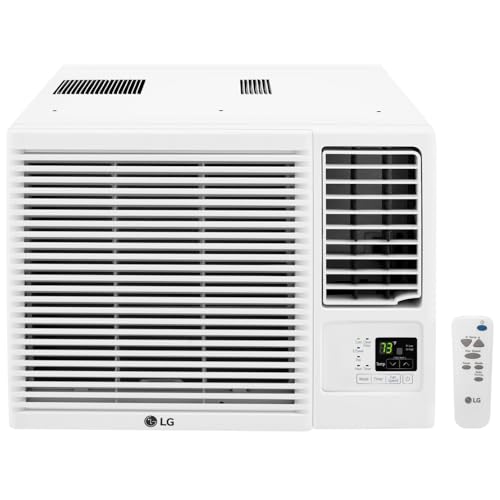
LG sells this as an AC and heater combination for a bedroom or living room of about 330 square feet, with supplemental heat for cooler days, two speeds each for cooling, heating and fan, and a remote. It runs on a standard 115V circuit, which is the single most useful fact on the page, because the larger heat units need a different outlet.

The heat is described as supplemental, and that is how to think of it. It will take the chill off a bedroom in spring or autumn, but it will not heat a room in a cold winter. Against the Midea inverter it uses a conventional fixed-speed compressor, so the cooling side is less steady, and against the Soleus it lacks the outside compressor layout and the quiet figure.

Ownership is simple: a washable filter and a spring coil clean. If you leave the unit installed over winter, seal the cabinet edges and cover the outside, because an unsealed unit leaks more cold air than the heater adds. Because the heat is supplemental, pair it with a thermostat-controlled setting rather than running it all night, which wastes power for little gain.

What works

  • Standard 115V supply, no new circuit
  • Supplemental heat for shoulder seasons
  • Remote with two speeds in each mode
  • Wide LG service network

Watch out for

  • Heat is supplemental, not primary
  • Fixed-speed compressor cycles
  • Unsealed cabinet leaks cold air in winter

Spec sheet

Cooling capacity
7,600 BTU
Coverage
330 sq ft
Supply
115V
Speeds
2 cooling, heating and fan
Control
Remote and electronic panel
02
Midea 8,000 BTU Smart Inverter Window AC with Heat
8,000 BTUInverterHeat mode5 modes
Check price on Amazon
Best for: A bedroom of about 350 square feet that needs steady cooling and light heat.

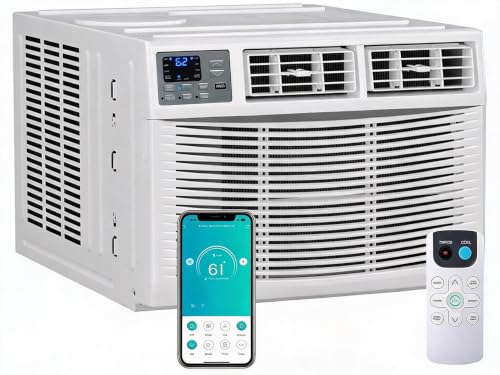
The Midea combines an inverter compressor with heat, dehumidify, auto, cool and fan modes in one 350 square foot unit. The inverter varies compressor speed, which reduces cycling and thump, while the heat mode gives you warmth in the shoulder seasons.

It is the least expensive way to get both a modulating compressor and heat. Compared with the LG 7,600 BTU it covers slightly more area and runs steadier, but the inverter board is a costlier part to replace. It does not state a heating capacity in the data, so judge the heat as a convenience, not a heater.

Ownership includes the filter and coil routine and a decision about winter. If the unit stays in the window, foam the edges and cover the outside, and use the timer so it does not run in an empty room. Resist the urge to leave it on heat mode with the window cabinet unsealed, since the leak around the sash costs more than the heater supplies.

What works

  • Inverter compressor smooths cooling
  • Five modes including heat and dry
  • Covers up to 350 square feet
  • LED display with app control

Watch out for

  • No heating BTU stated in the data
  • Inverter board is costly to replace
  • Heat is a supplement for mild weather

Spec sheet

Cooling capacity
8,000 BTU
Coverage
Up to 350 sq ft
Compressor
Inverter
Modes
Heat, auto, cool, dry, fan
Fan speeds
3
03
Soleus 12,000 BTU Window AC with 10,000 BTU Heater
12,000 BTU cooling10,000 BTU heat38 dB listed115V
Check price on Amazon
Best for: A room that needs real supplemental heat and quiet cooling with a wall opening.

The Soleus is the only unit here that states a heating capacity, 10,000 BTU, alongside 12,000 BTU of cooling on a 115V supply. It straddles the wall, so the noisy parts sit outside, and the listing quotes about 38 dB, similar to a library.

That 10,000 BTU of heat is the number to compare with a space heater: a 1,500 watt plug-in heater produces roughly 5,100 BTU per hour, so the Soleus has real heating output, though a 115V circuit cannot carry that load alongside much else. The tradeoffs are the install, which needs a wall opening rather than a standard sash, and the price, which is higher than the LG or the Midea.

Ownership requires planning the wall opening, sealing and the weight of the outdoor section. Run it on a dedicated circuit, because the heater draws steady current.

What works

  • States 10,000 BTU of heating capacity
  • Listed noise level around 38 dB
  • Straddling design cannot fall out
  • Window stays usable

Watch out for

  • Install needs a wall opening or sleeve
  • Higher price than standard units
  • Heater load needs a dedicated circuit

Spec sheet

Cooling capacity
12,000 BTU
Heating capacity
10,000 BTU
Quiet figure
38 dB, library level
Supply
115V
Wall thickness
Straddles up to 12.5 inch walls
04
LG 18,000 BTU Window AC with Heat, 230/208V, 1,000 sq ft
18,000 BTUSupplemental heat230/208V1,000 sq ft
Check price on Amazon
Best for: A garage, basement or shop up to 1,000 square feet with a 230V outlet.

This LG is the large-room version, rated at 18,000 BTU for up to 1,000 square feet with supplemental heat, two speeds in each mode, a digital control panel and a remote. It runs on 230/208V, which means a dedicated two-pole circuit with the correct plug and breaker.

That voltage requirement is the decisive fact. Few bedrooms have a 230V outlet by the window, so the unit suits a garage, basement, shop or an addition where one was wired in. In return you get cooling and heating capacity that no 115V unit here matches, with LG's wide service network behind it.

Ownership includes a very heavy lift, a sturdy bracket and the usual filter and coil routine. Have an electrician confirm the circuit before you buy, since a wrong plug type is the commonest reason these units are returned.

What works

  • Covers up to 1,000 square feet
  • Supplemental heat with digital controls
  • Brand with wide service coverage
  • Two speeds in each mode

Watch out for

  • Requires a 230/208V circuit
  • Very heavy for a window install
  • Heat is supplemental

Spec sheet

Cooling capacity
18,000 BTU
Coverage
Up to 1,000 sq ft
Supply
230/208V
Speeds
2 cooling, heating and fan
Control
Digital panel and remote
05
18,000 BTU 4-in-1 Window AC and Heater Combo with App
18,000 BTUCool, heat, dry, fanApp and voice5 modes
Check price on Amazon
Best for: A buyer who wants app and voice control on a large heating and cooling unit.

This unbranded-style 18,000 BTU combo offers cooling, heating, dehumidification and fan modes, with control by app, remote, panel or voice command and five operation modes in total. The data does not give a brand name, a voltage or a heating capacity, so confirm those on the listing before you buy.

Its selling point is the feature list: app and voice control on a large unit at a lower price tier than the LG 18,000 BTU. Its risk is support. Without a recognizable service network, a failed board or compressor becomes the seller's problem, and the data does not state a warranty.

Ownership is the usual filter and coil routine. At this size, check the electrical requirements on the nameplate and confirm the plug type, because many 18,000 BTU units require 230V. Ask the seller for the model number and warranty terms in writing before you order, because the listing data is thin on both.

What works

  • Four main modes in one large unit
  • App, remote, panel and voice control
  • Lower price tier than the LG 18,000 BTU
  • Rated for year-round use

Watch out for

  • No brand, voltage or heating capacity in the data
  • Support depends on the seller
  • Heavy, large cabinet

Spec sheet

Cooling capacity
18,000 BTU
Modes
Cool, heat, dehumidify, fan, plus
Control
App, remote, panel, voice
Voice
Alexa and compatible assistants
Use
Year-round comfort
06
Seasons 23,200 BTU 230/208V Window AC with Heat
23,200 BTU230/208V24-hour timerSleep mode
Check price on Amazon
Best for: A large shop, garage or basement over 1,000 square feet with a 230V circuit.

The Seasons is the largest unit in the lineup at 23,200 BTU, with heat, three fan speeds, three cooling modes, auto-restart, a programmable 24-hour timer, an energy-saver mode and a sleep mode. It requires a 230/208V supply.

At this size it is a shop, garage, large basement or commercial-style space unit, not a bedroom unit. Compared with the LG 18,000 BTU it adds more than 5,000 BTU of capacity, but a window cabinet this large is a serious weight and needs proper support. Cycles are long and the current draw is high.

Ownership requires an electrician for the circuit, a heavy-duty bracket and filter and coil care. Auto-restart is useful after a power cut, and the timer helps avoid running an empty space.

What works

  • Largest capacity here at 23,200 BTU
  • Programmable 24-hour timer
  • Auto-restart after power loss
  • Sleep and energy-saver modes

Watch out for

  • Needs a 230/208V circuit
  • Very heavy cabinet needs strong support
  • Oversized for any residential bedroom

Spec sheet

Cooling capacity
23,200 BTU
Supply
230/208V
Fan speeds
3
Timer
Programmable 24-hour on and off
Extras
Auto-restart, energy saver, sleep mode

Spec sheet decoder

What the numbers on the box really mean

The specs manufacturers lead with, translated into what they tell you about real-world performance.

Supplemental heat

A heating function intended to add warmth, not to replace a furnace. It is usually electric resistance.

Watch forThe LG 7,600 and 18,000 BTU describe heat this way, and no capacity is given.

Heating BTU

The warmth output per hour in heat mode. A watt of resistance heat yields 3.412 BTU per hour.

Watch forOnly the Soleus lists one, at 10,000 BTU.

230/208V

A two-phase supply used for large appliances, requiring a two-pole breaker and a specific plug.

Watch forThe LG 18,000 BTU and Seasons 23,200 BTU need it, and the others use 115V.

Inverter

A compressor that modulates speed instead of switching on and off, smoothing cooling.

Watch forThe Midea 8,000 BTU is the only inverter here.

Auto-restart

A feature that resumes the last setting after a power cut.

Watch forThe Seasons lists it, which helps for an unattended space.

Methodology

How We Evaluated These Window Air Conditioners with Heat

Heat claims

We separated units that state a heating capacity from those that only mention supplemental heat. The Soleus at 10,000 BTU is the only stated figure, so the others were scored cautiously.

Electrical fit

We counted the supply voltage as part of the product. The 115V models avoid an electrician, while the LG 18,000 BTU and Seasons 23,200 BTU need 230/208V and scored lower on ease.

Cooling quality

We compared compressor type and capacity, giving credit to the Midea inverter and noting the Soleus listed 38 dB. Heat was not allowed to excuse weak cooling.

Features and controls

We weighed apps, voice, timers and auto-restart. The Seasons and the 18,000 BTU combo carry the longest feature lists, but the LG offers the simplest controls.

Support

We considered brand service networks and the clarity of the listing, based on owner feedback patterns. LG scored best, and the unbranded combo lost points for missing details.

Decision guide

How to Choose the Right Window Air Conditioners with Heat

By Room Size

SituationPickWhy
Bedroom up to 330 sq ftLG 7,600 BTU with Heat115V, supplemental heat
Bedroom up to 350 sq ftMidea 8,000 BTU InverterInverter and heat
Large room needing heatSoleus 12,000 BTU10,000 BTU heater
Garage or shop near 1,000 sq ftLG 18,000 BTU with Heat230/208V capacity

By Budget

SituationPickWhy
Lowest cost entryLG 7,600 BTU with HeatSimplest, 115V
Mid-range inverterMidea 8,000 BTU InverterSteady cooling
Lower price for large unit18,000 BTU 4-in-1 ComboApp and voice
Highest outlay for quiet heatSoleus 12,000 BTUStated heating capacity

115V vs 230/208V

115V

The LG 7,600 BTU, Midea 8,000 BTU and Soleus plug into a standard dedicated circuit. They suit bedrooms and living rooms, and the heat is limited by what 115V can supply.

230/208V

The LG 18,000 BTU and Seasons 23,200 BTU deliver far more capacity but need a two-pole circuit. They suit garages, shops and basements.

Choose 115V unless the space truly needs more than about 12,000 BTU.

Heat Expectations

SituationPickWhy
Take the chill off a bedroomLG 7,600 BTU with HeatSupplemental heat
Real heat output with a stated figureSoleus 12,000 BTU10,000 BTU listed
Heat a large garage on 230VSeasons 23,200 BTULargest capacity
Cooling with occasional heatMidea 8,000 BTU InverterFive modes

For Shoulder Seasons Specifically

Look for

A unit that heats a bedroom on a 50F morning without a new circuit, and a seal that survives being left in. Heating capacity is secondary to a tight install.

In this comparison

The LG 7,600 BTU and Midea 8,000 BTU do this on 115V. The Soleus is the strongest if you can mount it in a wall opening.

When to Spend More

Spend more if

You want quiet, steady cooling plus real heating output. The Soleus 12,000 BTU or the Midea 8,000 BTU inverter reward that spend.

Save if

You only need the heat occasionally. The LG 7,600 BTU with Heat does the job for less.

Ownership

Maintenance schedule

The upkeep that decides whether this machine lasts two seasons or ten.

TaskIntervalWhy it matters
Wash the filterEvery 2 to 4 weeksA clogged filter chokes airflow in both cooling and heating, and a heater with poor airflow can overheat.
Clean the coilsEach springDust cuts heat transfer. A soft brush restores performance.
Check the power cord and outletEach seasonHeating draws steady high current, so a warm plug is a warning. Replace damaged cords and outlets.
Seal and cover for winterEach autumnGaps leak cold air and make the heater work harder. Foam the edges and cover the outside.
Confirm drainageEach installA slight outward tilt drains condensate outside. A level unit drips into the room.

FAQ

Frequently Asked Questions

Can a window AC with heat replace my furnace?

No. The heat is supplemental and costs more per degree than a heat pump or gas heat. It suits chilly mornings in spring and autumn, not a cold winter.

Do I need a 230V outlet?

Only for the larger units such as the LG 18,000 BTU and the Seasons 23,200 BTU. The LG 7,600 BTU, Midea 8,000 BTU and Soleus run on a standard 115V circuit.

How does the heat work?

Most use an electric resistance element, like a space heater built into the cabinet. Each kilowatt produces about 3,412 BTU per hour, which is why the heat is expensive to run. A heat pump moves heat instead of making it, which is why mini splits cost far less to run for winter use.

Can I leave a unit with heat installed in winter?

You can, but seal the cabinet gaps and cover the outside. An unsealed unit leaks cold air and defeats the purpose.

Is an inverter useful with heat?

For cooling, yes, because it steadies the temperature. The heat function is separate, so do not expect inverter efficiency in heating mode.

Which unit is best for a garage?

The LG 18,000 BTU or the Seasons 23,200 BTU, provided you have a 230V circuit. The 4-in-1 combo is cheaper but give less support and no stated electrical details. Check the nameplate for amperage and the plug shape before ordering any 230V unit.

Bottom line

The short version

Browse more window air conditioners with heaton Amazon →
James Miller, Lead Machine Editor

About the author

James Miller

Lead Machine Editor, MachineFanatic

James Miller leads MachineFanatic's buying guides, turning spec sheets, manuals and owner feedback into clear verdicts on power tools, outdoor power equipment, shop machines and kitchen machines.

More from James →

Keep reading

Related guides