
Amazon affiliate links - we earn a commission.Affiliate disclosure

Buying guide · 12 min read · Updated 2026-11-07

Best 1500W Inverters for Camping (2026)

Seven 1500W camping inverters, including 12V, 24V and dual-input units, compared on waveform, ports, protections and the battery you need to run them.

James MillerBy James MillerLead Machine Editor7 machines comparedSpec-sheet verified
Best 1500W Inverters for Camping

At a glance

Our top picks

Side by side

Spec comparison

Camping asks different things of an inverter than a permanent RV install. The unit lives in a truck bed, a trailer tongue box or the back of a van, gets bumped around, and is often connected to a deep-cycle battery or a small solar setup rather than a big house bank. Dust, damp and temperature swings are as much a part of the job as the electrical load.

That changes what matters: input voltage flexibility, a rugged case, readable fault codes and ports for phones and cameras. The picks below are judged on those points, with each one placed against the kind of trip it suits.

Before you buy

6 Criteria to Look For Before Buying a 1500W Inverter for Camping

  1. 01

    Battery voltage match

    Inverters are built for a specific input: 12 volt, 24 volt or auto-detect. A 1500W unit on 12 volts draws roughly 140 amps, while on 24 volts it draws about 70. The XUYUAN adapts, the TAGEEBLU needs 24 volts, and the rest need 12. Match the inverter to the battery you already own.

  2. 02

    Waveform type

    Pure sine output suits laptops, camera chargers and motors, while modified sine can cause buzzing and heat. Six picks are pure sine, and the Cantonape is modified. Check the labels of the devices you charge before choosing the cheaper waveform. Medical devices like CPAP machines should always use pure sine.

  3. 03

    Rugged housing and mounting

    Camping puts an inverter in a truck bed or tool box where it vibrates and collects dust. The XUYUAN lists a magnesium-aluminum housing that conducts heat out, and most others use plastic and steel cases. Mount the unit on a solid surface with clear vents. Avoid wedging it between gear.

  4. 04

    Cable length and gauge

    A 1500W load on 12 volts needs thick cable on a short run. The BELTTT includes three-foot thicker cables, while others expect you to supply them. Longer cable needs a larger gauge to avoid voltage drop. A thin cable is the most common reason a new inverter trips.

  5. 05

    Ports for small devices

    Phones, cameras and lights are the main camping loads, so USB and Type-C matter. The XUYUAN offers Type-C and a 5 amp USB output, and the ZETAWALE adds Type-C. Running an inverter just to charge a phone wastes battery, so built-in ports avoid that. Count the devices you plan to charge.

  6. 06

    Idle draw and runtime

    An inverter left on with no load still drains the battery. The EFFORTWAY states low no-load loss, but most units idle at a few watts to over ten. On a 100Ah battery that adds up over a weekend. Switch the unit off between uses, and size your battery for real watt-hours.

Detailed reviews

The 7 best 1500w inverters for camping, explained

01
XUYUAN 1500W Pure Sine Inverter, 12V or 24V
1500W continuous12V/24V autoType-C fast chargeMetal case
Check price on Amazon
Best for: Campers who move between 12 volt and 24 volt batteries and want rugged, well-instrumented power.

XUYUAN detects whether the battery is 12 volts or 24 volts and adapts, which is unusual and handy if you swap between a vehicle battery and a larger camping bank. It lists a fully isolated architecture, a colour LCD that shows voltages and fault codes, and a magnesium-aluminum housing that doubles as a heat sink. Type-C fast charging and a 5 volt, 5 amp USB output cover phones and tablets.

The compromise is that auto-detect adds a failure mode if the battery voltage is ambiguous, such as a deeply discharged 24 volt bank that reads like a 12 volt one. Read the manual and confirm the detection before first use. Against the TAGEEBLU 24V, it is more flexible but less specialised.

Plan for the physical demands of camping. A metal case copes better with rattling in a truck bed, but it still needs ventilation and shade, and the DC cable must be strain-relieved. Fuse near the battery and keep the run short. Carry a printed note of the detected voltage and the cutoff settings, since a fault at a remote site is easier to solve with the numbers in hand.

What works

  • Auto-detects 12 or 24 volt input
  • Metal housing for rough transport
  • Color LCD with fault codes
  • Type-C and 5 amp USB charging

Watch out for

  • Auto-detect needs checking on a drained bank
  • Less proven brand than larger names

Spec sheet

Continuous output
1500W
Peak
3000W
Input
12V or 24V auto-detect
Housing
Magnesium-aluminum
Ports
Type-C, USB 5V/5A, AC
02
ZETAWALE 1500W Pure Sine Inverter, 4 Outlets
1500W pure sine3000W peak4 AC outletsLCD remote
Check price on Amazon
Best for: Group camp setups where several people charge and cook from one inverter.

ZETAWALE gives four AC outlets, a hardwire terminal, USB and Type-C ports and an LCD remote, which suits a camp kitchen where several people want power at once. The listing describes a heat dissipation approach that does not rely only on a fan and the outer shell. It is a pure sine unit with a 3000W peak.

The drawback is footprint and the lack of a published distortion number, so sensitive gear has less assurance than with a unit that states it. The four outlets also share the one 1500W limit, which people forget when a slow cooker, a kettle and chargers all connect.

For a base-camp trailer it is a good fit. Mount it on a solid panel, give the vents room and let the LCD remote reach the cooking area. A neat trick is to leave the hardwire terminal covered and use only the outlets unless you have an installer.

What works

  • Four AC outlets plus a hardwire terminal
  • LCD remote for use away from the unit
  • USB and Type-C ports included
  • Pure sine output

Watch out for

  • No published distortion figure
  • Large for tight vehicle spaces

Spec sheet

Continuous output
1500W
Peak
3000W
AC outlets
4
Terminal
1 hardwire
Remote
LCD
03
BELTTT 1500W Pure Sine Inverter, 3 ft Cables
1500W pure sine3000W surgeDual AC3 ft cables
Check price on Amazon
Best for: First-time buyers who want a short, thick cable set included in the box.

BELTTT supplies its own three-foot battery cables, which removes one of the most common first-time mistakes: buying cable that is too thin. The unit has dual AC outlets, a 5 volt 2.1 amp USB port and a smart LCD for input and output readings. The output is pure sine with a 3000W surge.

The trade is that three feet is a fixed length, so if your battery sits farther away you must either relocate the inverter or buy heavier extension cable. Compared with the XUYUAN, it is simpler but lacks 24 volt flexibility.

For car or truck camping it is a convenient kit. Clamp the cables to a deep-cycle battery, mount the unit where air moves, and check the supplied lugs are tight before trips. Coil any spare cable loosely and secure it, since a loose heavy cable can short against metal in a bouncing truck bed.

What works

  • Includes three-foot thicker cables
  • Dual AC outlets plus USB
  • Smart LCD shows input and output
  • Pure sine output

Watch out for

  • Fixed cable length limits placement
  • No 24 volt option

Spec sheet

Continuous output
1500W
Surge
3000W
AC outlets
Dual
USB
5V 2.1A
Cables
3 ft thicker cables supplied
04
Vansdon 1500W Pure Sine Inverter, Low THD
1500W continuous3000W surgeTHD 3 to 4%Regulated output
Check price on Amazon
Best for: Campers charging cameras, drones and laptops who want the cleanest stated power.

Vansdon states distortion of only three to four percent and a regulated output voltage, which suits camera chargers, laptops and drone batteries that dislike ragged power. It converts 12 volt battery power to household voltage at 1500W continuous with a 3000W surge.

What you lose is features. There is no 24 volt option, no fast charging port headline and no metal-case ruggedness claim, so it is a plain electrical box. Beside the BELTTT it asks you to supply your own cable.

For camping with electronics, the clean output is the point. Pair it with a deep-cycle battery, fuse near the terminal and keep the unit shaded. Pair it with a battery monitor so you can see how many hours remain, which the inverter itself cannot tell you.

What works

  • Distortion stated at 3 to 4 percent
  • Output regulated as the battery sags
  • Pure sine suits electronics
  • 3000W surge allowance

Watch out for

  • Cables not supplied
  • Fewer ports than rivals

Spec sheet

Continuous output
1500W
Surge
3000W
Distortion
3 to 4% THD
Regulation
Stable output across input range
Input
12V DC
05
EFFORTWAY 1500W Pure Sine Inverter, 3 Outlets
1500W pure sine3000W surge90% efficient3 AC outlets
Check price on Amazon
Best for: Weekend campers who want a low-cost unit with a stated efficiency figure.

EFFORTWAY lists efficiency up to 90 percent with low no-load loss, which matters on a trip where the battery has to last through the night. It supplies three AC outlets and two USB-A ports in a conventional case.

The efficiency number is a best case, and the unit has no remote or Type-C port, so it is more basic than the ZETAWALE or XUYUAN. It sits in the lower price tiers, which is why it ranks as the value choice.

It suits weekend trips with a few devices and one cooking appliance at a time. Turn it off when idle to save the battery. Keep it in the shade of a cooler or cab, because direct sun on the case reduces how long it can run at full load.

What works

  • Low no-load loss stated
  • Three AC outlets and two USB ports
  • Pure sine at 1500W continuous
  • Lower relative price tier

Watch out for

  • No remote or Type-C port
  • Efficiency is a best-case claim

Spec sheet

Continuous output
1500W
Surge
3000W
Efficiency
Up to 90%
AC outlets
3
USB
2 USB-A fast ports
06
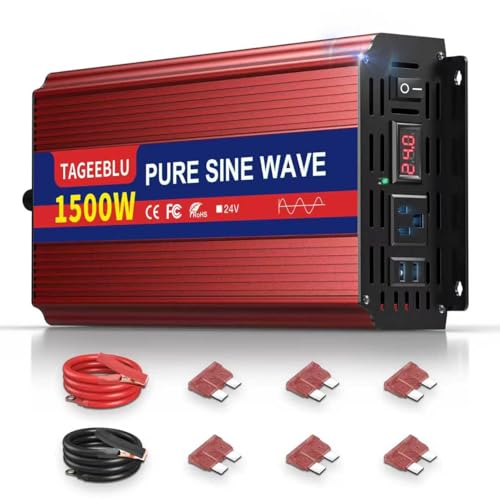
TAGEEBLU 24V 1500W Pure Sine Inverter
24V input1500W pure sine2 AC outletsLCD display
Check price on Amazon
Best for: Campers with an existing 24 volt battery bank who want lighter cable and lower current.

TAGEEBLU is built for a 24 volt battery, which halves the current compared with a 12 volt system at the same power. At 1500W a 24 volt system draws roughly 65 to 70 amps instead of about 140, so cable is lighter and voltage drop is smaller. It has two AC outlets and an LCD.

It only works with 24 volt batteries, so it is the wrong choice if you have a standard 12 volt car battery. The listing also warns that startup surge for several appliances can be three to six times rated power, which is a useful reminder that motors need headroom.

It makes sense for a trailer or truck-camper that already runs a 24 volt bank or for a solar setup built around it. Check your bank voltage with a meter before connecting, since a mismatch is the most common way to damage this kind of unit.

What works

  • 24 volt input halves battery current
  • Lighter cable requirements
  • LCD display for readings
  • Pure sine output

Watch out for

  • Useless on a 12 volt battery
  • Only two AC outlets

Spec sheet

Continuous output
1500W
Input
24V DC
AC outlets
2
Display
LCD
Waveform
Pure sine
07
Cantonape 1500W Modified Sine Inverter
1500W modified sineDual ACDual USBLED display
Check price on Amazon
Best for: Budget campers running lights and simple resistive loads only.

Cantonape is the lowest-priced unit here and the only one that is modified sine, which is a stepped approximation of the grid waveform. It lists dual AC outlets, dual 3.1 amp USB ports and an LED display, plus six protections including reverse polarity.

The waveform is the compromise. Modified sine can make motors buzz and run warm, can confuse some chargers and is a poor match for audio gear, CPAP machines and some battery chargers. For lights, a simple heater element or a basic charger it is fine.

Buy it only if your loads are simple and your budget is tight. Otherwise, step up to any pure sine unit above. If you do use it, avoid running a drill or a blender from it, and keep it to loads where a rougher waveform does no harm.

What works

  • Lowest relative price in the group
  • Six protections including reverse polarity
  • LED shows voltage and power
  • Dual AC and dual USB

Watch out for

  • Modified sine waveform
  • Not suited to motors or sensitive electronics

Spec sheet

Continuous output
1500W
Waveform
Modified sine
AC outlets
Dual
Protections
6 kinds
Display
LED voltage and power

Spec sheet decoder

What the numbers on the box really mean

The specs manufacturers lead with, translated into what they tell you about real-world performance.

Pure vs modified sine

Pure sine matches grid power; modified sine is a stepped approximation. Pure sine is gentler on electronics and motors.

Watch forThe Cantonape is the only modified sine unit in this lineup.

Input voltage

The nominal battery voltage the inverter expects. Higher input voltage means lower current for the same power.

Watch forThe XUYUAN auto-detects 12 or 24 volts and the TAGEEBLU needs 24 volts.

Peak versus continuous

Continuous is the sustained limit. Peak is a short allowance for startup surges.

Watch forAll pure sine units list 3000W peak on a 1500W rating without a stated duration.

THD percent

Total harmonic distortion shows how clean the waveform is. Lower is better for sensitive devices.

Watch forOnly the Vansdon states a figure, three to four percent.

Fault codes

Displayed messages that identify the cause of a shutdown. They save time in the field.

Watch forThe XUYUAN and BELTTT show readings and fault information on screen.

Methodology

How We Evaluated These 1500W Inverters for Camping

Camping suitability

We judged how each unit copes with rough transport, shaded mounting and a fluctuating battery. The XUYUAN's metal housing and input flexibility stood out. Rugged design matters more than brand for outdoor use.

Waveform and electronics safety

We separated pure sine units from the modified sine Cantonape, and looked for published distortion. The Vansdon states three to four percent. Cleaner output protects camera and laptop chargers.

Input voltage flexibility

We compared 12 volt, 24 volt and auto-detect inputs. The XUYUAN adapts, the TAGEEBLU commits to 24 volts and the rest need 12. Flexibility reduces mistakes when batteries change.

Ports and convenience

We counted AC outlets and USB or Type-C ports, from the ZETAWALE's four outlets to the XUYUAN's fast charging. Convenience reduces the number of adapters needed. We weighed this against bulk.

Value and idle draw

We placed units on relative price tiers and noted efficiency claims such as the EFFORTWAY's up to 90 percent. Low idle draw saves battery on long trips. We treated claims as best cases.

Decision guide

How to Choose the Right 1500W Inverters for Camping

By Battery Type

SituationPickWhy
12 volt car or deep-cycle batteryVansdon 1500WClean output on a standard 12 volt system
Mixed 12 and 24 volt batteriesXUYUAN 1500WAuto-detects input voltage
24 volt trailer bankTAGEEBLU 24V 1500WHalf the current of a 12 volt unit
Short run from truck batteryBELTTT 1500WIncludes three-foot thicker cables

By Budget

TierPickWhy
LowestCantonape 1500WModified sine for simple loads
LowEFFORTWAY 1500WPure sine with stated efficiency
MiddleXUYUAN 1500WFlexible input and fast charging
HigherZETAWALE 1500WFour outlets and hardwire terminal

12 Volt vs 24 Volt Systems

12 volt

Most vehicles use 12 volts, so the BELTTT, Vansdon and EFFORTWAY connect directly. The drawback is current: 1500W draws about 140 amps and demands thick cable.

24 volt

The TAGEEBLU halves the current, which means lighter cable and less voltage drop. It requires a 24 volt battery, so it suits a dedicated bank.

Choose 12 volt for vehicles; choose 24 volt only if you already own the bank.

Charging Ports

PreferencePickWhy
Fast Type-C and 5 amp USBXUYUAN 1500WType-C fast charging
Many outlets for a groupZETAWALE 1500WFour AC outlets
Basic USBEFFORTWAY 1500WTwo USB-A ports
AC outlets onlyTAGEEBLU 24V 1500WTwo AC outlets

For Camera and Drone Charging Specifically

Look for

Pure sine output and stated low distortion. Chargers run cooler and last longer on clean power.

In this comparison

The Vansdon states three to four percent distortion, and the XUYUAN adds Type-C ports for direct charging.

When to Spend More

Spend more if

You camp often, run sensitive gear or switch batteries. The XUYUAN or ZETAWALE pays back in convenience.

Save if

You run simple loads a few weekends a year. The EFFORTWAY or Cantonape cover basics.

Ownership

Maintenance schedule

The upkeep that decides whether this machine lasts two seasons or ten.

TaskIntervalWhy it matters
Check cable clampsBefore each tripClamps can loosen in transport. A loose clamp heats and causes shutdowns. Take a minute to look over the lugs for green corrosion as well.
Wipe and dry the caseAfter each tripDust and moisture collect in vents. Keep the unit dry before storage.
Test with a known loadBefore each seasonRun a kettle or heater for ten minutes. This confirms stable output before you rely on it.
Inspect fuse and cableEvery six monthsLook for discoloured insulation or a warm fuse holder. Replace damaged parts.
Store charged and disconnectedOff seasonDisconnect the inverter from the battery to prevent idle drain. This also avoids accidental shorts.

FAQ

Frequently Asked Questions

Can I run a 1500W inverter off a car battery?

Only with the engine running or for short bursts. A starter battery is not designed for deep discharge. Use a deep-cycle battery or a power bank for extended use.

Is modified sine fine for camping?

For lights and simple heaters, yes. For phones, laptops, CPAP machines and motors, pure sine is safer. Five of the seven here are pure sine. Anything with a motor or a precision charger deserves the cleaner waveform.

How long will a battery power a 1500W load?

A 100Ah lithium battery lasts roughly 40 minutes at full load. Typical camping loads are far lighter, so runtime is longer. Calculate from watt-hours. Heavy loads shorten that sharply, and cold weather reduces usable capacity further.

Do I need a fuse?

Yes. A fuse close to the battery protects the cable from a short. Choose one rated for the cable and the inverter draw.

12 or 24 volt for camping?

Twelve volts is simpler since most vehicles use it. Twenty-four volts reduces current and cable size if you already have the bank. The XUYUAN handles both.

Can I use it with solar panels?

Yes, through a battery and charge controller. The inverter should connect to the battery, not directly to panels. Size the battery for your loads.

Bottom line

The short version

Browse more 1500w inverters for campingon Amazon →
James Miller, Lead Machine Editor

About the author

James Miller

Lead Machine Editor, MachineFanatic

James Miller leads MachineFanatic's buying guides, turning spec sheets, manuals and owner feedback into clear verdicts on power tools, outdoor power equipment, shop machines and kitchen machines.

More from James →

Keep reading

Related guides