
Amazon affiliate links - we earn a commission.Affiliate disclosure

Buying guide · 12 min read · Updated 2026-11-07

Best Power Inverters Under $100 (2026)

Five 12V power inverters under $100, from a 300W pure sine wave unit to a 1000W battery-terminal model, with real limits explained.

James MillerBy James MillerLead Machine Editor5 machines comparedSpec-sheet verified
Best Power Inverters Under $100

At a glance

Our top picks

Side by side

Spec comparison

Moving up from the cheapest inverters buys three things: cleaner waveforms, better charging ports and more honest capacity. The extra money rarely buys brute power, but it does buy a unit that treats sensitive electronics more gently.

The central decision is whether you need clean power or simply more watts. A small clean unit and a large rough unit solve different problems, and mixing them up is the usual buying mistake. Listing prices move, and the $100 cap reflects prices when this guide was updated on 2026-11-07.

Before you buy

6 Criteria to Look For Before Buying a Power Inverter Under $100

  1. 01

    Pure sine versus modified sine

    Pure sine copies grid power, while modified sine is a stepped approximation. The E-POLAR 300W is the only pure sine unit here, and that is why it suits laptops and cameras best. The TWING 1000W, POTEK 500W, VANSOET 400W and Goodway 400W are modified sine class, which can make motors run hot and electronics hum. If the device label mentions a motor or a medical function, choose pure sine.

  2. 02

    Continuous watts against your largest load

    Add the wattage of everything you will run at once, then keep 20 percent spare. A laptop at 65W fits any unit here, while a 600W power tool needs the TWING 1000W. The usual mistake is reading peak numbers as capacity, such as the POTEK's 1000W peak against 500W continuous. Continuous is what the unit can hold, and peak only covers a startup spike.

  3. 03

    Socket versus battery connection

    A lighter socket is fused at 10 to 15A, so it supplies roughly 120 to 180W. The E-POLAR, VANSOET and Goodway fit that world, while the 500W POTEK and 1000W TWING need battery leads to deliver. A 1000W load draws about 90 to 100A at 12V, which is far beyond any plug. Match the connection to the unit before you buy.

  4. 04

    USB-C power delivery

    Modern laptops charge over USB-C at 45 to 65W. The E-POLAR's 60W port can do that directly, while the VANSOET's 30W port suits phones and tablets and the Goodway's 18W port is slow. A slow port is fine for a phone but frustrating for a laptop. Read the wattage, not just the port type.

  5. 05

    Standby draw and switching

    An inverter running with no load still draws current, which can drain a parked battery over days. The VANSOET's dedicated AC switch lets you run only the USB side without waking the inverter stage. Without a switch, unplug the unit when you leave. Standby draw is small but compounds on a weak battery.

  6. 06

    Fuses and cable

    A fuse protects the wiring, and a blown fuse is routine, not a defect. The TWING uses a mini slip fuse, the blade type found in a car fuse box, so spares are cheap. For the 500W and 1000W units, use short, heavy cable and fuse near the battery. Thin cable drops voltage and triggers a premature low-voltage shutdown.

Detailed reviews

The 5 best power inverters under $100, explained

01
E-POLAR 300W pure sine wave inverter, 60W USB-C, 2 AC
300W pure sine2 AC outlets60W USB-C PD2 USB-A ports
Check price on Amazon
Best for: Laptops and USB-C devices where clean power matters.

This is the only pure sine wave unit in the lineup, and that matters more than any other spec at this price. A pure sine output matches grid power, so laptop chargers, camera chargers and sensitive electronics run cooler and quieter than on a stepped waveform. It adds two AC outlets, two USB-A ports and a 60W USB-C power delivery port, which can charge a laptop directly without the AC brick.

The 300W rating is modest next to the 500W POTEK and the 1000W TWING, so it is a clean-power choice, not a capacity choice. It comes with a detachable 3.2 ft input cable using an XT60 connector, which means you can swap the lighter plug for a battery lead if you build one. Through a lighter socket the realistic ceiling is still 120 to 180W.

Ownership is easy because a detachable cable is the part most likely to wear out and it can be replaced alone. The XT60 connector is a common hobby plug, so spare leads are easy to find. Keep it in a spot with airflow, since small units still shed heat under a laptop load.

What works

  • Pure sine output is gentle on laptops and cameras
  • 60W USB-C port charges a laptop without the brick
  • Detachable XT60 input cable is replaceable
  • Two AC outlets and two USB-A ports for sharing

Watch out for

  • 300W is far below the 500W and 1000W units here
  • Lighter socket caps real output near 120 to 180W
  • Not meant for motors or heating appliances

Spec sheet

Continuous output
300W
Waveform
Pure sine
AC outlets
2
USB ports
2 USB-A plus 60W USB-C
Input cable
3.2 ft detachable, XT60
02
TWING 1000W modified sine inverter, dual AC, display
1000W continuousDual AC outletsDigital displayUSB to 2.4A
Check price on Amazon
Best for: Corded tools or a small appliance wired to a vehicle battery.

The TWING is the capacity leader of this price band, with 1000W continuous across two 110V outlets and a digital display. It uses a cooling fan and a mini slip fuse, the same blade type found in a car fuse box. The waveform is modified sine, so it suits tools and chargers better than sensitive audio or medical gear.

At 1000W it has twice the rating of the POTEK 500W and more than three times the E-POLAR 300W. That rating is paper capacity unless you wire it to the battery, because a lighter socket cannot supply the roughly 90 to 100A a full load draws at 12V. Treat it as a clamp-on unit for a vehicle with a healthy battery and the engine running.

Plan for heavy cable and a fuse near the battery, and expect the fan to spin up under load. A mini slip fuse is cheap and easy to swap, so carry spares. Do not run it for long on an idling engine with a weak alternator.

What works

  • 1000W continuous is twice the POTEK 500W
  • Dual AC outlets for two corded loads
  • Digital display shows what the unit is doing
  • Mini slip fuse is cheap and easy to swap

Watch out for

  • Modified sine output limits motor and audio use
  • Needs heavy cable and a battery connection
  • Full load pulls roughly 90 to 100A at 12V

Spec sheet

Continuous output
1000W
Waveform
Modified sine
AC outlets
2
USB output
0 to 2.4A
Cooling and fuse
Fan and mini slip fuse
03
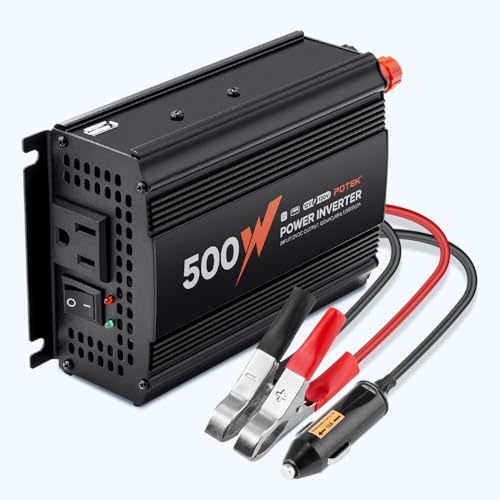
POTEK 500W modified sine inverter, 1000W peak, 2 AC
500W continuous1000W peak2 AC outletsUSB-A port
Check price on Amazon
Best for: Two corded loads that stay under 400W.

The POTEK lists 500W continuous and 1000W peak with two AC outlets and a USB-A port. It is straightforward modified sine, and the listing itself tells you to check waveform compatibility before connecting a device. That honesty is useful, because modified sine is a real limit, not a footnote.

It sits between the E-POLAR 300W and the TWING 1000W, and the price tier reflects that middle position. Against the TWING it has half the capacity but a lighter cable demand, since a 500W load draws roughly 45 to 50A. Against the VANSOET 400W it adds only 100W, so the choice comes down to ports and switch layout.

Ownership is simple. Check the leads and any fuse before the first real load, keep the vents clear, and use it with the engine running for anything beyond charging.

What works

  • 500W continuous with two AC outlets
  • Draws about half the current of the 1000W TWING
  • Listing is upfront about waveform limits
  • Mid price tier within the cap

Watch out for

  • Modified sine only, so motors may run hot
  • Single USB-A port is basic for modern devices
  • Only 100W more than the VANSOET 400W

Spec sheet

Continuous output
500W
Peak output
1000W
Waveform
Modified sine
AC outlets
2
USB output
1 USB-A
04
VANSOET 400W inverter, AC switch, 30W PD USB-C
400W continuous30W PD USB-CAC on/off switchSmart cooling
Check price on Amazon
Best for: Phone and tablet charging with an occasional AC load.

The VANSOET has a dedicated switch for the AC outlets, so you can leave it plugged in and run only the USB side without waking the inverter stage. It adds a 30W power delivery USB-C port and a temperature-based cooling fan. The listing does not claim pure sine, so treat the AC output as modified sine.

At 400W it matches the Goodway on continuous output but adds a faster USB-C port than the Goodway's 18W. Against the E-POLAR it has more AC capacity but half the USB-C power, since the E-POLAR's port delivers 60W. The AC switch is the practical difference, and it saves standby drain when you only need phone charging.

Ownership is easy: a separate switch means you stop the inverter stage without unplugging. Keep the fan intake free of dust, and do not stack bags over it, since a blocked fan shortens its life.

What works

  • Dedicated AC switch cuts standby draw
  • 30W USB-C port charges phones quickly
  • Cooling fan responds to temperature
  • 400W continuous covers small appliances

Watch out for

  • Waveform is not stated as pure sine
  • USB-C power is half the E-POLAR's 60W
  • Lighter socket still limits real output

Spec sheet

Continuous output
400W
USB-C
30W power delivery
AC control
Dedicated on/off switch
Cooling
Fan, temperature based
Waveform
Not stated as pure sine
05
Goodway Power 400W modified sine inverter, USB-C and USB-A
400W continuous1 AC outletUSB-C 18WUSB-A 2.4A
Check price on Amazon
Best for: A small glovebox inverter with one outlet.

The Goodway is built around size: it is described as shorter than a smartphone and lightweight, with one AC socket, one USB-A port at 2.4A and one USB-C port at 18W. The input range is 10 to 15.5V DC and the output is 110 to 120V AC at 60Hz, and it is a modified sine design. That input range is wide enough to tolerate a sagging battery under load.

At 400W continuous it matches the VANSOET, but with a single AC socket and a slower 18W USB-C port. The size advantage is real if glovebox space is tight, and it undercuts the POTEK 500W on capacity by 100W. It is the least feature-rich pick here, which is why it ranks last.

Ownership is minimal, since there is little to service. Keep it out of direct sun on the dash, and do not run it near its limit for long periods.

What works

  • Shorter than a smartphone, easy to stash
  • Wide 10 to 15.5V input tolerates a sagging battery
  • USB-C and USB-A ports on one small body
  • 400W continuous in a compact case

Watch out for

  • Single AC socket only
  • USB-C is limited to 18W
  • Modified sine output, not pure sine

Spec sheet

Continuous output
400W
Input range
10 to 15.5V DC
Output
110 to 120V AC, 60Hz
AC outlets
1
USB ports
USB-A 2.4A, USB-C 18W

Spec sheet decoder

What the numbers on the box really mean

The specs manufacturers lead with, translated into what they tell you about real-world performance.

Continuous versus peak watts

Continuous is what the unit can hold for hours. Peak covers a brief surge, often under a second.

Watch forThe POTEK pairs 500W continuous with 1000W peak, so size to the 500W.

Pure sine wave

An output waveform that matches grid power. It runs electronics and motors more cleanly and more efficiently.

Watch forOnly the E-POLAR 300W claims pure sine in this lineup.

USB-C power delivery

A negotiated charging standard that can deliver tens of watts. Higher wattage charges laptops faster.

Watch forThe E-POLAR offers 60W, the VANSOET 30W and the Goodway 18W.

Input voltage range

The DC voltage window the inverter accepts. A wider window rides through battery sag without shutting down.

Watch forThe Goodway lists 10 to 15.5V, a useful tolerance for a loaded battery.

Mini slip fuse

A blade-type fuse like those in a car fuse box. It is cheap and easy to replace.

Watch forThe TWING 1000W uses one, so carry spares of the right rating.

Methodology

How We Evaluated These Power Inverters Under $100

Waveform and device fit

We evaluated waveform first, because it decides what a unit can safely run. Only the E-POLAR 300W is pure sine, and the other four are modified sine class. Units were scored on how well their waveform matches realistic loads, such as laptop chargers.

Usable capacity

We evaluated continuous output and how reachable it is through the supplied connection. The lineup runs from 300W to 1000W, but a lighter plug caps useful power near 150W. Units that can only deliver their rating on battery leads were scored with that in mind.

Port quality

We looked at USB amperage and USB-C wattage, based on the spec sheet and owner feedback patterns. The E-POLAR's 60W port outranks the VANSOET's 30W and the Goodway's 18W. AC outlet count mattered too, with two outlets on the E-POLAR, TWING and POTEK.

Protection and serviceability

We evaluated listed protections and fuse access. A mini slip fuse on the TWING is a simple field fix, and the detachable cable on the E-POLAR can be replaced alone. Overload, overheat and voltage cutouts were treated as the baseline.

Value inside the cap

We compared capacity and features against price tier. The TWING gives the most watts and the E-POLAR gives the cleanest power. A unit scored well when its extra cost bought something a buyer would actually use.

Decision guide

How to Choose the Right Power Inverters Under $100

By What You Plug In

SituationPickWhy
Laptop and USB-C devicesE-POLAR 300WPure sine and 60W USB-C
Phones and tablets, occasional ACVANSOET 400WDedicated AC switch and 30W USB-C
Two corded loads under 400WPOTEK 500WTwo outlets and 500W continuous
A corded tool on a batteryTWING 1000W1000W continuous across two outlets
One small load, tiny spaceGoodway 400WCompact body with USB-C and USB-A

By Budget

Budget tierPickWhy
Lower end of the lineupGoodway 400WSmall and simple at a low tier
Low to middleE-POLAR 300WPure sine and USB-C for a modest premium
MiddlePOTEK 500WTwo outlets at mid capacity
Upper endTWING 1000WHighest capacity inside the cap

Clean Power vs More Watts

Clean power

The E-POLAR 300W gives pure sine output and a 60W USB-C port. It handles laptops and cameras with less heat and noise. The cost is capacity, since 300W will not run a tool.

More watts

The TWING 1000W and POTEK 500W give capacity, but with a modified sine waveform. They suit corded tools and chargers, and need battery leads for full output. Sensitive electronics may hum or run warm.

Choose the E-POLAR for electronics. Choose the TWING or POTEK for tools.

By Charging Port

PreferencePickWhy
Charge a laptop over USB-CE-POLAR 300W60W power delivery
Fast phone chargingVANSOET 400W30W USB-C
Basic USB chargingGoodway 400W18W USB-C and 2.4A USB-A
USB as a backup onlyTWING 1000WUSB to 2.4A alongside two AC outlets

For Laptop Charging Specifically

Look for

Look for pure sine output and a USB-C port rated for your laptop's wattage, typically 45 to 65W. Laptop chargers draw modest power but are sensitive to waveform. A loud buzz from a modified sine unit is a sign of stress.

In this comparison

The E-POLAR 300W is the clear choice with 60W USB-C and pure sine output. The VANSOET 400W works through its AC outlet or a 30W USB-C port. The Goodway 400W will charge a laptop slowly through its 18W port or its AC socket.

When to Spend More

Spend more if

You need motors, medical gear or a microwave. None of the five picks here suits those jobs, and the TWING 1000W will run hot on a motor. Move to a larger pure sine unit in a higher budget tier.

Save if

You only charge devices. The Goodway 400W or VANSOET 400W covers that, and the extra capacity of the TWING 1000W would sit unused.

Ownership

Maintenance schedule

The upkeep that decides whether this machine lasts two seasons or ten.

TaskIntervalWhy it matters
Inspect plug and cableMonthlyA worn plug or lead heats up and drops voltage. Replace anything scorched or loose.
Check battery clamps and terminalsEvery few usesVibration loosens clamps. A loose connection arcs and heats, so tighten and clean it.
Replace blown fusesAs neededA blown fuse is a normal protective event. Match the rating exactly and never fit a bigger one.
Clean fan and ventsEvery seasonDust blocks cooling and shortens fan life. Blow it clear with compressed air.
Unplug when parkedEvery timeStandby draw drains a weak battery over days. A switch or unplugging stops that.

FAQ

Frequently Asked Questions

Is pure sine worth it under this cap?

Yes, if you charge laptops or run sensitive electronics. The E-POLAR 300W is the one pure sine pick here. If you only charge phones, modified sine is acceptable.

Can the 1000W TWING run off a lighter socket?

No. A lighter socket supplies roughly 120 to 180W, and a 1000W load draws about 90 to 100A at 12V. Use battery leads with a fuse close to the battery.

How long will an inverter run on a car battery?

It depends on load and battery capacity. A starting battery tolerates small loads briefly, so run the engine for anything beyond a charger.

Does a bigger peak number mean more power?

No. Peak only covers a brief startup surge, such as the POTEK's 1000W against 500W continuous. Continuous output is the number to plan around.

Are these inverters safe to leave plugged in?

It is better not to. Even idle units draw current, and a parked car battery can sag over days. Use a switch like the VANSOET's or unplug.

Can I run a microwave on any of these?

Not reliably. Microwaves draw far more than a rated output suggests and prefer pure sine. Choose a much larger pure sine unit for that.

Bottom line

The short version

Browse more power inverters under $100on Amazon →
James Miller, Lead Machine Editor

About the author

James Miller

Lead Machine Editor, MachineFanatic

James Miller leads MachineFanatic's buying guides, turning spec sheets, manuals and owner feedback into clear verdicts on power tools, outdoor power equipment, shop machines and kitchen machines.

More from James →

Keep reading

Related guides