
Amazon affiliate links - we earn a commission.Affiliate disclosure

Buying guide · 12 min read · Updated 2026-11-07

Best Power Inverters Under $300 (2026)

Five power inverters under $300, from a 4000W hardwire-capable unit to a compact pure sine model, with the real battery demands explained.

James MillerBy James MillerLead Machine Editor5 machines comparedSpec-sheet verified
Best Power Inverters Under $300

At a glance

Our top picks

Side by side

Spec comparison

At the top of this budget range the extra money buys capacity, terminals and outlets that can handle serious loads. It does not buy a magic fix for the battery behind the inverter, which is the real limit at this size.

Because the range stretches from small clean units to very large ones, the useful question is how big your single heaviest load is. Pick for that load, then check the cable, fuse and battery. Listing prices move, and the $300 cap reflects prices when this guide was updated on 2026-11-07.

Before you buy

6 Criteria to Look For Before Buying a Power Inverter Under $300

  1. 01

    Your single heaviest load

    Capacity should follow your largest single load, not the sum of every gadget you own. The LVYUAN 4000W suits loads near 3000W, the TVNIKD 2500W suits loads near 2000W and the BELTTT 1000W suits loads near 800W. Buyers who pick the biggest unit usually find they use a fraction of it. Add 20 percent margin to the heaviest load and stop there. A coffee maker, a space heater and a hair dryer each draw 1000 to 1500W, so running two at once crosses the 2500W mark quickly.

  2. 02

    Battery bank and cable

    DC current is AC watts divided by 12, plus losses. A 4000W load draws roughly 350A, a 2500W load roughly 220 to 230A and a 1000W load roughly 90 to 100A. Such currents demand very heavy cable, a large fuse and a deep-cycle battery bank. The inverter is the cheap part of the system. A deep-cycle bank is rated in amp-hours, and half of that rating is the usable amount in practice.

  3. 03

    Pure sine versus modified sine

    The BELTTT 1000W and E-POLAR 300W are pure sine, while the TVNIKD 2500W and MOVFFGGRM 500W are modified sine class. Pure sine suits motors, laptops and sensitive electronics. Modified sine is fine for resistive loads. The LVYUAN does not claim pure sine, so check device labels before connecting a motor. Pure sine also runs at higher efficiency, so less battery power turns into heat.

  4. 04

    Hardwire terminal versus plug outlets

    The LVYUAN has a hardwire terminal for a fixed circuit, and the others rely on plug outlets. A standard outlet is rated for about 1800W, so a larger load needs the terminal. A hardwired install should follow local electrical rules and use a qualified installer. A terminal is a capability, not a convenience.

  5. 05

    Surge and peak ratings

    The LVYUAN lists 8000W peak, the BELTTT lists 2000W peak and the MOVFFGGRM lists 1000W peak. Peak only covers a startup spike lasting a moment. Plan for continuous output and treat peak as margin for motor starts. A compressor can need a surge each time it cycles on. Motor loads with a high startup draw, such as a well pump, are where peak ratings are actually used.

  6. 06

    Remote and display

    The LVYUAN has a 16.4 ft wired remote and the BELTTT has an LCD that shows input and output. These help when the unit is hidden or the battery sags. They add no capacity, so do not pay for them if your loads are small. A display is most valuable on a unit that runs near its limit.

Detailed reviews

The 5 best power inverters under $300, explained

01
LVYUAN 4000W inverter, 8000W peak, 4 AC, hardwire, remote
4000W continuous8000W peak4 AC outletsHardwire terminal
Check price on Amazon
Best for: A fixed install feeding a panel or several heavy loads.

The LVYUAN is the highest-capacity unit in the lineup, with 4000W continuous and 8000W peak. It has four AC outlets, one USB port, a hardwire terminal and an LCD display, plus a 16.4 ft wired remote. The hardwire terminal lets it feed a panel or a fixed circuit rather than a plug.

At 4000W it is well above the TVNIKD 2500W and four times the BELTTT 1000W. That capacity is a serious commitment, because a 4000W load draws roughly 350A at 12V. It needs very heavy cable, a large fuse and a battery bank built for it, and a starting battery will not do.

Plan the install as a project: short heavy cable, a proper fuse near the battery, secure mounting and airflow. The wired remote helps when the unit sits in a truck bed or cabinet. Buy this only if loads near 3000W are on your list.

What works

  • 4000W continuous is the top capacity here
  • Hardwire terminal supports a fixed circuit
  • Four AC outlets for several loads
  • 16.4 ft wired remote suits hidden mounting

Watch out for

  • Full load pulls roughly 350A at 12V
  • Needs a big battery bank and very heavy cable
  • Far more capacity than most buyers need

Spec sheet

Continuous output
4000W
Peak output
8000W
AC outlets
4, plus hardwire terminal
USB output
1 port
Remote
16.4 ft wired
02
TVNIKD 2500W inverter, 3 AC outlets, USB, LCD, ten 30A fuses
2500W continuous3 AC outletsTen 30A fusesLCD display
Check price on Amazon
Best for: Camper and work truck loads that need real capacity.

The TVNIKD sits at 2500W with three AC outlets, one 2A USB port and an LCD battery readout. Its ten built-in 30A fuses protect the unit, and the listing does not claim pure sine, so treat the output as modified sine. It is the practical middle of the lineup.

Against the LVYUAN 4000W it gives up 1500W but needs a more manageable 220 to 230A at full load. Against the BELTTT 1000W it has two and a half times the capacity but a stepped waveform. Its three outlets share the rating, so more sockets do not mean more capacity.

This is a good fit for a camper, a work truck or a small shop with resistive and tool loads. Fit heavy cable and a fuse near the battery, and do not rely on the internal fuses alone. Keep the engine running during heavy use.

What works

  • 2500W continuous with a more manageable draw
  • Three outlets for several corded loads
  • Ten built-in 30A fuses add protection
  • LCD shows live battery status

Watch out for

  • Modified sine output, not pure sine
  • Full load pulls roughly 220 to 230A at 12V
  • Only one 2A USB port

Spec sheet

Continuous output
2500W
AC outlets
3
USB output
1 port, 2A
Fuses
Ten 30A, built in
Display
LCD battery status
03
BELTTT 1000W pure sine inverter, 2000W peak, LCD, dual AC
1000W pure sine2000W peakDual AC outletsLCD display
Check price on Amazon
Best for: Clean power at moderate capacity without a big battery bank.

The BELTTT 1000W is the only unit here that is both pure sine and at the middle of the capacity range. It has dual AC outlets, a 5V 2.1A USB port and an LCD display, with 2000W peak over its 1000W continuous. For laptops, small motors and sensitive chargers it is the cleanest option in the lineup.

It has a quarter of the LVYUAN's capacity but asks for roughly 90 to 100A instead of 350A, which a healthy vehicle battery can supply. Against the E-POLAR 300W it adds more than three times the capacity, and against the TVNIKD it adds clean output. For many buyers this is the right place to stop.

Keep the cable short and heavy, and fuse close to the battery. The LCD makes a sagging battery easy to spot before shutdown. If your largest load stays under 800W, spending more on this page buys capacity you will not use.

What works

  • Pure sine output at moderate capacity
  • Draws about a quarter of the LVYUAN's current
  • Dual outlets and an LCD display
  • Easy to mount and cool

Watch out for

  • 1000W is too small for high-current tools
  • Single 2.1A USB port is basic
  • Still needs battery leads and a fuse

Spec sheet

Continuous output
1000W
Peak output
2000W
Waveform
Pure sine
AC outlets
2
USB output
5V 2.1A
04
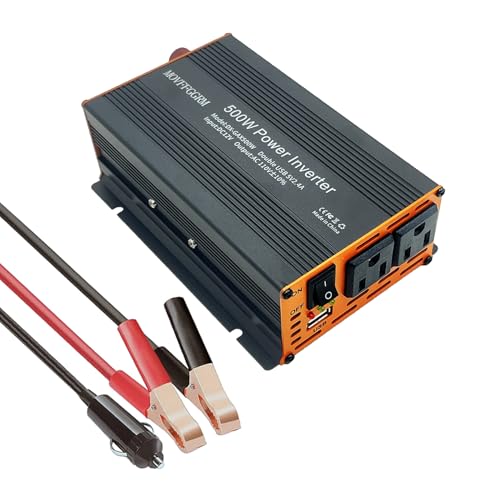
MOVFFGGRM 500W modified sine inverter, 1000W peak, 2 AC
500W continuous1000W peak2 AC outlets1 USB port
Check price on Amazon
Best for: Light corded loads at the lowest price tier.

The MOVFFGGRM is the lowest price tier in the lineup, with 500W continuous, 1000W peak, two AC outlets and one USB output. It is modified sine and lists protection against overheating, voltage faults, short circuit and overload. It can run from a 12V socket or by wire.

Against the BELTTT 1000W it has half the capacity and a stepped waveform, and against the LVYUAN it is an eighth of the size. Its strength is that it asks only roughly 45 to 50A at full load, so a normal battery handles it easily. It is the choice if you need a modest second outlet and nothing more.

It comes from a lesser-known brand, so inspect the leads and fuse before the first real load. Keep the load under 500W and the vents clear. Treat it as a light-duty unit for tools that stay under about 400W.

What works

  • Lowest price tier in this lineup
  • Two AC outlets at 500W continuous
  • Draws only roughly 45 to 50A at full load
  • Listed protections cover common faults

Watch out for

  • Modified sine output limits motors and audio
  • Lesser-known brand with thin support history
  • Only one USB port

Spec sheet

Continuous output
500W
Peak output
1000W
Waveform
Modified sine
AC outlets
2
USB output
1 port
05
E-POLAR 300W pure sine inverter, 60W USB-C, 2 AC
300W pure sine2 AC outlets60W USB-C PD2 USB-A ports
Check price on Amazon
Best for: Laptops and USB-C devices where clean power matters.

The E-POLAR is a small pure sine unit with two AC outlets, two USB-A ports and a 60W USB-C power delivery port. Its input is a 3.2 ft detachable cable with an XT60 connector. It is built for devices, not tools.

At 300W it is the smallest unit here, a thirteenth of the LVYUAN, but it is cleaner than the modified sine TVNIKD and MOVFFGGRM. The 60W USB-C port can charge a laptop directly. It is a poor use of a budget this large unless clean device power is the whole goal.

Ownership is easy since the detachable cable is the part that wears. Keep it ventilated and the load under 300W. Through a lighter socket the realistic ceiling is still 120 to 180W.

What works

  • Pure sine output is gentle on laptops
  • 60W USB-C port charges a laptop directly
  • Detachable XT60 input cable is replaceable
  • Two AC outlets and two USB-A ports

Watch out for

  • 300W is the smallest capacity here
  • Lighter socket caps real output near 120 to 180W
  • Not meant for motors or heating loads

Spec sheet

Continuous output
300W
Waveform
Pure sine
AC outlets
2
USB ports
2 USB-A plus 60W USB-C
Input cable
3.2 ft detachable, XT60

Spec sheet decoder

What the numbers on the box really mean

The specs manufacturers lead with, translated into what they tell you about real-world performance.

Continuous output

The power the unit can hold for hours. It decides what you can run.

Watch forThe LVYUAN at 4000W and the E-POLAR at 300W differ by more than ten times.

Peak output

A short overload allowance. It helps motor starts but not steady load.

Watch forThe LVYUAN lists 8000W peak against 4000W continuous.

Hardwire terminal

A screw terminal that connects the inverter output to fixed wiring. It suits panels and permanent circuits.

Watch forOnly the LVYUAN lists one in this lineup.

Pure sine wave

A smooth waveform that matches grid power. It runs motors and electronics more cleanly.

Watch forOnly the BELTTT 1000W and E-POLAR 300W claim it here.

Built-in fuses

Fuses inside the unit protect its own circuit. They do not replace a fuse on the battery lead.

Watch forThe TVNIKD lists ten 30A fuses, but a battery fuse is still needed.

Methodology

How We Evaluated These Power Inverters Under $300

Usable capacity

We evaluated continuous output and the battery it demands. The lineup spans 300W to 4000W, but the largest units need serious battery banks. A rating only counted when a realistic setup could support it. The LVYUAN at 4000W was weighed against the roughly 350A it implies at full load.

Waveform fit

We scored waveform against realistic loads. Two of the five claim pure sine and the other three are modified sine class or unstated. Motor and laptop loads rewarded pure sine.

Installation demand

We evaluated how hard each unit is to install, based on the spec sheet and owner feedback patterns. The E-POLAR and MOVFFGGRM are simple, while the LVYUAN needs heavy cable, a large fuse and often a hardwire connection. Effort was weighed against capacity.

Outlets and terminals

We looked at outlet count, terminals and USB options. The LVYUAN has four outlets and a hardwire terminal, and the E-POLAR has 60W USB-C. Ports mattered most when they matched typical loads. Outlets share the total rating, so more sockets never meant more capacity.

Value inside the cap

We compared capacity, waveform and features against price tier. The MOVFFGGRM is the lowest tier, and the LVYUAN is the top. A unit scored well when the extra cost bought something a buyer would actually use.

Decision guide

How to Choose the Right Power Inverters Under $300

By Heaviest Load

SituationPickWhy
Laptop and phone chargersE-POLAR 300WPure sine and 60W USB-C
Light corded tool under 400WMOVFFGGRM 500WTwo outlets at the lowest tier
Laptop plus a small motorBELTTT 1000WPure sine at 1000W
Camper or work truck loadsTVNIKD 2500W2500W with three outlets
Fixed install or several heavy loadsLVYUAN 4000W4000W with a hardwire terminal

By Budget

Budget tierPickWhy
Lowest in the lineupMOVFFGGRM 500WModest capacity at the lowest tier
Low to middleE-POLAR 300WClean power for devices
MiddleBELTTT 1000WPure sine at moderate capacity
Upper middleTVNIKD 2500WMid-high capacity
Top of the capLVYUAN 4000WHighest capacity and hardwire terminal

Plug-In Outlets vs Hardwired Install

Plug-in outlets

The TVNIKD 2500W, BELTTT 1000W, MOVFFGGRM 500W and E-POLAR 300W use plug outlets. They are simple, flexible and fit most uses. A standard outlet tops out around 1800W.

Hardwired

The LVYUAN 4000W has a hardwire terminal that feeds fixed wiring. It suits a camper panel or a shop circuit with large loads. It should be installed to local electrical rules, ideally by a qualified installer.

Choose plug outlets unless you need to feed a fixed panel or exceed about 1800W on one circuit.

By Battery Setup

PreferencePickWhy
A starting battery with the engine runningBELTTT 1000WDraws roughly 90 to 100A
A small deep-cycle batteryMOVFFGGRM 500WDraws roughly 45 to 50A
A large deep-cycle bankTVNIKD 2500WDraws roughly 220 to 230A
A dedicated bank and heavy cableLVYUAN 4000WDraws roughly 350A at full load

For Camper and RV Use Specifically

Look for

Look for capacity that matches your largest appliance and a battery bank that can feed it. Camper loads are often a coffee maker, a laptop and a fan. A hardwire terminal helps if the inverter feeds a panel.

In this comparison

The TVNIKD 2500W covers most camper loads with three outlets. The LVYUAN 4000W suits a larger rig and a panel feed. The BELTTT 1000W is enough for a laptop, lights and a fan.

When to Spend More

Spend more if

You need pure sine at very high capacity or a full off-grid system. The LVYUAN 4000W is the top here, but a larger pure sine unit in a higher tier would cover motors cleanly.

Save if

Your loads are devices. The E-POLAR 300W or MOVFFGGRM 500W handle that, and the extra capacity of the LVYUAN would sit unused.

Ownership

Maintenance schedule

The upkeep that decides whether this machine lasts two seasons or ten.

TaskIntervalWhy it matters
Inspect battery cables and lugsMonthlyHeavy cable carries high current and a loose lug heats up. Check for discoloration and tighten as needed. Replace any lug with green corrosion.
Check the fuse and holderEvery few monthsA corroded holder adds resistance. Clean it and replace blown fuses with the exact rating.
Clear fan and ventsEvery seasonDust raises temperature and shortens fan life. A unit that runs hot at light load usually has a clogged fan.
Inspect hardwire connectionsEvery seasonVibration loosens terminals. A loose terminal arcs and heats, so check torque with the power off. Re-check after the first few uses, when new connections settle.
Switch off when parkedEvery timeStandby draw drains a weak battery over days. Use the switch or remote to cut it. A remote helps because you do not need to reach the unit to switch it off.

FAQ

Frequently Asked Questions

Do I need the 4000W LVYUAN?

Only if a single load is near 3000W or you feed a panel. A 4000W load draws roughly 350A at 12V. For most buyers the 1000W or 2500W units are a better fit. If you are unsure, start with the 1000W and move up only when a real load demands it.

Is pure sine worth it at this cap?

For laptops, motors and sensitive electronics, yes. The BELTTT 1000W and E-POLAR 300W are the pure sine picks. For resistive loads the TVNIKD 2500W is fine.

Can I run these off a car battery?

The smaller units, yes, with the engine running. The larger units need a deep-cycle bank, since a starting battery cannot sustain thousands of watts. Keep cable short, because voltage drop in a long run wastes power and can trip the low-voltage cutout.

Does peak wattage matter?

Only for a short startup spike. The LVYUAN's 8000W peak does not let it run an 8000W load. Plan around continuous output. The same logic applies to every unit here, whatever the box says.

What cable do I need for a 4000W inverter?

Follow the manual's gauge chart, and expect very heavy cable such as 4/0 for short runs. Fuse close to the battery, and keep the run as short as practical.

Can I hardwire the LVYUAN myself?

Possibly, but it is a high-current electrical job. Follow local rules and the manual, and use a qualified installer if you are not sure.

Bottom line

The short version

Browse more power inverters under $300on Amazon →
James Miller, Lead Machine Editor

About the author

James Miller

Lead Machine Editor, MachineFanatic

James Miller leads MachineFanatic's buying guides, turning spec sheets, manuals and owner feedback into clear verdicts on power tools, outdoor power equipment, shop machines and kitchen machines.

More from James →

Keep reading

Related guides