


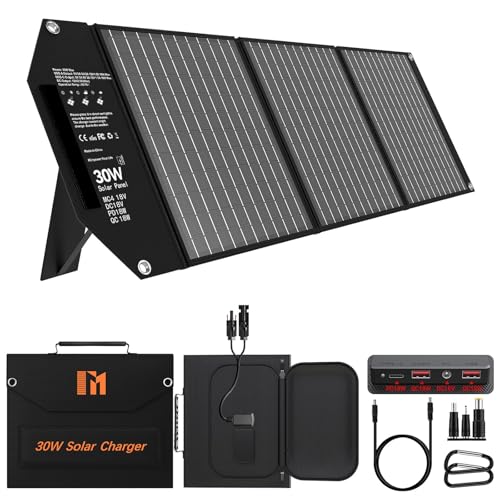

Renogy builds this panel around a parallel connection of its cell groups, which is the detail that earns it the top slot. A shadow from a branch or a backpack strap drops one group instead of collapsing the whole string, so a phone keeps charging at a reduced rate rather than stopping. For a panel you will prop against a rock or a tent pole in uneven light, that is worth more than any efficiency headline.
The output side is generous for the class. USB-C Power Delivery up to 20W handles a modern phone or a small tablet, and the USB-A port covers older gear with Quick Charge. At just over a pound it is lighter than the ENOFLO by roughly 0.9 lb, and its folded footprint is close to a laptop sleeve. The tradeoff is that there is no 12V barrel output, so it will not feed a small lead-acid maintainer the way the ENOFLO can.
Ownership is simple. The folded block is thin enough to slide into a pack pocket, but the corner grommets are the wear point, so clip it by the loops instead of dragging it by one corner. Keep the USB flap closed in dusty conditions and wipe the surface with a damp cloth, since grit on the laminate shows up as lost output before it shows up as scratches.
What works
- Parallel cell groups keep output alive through partial shade
- USB-C PD up to 20W suits modern phones and tablets
- Lightest panel in this comparison at 1.23 lb
- Folds to roughly laptop-sleeve size for pack storage
Watch out for
- No DC barrel output for small 12V maintainers
- 30W rating means a half-charged phone battery takes hours
Spec sheet
- Rated power
- 30W
- USB-C output
- PD 3.0, up to 20W
- USB-A output
- QC 3.0, up to 18W
- Weight
- 1.23 lb
- Folded size
- 10.55 x 8.86 x 0.71 in