
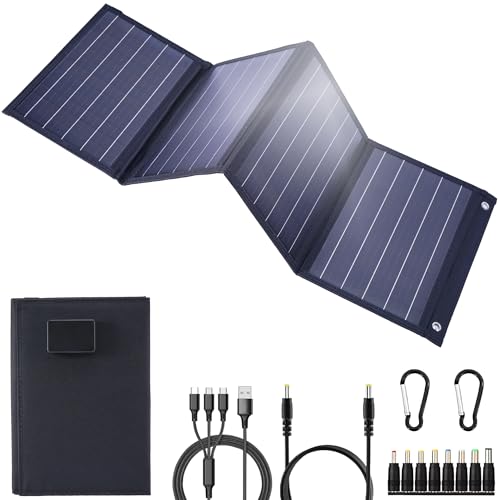
Amazon affiliate links - we earn a commission.Affiliate disclosure

Buying guide · 12 min read · Updated 2026-11-07

Best 40W Foldable Solar Panels (2026)

Six 40W foldable solar panels compared on kickstands, DC input fit for small power stations, weight and weather sealing, with rated versus real output.

James MillerBy James MillerLead Machine Editor6 machines comparedSpec-sheet verified
Best 40W Foldable Solar Panels

At a glance

Our top picks

Side by side

Spec comparison

This is the size where a panel stops being a gadget and starts to be a modest power source. It can still handle phones and USB packs, but the real new job is trickling a small power station or a 12V accessory, so the quality of the DC output and the weight of the panel begin to matter.

Kickstands, carry handles and port protection are not decoration here. They decide whether you actually set the panel at the right angle or just lay it flat, and a few degrees of tilt can add more output than any efficiency claim on the box.

Before you buy

6 Criteria to Look For Before Buying a 40W Foldable Solar Panel

  1. 01

    Matching DC output to your station

    Small power stations accept panel input over a narrow voltage window, often 12V to 24V, and a panel outside that window will not charge. The Powkey lists 12V to 15V with a 5521 plug, and the MHPOWOS gives a 5A DC output. Check your station's input range and connector before you spend anything.

  2. 02

    Kickstand and tilt

    A flat panel loses a meaningful share of output compared with one aimed at the sun. The SunJack, Powkey and fiberglass-back panel all include kickstands. Aiming the panel every hour or two is worth more than any efficiency percent on the listing.

  3. 03

    Cell type and heat behavior

    N-type cells, as on the MPPT panel, age slower and lose less output as they warm than older P-type cells. In a hot climate the difference can be worth several watts at midday. For a cool-weather user it matters less.

  4. 04

    Weight against ruggedness

    The fiberglass-back panel weighs about 2.2 lb and the Powkey 4.2 lb. Lighter panels use thinner backing and are easier to damage, while heavier ones cope better with a rocky campsite. Decide whether you carry it or drive to the site.

  5. 05

    Port protection

    A panel's IP rating usually covers the laminate, not the USB socket. The SunJack is the one pick here with rated ports, which matters in rain. If you charge outdoors in wet weather, seal quality at the port counts more than the panel rating.

  6. 06

    USB-C and USB-A limits

    The FlexSolar offers 18W on each USB port, and the MPPT panel lists USB-A up to 27W. A device can only draw what the panel produces, so the port rating is a ceiling, not a promise. In practice, expect around 25 to 32 watts total on a clear day.

Detailed reviews

The 6 best 40w foldable solar panels, explained

01
SunJack 40W Foldable ETFE Panel, IP67 Ports, Kickstands
40W ratedETFE mono cellsIP67 ports4-panel fold
Check price on Amazon
Best for: Campers who want an outdoor panel that survives rain and rough handling.

What makes this SunJack different is that the ports, not only the panel, carry an IP67 rating. Most foldable panels seal the laminate and leave the USB sockets to fend for themselves, so a rainy afternoon or a splash is where the cheap ones die. Here the waterproof casing around the outputs closes that gap, and ETFE-laminated monocrystalline cells sit on top.

It folds from four sections to roughly the size of a tablet, with integrated kickstands and carabiners so you can angle the panel toward the sun and hang it from a pack. That tilt capability is worth real output, since aiming a panel at the sun instead of lying it flat can add a noticeable share to what the cells deliver. Compared with the FlexSolar 40W, SunJack trades a DC barrel for sturdier weather protection.

The four-section hinge is the long-term wear point. Fold along the stitched seams and do not let the cells press against the carabiner hardware, which can crack a cell in a crowded pack. Rinse off sand before closing, and keep the port cover seated, because the seal depends on the gasket staying clean.

What works

  • IP67-rated ports protect the output sockets too
  • ETFE-laminated monocrystalline cells resist UV haze
  • Kickstands and carabiners make aiming easy
  • Folds to roughly tablet size

Watch out for

  • No DC barrel for small power stations
  • Four-section hinge needs careful folding

Spec sheet

Rated power
40W
Cells
ETFE-laminated monocrystalline
Port protection
IP67-rated ports
Layout
4-panel collapsible
Extras
Kickstands and carabiners
02
FlexSolar 40W Foldable Panel, USB-C, USB-A and DC
40W rated18W USB-C and USB-ADC outputLED status light
Check price on Amazon
Best for: Users who charge two USB devices together and want a DC option.

FlexSolar gives this panel a charge-management chip that detects each connected device and sets output to suit it, plus both USB-A with Quick Charge and USB-C with PD at 18W each. That means two phones or a phone and a power bank can charge at the same time without the panel guessing wrong on voltage. A small LED shows whether the panel is receiving enough sun.

The DC output sets it apart from the SunJack. A panel at this class can feed a very small station or a 12V light directly, and being able to do that without a USB adapter saves a conversion step. The tradeoff is weather protection: the listing describes the panel as waterproof but does not promise a rated port seal like the SunJack's.

Treat the integrated chip as the thing to keep dry. Do not leave the panel on a damp tent floor with the ports facing down, and dry the sockets before packing. If output sags on a bright day, check the DC plug first; barrel jacks loosen with repeated use and are a frequent culprit in intermittent charging.

What works

  • USB-A and USB-C each deliver up to 18W
  • Charge IC adapts output to each connected device
  • DC output covers small 12V gear
  • LED indicator helps aim the panel

Watch out for

  • Port sealing is less clearly rated than the SunJack
  • Both USB ports share the same panel wattage

Spec sheet

Rated power
40W
USB-A
QC 3.0, 18W max
USB-C
PD 2.0, 18W max
DC output
Included
Charge IC
Auto device detection
03
40W Foldable N-Type Panel with MPPT, USB-C, USB-A, DC
40W ratedN-type cellsMPPT chargerUSB-A 27W
Check price on Amazon
Best for: Warm-weather users who want N-type cells and a tracked charge.

This panel uses N-type cells, a newer silicon technology that degrades more slowly and tolerates heat better than the older P-type cells in most budget panels. Pair that with an MPPT charger that detects devices and you have the most up-to-date electronics in the lineup. USB-A here is listed up to 27W, more than the other picks.

In practice, the headline is steadier output in heat. Silicon panels lose output as they warm, and N-type cells lose less of it, which shows on a hot afternoon. The listing claims a 25 percent efficiency, which I read as a cell figure and not a finished panel figure. Against the MHPOWOS, you gain the tracker and the cell type, and give up the extra weight and rugged fold size.

Because the electronics are tracking and regulating, protect the controller area from moisture and avoid putting the panel face-down on hot pavement, which heats the electronics and shortens their life. Check the USB-A rating against your device, since a 27W port needs a compatible cable to reach that speed.

What works

  • N-type cells age slower and handle heat better
  • MPPT charger adapts to connected devices
  • USB-A rated up to 27W, the highest here
  • USB-C PD plus DC output cover most gear

Watch out for

  • Newer brand with a shorter track record
  • Electronics add a failure point versus a plain panel

Spec sheet

Rated power
40W
Cell type
N-type, 25 percent claim
USB-A
QC 3.0, up to 27W
USB-C
PD 2.0, up to 18W
Controller
MPPT with device detection
04
40W Foldable Panel with ETFE Lamination and Fiberglass Back
40W rated2.2 lbETFE laminationFiberglass back
Check price on Amazon
Best for: Hikers and cyclists who count every ounce.

At about 2.2 pounds, this is the lightest 40W panel in the comparison, nearly 2 lb lighter than the Powkey. The weight savings come from a fiberglass backing in place of the heavier fabric and aluminum frame used by others, and the high-density fiberglass resists scuffs, dust and wear on its back side. ETFE lamination covers the front and the panel carries an IP67 rating.

For a hiker or a cyclist, that weight is what makes it usable. It folds to about 11.4 by 10.7 inches, with kickstands on the back, so it propped easily on a rock or a bike rack. The cost of going light is a thinner feel; fiberglass can crack if the panel is stepped on or bent sharply, and there is less cushioning than on the MHPOWOS.

Long term, treat the fiberglass back like a thin laminate. Do not pack it under a heavy object, store it flat and keep the kickstands folded when it travels so they cannot gouge the surface. Wipe off grit from the back as well as the front, since abrasive grit between the layers wears the edges.

What works

  • Lightest 40W panel here at about 2.2 lb
  • ETFE front with IP67 rating
  • Fiberglass back resists dust and wear
  • Kickstands let you aim the panel

Watch out for

  • Thin fiberglass backing can crack under a heavy load
  • Little padding compared with fabric-framed panels

Spec sheet

Rated power
40W
Weight
2.2 lb
Folded size
11.42 x 10.67 in
Back panel
High-density fiberglass
Water rating
IP67
05
MHPOWOS 40W Folding Charger, DC 5A, USB-C, USB-A
40W ratedDC output 5A max3 lb23% ETFE mono
Check price on Amazon
Best for: Owners of small power stations who want a stronger DC feed.

MHPOWOS gives this panel a proper DC output rated to 5A, which is more current than the barrel outputs on the thinner panels. That matters if you plan to feed a small power station or a 12V battery, because a weak DC path throttles the panel. It also has a USB-C and a USB-A, so the same sheet can charge a phone in the afternoon and a station after dinner.

The panel weighs about 3 lb and folds to 12.5 x 8.8 x 1.5 inches, thicker than the others because of its heavier frame. The ETFE monocrystalline cells carry a 23 percent efficiency claim and an IP65 rating, a notch below the IP67 on the SunJack. It is a middle-of-the-road build, and it sits above the budget panel in durability while staying below the SunJack for weather protection.

Because the DC output carries real current, inspect the barrel plug and the cable regularly. A loose or corroded DC jack heats up under 5A and can melt the plug housing, so replace a discolored connector at once. Keep the folded panel flat, with the frame edges protected, and avoid dragging it by the cable.

What works

  • DC output rated to 5A feeds small stations
  • ETFE monocrystalline cells with 23 percent claim
  • USB-C and USB-A cover phone charging
  • Solid frame handles rough camp use

Watch out for

  • IP65 rating trails the IP67 picks
  • Thicker folded package than the lighter panels

Spec sheet

Rated power
40W
DC output
5A max
Weight
3 lb
Folded size
12.5 x 8.8 x 1.5 in
Water rating
IP65
06
Powkey 40W Foldable Panel with 12V to 15V DC and Kickstand
40W rated12-15V DC output4.2 lbKickstand
Check price on Amazon
Best for: Owners of 100Wh to 200Wh stations who want a matched DC panel.

Powkey is aimed squarely at people who own a 100Wh to 200Wh power station and want a panel to keep it topped up. The 12V to 15V DC output with a 5521 plug matches the input on many small stations, so there is no adapter hunting. A kickstand holds the panel at an angle while the cells push a 22 percent claimed conversion.

It is also the heaviest 40W panel here at 4.2 lb, about twice the weight of the 2.2 lb fiberglass-back model, and that difference is felt in every pack. You get a sturdier frame and a more serious output, but you give up easy carry. The USB is Quick Charge only, so it is not the best for phones next to the SunJack or FlexSolar.

Because the plug is a 5521 barrel, check polarity and voltage against your station before connecting it. A mismatch will not fry a protected station but it will not charge either. Keep the plug dry, store the kickstand folded and wipe the cells with a soft cloth, since the heavier frame tends to collect grit at the hinges.

What works

  • 12V to 15V DC output matches common small stations
  • Kickstand holds the panel at a good angle
  • 22 percent claimed cell conversion
  • Sturdy frame handles rough use

Watch out for

  • Heaviest 40W panel here at 4.2 lb
  • USB output is Quick Charge only

Spec sheet

Rated power
40W
DC output
12V to 15V, 5521 plug
USB output
QC 3.0
Weight
4.2 lb
Cell claim
22 percent

Spec sheet decoder

What the numbers on the box really mean

The specs manufacturers lead with, translated into what they tell you about real-world performance.

N-type cells

A newer silicon cell design that loses less output to heat and ages more slowly than the older P-type. It usually costs a little more.

Watch forOnly the MPPT panel in this lineup lists N-type cells.

5A DC output

The maximum current the barrel output is built to carry. Higher current means a stronger feed to a station or battery.

Watch forThe MHPOWOS lists 5A, while most panels in this class do not state a current limit.

12V to 15V DC

The voltage range of the barrel output. Stations accept panels inside a window, so the range must overlap yours.

Watch forThe Powkey lists 12V to 15V, which suits many 100Wh to 200Wh stations.

IP67 ports

A rating that applies to the output sockets, not just the laminate. It means the seal can survive brief immersion.

Watch forOnly the SunJack claims IP67 ports specifically.

PD 2.0 versus PD 3.0

Older PD 2.0 negotiates fixed voltages, while PD 3.0 adds finer steps. Most phones work with either.

Watch forThe FlexSolar and MPPT panel both list PD 2.0, which is fine for phones but older than newer laptop chargers.

Methodology

How We Evaluated These 40W Foldable Solar Panels

Wattage class filter

We kept only panels rated at 40W and dropped listings for 400W and 30W panels that surfaced in the data. A 400W panel is ten times the size and would make any comparison meaningless.

Output and station fit

We compared DC output ratings and USB limits, from the MHPOWOS at 5A DC to the MPPT panel with USB-A at 27W. The DC specifications decide whether a small station will charge at all.

Build and sealing

We read ingress ratings and construction details, noting IP67 on the SunJack and fiberglass-back panel and IP65 on the MHPOWOS. Port protection was weighted above laminate claims.

Weight and carry

We compared weights from 2.2 lb on the fiberglass-back panel to 4.2 lb on the Powkey, along with folded size and kickstand design.

Owner feedback patterns

We looked at repeated complaints about loose DC jacks, delamination and optimistic wattage claims. Patterns of those issues reduced a panel's ranking.

Decision guide

How to Choose the Right 40W Foldable Solar Panels

By Primary Use

SituationPickWhy
Rainy backpacking tripsSunJack 40WIP67 ports and ETFE cells.
Topping up a 100Wh to 200Wh stationPowkey 40W12V to 15V DC matched to small stations.
Charging two phones at onceFlexSolar 40W18W on both USB ports.
Ultralight hikingFiberglass-back 40W panelAbout 2.2 lb.
Hot climate useN-type MPPT 40W panelN-type cells hold output in heat.
Higher DC current feedMHPOWOS 40W5A DC output.

By Budget

TierPickWhy
Lowest costPowkey 40WBasic build with a matched DC output.
Lower midMHPOWOS 40WDC 5A and ETFE cells.
MidFlexSolar 40WCharge IC and dual USB.
Upper midFiberglass-back 40W panelLight weight and IP67.
Top of lineupSunJack 40WRated ports and kickstands.

Heavy Frame vs Light Backing

Heavier frame panels

The Powkey at 4.2 lb and the MHPOWOS at 3 lb are stiffer and cope better with rough camps. They cost you weight and pack space.

Light backing panels

The fiberglass-back panel at about 2.2 lb is easier to carry and set up, but its thin back can crack under load. It suits hikers more than car campers.

Choose the Powkey or MHPOWOS for car camping and the fiberglass-back panel for hiking.

Station Top-Up vs Phone Charging

PreferencePickWhy
Mostly feeding a small stationPowkey 40W12V to 15V with a 5521 plug.
Mostly charging phonesFlexSolar 40WDual 18W USB with a charge IC.
A bit of bothMHPOWOS 40WDC 5A plus USB-C and USB-A.
Wet conditions both waysSunJack 40WIP67 ports.

For Small Power Stations Specifically

Look for

A DC output whose voltage range sits inside your station's input window, a connector that matches or has an adapter, and a stated current rating so the barrel does not overheat.

In this comparison

The Powkey 40W with its 12V to 15V 5521 output is the closest match for 100Wh to 200Wh stations. The MHPOWOS 40W is the pick if you want more stated current headroom.

When to Spend More

Spend more if

You will use it in wet or hot conditions often. The SunJack 40W and the N-type MPPT panel add rated ports and better heat behavior.

Save if

You use it a few weekends a year with a small station. The Powkey 40W or MHPOWOS 40W gets the DC job done at a lower cost.

Ownership

Maintenance schedule

The upkeep that decides whether this machine lasts two seasons or ten.

TaskIntervalWhy it matters
Wipe both sides of the panelAfter each outingGrit on the back wears the fabric edges and grit on the front blocks light. A damp cloth handles both.
Inspect the DC plugMonthly in useA loose barrel plug heats up under load. On the MHPOWOS rated at 5A a warm plug is a warning sign.
Check kickstands and hingesEvery few tripsKickstands bend and hinges fray. A bent stand on the Powkey or SunJack cannot hold the angle.
Dry and close the portsAfter wet useMoisture in a USB or DC socket corrodes the contacts. The SunJack's port seal only works if the gasket is clean.
Store flat out of heatBetween seasonsA hot trunk softens adhesives and warps frames. A closet shelf keeps the laminate flat.

FAQ

Frequently Asked Questions

Will a 40W panel run a power station?

It will charge one slowly. In good sun it adds around 25 to 32 watts, so a 100Wh station takes several hours to fill, and a 300Wh station needs more than a day.

Is a DC output better than USB?

For stations and 12V gear, yes, because it avoids the conversion losses of USB. For phones, USB-C PD is simpler. The best panels offer both.

Do kickstands really matter?

They do. Tilting a panel toward the sun instead of laying it flat can raise output noticeably, especially in the morning and late afternoon.

Are N-type cells worth paying for?

In hot climates and for daily use, yes, because they lose less output as they warm and degrade more slowly. For occasional cool-weather use the gain is small.

Can I connect two 40W panels together?

Only if the station's input accepts the combined voltage or current. Parallel adds current and series adds voltage, so check the station's limits before connecting.

How do I know a DC plug will fit my station?

Look up the station's solar input connector and voltage window, then match the panel's plug and voltage range. Many stations use 8mm or 5521 barrels, but adapters vary.

Bottom line

The short version

Browse more 40w foldable solar panelson Amazon →
James Miller, Lead Machine Editor

About the author

James Miller

Lead Machine Editor, MachineFanatic

James Miller leads MachineFanatic's buying guides, turning spec sheets, manuals and owner feedback into clear verdicts on power tools, outdoor power equipment, shop machines and kitchen machines.

More from James →

Keep reading

Related guides