
Amazon affiliate links - we earn a commission.Affiliate disclosure

Buying guide · 12 min read · Updated 2026-11-07

Best Commercial Meat Grinders (2026)

Six commercial-style meat grinders compared by head size, horsepower, hourly output claims, stainless build and overload protection, from #12 to #32 heads.

James MillerBy James MillerLead Machine Editor6 machines comparedSpec-sheet verified
Best Commercial Meat Grinders

At a glance

Our top picks

Side by side

Spec comparison

A commercial grinder differs from a kitchen one in size and duty cycle rather than in kind. The head number, from #12 to #32, tells you how wide the auger and plate are; a bigger head moves more per revolution, and the motor behind it has to be sized to match.

The numbers on these listings are generous. Hourly output claims climb into the hundreds of pounds, and watts and horsepower are quoted in different ways. This guide sorts the lineup by head size, stated motor rating, material and the protection built around the motor, since those predict how the machine behaves in year three.

Before you buy

6 Criteria to Look For Before Buying a Commercial Meat Grinder

  1. 01

    Head size versus job

    A #12 head, like the VEVOR's and Valley Sportsman's, handles a deer or two at a time. A #22, as on the MEAT! and ARINOO, moves more per turn, and a #32, as on the LEM and the larger VEVOR, suits whole carcasses. Bigger heads need bigger motors and benches, so match the head to your largest regular batch. A common mistake is buying a #32 because it sounds future-proof, then discovering that a single batch of burger leaves more meat clinging inside the large head than ends up on the tray. Waste and cleanup time scale with head size, so oversizing costs you every session.

  2. 02

    Horsepower and rated watts

    The LEM #32 lists 1.5 HP, the VEVOR #32 1100 watts equal to 1.5 HP, the #22 units 1 HP, the Valley Sportsman 3/4 HP and the small VEVOR 850 watts. These are different ways of quoting a motor, so convert: 746 watts is about one horsepower. Compare like with like before ranking.

  3. 03

    Output claims per hour

    The VEVOR #32 claims 992 pounds per hour, the ARINOO #22C 550 and the Valley #12 450. These are ideal-condition maximums with cold, pre-cut meat. Use them to compare machines, and expect real throughput to be well below them. Real output also depends on how fast you can feed and tray the meat, so a machine that grinds 500 pounds per hour is limited in practice by the person at the hopper, not by the motor, once you pass a certain size.

  4. 04

    Overload and electrical protection

    The Valley Sportsman states overload protection, and the VEVOR #32 lists ETL approval. Protection that trips before the windings burn is worth more than extra watts. If a listing says nothing, assume none. A tripped protector is not a defect but a sign that the load, usually a jam or a warm-fat smear, exceeded what the motor can sustain, and the right response is to clear the cause rather than keep resetting.

  5. 05

    Material and fasteners

    The ARINOO uses 304 stainless, the MEAT! uses stainless down to the bolts and the LEM is stainless throughout. Stainless resists rust, but hardware and the auger also matter. Aluminum heads need oil and drying. Whatever the material, look at the auger and plate surfaces, because a rough casting wears the plate and leaves metal flecks, and the food-contact parts should be smooth, machined and easy to clean in the crevices where fat collects.

  6. 06

    Footprint and power supply

    All of these run on standard 120 volt outlets according to their listings, but the larger machines weigh a great deal. Measure the bench, and check that the circuit can supply the amps a 1.5 HP motor demands. A 1.5 HP motor can draw well over 10 amps at start-up, so avoid sharing the circuit with a freezer or a space heater, and avoid thin extension cords, which drop voltage and overheat under that load.

Detailed reviews

The 6 best commercial meat grinders, explained

01
LEM BigBite #32 Electric Meat Grinder, 1.5 HP
#32 head1.5 HP motorRaw chicken bonesStainless build
Check price on Amazon
Best for: Serious home processors and small butchers handling whole carcasses.

LEM's #32 pairs a 1.5 horsepower motor with a stainless steel build and a head wide enough to move serious volume. The listing states it handles beef, pork, poultry, lamb, venison and raw chicken bones, which is a rare explicit statement among home-oriented commercial machines. Three plates, a knife, a stomper and stuffing tubes ship in the box.

A #32 head is roughly twice the throat diameter of a #12, so the auger swallows larger pieces of meat and wastes less time on pre-cutting. Against the Valley Sportsman #12 in this guide, the LEM trades a smaller motor-to-head ratio for a much bigger intake, which favors processing whole sides rather than steady trickle work.

Expect a large, heavy machine that wants a dedicated bench or a rolling stand. Hand wash the head parts, dry them completely and coat the plates with a thin layer of food-safe oil before storage. Chill the meat firmly, because a #32 auger will still smear warm fat. If you plan to grind bone, keep pieces small and feed them gradually rather than in a single large mass.

What works

  • 1.5 HP motor with a #32 head
  • Stated capability for raw chicken bones
  • Stainless steel build resists rust
  • Full set of plates, knife and tubes

Watch out for

  • Large and heavy, needs a dedicated spot
  • Overkill for small batches
  • Hand wash and oil upkeep

Spec sheet

Head
#32
Motor
1.5 HP
Handles
Beef, pork, poultry, lamb, venison, raw chicken bones
Body
Stainless steel
Includes
3 plates, knife, stomper, stuffing tubes
02
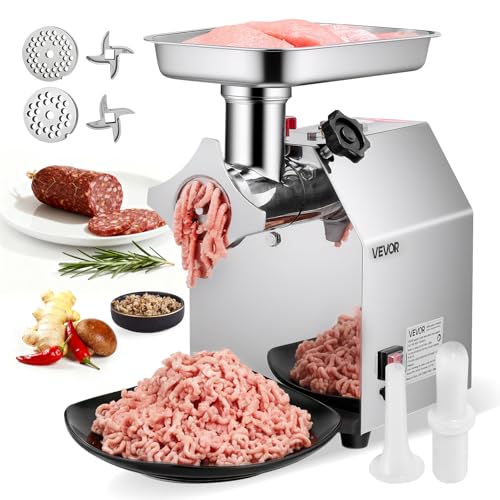
VEVOR #32 1100W 1.5 HP Commercial Meat Grinder
#32 head1100W / 1.5 HP992 lb/h claimETL approved
Check price on Amazon
Best for: Hunters and butchers who want #32 capacity at a lower outlay.

VEVOR's #32 states 1100 watts, equal to 1.5 horsepower, and a claimed output of up to 992 pounds per hour. It includes two cross blades, a 10 millimeter coarse plate pre-installed, a 4.5 millimeter fine plate and an integrated box to keep the accessories together. The listing notes ETL approval.

The same head size and motor class as the LEM #32 is offered here, but with fewer track-record details. ETL approval means the electrical design has been checked by a recognized testing laboratory, which is a meaningful safety statement but not a durability one. Hourly output figures like 992 pounds are maximums under ideal conditions, so use them for comparison, not planning.

Keep the storage box nearby so the small parts do not go missing, and treat the coarse-first, fine-second sequence as the right way to run sausage meat. Dry the plates after washing, oil them lightly and keep a spare knife, since a dull knife is the most common cause of smear. This is a machine for batches of tens of pounds, not a pound of burger at a time.

What works

  • #32 head with a 1.5 HP motor
  • ETL approved listing
  • Two blades and several plates included
  • Integrated accessory storage

Watch out for

  • 992 lb per hour claim is a ceiling
  • Less track record than LEM
  • Very large for home kitchens

Spec sheet

Head
#32
Motor
1100 watt, 1.5 HP
Output claim
Up to 992 lb per hour
Plates
10 mm coarse, 4.5 mm fine, more
Listing
ETL approved, storage box
03
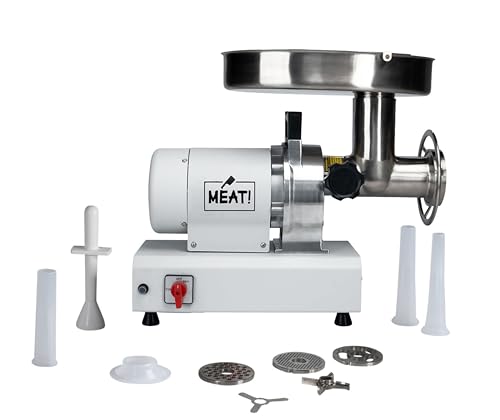
MEAT! 1 HP Pro-Grade #22 Meat Grinder
#22 head1 HP motor11 to 14 lb/minAll stainless
Check price on Amazon
Best for: Hunters who want faster throughput without a #32 footprint.

The MEAT! #22 uses a 1 horsepower motor behind a mid-size #22 head and claims 11 to 14 pounds of ground meat per minute. All parts are stainless steel, the listing says down to the last bolt, and a coarse and a fine plate come with it.

A #22 sits between the #12 and the #32: it is bigger than home hunting-class machines but easier to place on a counter than the biggest heads. The per-minute claim is higher than the Valley Sportsman #12's 7 to 10 on its sibling, which suits batch processing of venison or pork trim. Stainless hardware also matters for upkeep, since rusted steel bolts are a common failure on cheaper machines.

The set of plates is minimal, so plan to buy a sausage plate if you stuff. Wash, dry and oil the head parts as with any grinder, and pre-chill the meat. A mid-size machine like this is happiest with strips the width of a finger, not large chunks, since the auger can bridge over bulky pieces.

What works

  • 1 HP motor with a #22 head
  • Claimed 11 to 14 lb per minute
  • Stainless steel throughout
  • Coarse and fine plates included

Watch out for

  • Only two plates in the box
  • Throughput claim is a manufacturer figure
  • Still a large machine

Spec sheet

Head
#22
Motor
1 HP
Throughput claim
11 to 14 lb per minute
Build
Stainless down to the bolts
Plates
Coarse and fine
04
ARINOO #22C 1 HP Commercial Meat Grinder
#22 head1100W (1 HP)550 lb/h claim304 stainless
Check price on Amazon
Best for: Processors who value 304 stainless and a mid-size head.

ARINOO's #22C is built from 304 stainless steel, which the maker highlights for wear and corrosion resistance. An 1100 watt motor rated at 1 horsepower drives the #22 head, and the output claim is up to 550 pounds of meat per hour. It is marketed for beef, pork, lamb and deer.

The 304 grade is the useful detail. It is the common food-service stainless, tougher against corrosion than lower grades and easy to sanitize, which matters if you process wet game or brined meats. In this lineup, the ARINOO is a direct competitor to the MEAT! #22, with a stronger material statement and a lower claimed throughput.

Care is standard: hand wash, dry, oil. Keep the machine on a stable bench, since a 1 HP motor produces torque that can walk a light stand. Check the plate fit before each run, because a loose plate lets meat squeeze behind it and mash instead of cut. Use only the hand pusher provided, never your fingers, and stop the machine fully before clearing the throat.

What works

  • 304 stainless steel construction
  • 1 HP motor rated at 1100 watts
  • #22 head balances size and capacity
  • Suited to game and brined meat

Watch out for

  • 550 lb per hour is a maximum claim
  • Short brand history
  • Heavy to move

Spec sheet

Head
#22C
Motor
1100 watt, 1 HP
Output claim
Up to 550 lb per hour
Material
304 stainless steel
Use
Beef, pork, lamb, venison
05
Valley Sportsman #12 0.75 HP Commercial Grinder
#12 head3/4 HP450 lb/h claimOverload protection
Check price on Amazon
Best for: Hunters who want protection against jams and a stainless build.

The Valley Sportsman #12 is a 3/4 horsepower machine on 120 volts with built-in overload protection and a full stainless steel body, head, auger and tray. The listing claims up to 450 pounds per hour and a precision-engineered auger for steady intake.

Overload protection is the practical feature. When a jam or a tough piece of meat stalls the motor, the protector trips instead of letting the windings burn, and you reset it after a cool-down. That matters on a machine that will see game and bone-in trim. The listing shows both a 3/4 HP rating and a 500 watt figure, so the two are not the same number, and the horsepower statement should be treated as the motor class.

Against the VEVOR #12 below, the Valley trades a smaller motor figure for protection and an all-stainless build. Wash and dry the parts after use, and when the protector trips, unplug the unit, clear the jam and wait before resetting. A #12 suits steady batch work of a deer or two at a time.

What works

  • Overload protection trips before the motor burns
  • Full stainless body, head, auger and tray
  • Claimed 450 lb per hour on a #12 head
  • Runs on a standard 120 volt outlet

Watch out for

  • Smaller motor than the #22 and #32 units
  • Listing shows two different power figures
  • Needs a cool-down after a trip

Spec sheet

Head
#12
Motor
3/4 HP, 500 watt listed
Output claim
Up to 450 lb per hour
Power
120 volt
Protection
Overload protection
06
VEVOR #12 850W Commercial Meat Grinder, 7 lb/min
#12 head850W motor7 lb/minWaterproof switch
Check price on Amazon
Best for: Occasional butchers who want a #12 on a smaller outlay.

VEVOR's #12 is the smallest and most affordable commercial-style grinder here. An 850 watt motor drives a #12 head at a claimed 7 pounds per minute, with two stainless blades, a pre-installed 6 millimeter plate and a waterproof boat-shaped switch.

The switch is a thoughtful detail: it is sealed against splashes, which helps in a wet butchering space. Against the Valley Sportsman #12, you get a higher watt figure and a lower build tier, but no stated overload protection. Compared with the LEM #32 or VEVOR #32, it is a fraction of the capacity but fits a smaller space.

It is a machine for a few animals a year or regular batches of 10 to 20 pounds. Keep the plate fit tight, and use the coarse plate first for sausage, then the fine. Dry and oil the parts, and let the motor rest after long runs, since sustained load on an 850 watt motor warms it quickly.

What works

  • 850 watt motor on a #12 head
  • Sealed boat-style switch
  • Two stainless blades included
  • Compact for a commercial-style unit

Watch out for

  • No stated overload protection
  • 7 lb per minute is a claim
  • Fewer plates in the box

Spec sheet

Head
#12
Motor
850 watt
Throughput claim
7 lb per minute
Blades
2 stainless blades
Switch
Waterproof boat-style

Spec sheet decoder

What the numbers on the box really mean

The specs manufacturers lead with, translated into what they tell you about real-world performance.

#12, #22, #32

Head sizes that indicate throat and plate diameter, with larger numbers moving more meat per turn.

Watch forThe small VEVOR is a #12, the MEAT! and ARINOO are #22, the LEM and VEVOR large are #32.

HP versus watts

Two ways of rating a motor; about 746 watts equals one horsepower.

Watch forThe Valley lists 3/4 HP and a 500 watt figure, so check which one is rated.

Lb per hour

A maximum throughput under ideal conditions.

Watch forThe VEVOR #32 claims 992 and the ARINOO 550, which are ceilings.

ETL approved

A recognized lab has checked the electrical safety.

Watch forThe VEVOR #32 lists it, which says little about durability.

304 stainless

A common food-service grade of stainless steel.

Watch forThe ARINOO names it; others say stainless without a grade.

Methodology

How We Evaluated These Commercial Meat Grinders

Head and motor match

We compared the head size to the stated motor, from the #12 VEVOR at 850 watts to the #32 LEM at 1.5 HP.

Throughput claims

We read the per-hour and per-minute claims, ranging from the VEVOR #12's 7 pounds per minute to the VEVOR #32's 992 per hour, and treated them as ceilings.

Protection and certification

We credited stated overload protection on the Valley and ETL approval on the VEVOR #32.

Materials

We favored stainless throughout and noted the ARINOO's 304 grade.

Fit to the buyer

We matched each head size to a realistic user, from small-batch hunters to whole-carcass processors.

Decision guide

How to Choose the Right Commercial Meat Grinders

By Batch Size

SituationPickWhy
A deer or two at a timeValley Sportsman #12Protected motor and #12 head
Regular 10 to 20 lb batchesVEVOR #12 850WEntry commercial size
Several animals per seasonMEAT! #22 1 HP11 to 14 lb per minute claim
Whole carcasses and volumeLEM BigBite #321.5 HP and #32 intake

By Budget

TierPickWhy
LowestVEVOR #12 850WSmallest commercial unit
Low-midValley Sportsman #12Protection and stainless
MidARINOO #22C304 stainless #22
HigherLEM BigBite #32Proven brand and bone capability

#12 vs #32

#12 head

The VEVOR and Valley Sportsman fit smaller benches and suit steady batches of a few animals a season.

#32 head

The LEM and VEVOR large swallow bigger pieces and suit whole-carcass volume, but demand a stand and a stronger circuit.

Pick a #12 for a few deer a year; step up to a #32 only if you routinely process whole sides.

By Protection Features

SituationPickWhy
Wants overload protectionValley Sportsman #12Trips before the motor burns
Wants a certificationVEVOR #32ETL approved listing
Wants a splash-proof switchVEVOR #12 850WBoat-style sealed switch
Wants 304 steelARINOO #22CNamed stainless grade

For Game Processing Specifically

Look for

Metal gears, a head sized to your batch and a motor that will not stall on sinew. Overload protection helps when a tendon jams the auger.

In this comparison

The Valley Sportsman #12 adds overload protection, and the MEAT! #22 and LEM #32 give faster volume.

When to Spend More

Spend more if

You process whole carcasses or run the machine for hours, in which case a LEM #32 or a protected motor repays the cost.

Save if

You process a few animals a year. A VEVOR #12 is plenty.

Ownership

Maintenance schedule

The upkeep that decides whether this machine lasts two seasons or ten.

TaskIntervalWhy it matters
Hand wash, dry and oil partsAfter each useMoisture rusts plates and knives. A thin oil coat protects them in storage.
Replace or sharpen the knifeEach seasonA dull knife smears fat and loads the motor. A sharp knife with a flat plate cuts cleanly, and one that has worn dome-shaped on its face should be replaced as a set with the plate.
Check plate and ring fitBefore each runA loose plate lets meat mash behind it.
Inspect the cord and switchEach seasonWet environments wear cords and switches. Replace damage immediately.
Reset protection after cooldownWhen it tripsAn overload trip means the motor was too hot. Wait before resuming.

FAQ

Frequently Asked Questions

Do I need a commercial grinder for home use?

Only if you process whole animals or grind often. A #8 home grinder handles most households. A #12 is the step up for hunters.

Can these grind bones?

Only the LEM #32 lists raw chicken bones. Others do not state a bone rating, so assume none and check the manual. Even where bone is allowed, feed small pieces slowly and expect faster wear on the knife and plate, which you should replace on a schedule.

What does the lb per hour number mean?

It is the maximum throughput under ideal conditions with cold meat. Real output is lower.

Are 120 volt outlets enough?

The listings state 120 volt operation, but a 1.5 HP motor draws substantial current. Use a dedicated circuit, avoid long extension cords and check the breaker rating in the manual before the first run, since a tripped household breaker mid-batch leaves meat warming on the bench.

How do I prevent smearing?

Chill the meat and head parts, keep the knife sharp and feed strips. Smear means the fat is warm, and a smeared grind makes dense, pasty sausage. Freeze the head, plate and knife for half an hour first, and grind in small batches so the meat stays cold from the first strip to the last.

Why does the motor trip?

Overload protection trips when the motor draws too much current. Clear the jam and let it cool.

Bottom line

The short version

Browse more commercial meat grinderson Amazon →
James Miller, Lead Machine Editor

About the author

James Miller

Lead Machine Editor, MachineFanatic

James Miller leads MachineFanatic's buying guides, turning spec sheets, manuals and owner feedback into clear verdicts on power tools, outdoor power equipment, shop machines and kitchen machines.

More from James →

Keep reading

Related guides