
Amazon affiliate links - we earn a commission.Affiliate disclosure

Buying guide · 12 min read · Updated 2026-11-07

Best Meat Grinders for Deer (2026)

Six grinders for processing venison at home, compared by head size, sustained motor rating, gear material and how many deer each can handle in a season.

James MillerBy James MillerLead Machine Editor6 machines comparedSpec-sheet verified
Best Meat Grinders for Deer

At a glance

Our top picks

Side by side

Spec comparison

MachineHeadMotorRateBuild
LEM BigBite #8 Electric Grinder, 0.5 HPBest Overall for a Few DeerLEM BigBite #8 Electric Grinder, 0.5 HP#80.5 HPAbout 7 lb per minuten/a
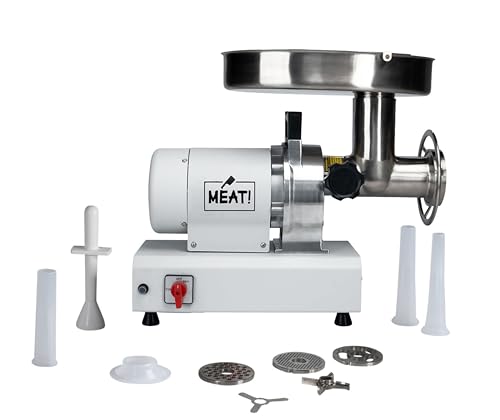
MEAT! 0.75 HP Pro-Grade #12 GrinderBest Step-Up #12MEAT! 0.75 HP Pro-Grade #12 Grinder#120.75 HPn/aStainless down to the bolts
Weston #12 Electric Grinder and Stuffer, 750WBest for Sausage SeasonWeston #12 Electric Grinder and Stuffer, 750W#12750 watt, 1 HPAbout 4 lb per minuten/a
AAOBOSI #12 3000W Wild Game GrinderBest Metal-Gearbox ValueAAOBOSI #12 3000W Wild Game Grinder#123000 watt peak, pure copperAbout 7 lb per minuten/a
MEAT! 1 HP Pro-Grade #22 GrinderBest for Large VolumeMEAT! 1 HP Pro-Grade #22 Grinder#221 HPn/aStainless down to the bolts
#32 1.5 HP Commercial Grinder, 880 lb/hBest Heavy-Duty Protected#32 1.5 HP Commercial Grinder, 880 lb/h#321.5 HP, 110 volt lubricatedn/aStainless body, head, auger, tray

Venison is lean, sinewy and cold when you work it, which makes it harder on a grinder than store-bought beef. Silver skin wraps around the muscle, connective tissue collects around the knife, and a whole deer can mean dozens of pounds of trim to push through in a single afternoon.

A good deer grinder is judged by sustained motor rating, head size and gear material, not by the peak numbers on the box. This guide sorts the lineup by how many animals each machine can reasonably handle in a season and by what happens to the machine in year three, after a few hundred pounds of sinewy trim.

Before you buy

6 Criteria to Look For Before Buying a Meat Grinder for Deer

  1. 01

    Deer per season

    A #8 head like the LEM handles roughly three to five deer a season, a #12 like the MEAT! 0.75 HP or the Weston suits four to a dozen, and a #22 or #32 suits group processing. Estimate your yearly pounds, not your best day. A machine sized for ten deer is a nuisance if you take two. Remember that a field-dressed whitetail yields a modest amount of boneless meat once bone, fat and silver skin are removed, so a household taking two deer is grinding perhaps 60 to 100 pounds across a whole season. That is a few hours at a #8 and rarely justifies a bigger head, while a group that pools a dozen animals changes the arithmetic entirely.

  2. 02

    Sustained motor rating

    The LEM lists 0.5 HP, the MEAT! #12 0.75 HP, the Weston 750 watts at 1 HP, the MEAT! #22 1 HP and the #32 1.5 HP. The AAOBOSI lists only a 3000 watt peak, which says little. Sinewy venison punishes a small motor, so favor a clear sustained figure. Lean game also has little fat to lubricate the auger, so friction and heat build faster than with fatty beef. That is one more reason to chill the trim hard, work in small batches and give any motor a rest between loads, whatever its rating says.

  3. 03

    Gear material

    The Weston and the AAOBOSI state metal gears, and the LEM and MEAT! build on stainless hardware. Venison is full of connective tissue that can shock a gear train. Plastic gears are a risk for game. A frozen sliver of tendon or a chunk of gristle can lock the auger for an instant, and a gear tooth takes the shock. Metal teeth flex and survive, while plastic teeth shear off, and a machine with a stripped gear hums without grinding and needs a repair or replacement before the next deer.

  4. 04

    Silver skin and trim tolerance

    Silver skin wraps around the knife and slows the cut on any grinder. A larger head and a sharp knife cope better, but trimming is the only real fix. Machines with reverse, like the Weston, recover from a wrap-up without disassembly.

  5. 05

    Plates for the end product

    Burger wants a coarse-to-medium plate, sausage a fine one after a coarse first pass, and jerky strips need a slicer rather than a grinder. The LEM includes three plates, while the MEAT! models include two. Count what you will make.

  6. 06

    Cleanup and storage

    A bigger head means a bigger cleanup. Stainless is easy to wash, while aluminum needs hand washing and oil. A machine that comes out once a year needs parts you can find again, and a storage box helps. After the season, wash every part, dry it with a towel and set it near warm air for an hour before oiling, since trapped water under the oil is what rusts plates in a cold garage over the winter. Store the head and plates in a sealed bag with a packet of desiccant.

Detailed reviews

The 6 best meat grinders for deer, explained

01
LEM BigBite #8 Electric Grinder, 0.5 HP
#8 head0.5 HP motor~7 lb/minStainless build
Check price on Amazon
Best for: Hunters who take a few deer a season.

The LEM BigBite #8 is the benchmark deer grinder for a household. A 0.5 horsepower motor behind a #8 head processes about 7 pounds a minute by the maker's figure, and the stainless build shrugs off the moisture and blood that come with fresh trim. Three plates, a knife, a stomper and stuffing tubes arrive in the box, which covers burger, breakfast sausage and summer sausage.

A #8 head is a sensible fit for the volume of most hunters. Guides commonly put a #8 at roughly three to five deer per season, and above about eight deer a year a #12 starts to make sense. At 7 pounds per minute, a deer's worth of trim goes through in the time it takes to prepare the next batch, and the motor stays within its comfort zone if you rest it between loads.

The LEM's strength is parts support: plates, knives and stuffing kits are easy to find, which matters because venison dulls knives. Silver skin is the enemy, so trim it before grinding, because it winds around the knife and slows the cut. Chill the meat to near freezing, keep batches under about 10 pounds and add pork fat for sausage. Hand wash, dry and oil the parts after the day's work, and replace the knife every season.

What works

  • 0.5 HP motor with a stainless build
  • About 7 lb per minute claimed throughput
  • Three plates, knife, stomper and tubes included
  • Plates and knives are easy to replace

Watch out for

  • No slow stuffing speed
  • Smaller head than a #12
  • Needs careful trimming of silver skin

Spec sheet

Head
#8
Motor
0.5 HP
Rate
About 7 lb per minute
Includes
3 plates, knife, stomper, tubes
Body
Stainless steel
02
MEAT! 0.75 HP Pro-Grade #12 Grinder
#12 head0.75 HP motor7 to 10 lb/minAll stainless
Check price on Amazon
Best for: Hunters who process four or more deer or grind for others.

The MEAT! #12 pairs a 0.75 horsepower motor with a #12 head and claims 7 to 10 pounds per minute. The listing stresses all-stainless construction, down to the last bolt, and the kit includes coarse and fine plates.

A #12 head is a size up from the LEM's #8, with a wider throat and a plate that passes more trim per revolution. For a hunter who processes four or more deer or who grinds for friends, the extra head size cuts the time at the machine, and the 0.75 HP motor has about 50 percent more rated power than the LEM's 0.5 HP. That reserve helps with tough, sinewy trim from older bucks.

Stainless hardware matters when the machine is washed often, because rust on a bolt becomes rust on a plate. The kit is lean on accessories, so budget for a stuffing kit and a sausage plate if you plan to stuff. Keep the machine well chilled, trim silver skin, and watch the motor temperature during long runs. A #12 is also heavier, so give it a stable bench.

What works

  • 0.75 HP motor with a #12 head
  • Claimed 7 to 10 lb per minute
  • Stainless down to the bolts
  • Coarse and fine plates included

Watch out for

  • Lean accessory kit
  • Heavier than a #8
  • Throughput is a manufacturer claim

Spec sheet

Head
#12
Motor
0.75 HP
Throughput claim
7 to 10 lb per minute
Build
Stainless down to the bolts
Plates
Coarse and fine
03
Weston #12 Electric Grinder and Stuffer, 750W
#12 head750W 1 HP2 speeds + reverseMetal gears
Check price on Amazon
Best for: Hunters who make a lot of sausage as well as ground venison.

Weston's #12 is built like a butcher's machine, with a die-cast aluminum body, metal gears and a cam-action headlock. A 750 watt motor, listed as 1 horsepower, grinds about 4 pounds per minute on a #12 head, and two speeds plus reverse let you grind quickly and then slow down for stuffing.

The 4 pounds per minute is slower on paper than the LEM's 7 or the MEAT!'s 7 to 10, but the reverse and the metal gears are what matter on sinewy venison, because they let you back a jam out without disassembling. The slow first speed is the feature that makes this the sausage season pick: stuffing at a gentle pace keeps casings from bursting and air from entering.

Aluminum parts need hand washing and a light oil coat, and they should never go in a dishwasher. After a heavy day, rinse the head promptly, since blood corrodes aluminum if it dries on. Check the cam lock before each batch, and keep the knife sharp. If your deer program includes plenty of summer sausage and jerky strips, the Weston's workflow is the smoothest.

What works

  • Metal gears and a die-cast aluminum body
  • Slow first speed suits stuffing
  • Reverse clears sinew jams
  • 1 HP motor rating on a #12 head

Watch out for

  • About 4 lb per minute is slower on paper
  • Aluminum needs careful washing
  • Heavy on the bench

Spec sheet

Head
#12
Motor
750 watt, 1 HP
Rate
About 4 lb per minute
Speeds
2 plus reverse
Body
Die-cast aluminum, metal gears
04
AAOBOSI #12 3000W Wild Game Grinder
#12 head3000W peak7 lb/minAll-metal gearbox
Check price on Amazon
Best for: Hunters who want a #12 with metal gears at a modest outlay.

AAOBOSI built this one for hunting and wild game, with a #12 head, a copper motor, a 3 millimeter thickened stainless housing and a full metal gearbox. The 3000 watt figure is a peak rating, and the listing claims about 7 pounds per minute. A built-in storage box keeps accessories with the machine.

The metal gearbox is the reason it makes the list. On a machine in this price class, an all-metal gear train is the feature most likely to survive a season of sinew. Compared with the Weston, you get a similar head size and a faster claimed rate, but no slow stuffing speed and no brand history to lean on.

Treat the 3000 watt as a peak and plan batches accordingly: chill the trim, feed in strips and let the motor rest between loads. Keep the housing dry and clean, because stainless that stays wet and dirty will stain and corrode at the seams. The storage box is a practical detail for a machine that comes out once a year, since small parts go missing in a hunting season.

What works

  • All-metal gearbox
  • Thickened 3 mm stainless housing
  • #12 head with about 7 lb per minute claim
  • Built-in accessory storage

Watch out for

  • 3000 watt is a peak figure
  • No slow stuffing speed
  • Short brand history

Spec sheet

Head
#12
Motor
3000 watt peak, pure copper
Rate
About 7 lb per minute
Housing
3 mm thickened stainless
Gearbox
All-metal
05
MEAT! 1 HP Pro-Grade #22 Grinder
#22 head1 HP motor11 to 14 lb/minAll stainless
Check price on Amazon
Best for: Hunters who process a dozen or more animals.

The MEAT! #22 is the large-volume option: a 1 horsepower motor behind a #22 head claims 11 to 14 pounds per minute, with all-stainless construction and two plates. It is the right size for a hunter who processes a dozen animals or runs a group processing day.

That capacity has a cost in size and cleanup. The #22 head is bulkier than a #12, the footprint is larger, and every part you wash is larger. If you process three deer a year, you will spend more time cleaning than grinding, and the extra capacity is wasted. If you process ten, it is a time saver.

Stainless hardware again earns its place. Chill the trim, feed in strips and let the auger pull. Keep the batch size under what the motor can handle in a few minutes, rest between loads and replace the knife often. A bench or stand is a must, and the cord should be a heavy-duty one.

What works

  • 1 HP motor on a #22 head
  • Claimed 11 to 14 lb per minute
  • Stainless throughout
  • Handles group processing days

Watch out for

  • Larger and heavier than a #12
  • Wasted capacity for a few deer
  • Only two plates

Spec sheet

Head
#22
Motor
1 HP
Throughput claim
11 to 14 lb per minute
Build
Stainless down to the bolts
Plates
Coarse and fine
06
#32 1.5 HP Commercial Grinder, 880 lb/h
#32 head1.5 HP motor880 lb/h claimOverload protection
Check price on Amazon
Best for: Small processors and groups handling large volumes.

This #32 is the heavy hitter: a 1.5 horsepower, 110 volt lubricated motor, integrated overload protection and a body, head, auger and tray made entirely of stainless steel. The listing claims 880 pounds per hour and a precision-engineered auger for high-capacity intake.

For a hunter, the overload protection is the real draw. Sinewy venison can stall a motor, and a protector that trips before the windings burn saves a machine. The scale is the issue: this is a machine for whole-carcass volume, and it is overkill for home use.

Budget for a stand and a dedicated circuit, and expect a long cleanup. Run it with cold trim, reset the protection only after a cool-down and keep the knife sharp. If you process a few deer a year, a #8 or #12 is a better fit. If you run a processing operation, this is the right size.

What works

  • 1.5 HP lubricated motor
  • Overload protection built in
  • All-stainless body, head, auger and tray
  • 880 lb per hour claim

Watch out for

  • Oversized for home use
  • Needs a stand and strong circuit
  • Heavy to clean and move

Spec sheet

Head
#32
Motor
1.5 HP, 110 volt lubricated
Output claim
880 lb per hour
Protection
Integrated overload protection
Build
Stainless body, head, auger, tray

Spec sheet decoder

What the numbers on the box really mean

The specs manufacturers lead with, translated into what they tell you about real-world performance.

#8, #12, #22, #32

Head sizes, with larger numbers moving more per revolution.

Watch forThe LEM is a #8, the Weston, AAOBOSI and MEAT! 0.75 HP are #12, the MEAT! 1 HP is a #22.

HP rating

A sustained motor rating, where one horsepower is about 746 watts.

Watch forThe Weston's 750 watts equals about 1 HP, and the AAOBOSI's 3000 watt is a peak.

Lb per minute

A manufacturer claim for throughput under ideal conditions.

Watch forThe LEM claims 7, the MEAT! #12 7 to 10, the Weston about 4.

Overload protection

A trip that stops the motor before it burns.

Watch forThe #32 lists it; the others do not state it.

All-metal gearbox

Gears made of metal throughout.

Watch forThe AAOBOSI and Weston state it.

Methodology

How We Evaluated These Meat Grinders for Deer

Fit to deer volume

We matched head sizes to realistic annual volumes, from the LEM #8 for a few deer to the #32 for group processing.

Sustained power

We compared horsepower ratings and treated peak watts as marketing.

Gears and housing

We favored named metal gears and thick stainless, as on the AAOBOSI and Weston.

Features for trim

We credited reverse and overload protection that help with sinew.

Accessories and support

We counted plates and stuffing kits and favored brands with replaceable parts.

Decision guide

How to Choose the Right Meat Grinders for Deer

By Deer Per Season

SituationPickWhy
Two to five deerLEM BigBite #8Right-sized #8 with a full kit
Four to eight deerMEAT! 0.75 HP #12Larger head and more motor
Eight or more, plus sausageWeston #12Reverse and slow stuffing
A dozen or moreMEAT! 1 HP #22Large head, 11 to 14 lb per minute

By Budget

TierPickWhy
LowestAAOBOSI #12Metal gearbox at a modest cost
Low-midLEM BigBite #8Proven and complete
MidMEAT! 0.75 HP #12Stainless #12
Higher#32 1.5 HPProtected heavy-duty motor

#8 vs #12

#8 head

The LEM suits three to five deer, fits a counter and cleans up fast.

#12 head

The MEAT!, Weston and AAOBOSI move more per revolution and suit larger volumes.

Pick a #8 for a few deer; pick a #12 if you pass about eight deer a year or grind elk and moose.

By Sausage Plans

SituationPickWhy
Heavy sausage useWeston #12Slow stuffing speed
Mostly burgerLEM BigBite #8Fast and simple
Large mixed batchesMEAT! 1 HP #22High throughput
Occasional sausageAAOBOSI #12Includes storage and accessories

For Sinewy Trim Specifically

Look for

Metal gears, reverse and a sharp knife. Trim silver skin first and keep the trim near freezing.

In this comparison

The Weston's reverse and metal gears and the AAOBOSI's all-metal gearbox suit sinew best.

When to Spend More

Spend more if

You process more than eight deer a year, in which case a #12 or #22 saves hours.

Save if

You take a few deer. The LEM #8 is enough.

Ownership

Maintenance schedule

The upkeep that decides whether this machine lasts two seasons or ten.

TaskIntervalWhy it matters
Trim silver skinBefore each batchIt wraps the knife and slows the cut.
Rinse blood promptlyAfter each sessionBlood corrodes aluminum and stains stainless.
Oil plates and knivesAfter washingA thin coat prevents rust during off-season storage.
Replace the knifeEach seasonVenison dulls steel, and a dull knife smears fat.
Check cord and switchBefore each seasonStorage can damage cords.

FAQ

Frequently Asked Questions

What size grinder do I need for deer?

A #8 suits three to five deer a season, and a #12 suits more. Bigger heads are for group processing.

Should I grind venison frozen?

No. Chill it near freezing so it is firm but not frozen solid. Fully frozen chunks stall the auger and shock the gears, and they smear instead of cutting. If the trim is hard, move it from the freezer to the refrigerator for an hour before grinding, and keep the head parts cold as well.

Do I need to add fat?

Venison is very lean, so many hunters add pork fat for burger and sausage, commonly in the range of ten to twenty percent by weight. Grind the fat cold and partly frozen, and mix it with the venison before the second pass so it distributes evenly instead of smearing on the plate.

Can I grind bones from a deer?

No. Home grinders are not made for deer bones. Trim all bone and gristle first.

Why does the grinder bog down?

Silver skin, a dull knife or warm meat is the usual cause. Trim, sharpen and chill.

Is a stand mixer attachment enough?

For one deer, perhaps. For several, a dedicated grinder saves time and spares the mixer motor, which is not built to run for an hour under the load of sinewy trim. Attachment grinders also have small throats, so they need smaller pieces and more prep.

Bottom line

The short version

Browse more meat grinders for deeron Amazon →
James Miller, Lead Machine Editor

About the author

James Miller

Lead Machine Editor, MachineFanatic

James Miller leads MachineFanatic's buying guides, turning spec sheets, manuals and owner feedback into clear verdicts on power tools, outdoor power equipment, shop machines and kitchen machines.

More from James →

Keep reading

Related guides