
Amazon affiliate links - we earn a commission.Affiliate disclosure

Buying guide · 12 min read · Updated 2026-11-07

Best Cordless Electric Tillers (2026)

Battery tillers compared by pack energy, motor type, tilling width and depth, so you know how much bed one charge really covers before you buy a kit.

James MillerBy James MillerLead Machine Editor5 machines comparedSpec-sheet verified
Best Cordless Electric Tillers

At a glance

Our top picks

Side by side

Spec comparison

A cordless tiller is a battery problem as much as a tilling problem. The motor and tines set what the machine can do in a minute, but the battery decides how many minutes you get.

Battery chemistry, pack capacity and motor type all shift the answer. This guide reads those numbers for you, so you can judge how much ground a charge really covers and what to do when it runs out.

Before you buy

6 Criteria to Look For Before Buying a Cordless Electric Tiller

  1. 01

    Battery energy in watt hours

    Runtime follows energy, not amp hours alone. Multiply voltage by amp hours: one 40V 4.0Ah pack is 160Wh, a pair of 40V 5.0Ah packs is 400Wh, and a pair of 20V 4.0Ah packs is 160Wh. That is why the 40V 12 inch kit outlasts the 20V kits. Compare Wh, not just the voltage headline. A common mistake is to assume a higher voltage always means more power; voltage only sets the system, and capacity sets how long it can deliver.

  2. 02

    Brushless versus brushed

    A brushless motor, as in the SEYVUM and the 600W kit, wastes less energy as heat, runs cooler under load and has no brushes to wear out. A brushed motor like the Alloyman is cheaper but loses efficiency. For a tool that works hard in soil, brushless is worth a small premium. It also tends to hold speed better as the pack drains, where a brushed motor slows noticeably in the last third of the charge.

  3. 03

    Battery platform and replacement

    A battery is the wear part: expect 300 to 500 charge cycles before capacity drops. The Greenworks 40V shares packs with many tools and has easy replacements. Generic kits may not have packs available in three years. Check before buying. A good test is to search for the pack by model number and confirm that third-party or direct replacements exist and ship.

  4. 04

    Width and passes

    A 12 inch path covers 20 percent more soil per pass than a 10 inch one, and 33 percent more than a 9 inch one. Wider heads shorten the job and spend less battery per square foot, as long as the motor can pull the load. On a 20V machine, a wider head may bog down, so 9 inches is the practical limit at that voltage.

  5. 05

    Depth and soil type

    Cordless depth ratings of 7 to 8 inches are best-case. In firm soil expect 3 to 5 inches. Torque limits are tighter than corded, so use cordless in beds that have been worked before. If the machine slows sharply, back off the pass depth rather than leaning on the handle.

  6. 06

    Spare batteries and charge time

    A fast charger helps, but two batteries is better. The SEYVUM, Alloyman and 600W kits all include a pair, which lets you work while one charges. A single-pack kit such as the Greenworks 40V requires a second pack for large beds, and a spare 4.0Ah pack is the first accessory worth buying.

Detailed reviews

The 5 best cordless electric tillers, explained

01
40V 12 inch cordless tiller with two 5.0Ah batteries, wheeled
40V system12 in wide8 in deep2x5.0Ah
Check price on Amazon
Best for: Gardeners with several beds who want maximum runtime and a wheeled frame.

This 40 volt tiller combines a 12 inch tilling width, an 8 inch depth rating and two 5.0Ah batteries. Two 5.0Ah packs at 40 volts hold roughly 400 watt hours between them, about two and a half times the energy of a single 4.0Ah 40 volt pack, which is the main reason it leads this guide on runtime.

The tradeoff is that it is a generic-brand kit, so the batteries and charger are not interchangeable with other tools you may own, and long-term replacement packs are uncertain. The wheeled design is a real convenience: you roll it between beds instead of carrying it. Against the 10 inch Greenworks 40V it has a wider path and double the energy, but without the brand's battery ecosystem.

As with all cordless tools, store the packs indoors, avoid leaving them fully discharged over winter, and clear wrapped roots only with the battery out. Treat the kit as a good-value package whose weak point is future battery supply. In practice the wheels also reduce fatigue, because you are not carrying the whole weight of the head and motor between passes. If you hit a stone, release the trigger at once and back the machine off rather than forcing it, since a stalled brushed or brushless motor on a battery will heat the pack quickly.

What works

  • Two 5.0Ah batteries give long runtime
  • 12 inch path with 8 inch depth
  • Wheels make transport easy
  • No cord or fuel

Watch out for

  • Generic brand, uncertain battery supply
  • Still limited torque in firm soil

Spec sheet

Power
40V cordless
Width
12 inches
Depth
8 inches
Batteries
Two 5.0Ah
Design
Wheeled for easy movement
02
SEYVUM 20V brushless cordless tiller, 9 inch, 2x4.0Ah
20V brushless9 in wide7 in deep2x4.0Ah
Check price on Amazon
Best for: Small and mid-size beds where a brushless motor and two batteries matter.

The SEYVUM pairs a brushless motor with two 4.0Ah batteries, a 9 inch width and a 7 inch depth. The maker quotes about 50 minutes of runtime on the pair. A brushless motor wastes less energy as heat and has no brushes to wear, so on the same battery energy it generally delivers more usable work than a brushed motor.

The tradeoff is scale. At 20 volts the pair holds about 160 watt hours, well under half the 40 volt 5.0Ah kit, so it suits beds and borders rather than long rows. The quoted 20,000 RPM is the motor speed before the gear reduction, not the tine speed. Against the Alloyman 20V it adds a brushless motor for similar capacity.

Store the batteries indoors, keep the vents clear and remove the pack before clearing tines. Because it is a newer brand, check battery availability. In use, the brushless design means the machine stays cooler on long sessions, and the two-pack kit lets you swap and keep going. Do not expect it to break compacted ground; it is happiest in beds that were turned last season and need loosening and compost mixing.

What works

  • Brushless motor is efficient and durable
  • Two 4.0Ah batteries included
  • 9 inch width, 7 inch depth
  • Light enough for easy handling

Watch out for

  • 20V energy limits large jobs
  • Newer brand with uncertain parts

Spec sheet

Power
20V brushless
Width
9 inches
Depth
7 inches
Batteries
Two 4.0Ah, about 50 min
Motor
20,000 RPM brushless
03
Greenworks 40V 10 inch cordless tiller, 4.0Ah kit
40V battery10 in path4.0Ah packUp to 45 min
Check price on Amazon
Best for: Gardeners who already own Greenworks 40V tools or want strong support.

The Greenworks 40V tiller is a 10 inch cultivator with a 4.0Ah battery, quoted at up to 45 minutes of run time. It is part of the large Greenworks 40V battery family, so the pack also fits many mowers, trimmers and blowers.

The tradeoff is that a single 4.0Ah 40 volt pack holds about 160 watt hours, so a large bed needs a second pack or a recharge stop. It is not the most powerful cordless unit, but it is the one with the best support: replacement batteries are widely available, and warranty service is easy to find. Compared with the 12 inch 40V wheeled kit, it has a narrower path and about 40 percent of the energy.

Store the pack indoors, clean the tines and check the manual for the maker's storage voltage guidance. It is the lowest-risk long-term cordless buy here. Owners who already have a 40V mower or trimmer effectively get a bare-tool price advantage, since an extra pack is the only addition they need. Expect the head to be happiest in soft soil, and plan two passes for anything denser.

What works

  • Shares the Greenworks 40V battery family
  • Up to 45 minutes of runtime
  • Established warranty and parts
  • Simple controls

Watch out for

  • Single battery limits large jobs
  • 10 inch path

Spec sheet

Power
40V lithium-ion
Width
10 inches
Battery
4.0Ah included
Runtime
Up to 45 minutes
Use
Hard, compact soil in beds
04
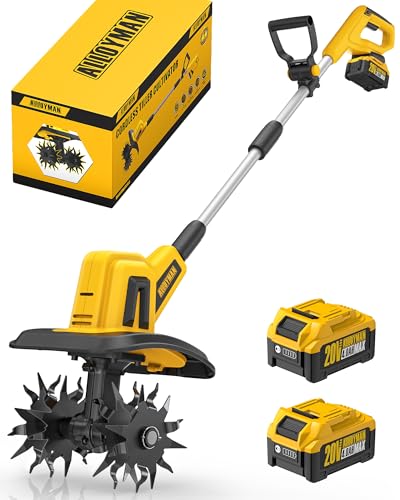
Alloyman 20V cordless tiller, 9 inch, 2x4.0Ah, 4 tines
20V battery9 in wide4 steel tines360 RPM
Check price on Amazon
Best for: Small beds where you want two batteries at a modest cost.

The Alloyman uses a 20 volt system with two 4.0Ah batteries, a 9 inch width and four durable steel tines at up to 360 RPM. It is aimed at gardeners who want freedom from outlets without paying for a big-brand platform.

The tradeoff is that four tines leave a coarser finish than the 48-tine designs, and it has no brushless motor. For loose beds and borders it works well, and the two batteries mean you can alternate packs. Against the SEYVUM it matches the width and capacity but gives up the brushless motor.

Keep the packs indoors, clean tines after each use and remove the battery before clearing a jam. Four tines mean wrapped roots are easy to free, and the tines themselves are easy to wipe clean. Over time the main wear items are the battery packs and the tine tips, so budget for a replacement pack in year three or four.

What works

  • Two 4.0Ah batteries and charger
  • 9 inch width
  • Simple four-tine head
  • 360 RPM tines

Watch out for

  • Four tines leave a coarser finish
  • Brushed motor, shorter motor life

Spec sheet

Power
20V cordless
Width
9 inches
Tines
4 steel
Tine speed
360 RPM
Batteries
Two 4.0Ah and charger
05
600W brushless cordless tiller, 9 inch, 2x3.0Ah
600W brushless9 in wide360 RPM2x3.0Ah
Check price on Amazon
Best for: Gardeners who want a brushless motor and a second battery on a tight budget.

This cordless tiller lists a 600 watt brushless motor, 360 RPM tines, a 9 inch width and two 3000mAh batteries with a charger. The 600 watt rating is the highest stated motor power among the 20 volt kits here.

The tradeoff is the smaller 3.0Ah packs, which carry about 25 percent less energy than 4.0Ah ones, so runtime is shorter on hard work. A stated 600 watts is peak motor power, so it does not mean continuous output. Compared with the SEYVUM, it offers a similar format and a stronger motor claim, but less battery.

Store the batteries indoors and clean after use. Check that the two packs are the same age and charge state, since mismatched packs can drain unevenly. Treat the 600 watt figure as a marketing peak, not a continuous rating, and judge the machine by pack energy and tine speed.

What works

  • Brushless motor
  • Two batteries and charger
  • 360 RPM tines
  • 9 inch path

Watch out for

  • 3.0Ah packs shorten runtime
  • Motor wattage is a peak rating

Spec sheet

Power
600W brushless
Width
9 inches
Tine speed
360 RPM
Batteries
Two 3.0Ah
Charger
Included

Spec sheet decoder

What the numbers on the box really mean

The specs manufacturers lead with, translated into what they tell you about real-world performance.

Watt hours

Battery energy: volts times amp hours. It is the best predictor of runtime.

Watch for40V 5.0Ah x2 is about 400Wh; 20V 4.0Ah x2 about 160Wh.

Brushless

A motor without carbon brushes, more efficient and longer lived.

Watch forSEYVUM and the 600W kit are brushless.

Motor RPM versus tine RPM

Motor speed is before gearing, tine speed after.

Watch forSEYVUM lists 20,000 RPM motor speed but tines turn slower.

Peak versus continuous watts

Peak watts show momentary capability, not sustained output.

Watch forThe 600W claim is a peak rating.

Tilling width

Path per pass.

Watch for12 inches on the 40V kit, 9 inches on the 20V kits.

Methodology

How We Evaluated These Cordless Electric Tillers

Battery energy

We calculated watt hours from voltage and amp hours for each kit. The 40V 5.0Ah pair leads at about 400Wh, the 40V 4.0Ah single follows, and the 20V pairs sit near 160Wh.

Motor type

We separated brushless and brushed motors. Brushless was credited for efficiency and wear. The peak wattage claim of 600W was discounted.

Width and depth

We compared 9, 10 and 12 inch widths and 7 to 8 inch depth ratings, and judged how many passes a typical bed needs.

Battery support

Based on the spec sheet and owner feedback patterns, we weighed platform sharing and replacement packs. Greenworks scored highest.

Handling

We considered wheeled frames, handle design and safety locks. The wheeled 40V kit was credited for transport.

Decision guide

How to Choose the Right Cordless Electric Tillers

By Bed Area

SituationPickWhy
A few small bedsAlloyman 20VTwo batteries, simple
Several beds, mixed sizeSEYVUM 20V brushlessEfficient motor and 50 min runtime
Many beds or long rows40V 12 inch wheeled kitMost energy and width
Quick jobs near other 40V toolsGreenworks 40VPlatform sharing
Brushless on a budget600W brushless kitBrushless with two packs

By Budget

TierPickWhy
LowestAlloyman 20VTwo batteries at low cost
Low600W brushless kitBrushless for little more
MidSEYVUM 20VBrushless and 4.0Ah x2
Mid-high40V 12 inch kitMost energy
HighestGreenworks 40VBrand ecosystem

20V vs 40V

20V

The SEYVUM, Alloyman and 600W kits are lighter and cheaper but hold about 160Wh in a pair. They suit small beds.

40V

The 40V 12 inch kit and Greenworks 40V hold more energy per pack and move more soil. They suit larger plots and share batteries with other tools.

Pick 20V for small beds and 40V for anything larger.

Motor Type

PreferencePickWhy
Longest motor lifeSEYVUM 20VBrushless
Strongest motor claim600W brushless kit600W peak
Lowest costAlloyman 20VBrushed
BalancedGreenworks 40VProven design
Large-bed efficiency40V 12 inch kitMore battery

For Spring Bed Prep Specifically

Look for

Look for two batteries or a large pack so you can finish a session. Spring soil is damp and heavier, which drains packs faster.

In this comparison

The 40V 12 inch kit with 400Wh and the SEYVUM with two 4.0Ah packs are the best fit.

When to Spend More

Spend more if

Spend more if you till often or own 40V tools. The Greenworks 40V and the 12 inch kit are worth it.

Save if

Save if you till a bed or two. The Alloyman and 600W kits are enough.

Ownership

Maintenance schedule

The upkeep that decides whether this machine lasts two seasons or ten.

TaskIntervalWhy it matters
Store batteries indoorsWinterCold and full charge degrade lithium cells. Store at 40 to 60 percent, and keep them off a concrete floor in an unheated garage where winter cold will shorten their life.
Clean tinesEvery sessionRoots and soil add load and rust. Remove the battery first, then scrape and brush the tines and dry them before storage.
Clear ventsEvery few usesDust causes heat in the motor and battery.
Check fastenersMonthlyVibration loosens bolts, and a loose tine wobbles and wears the shaft over time.
Charge before storageEvery 2 to 3 monthsTop up idle packs to avoid deep discharge, which can permanently damage lithium cells.

FAQ

Frequently Asked Questions

How long does a cordless tiller run?

About 30 to 50 minutes on a good pack under load. Two batteries double that.

Are cordless tillers as strong as corded?

No. Corded 13.5A machines have more sustained torque. Cordless is fine for worked soil and beds, and its freedom from a cord makes it the better tool for scattered raised beds and borders.

Is brushless worth it?

Usually yes. It is more efficient and has no brushes to wear.

20V or 40V?

40V packs hold more energy and are better for larger beds. 20V suits small jobs.

How many years do batteries last?

Often 3 to 5 years with good care. Heat is the main enemy, so never leave a pack in a hot car or in direct summer sun, and let it cool before charging after a hard session.

Can I use it in wet soil?

Avoid it. Wet soil clumps and drains the battery faster than dry, so wait a day or two after rain and test a handful for crumble before you start.

Bottom line

The short version

Browse more cordless electric tillerson Amazon →
James Miller, Lead Machine Editor

About the author

James Miller

Lead Machine Editor, MachineFanatic

James Miller leads MachineFanatic's buying guides, turning spec sheets, manuals and owner feedback into clear verdicts on power tools, outdoor power equipment, shop machines and kitchen machines.

More from James →

Keep reading

Related guides